Attending carefully to a work of art can shape our care for the world; slowing down to observe is itself an intervention in the rapidly deteriorating environments wrought by a system whose mantra is speed and innovation. Both close reading and ecological awareness prioritize the apprehension of similarities and differences to recognize and value interconnections. If attention is a form of love, then ecology is, as Gary Snyder has written, “a problem of love.”1 As I’ve written elsewhere, while the Sixth Mass Extinction isn’t a problem that may be solved by close reading, I can’t imagine it is one that will be meaningfully addressed without it.
The Slow Art Movement, created by Phil Terry in 2008, challenges our collective tendency to spend, on average, seventeen seconds looking at a work of art in a museum. Generally speaking, people spend more time reading information tags, tellingly referred to by some curators as “tombstones,” than looking at the paintings, sculptures, or installations to which they refer. Terry first had the idea in 2008, after hours in the Jewish Museum in New York looking at Hans Hoffman’s Fantasia and Jackson Pollock’s Convergence. Today, more than 110 museums and galleries around the world slow down each year on April 10, “Slow Art Day,” and many museums all over the world feature more inclusive, experiential programming as a result. By combatting the conveyor belt approach to art, the Slow Art Movement is also, I would argue, a corrective to our contemporary mode of living, from the pull of instantaneous gratification and mandate for multitasking to the virtualization of experience itself.
At the academic end of the movement is the late Arden Reed’s Slow Art: The Experience of Looking, Sacred Images to James Turrell (University of California Press, 2017). Reed focuses on “acts of calling and recalling” (2), considering slow art both in terms of particular works, which build into their form or content “an unfolding over time, even if they are stationary” (3), and processes and practices of engaging with various works against the backdrop of technological capitalism—or what he calls “speed culture.” A professor of English at Pomona College, Reed’s discovery that “a painting could be as rich and as thorny as any literary or philosophical text” (1) was inspired by eight years of “dwelling” with Édouard Manet’s Young Lady in 1866 at the Met. He is quick to emphasize that “slow art names an encounter between object and observer; it refers to a class of experiences, not to a group of things,” and “slow art must be performed” (10-11). He also acknowledges that art itself “resists the quick take”: “looking at art can teach us the composure we need to look at art” (13). He places his hope in our desire for what I would call complex pleasure, the satisfaction that this kind of aesthetic, performative slowness can give against “the backdrop of our warp-speed present” (15).
Although he doesn’t spell it out, the dwelling that characterized Reed’s extended close reading of Manet’s painting is a form of ecological inhabitation. In this light, slow art is a practice of falling out of step with speed culture to be more present to ourselves and the world around us. Human beings are small, permeable systems in a big, complex world. This intricacy enriches us, but its layers of scale are vertiginous. Technological capitalism both impoverishes this intricacy and adds circuits within circuits of its own human-made systems in ever expanding real and virtual landscapes. While art nurtures and stretches us, increases our individual capacity for the complexity and ambiguity inherent in the universe, expanding the space within ourselves for otherness—other experiences, ways of being, forms of culture, and forms of life—it requires a slowing out of step with or turning away from the manufactured multisensory noise that permeates our everyday lives.
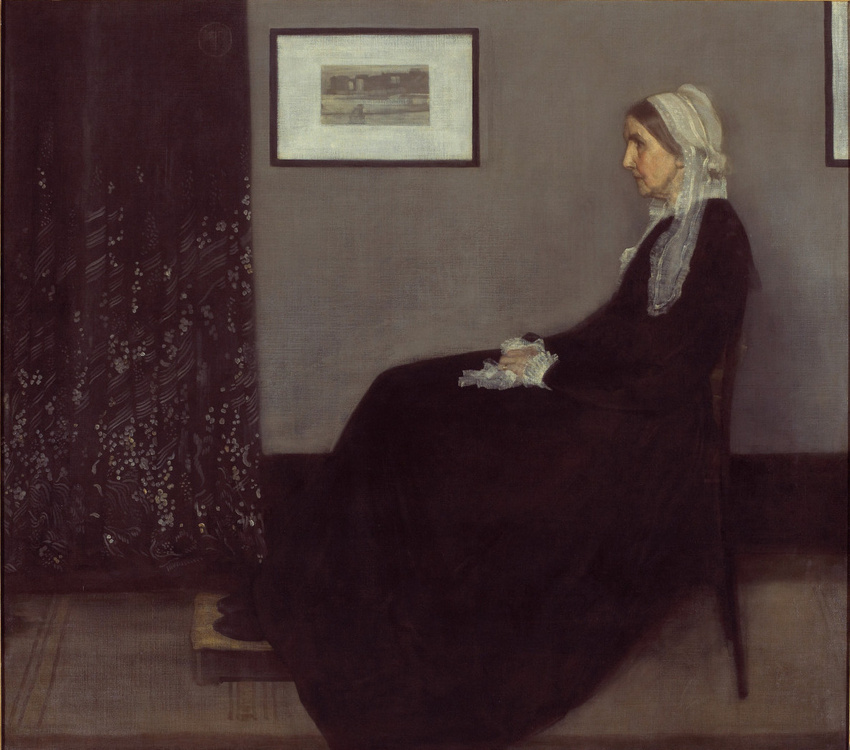
Like many, I’d seen James McNeil Whistler’s Arrangement in Grey and Black No. 1 (Portrait of the Artist’s Mother) a thousand times without really looking at it. Unlike Manet’s young woman, the artist’s mother is not looking at him or at us. This 1871 portrait in profile seems to keep its own council. The subject’s hands are folded around a lace handkerchief in her lap. Despite the title, the painting isn’t only an arrangement in grey and black; there are sepia tones on the floor and in the landscape painting (a seascape, a little like Monet’s The Cliffs at Étretat) hanging on the wall. I always remember her expression as stern but, looking closely, with magnification made possible by digital photography, I can see her eyes are bright and she almost has a half-smile on her face. She resists our gaze but, also, invites us into her attentive stillness.
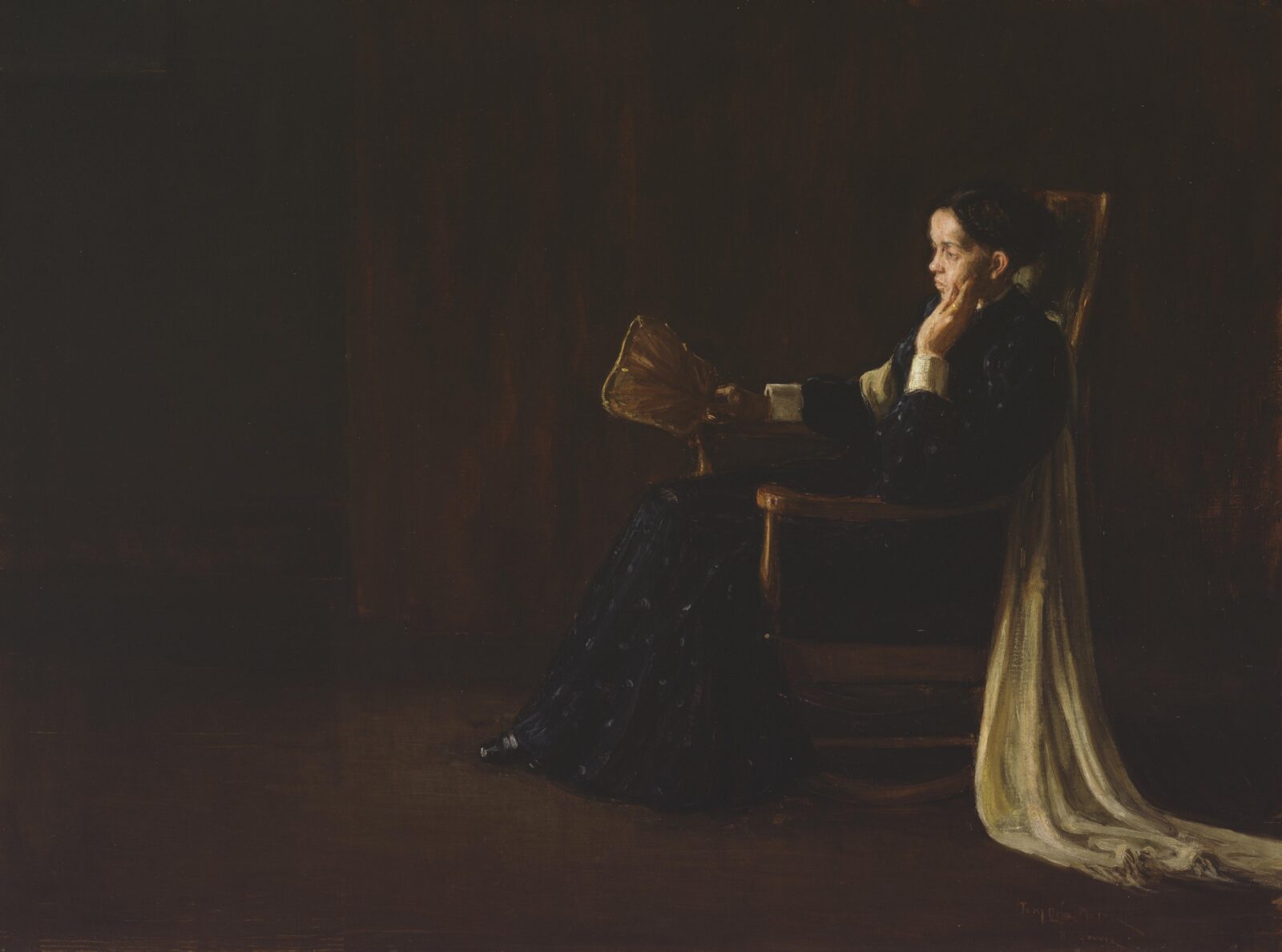
Henry Ossawa Tanner’s 1897 Portrait of the Artist’s Mother reproduces and reimagines this famous image. Tanner was a contemporary of Whistler and John Singer Sargent, and the first African American artist to gain international fame. Tanner’s portrait depicts his mother, Sarah Elizabeth Miller Tanner, who escaped North on the Underground Railroad as a child, sitting in a chair in profile. The background is much darker and emptier than that of Whistler’s portrait. There is no physical framed painting within the painting here, but there is a reference to Whistler’s portrait metaphorically inside the painting.
Tanner’s hands are quite different, active; one is holding a fan and the other is holding her cheek and chin. His mother’s dress is also black but, unlike Whistler’s mother, it has a light (perhaps floral) pattern, a hue that picks up the cream color of the folds of shawl draped off her rocking chair. The pattern of the dress and the draping of the shawl echo the window drapes of Whistler’s portrait, though it is not clear if this room has a (hidden) window or not. The brown shading of the wall in the background is decidedly ambiguous. It might be a curtain drawn across a view, another room, or a way out; it’s less solid than the left of the canvas, a much darker, richer brown. His mother’s position in her chair on the right seems more embodied than that of Whistler’s mother in hers. Unlike Whistler’s subject, we can see her full hair arrangement (there’s no lace cap) and the hint of cream collar matching her cuffs and shawl. The expression of Tanner’s subject is pensive; there is no half smile, just a steady gaze, focused in thought and feeling. She’s neither hot (using her fan) nor cold (wrapped in her shawl); a stillness, physical and emotional, pervades the canvas. These two portraits depict slowness and invite it formally, through their intertextual layers and foregrounded layering of light around a figure in black. In this way, each places human identity and feeling, however stylized and off-center the composition of the canvas, at the center of the stage.
Tanner’s Landscape (no date, held in the American to 1910 collection at the North Carolina Museum of Art) is quite different. While these two portraits engage viewers in the contemplation of relationships—between painter and subject, viewer and subject, subject and what she sees, thinks, feels, and back to the viewer and what she sees, thinks, feels—this painting does not contain clear human figures, only an image of human inhabitation. The house sits in a pastel blue-green swell of sky and land, mackerelled and in motion. There is an ambiguous dark area in the foreground. Could it be one or two cloaked figures standing together? Perhaps. Their relative size and shape has a human quality and, because they’re darker, they seem to be the only things not moving (even the house seems of a piece with the sky and trees, with brushstrokes that suggest weathering). In this way, the painting incorporates slowness through relative motion, in form and content. The tone of these overlapping colors, too, is arresting; it is as if we’ve suddenly found ourselves underwater but can still breathe. We’re able to take in the extraordinary, almost extra-human view of this human world with keen interest and serene detachment; we’ve become strange mermaids, seeing through a medium that foregrounds the relative motion of time itself, as light travels more slowly in water than air. Even more strangely, the “earth,” the landscape at the bottom of the land and/or seascape, seems to have its own waves, cresting around the dark figure(s) on the bottom right.

It not only takes time to see these aspects of a painting, but it also takes time to see such things in our own seeing—to reflect on how these reflections feel and what they might mean. Such experiences are available to museum visitors online or in person; one does not need to research the piece (if it was painted in France or America, in the field or in a studio, etc.) for this. All one needs is a half-hour’s sitting. And yet, slow seeing inevitably grows new dimensions of understanding from social and historical context, from knowing, for example, that Tanner “was a symbol of hope and inspiration for African-American leaders and young black artists, many of whom visited him in Paris,” and that, as Will South writes, race “remains at the heart of Henry Ossawa Tanner studies,” particularly Tanner’s own relationship to American racism and his self-identification as both white and black. Looking again at his Portrait of the Artist’s Mother, we see why race remains at the heart of Tanner studies. Race—and gender and sexuality and more—is not only at the heart of our social embodiment and ecological situatedness but also inscribed in the way in which this Portrait speaks to Whistler’s and to us. And, of course, it is inscribed in the idea of the museum itself. That is, in the museum’s colonial history and complex present, from the objects of art themselves to the context in which they are presented and viewed and, of course, in the embodiment of the viewer.
Looking back at his pastiche of Whistler’s painting and his Landscape, one might also see a commentary on the complexity of portraiture and landscape as racialized social forms. In Landscape we seem on both familiar ground and, also, underneath something; in dream-like motion but, also, subject to a terrible stagnation. As Reed might say, it is a case of both/and, not either/or; in Landscape, for example, one may experience both the serene detachment of an impressionist plein-air water creature and the visceral nightmare of a drowning social reality.
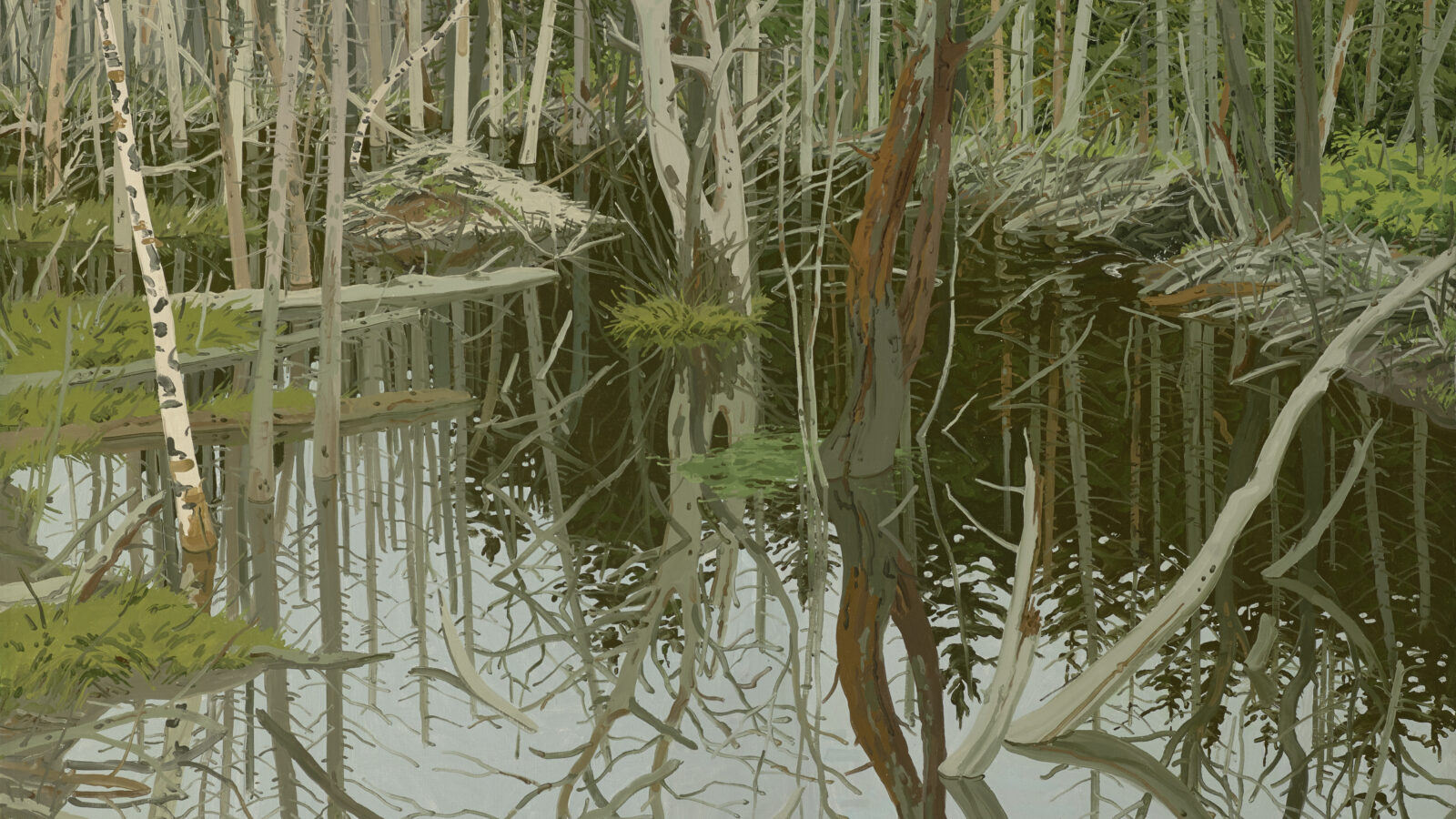
Neil Welliver’s 1975 Breached Beaver Dam is another watery landscape in the North Carolina Museum of Art that invites slow seeing . . . and suggests much more than it seems. While it takes up more than two-thirds of the canvas, the water is that which breaches the beaver’s work. As the title suggests, underneath is a broken home and, above, a silken reflection of the surrounding lit-from within grey, pink, and brown-hued trees (perhaps aspen and birch), the parents or siblings of those the beaver harvested. The painting plays with the idea that we both can and can’t see what we can’t see—forest for trees, dam for water, brush stroke for image—while encompassing us in what feels like an expansive, circumambient space. The trees breathe. And we breathe with them, among them, taking in their expelled oxygen, part of the cycle of nature and art, of making and breaking and making again, the magical looped linkages of atoms and elements, pigment and canvas, and you.
I’ve been fortunate to be able to stand in front of this enormous piece, roughly eight feet by eight feet, not including the frame, for hours on end, because I live near the museum where it hangs. I’ve felt alternately relaxed into my body and pixelated out of it, as the very scale of the piece turns its slick-surfaced realism into something almost abstract. Welliver painted this open-air scene in Maine, where he lived from 1970 until his death in 2005. He painted many such pieces, carrying “a 70-pound pack of painting supplies into remote landscapes” to “sit for three-hours at a time.”
Breached Beaver Dam is intensely immersive. It orients us in its world and, at the same time, feels disorienting; it records light’s derangement, coming from the water, reflecting the unseen sky above. We’re outside and we’re inside and we’re outside; our feet are wet, and we can hear a bird snapping a twig as we stand and reflect on art’s reflection on the hidden architectural wonder of a beaver’s dam. Instead of art as natura naturans, nature naturing, we have nature as art from art. This slow art isn’t Narcissus’s pool: it opens outward as well as inward, inviting us back—however far our thoughts roam, from Henry David Thoreau’s “skywater” to Central Maine Power’s proposal to clear cut a swath through the largest temperate forest in North America, Maine’s North Woods—back to the beaver whose dam is breached, to the broken art, the open space, that also made this painting. Slow art is the larger circumference of this open space, the invitation issued by every work of art to every viewer, reader, and listener. An invitation to a deeper engagement through a practice of sitting with a work over time—a practice that will surely enhance our ability to understand ourselves and live in the world.
: :
Endnotes
Helena Feder