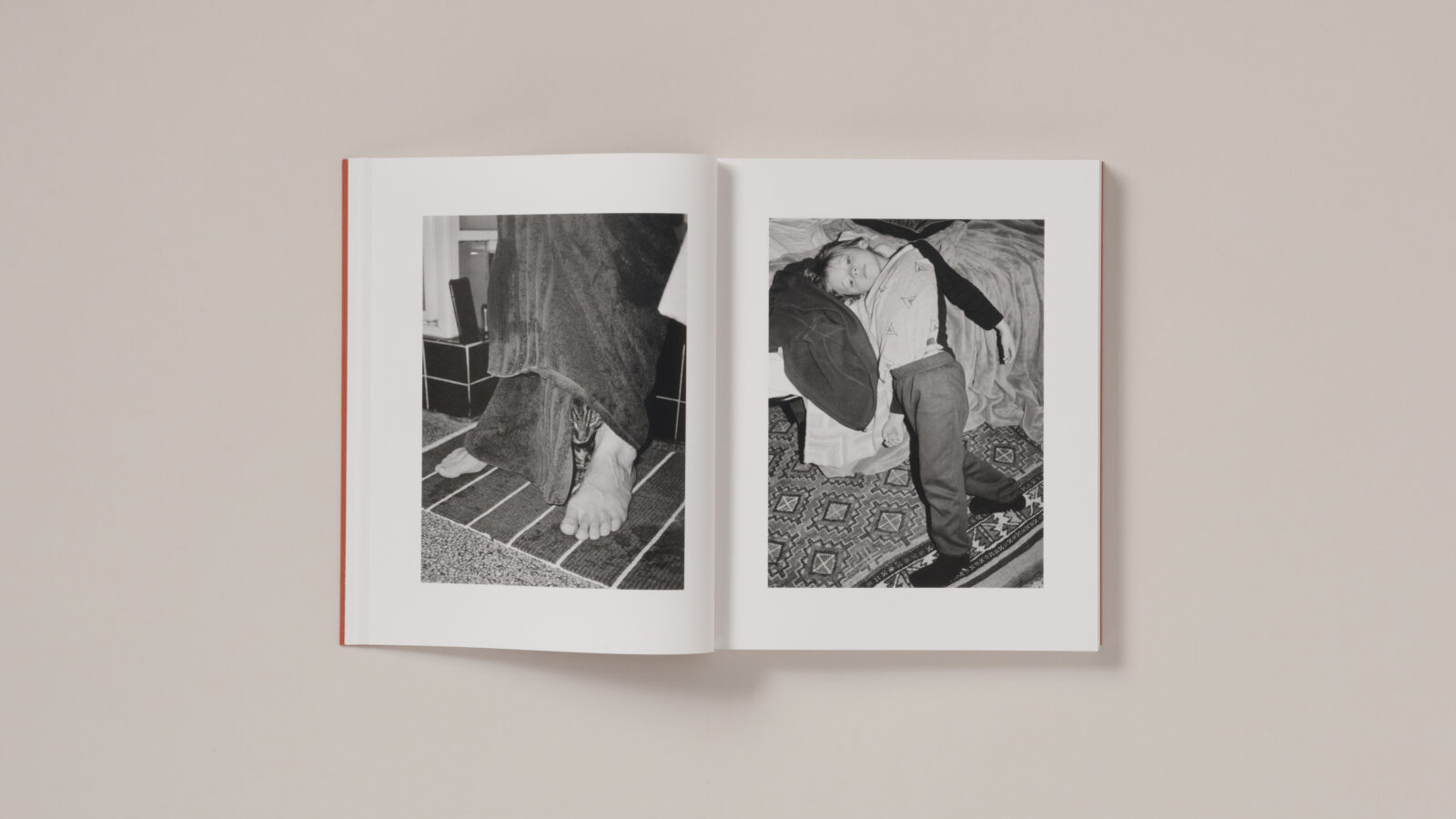
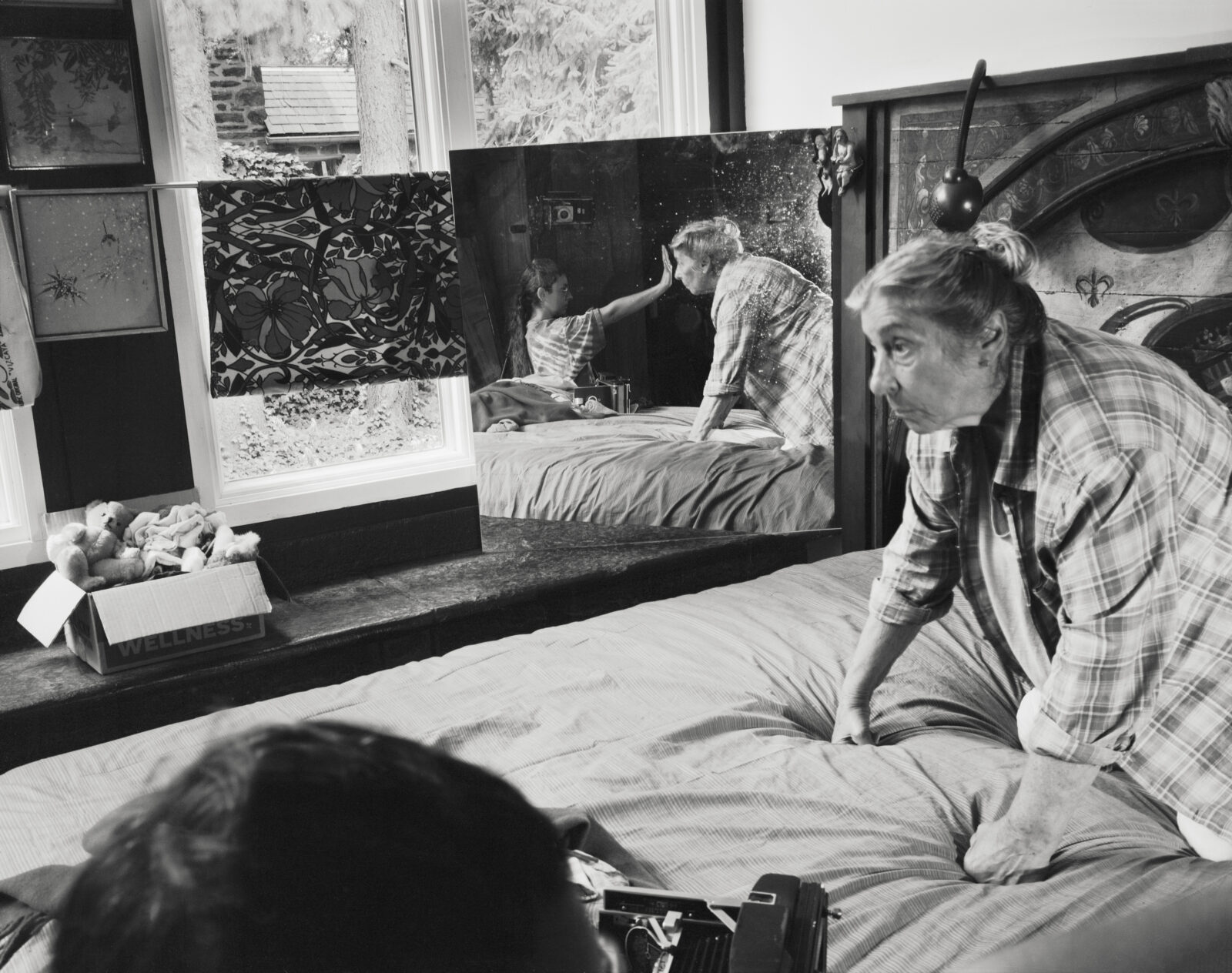
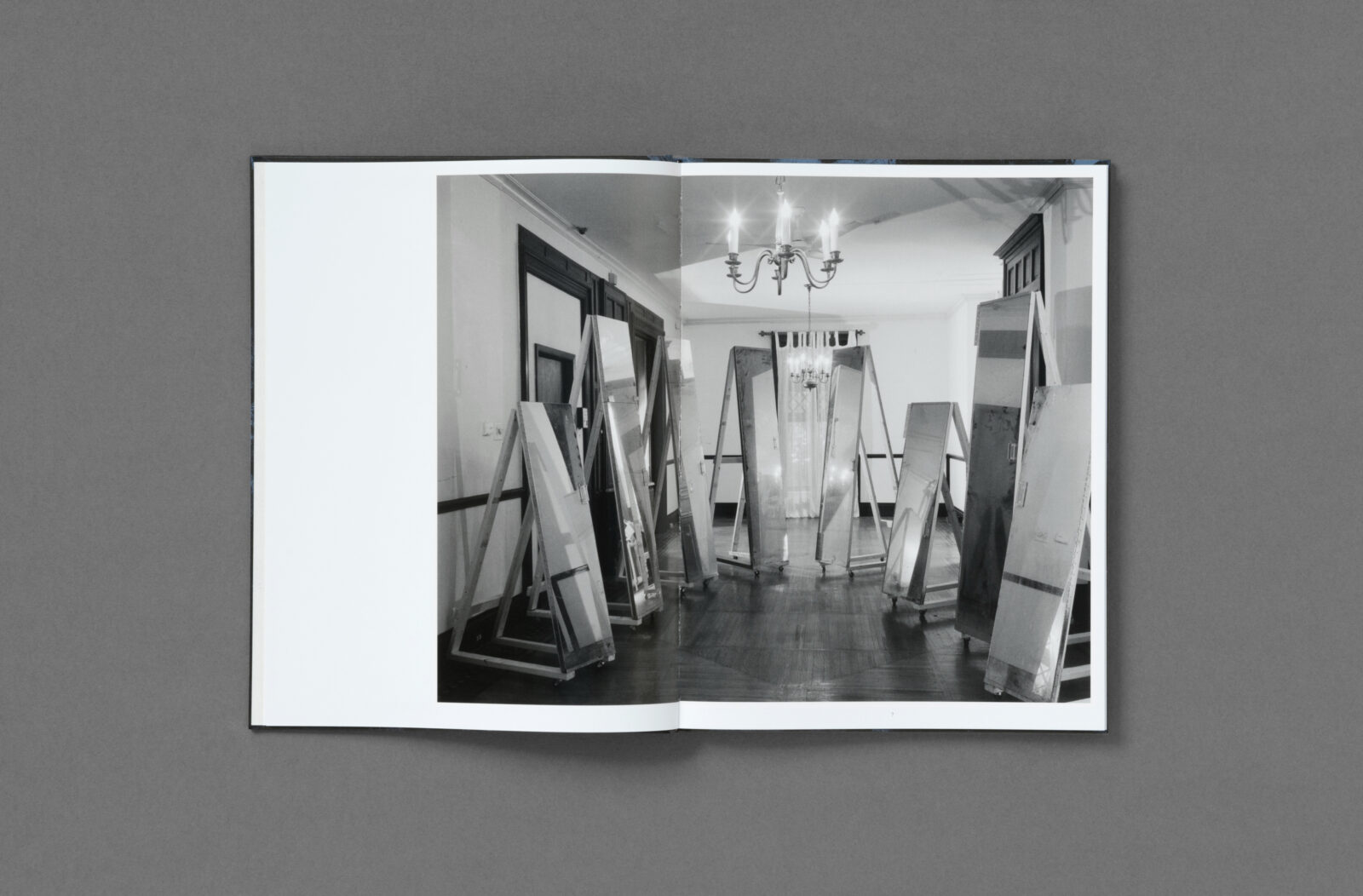
The mirrored closet doors are part of a collection of architectural salvage. Once obtained, they sit in an already stuffed-full house in upstate New York. During the COVID-19 pandemic their new owner, Antonette Berger, began suffering severe memory loss, later diagnosed as LATE, a brain disease whose symptoms mimic Alzheimers. Her artist daughter, Katherine Hubbard, proposed working together on a series of photos of their bodies amid the crowded stuff of the house, as it was gradually packed and cleared. Those closet doors were mounted upright on wheels so they could be moved and arranged around the house, appearing in many of the photographs Hubbard took with two large-format 4×5 film cameras.
Now the salvage resembles stage flats or sculptures, the surfaces of retina and camera upon which images appear upside down enabling human vision and photography. They reproduce, reflect, obscure, multiply, and defamiliarize. In some photos, their looming form is all that remains within the newly empty shelves and cleared wooden floors. Elsewhere the space is filled and multiplied by a disorientating array of actual and reflected cameras, body parts, boxed possessions, and tripods. Even when the wheeled mirrors do not appear, the picture plane gets similarly refracted: when Berger takes a bath, Hubbard’s feet poke into the front of the picture while also seeming to touch Berger’s naked body from behind courtesy of a bathroom mirror. Such psychological domains of grief and loss are frenetic and multiplying in their posed and held concentration.
For those familiar with Hubbard’s previous photography, texts, and performances, these photographs of The Great Room (2025) could seem a departure from a more literal focus on photographic process: the documenting of a darkroom’s trays and sinks (Basic situation, 2016), or the auditorium itself made into a darkroom in which Hubbard reads 70 sheets of text aloud while making a photogram of each page (Bring your own lights, 2016). When a body (Hubbard’s own) appeared in the Utah desert landscape of Four shoulders (the size of it) (2014), its movements at a distance illustrated and marked out the perceptual capacities of the camera lens. As Hubbard has commented, this makes an “inversion where the performing body enters the camera instead of the camera being set to capturing the body.”1
That this comment can also be applied to those scenes of mother and daughter in The Great Room suggests a connection rather than distance to the artist’s earlier projects. Hubbard’s darkroom, like a human body, is destined to break down (it is always over time found to be leaking light)—a site of shifting sensory modalities, with materials handled and felt in the red safelight glow. While Hubbard’s performance back on back (2015) explored proximity and touch by reading aloud while moving among a tightly arranged audience, The Great Room intersperses monoprints of Hubbard and Berger’s skin, made through the darkroom imprint of their bodies together on silver gelatin paper. These elegiac ultrasounds, like the live developing of Bring your own lights, turn photography’s fixation on the past and memory into an event of the now.
All of which suggests a connection of photographic process to daily lives that is not solely metaphorical and analogous and/or something reflexively foregrounded through choices of grain, focus, and exposure. It is one where the photographic and the everyday are inseparable from what Donna Haraway has called the “oddkin” that lives perform. “Kin is a wild category that all sorts of people do their best to domesticate,” Haraway writes. “Making kin as oddkin, rather than, or at least in addition to, godkin . . . troubles important matters, like to whom one is actually responsible.”2 This troubling appears not only in Hubbard’s work, but also in recent photobooks3 by Katrien De Blauwer, Odette England, Katrin Koenning, and Eriko Masaoka.4 Across differences of subject, technique, and geography, these artists share, I propose, Hubbard’s imperative of “destabilizing the primacy of sight within the sensory system of the body and destabilizing the primacy of light within photographic practice, which are both such patriarchal structuring agents.”5
Like Hubbard, Odette England explores kin as mother-daughter relations, with daughter Hepburn “appearing in my photographs and making her own”6 on a trip to Loudon County, Virginia, where FSA photographer Marion Post Wolcott lived from 1943 to 1954. England’s photobook The Long Shadow (2024) attends to the affective charge of that landscape, its echoing of her own upbringing on a dairy farm, while also suggesting the aspects of lives and stories that for herself, the women in her own family, as for Wolcott, were “hidden for good reasons or edited and compressed by others. I wanted to unwrap her desires and fears and make sense of my own.”7
England meets with Wolcott’s now adult children, piecing together a story of a photographic career curtailed and restricted by both the FSA and her husband’s expectations of women’s roles and family life. If Wolcott’s planned book of children’s photographs was deemed too time consuming by her husband Lee, England reproduces Wolcott’s unpublished family photographs. While Hepburn is shown by her naked back, with hands over her face, or as two bare legs and feet on a tree trunk, the children of the 1930s stand open and recognizable, naked and in nappies, playing in a stream or sat on wooden crates outdoors eating their lunch.
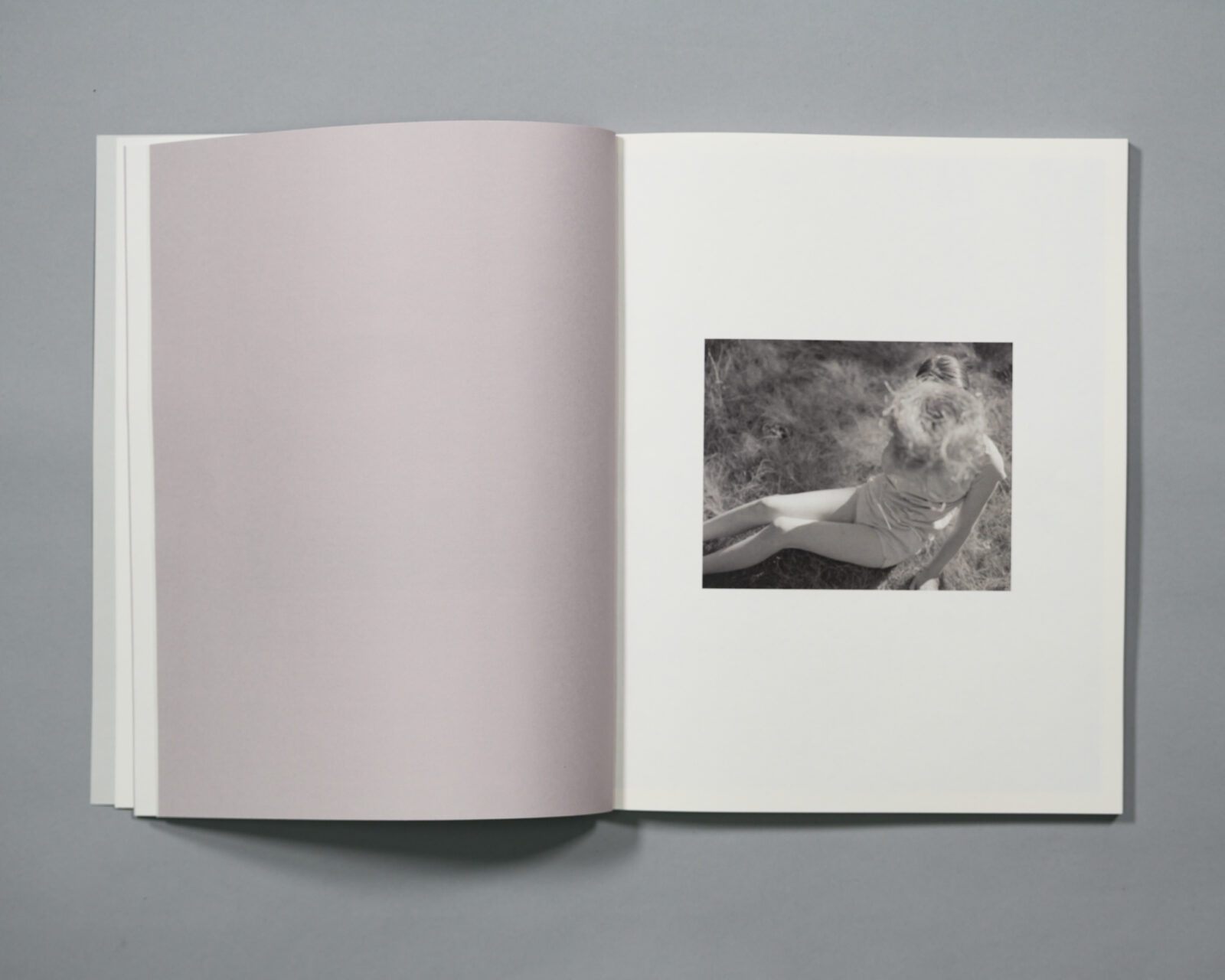
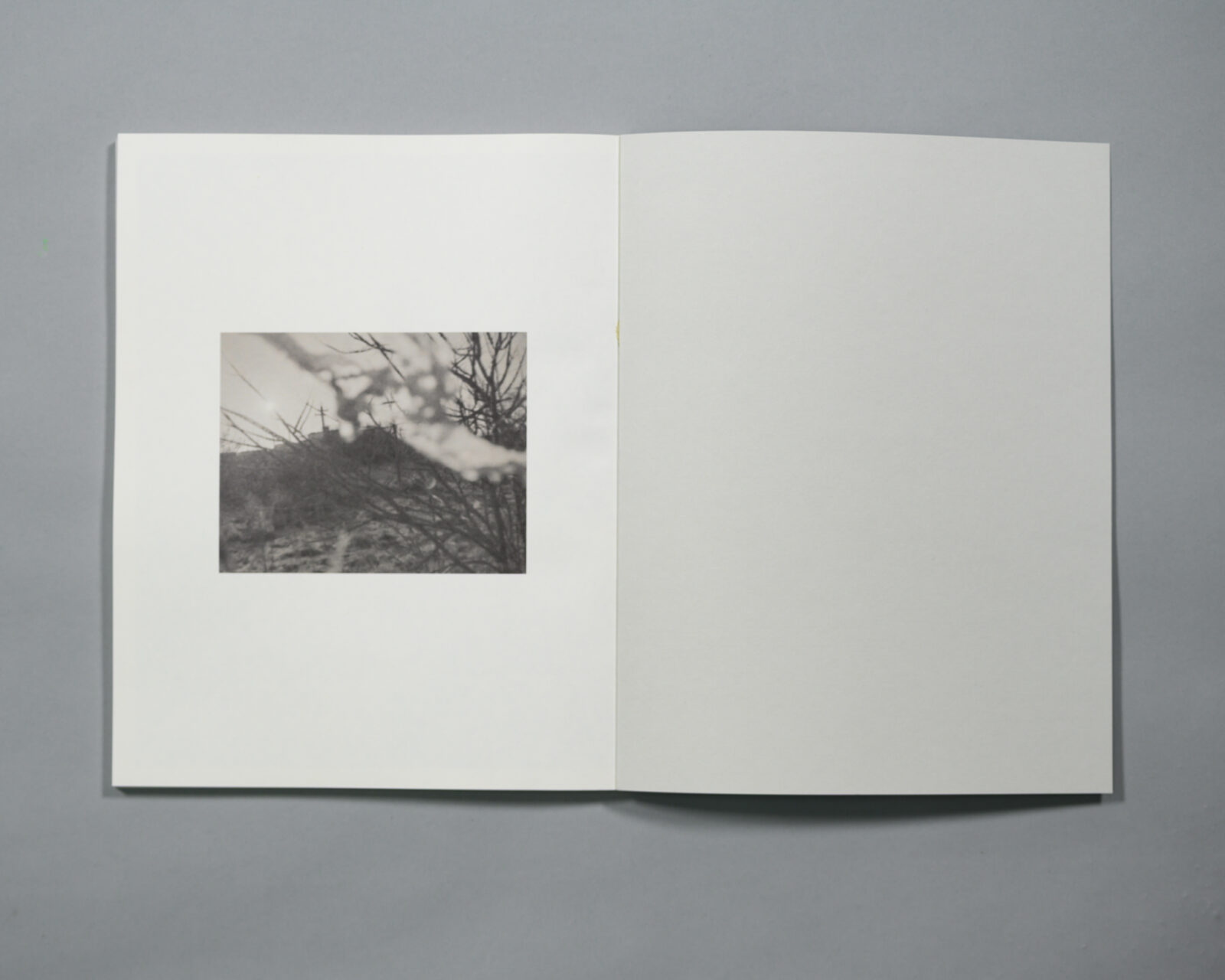
Hepburn is the main presence of England’s more recent photobook To Be Developed, To be Continued (2025), also sharing credits and copyright for images and sequencing. An arm covers her face above her bare, reclining torso; a t-shirt is pulled up over her head as she poses in jeans and t-shirt. The landscape is one of grasses, fields, country tracks, farm buildings, graffitied rural walls and barbed wire. To combine their subject and their technique, photographs appear ripped, blurred, oblique, over-exposed, enigmatic, with abrupt contrasts of foreground and background, all creating a personalized, phenomenology of body, environment, self, and relationship. This extends into a number of carefully constructed still lives of cloth, wire, cardboard, light, and often Hepburn’s up-reaching arm.
Like Hubbard, England’s previous projects engaged directly with photographic materiality. In a week long 2018 residency with Jennifer Garza-Cuen at the Robert Rauschenberg Foundation in Captiva, Florida, the two artists made 200 camera-less photographs (Past Paper//Present Marks, 2021) by submerging in Rauschenberg’s swimming pool expired photo paper owned by the famous artist, where it was exposed to both sun and moonlight (in Hubbard’s 2016 Bend the rays more sharply, exposed negatives were embedded at varying angles in a block of ice). During COVID-19, England took a photograph each day by loading a Kodak Instamatic X-45 with a 40-year-old film, noticing how its only two settings —“2 to 6 feet” and “beyond 6 feet”—had heightened pandemic relevance. Photographs of daily circumscribed lockdown life were captioned with six daily headlines, alongside screenshots of CNN and Fox News websites, in the resulting bookwork Beyond 6 Feet (2021).
These responses to a pressing personal and societal now suggest how photographic processes are utilized in To Be Developed, To Be Continued. Amid its sequence of variously sized black and white and color photographs, images are sometimes rephotographed so that a print is torn, or a sequence of images appear on a page as if taped together in the artist’s studio. This stages the verbs of the title and—along with the use of cropping, composition, and depth of field in the photos themselves—entangles Hepburn’s adolescence in photographic materiality. In each image and the totality of To Be Developed, To Be Continued, the photograph emerges as a privileged place for negotiating, controlling, and understanding the interconnections among interiority, the body, and its public performance and display. A figure I take to be Odette appears once, perhaps pretending to be ducking suspiciously out of the frame, image ripped at her forehead and shoulder, one somewhat wild peering eye a reminder of the ethical and personal challenges of a photographic project and a life.
Less defined entanglements of kin, materialism, and performance characterize Katrin Koenning’s between the skin and sea (2024). This is partly a consequence of scale, for here there are 126 photographs of human and animal bodies, the sea, flowers and trees, and a human object-world of picnic blankets, sleeping bags, plates, birthday cakes, and balloons, all attesting to “networks of love, grief, kinship, shelter and repair.” These are Koenning’s words from a three-paragraph text inserted into the book’s image sequence, where it functions rather like one of the newly developed photograms in Bring your own lights. Koenning tells the reader poetically that this book is another COVID project, a charged pacing of “five kilometres where we belonged – between the skin and the sea,” where new rhythms of time and life prompt the question: “Were we awake or dreaming?”8
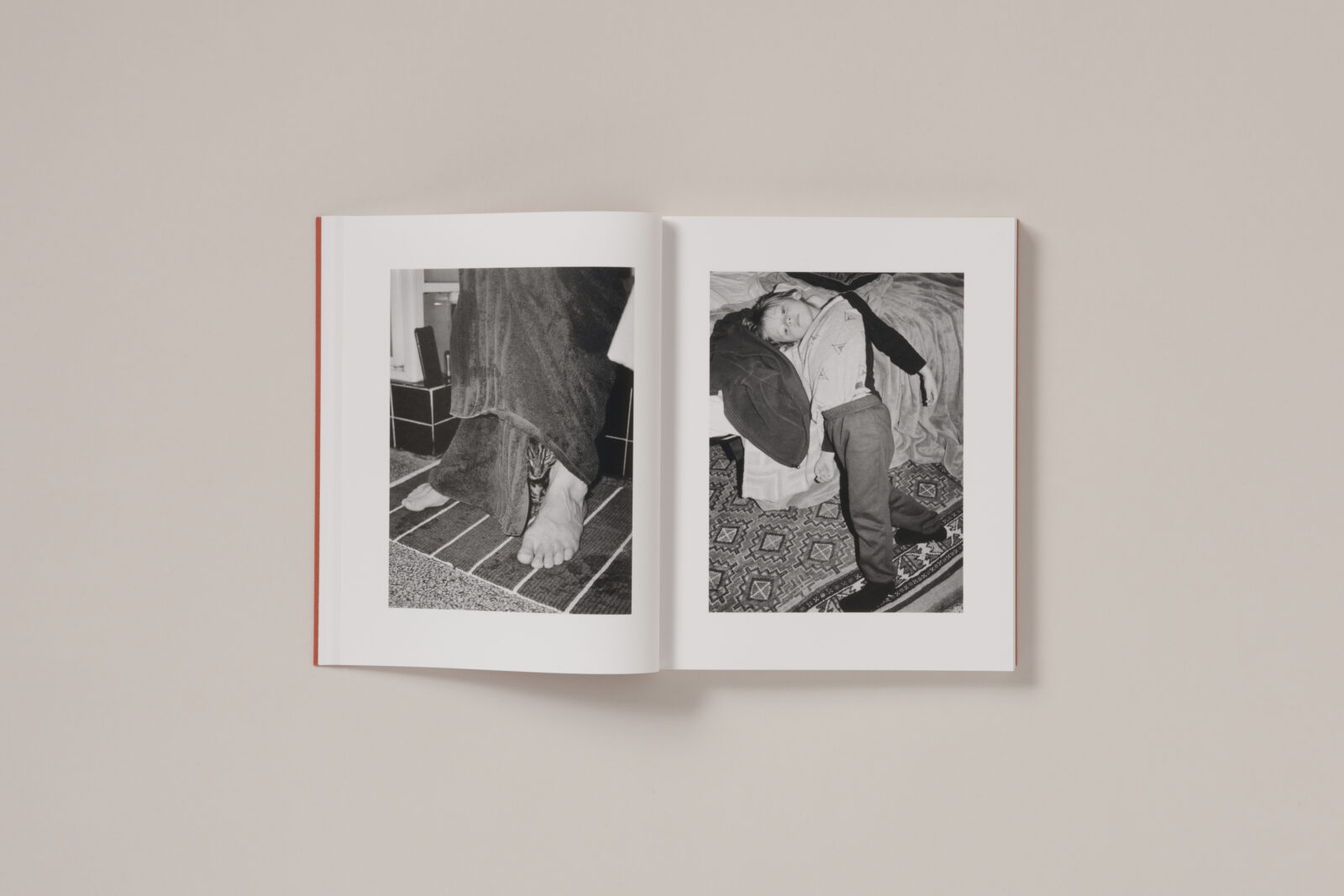
Koenning’s kin obligations differ from England’s. The two children on this book’s cover—floating in a dinghy with their backs to camera/ photographer/ reader—have their faces visible when the scenario returns in the book’s penultimate image (are they Koenning’s children?, I wonder, without getting a definite answer). This turning movement between beginning and closing demonstrates how Koenning negotiates between a conventional portrait (the two also reappear happily wearing princess crowns), and the opaque interiority closer to England’s approach, when the subject covers their face in a jumper or a sheet. Both modes recur, tentative and intimate, suggesting possibilities being tried out with care and trust, in both the relationship with the photographer and future life of the photograph. Such is the book’s concentrated attention that the same mood accrues to an apple on a bedside shelf, a snagged blind, and two toothbrushes in a cup.
All this affirms Jane Simon’s identification of a “contradictory site” of the domestic that “complicates the distinction between background and foreground, the inside and outside, the private and public.”9 Some photographs in this book form part of a larger project in which Koenning sees herself as an “unofficial town chronicler” for Robinvale, a purpose and geography left deliberately unspecified in Between the skin and sea. Some also appeared across four projects forming Koenning’s contribution to Melbourne Now (2023). These formed “a constellation on the wall, creating a dialogic space that enables a fellowship of images,” enacting her sense that “Artists have a duty to be weavers and repairers of stories.”10 If the book’s extended, meandering sequence emphasizes that space of “Were we awake or dreaming?” its attentions are also propositions about how German-born Koenning dwells and photographs, as she acknowledges, “on the unceded Lands of the Wurundjeri, Boon wurrung, Tati Tati, Mutti Mutti, Wamba Wemba, Gubbi Gubbi, Jinibara, Gunai kurnai and Taungurung.”11
Unlike England, Koenning’s images are a uniform size throughout, with some oscillations between landscape and portrait, black and white and color. In a previous collaborative bookwork, Astres Noirs (2016, with Sarker Protick), mobile phone photos of a face, bird, arm, or horse were printed on black sheets of paper then painted in silver ink. In between the skin and sea there is no such darkroom reversal, but shadows of books and trees, the photographer, the night sky, those toothbrushes, as well as bright sunlight, fire and smoke, and outdoor fairy lights, highlight the image as the daily negotiation of light and dark—and what is occluded, displayed and latent in time.
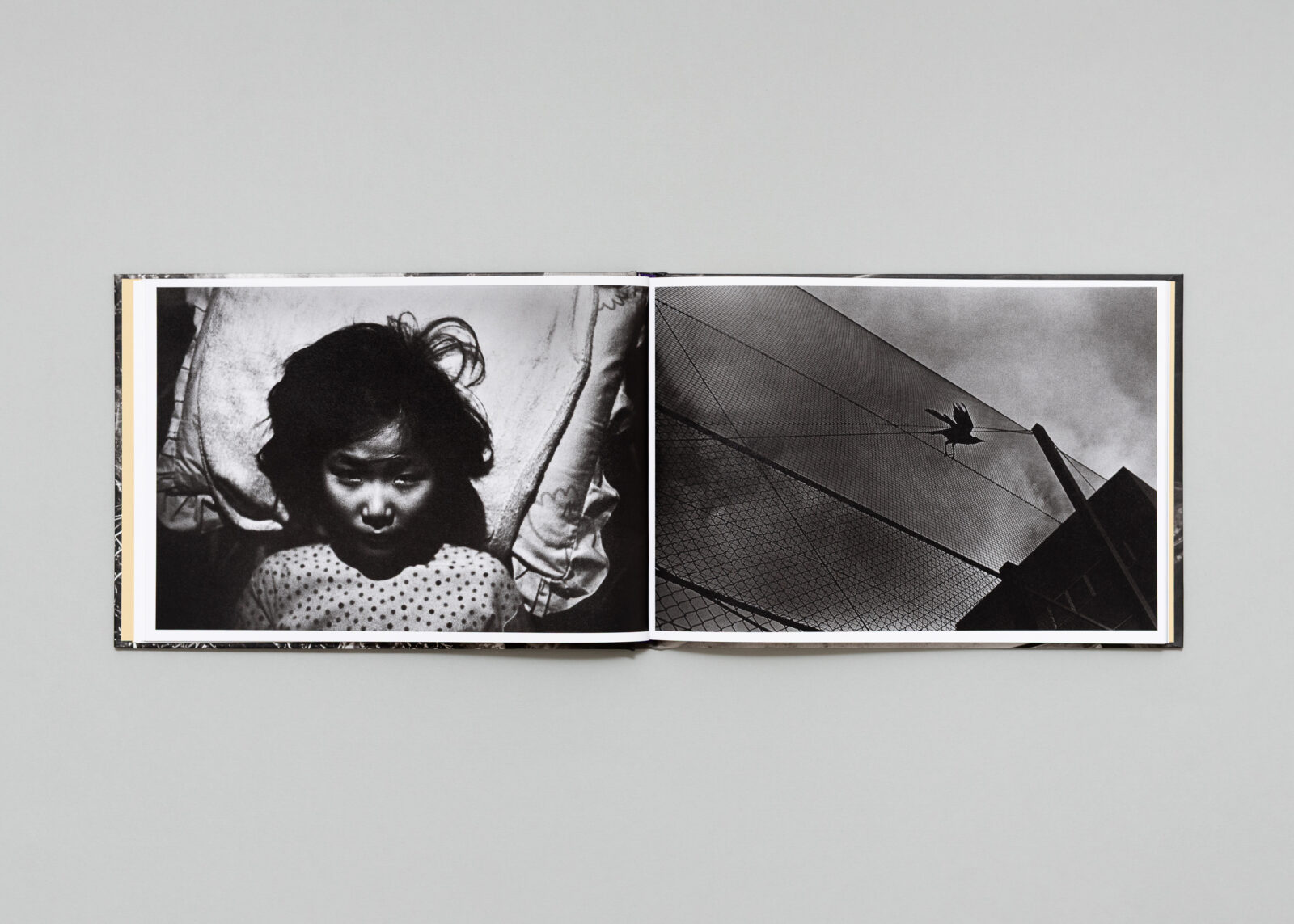
For Eriko Masaoka this performance intertwining oddkin and photographic grain requires some additional techniques. Masoaka’s In the Flap of a Bird’s Wing, Water Dries Up (2025) is a decade of images from living on a Hokkaido ranch amid the Ainu community in Japan, later extending geographically to Rotterdam, Gullfoss in Iceland, and the Azores. These photographs were originally developed as silver gelatin prints, later rephotographed with natural light shining through them from behind while using traditional Japanese shoji screens to “create an effect where the grain becomes translucent.” At its most extreme, close-ups of a bird’s wing against the sky, a face with open mouth, a figure on a road, all become life forms made and dissolving through atmospheric collaboration between weather and photographic grain.
In Masoaka’s own brief preface she anchors her book in an experience of “a mouse, badly beaten in a cowshed, but desperately struggling to stay alive. The life-force seemed to rise, steam-like, from its entire body, its every cell.” 12 Elsewhere, Masaoka has framed her photos through the self-coined term Tsubutsumi, which imbues particles and grain (tsubu) with Wadatsumi (sea god/sea spirit/the sea itself) and Yamatsumi (mountain god/spirit). This expounds a world view where “all subjects” including the photographer are understood as “drifting particles” and photos “explore and inhabit this tiny, floating world” of “very small things – particles and grains. I imagined that even these tiny particles might hold their own spirits.”13
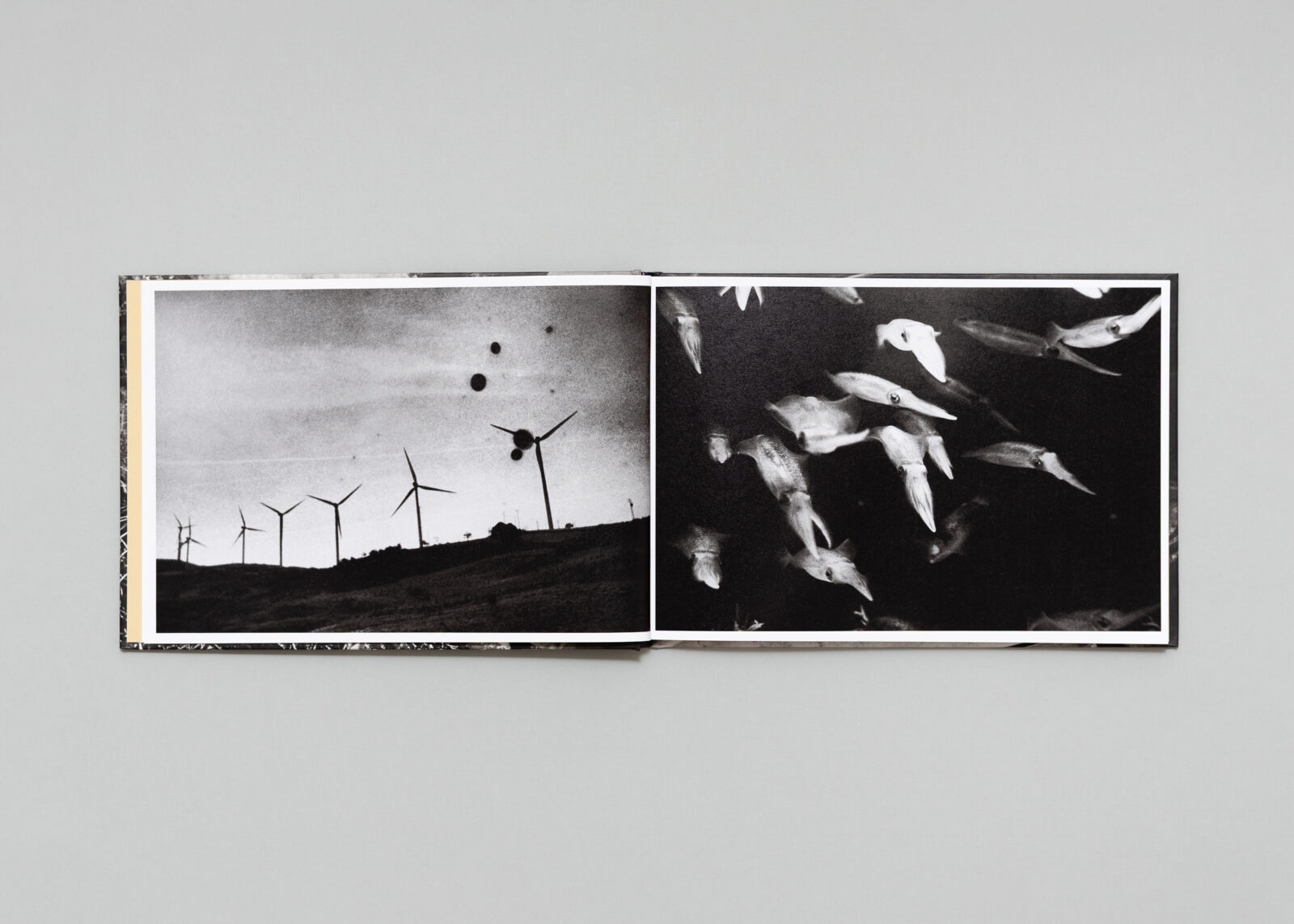
While close-ups of eyeballs, udders, and skulls suggest a photography of heightened, fleshed, and boned mortality, Masaoka is elsewhere attentive to a similar will to life in an array of rooftops, a child squeezing through a hole in a fence, and mountains pictured from an airplane window. In the aesthetic performance that occurs from rephotographing through the Shoji screen, Masaoka unfolds an oddkin obligation to the human and more-than-human life force she seeks to depict.14
These bookworks by Hubbard, England, Koenning, and Masaoka perform the entanglement of oddkin and materialism (photographic and otherwise). Returning to Hubbard’s The Great Room, one image distills this space of photographic practice. It shows one of the salvaged, mounted mirrors on its side in an otherwise emptied room, and Berger on the floor in front of it. This staging evokes how an image appears upside down on both the eye’s retina and the film plane in the camera (a point Hubbard speaks aloud in her 2014 performance Notes from Utah. Notes on Utah). It also shows the entropy of things, the vulnerability and frailty of the human body, how mirror and body adapt in a situation where habitual orientations of reflecting and vanity have been disrupted. It evokes the associative slippage that performance artist Chipo Chipaziwa, in her own written reflections on mirrors, makes between mimesis and nemesis, “the possibility that my own nemesis could be a mimesis of myselves.”15
Although England, Hubbard, and Koenning boldly reclaim female and child bodies from objectification and sexualization, their books construct a world apart from those visual cultures that objectify and sexualize according to what Hubbard has identified as the “patriarchal structuring agents” of sight and light16. It is in this context that Katrien De Blauwer’s Old Sweater Gets New Uses (2024) is a stark contrast. Unlike the other artists here, De Blauwer has self-styled herself as a “photographer without a camera,” working from a personal archive of vintage fashion, lifestyle, and erotic photography. Source images are cut, spliced, reprinted, colored with painted or crayoned marks, mounted on an array of papers, and sequenced in her frequent book publications.17 In Old Sweater Gets New Uses, for example, photographic fragments of female bodies naked and in underwear are montaged with photographs of a lampshade, a mirror, and a chair. Elsewhere, a woman seems disturbingly to have collapsed on the floor, another hangs out washing on a line, and others appear as thin slithers of head and hair, their affect always determined within an assemblage of photos, printing styles, colors, and papers, then surrounded by an ample white border of the page.
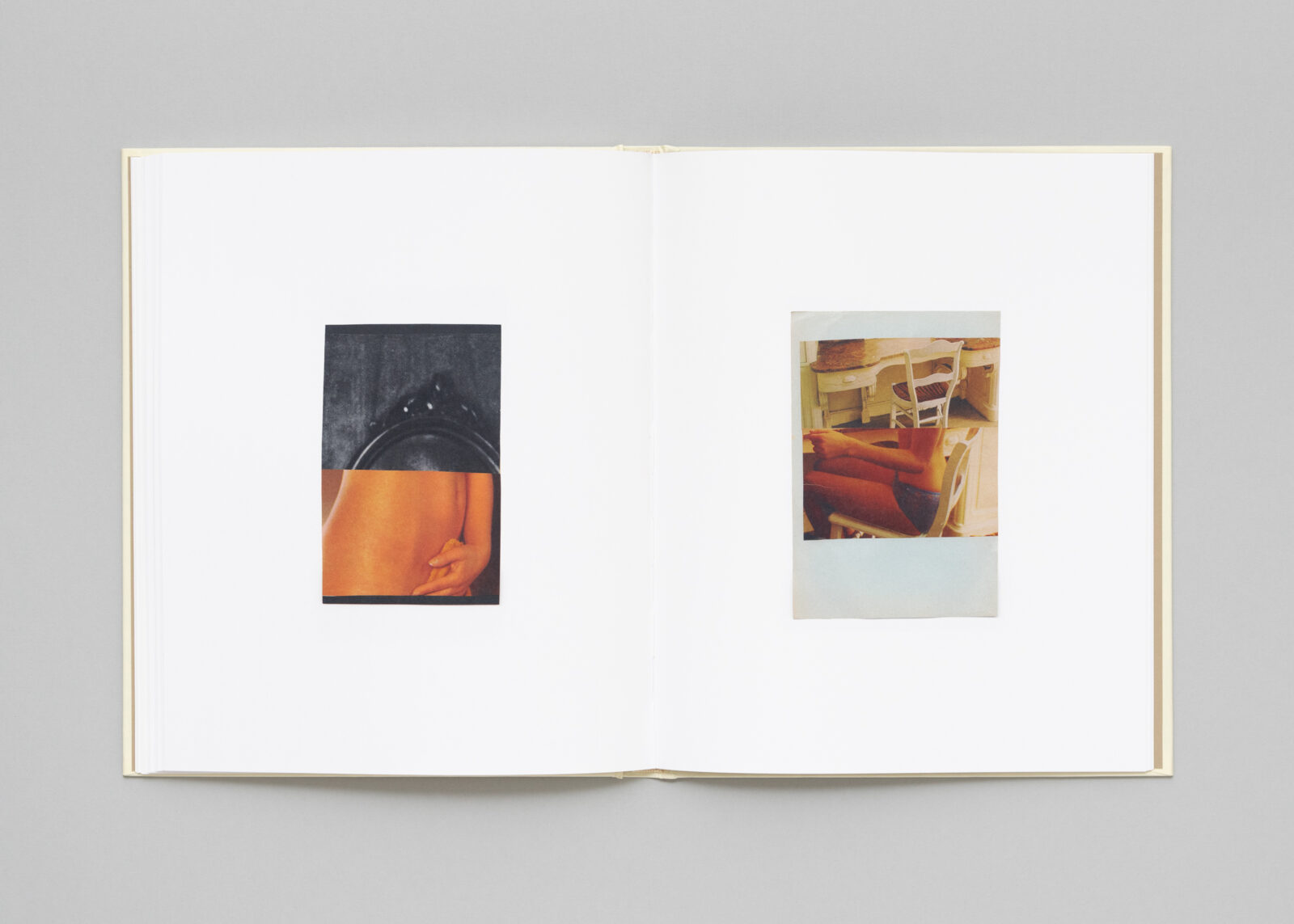
In De Blauwer’s own comments on her work, she has emphasized the “anonymity” of the figures in her photographs (bodies are fragmented and faces are rarely fully shown) and the construction of a “narrative,” as well as how her array of procedures are “creating a new contemporary mood.” De Blauwer emphasizes the “inner world” she sees these photographs constituting, her artist’s function as “a neutral intermediary between these stories of others and my own.” However, if De Blauwer’s tactics re-distribute the erotic charge of sexualized imagery intended for heterosexual male consumption, are there limits to this détournement? To apply what Roland Barthes famously observed of the striptease, even as fragments-in-assemblage these photographs function as “ritual signs [which] have only to be announced to evoke at once the idea of sex and its conjuration.”18
In Old Sweater Gets New Uses, De Blauwer responds through the agency asserted in her own tactile acts of finding, handling, selecting, touching, painting, arranging, and gluing photographs; the practice made after her own acts of viewing and consuming. By intertwining such materiality with her own desires and fears and those encoded in the photographs she appropriates, De Blauwer evokes how one function of “oddkin” is to ask, as Haraway does, “What shape is this kinship, where and whom do its lines connect and disconnect, and so what?”19
De Blauwer’s is a more disquieting vision than that of Haraway, England, and Koenning, their enmeshment within and claim to positive forms of local, familial, and societal belonging. Its performed emotions are recollected and reconstructed, not found like Masaoka’s in landscapes travelled through. As in all these photobooks, however, living a life and making sense of the relations it involves seem inseparable from the manipulations of photographic materials and what emerges from time spent in the controlled but leaky spaces of darkroom, performance, and book.
: :
Endnotes
- Katherine Hubbard, a slight cast down at the edge of the lips (Capricious, 2023), 225. This monograph also offers a comprehensive overview of all the early pieces mentioned throughout this essay, including Hubbard’s texts for performance-lectures and a full facsimile of the photograms for Bring your own light.
- Donna J. Haraway, Staying with the Trouble: Making Kin in the Chthulucene (Duke University Press, 2016), 2.
- The defining characteristics of the photobook as medium are the subject of Bettina Lockemann, Thinking the Photobook: A Practical Guide (Hatje Cantz, 2022).
- See the following full citations for these monographs: Katrien De Blauwer, Old Sweater Gets New Uses (Libraryman, 2024); Odette England, To Be Developed, To Be Continued (Tall Poppy Press, 2025); Katherine Hubbard, The Great Room (Loose Joints, 2025); Katrin Koenning, between the skin and sea (Chose Commune, 2024); Eriko Masaoka, In the Flap of a Bird’s Wing, Water Dries Up (Libraryman, 2025).
- Katherine Hubbard, a slight cast down at the edge of the lips (Capricious, 2023), 227.
- Odette England, The Long Shadow: Unwrapped – Marion Post Wolcott’s Labor and Love (Libraryman, 2024), 6.
- England, The Long Shadow, 8.
- Koenning, between the skin and sea, unpaginated.
- Jane Simon, The Domestic Interior and the Self in Contemporary Photography (Routledge, 2024), 3.
- Daniel Boetker-Smith, “In the studio with Katrin Koenning”, British Journal of Photography, 2023, accessed February 19, 2026, http://www.1854.photography/2023/08/in-the-studio-with-katrin-koenning/.
- Koenning, between the skin and sea, unpaginated.
- Eriko Masaoka, In the Flap of a Bird’s Wing, Water Dries Up (Stockholm: Libraryman, 2025), unpaginated.
- Eriko Masaoka, “TSUBUTSUMI”, accessed February 19, 2026, http://www.erikomasaoka.com/tsubutsumi/.
- It might also be a product of youth. A subsequent project, Still Rowing the River Ahead (2017-2022), has used a mobile phone camera to chronicle Masaoka’s more recent life in Europe with two young children, which as she has herself commented, often prohibits carrying a DSLR around and having the time for working in the darkroom.
- Chipo Chipizawia, My Mother, My Home (Archive Books, 2024), 62.
- Hubbard, a slight cast down at the edge of the lips, 227.
- De Blauwer’s publications with the Stockholm based Libraryman press, in addition to Old Sweater Gets New Uses, include You Could At Least Pretend to Like Yellow (2020), Why I Hate Cars (2019), and Dirty Scenes (2019). A further Libraryman volume, I Close My Eyes, Then I Drift Away (2019), relies not on archival source material, but on De Blauwer’s reworking of photographs by François Halard, whose own photographs offer another contemporary reworking of the stylized and erotically charged visual cultures with which De Blauwer’s archival practice engages.
- Roland Barthes, Mythologies, translated by Annette Lavers (Hill and Wang, 1972), 83.
- Haraway, Staying with the Trouble, 2.

David Berridge