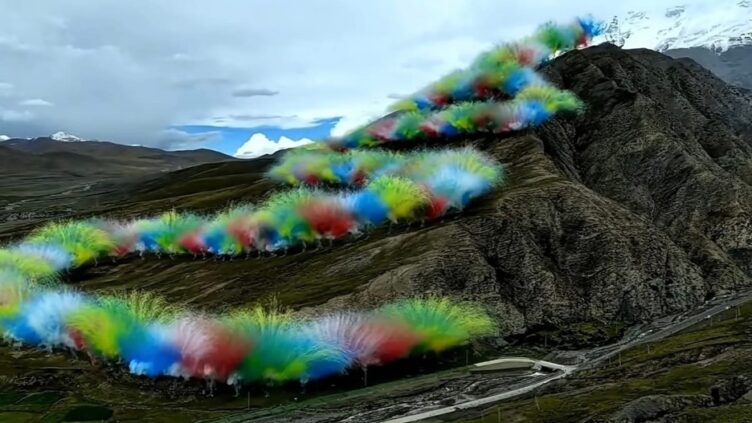
The explosive sparks and fiery arcs that flared across the Himalayan range for Cai Guo-Qiang’s site-specific artwork The Rising Dragon quickly drew the ire of environmentalists. Staged in September 2025, the firework project was a realization of Cai’s Ascending Dragon: Project for Extraterrestrials No. 2, an earlier work on paper in which a dragon rises from a mountain range symbolizing art’s capacity to communicate beyond the human realm. Cai’s sustained use of fireworks and other explosive materials to produce dragon-like patterns at a monumental scale has often been interpreted as an experiment in confronting a formless sublime. While existing critical readings of Cai’s work remain largely preoccupied with its ontological stakes—not unsurprising given that Cai has long been canonized as one of the representative figures of Chinese avant-garde art of the post-1980s—the most recent round of controversies sparked by environmentalists on Chinese social media attest to a growing public awareness of the ecological price of this genre of artistic production. These controversies also reveal long-enduring complicity between contemporary art and the fashion industry. When local authorities affirmed the need to “assess the ecological risks” of the performance and demanded reparations from the artist and his sponsor, the Canadian outdoor apparel brand Arc’teryx, Chinese environmentalists celebrated a victory.1
Yet what remains largely unspoken in debates about the Ascending Dragon series, however, are the project’s entanglements in the longue durée of extractivism under the settler-colonial regime in Tibet. “Why do we criticize Cai’s firework show while accepting the ongoing dam construction in Tibet?”—a Chinese media influencer was confronted with this question during a recent livestream. The new Medog (Motuo in Mandarin) hydroelectric dam on the Yarlung Tsangpo River registers a crucial expansion of extractive frontiers in Tibet, as hydro-extractivism is strategically planned to support—and be integrated with—the extraction of solar energy, wind power, hydropower, lithium, copper, gold, silver, and molybdenum. The energy and resources plundered from Tibet underpin China’s recent boom in EV manufacturing and the AI industry. The ways that this new phase of extractive capitalism is enmeshed with Chinese settler colonialism in Tibet and other ethnic minority regions has remained markedly underexamined. To name one obvious form of “slow violence,” the sedimented substances left behind by these terraforming processes produce forms of environmental toxicity to which Indigenous ethnic minorities are most vulnerable—an ongoing harm obscured by official narratives of “ecological preservation” through which the Chinese national state reasserts its ownership of minority-inhabited lands while denying the damage inflicted upon them.
To map ecologies within the settler-colonial extractive regime and to trace how that regime’s infrastructures impose a form of “planned violence” on Indigenous life is to treat extractivism not merely as an economic model but as what Matt Hooley calls an “extractive formation,” one “whose limits and whose histories give shape to our experiences, even when we disavow or disidentify with them.”2 Extraction builds itself into the environment, materializing in specific spatial and temporal configurations that have a corresponding aesthetic form. In this brief essay, I situate Cai’s work within Tibetan extractive formations to trace how extractive art reveals both the persistence of an extractive aesthetic and the operative logic of such a form under the settler-extractive regime in Tibet.
Aesthetics here should not be understood solely in terms of representational valence, but rather as techniques of rearranging spatial and temporal configurations in the process of producing extractive landscapes. Extractive aesthetics operates through, on the one hand, the imposition of a specific schema of perception that frames lands inhabited by ethnic minorities as reservoirs of exploitable resources, as “underdeveloped” or “empty land” (the settler-colonial myth of tabula rasa) open to planning, manipulation, and inscription.3 On the other hand, extractive aesthetics (re)engineer Indigenous territories into heterotopic spaces positioned as geographical Others vis-à-vis the expanding Han-Chinese-dominated metropolis—a spatial apparatus that simultaneously renders Indigenous peoples in Tibet ethnically othered. It is a production of an “outside” that is always available for extraction.
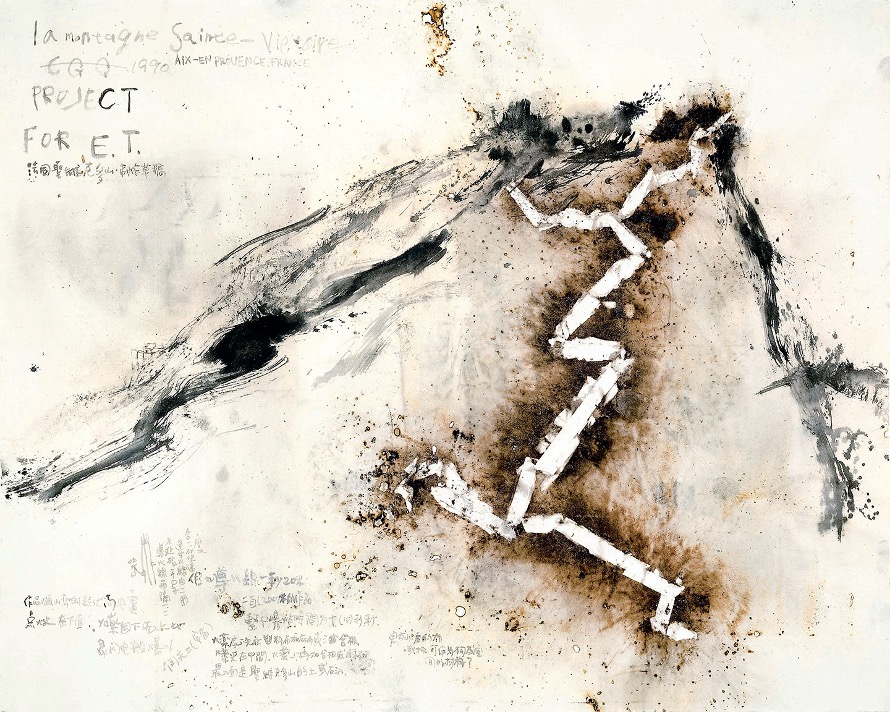
The extractive production of a landscape of otherness in Cai’s works is enacted through a process that I call geo-scription. For Cai, the traces of explosions are conceived as a form of writing: in his early gunpowder paintings, he “substituted the traditional colors of ink wash with the colors of gunpowder—combining explosive fieriness with the spiritual qualities of traditional Chinese literati painting.” His recent exhibition at the USC gallery similarly frames his explosive oeuvre as “an experimentation on materiality”—materiality here understood, according to the curators, in terms of the apparatuses of writing and inscription, the very apparatuses that mediate “human’s ability to harness elements and their relationship to a greater universe.”4 Yet what remains absent from discourses of “experimentation on materiality” is the latent materiality of the earth itself.
What does it mean to cast the earth as a kind of “matter” upon which “we”—the “human”—can write, as if it were a malleable, operable substrate to be fed into the apparatuses of inscription and (re)produced as a landscape imbued, as Cai would say, with “spirituality”? More crucially, who is the “we,” the “human,” invoked here? How can this universalized “human”—a category first elaborated within European imperial modernity—avoid being predicated on the dehumanization of others, a logic re-performed within the grammar of Chinese extractive-settler colonialism, where cultural cosmopolitanism (which, I would add, operates in tandem with ethnicization) offers no remedy? What is systematically denied in these discourses is that the cultural valence borne by such produced landscapes is itself a dimension of extractivism—an extractivism in contemporary China that has already become “cultural” or even “spiritual,”5 as it re-stipulates and authorizes the very sense of colonized land and water while annihilating Indigenous, non-extractive modes of relating to the earth and the ritual practices through which sense is given to nature.
Geo-scription allows us to take the reference to writing in Cai’s description of his own works not merely as a metaphor but as what foregrounds the modus operandi of extractive formation in Tibet within which The Rising Dragon should be situated. The tradition of land-art in People’s Republic of China is rooted in extractive projects imposed by the Chinese nation-state upon the lands of Indigenous ethnic minorities. The inscription of anthropogenic traces onto lands that, within settler-colonial narratives, are construed as “empty” enacts the Chinese national state’s claim to ownership of these lands and their subsoils, while simultaneously reaffirming its “civilizing” promise to “develop” and “modernize” these territories, a promise that functions to legitimize land dispossession and resource extraction. In other words, writing on the earth indexes a specific mode of production of extractive landscapes that is inseparable from a regime of knowledge production. Imperial-colonial practices of writing on and about land and its inhabitants—manifested through various forms of “-graphy,” from geography to ethnography sanctioned by the Chinese national state—accumulate vast quantities of data that, in turn, facilitate the conversion of Indigenous territories into extractive landscapes.
Cai has long been celebrated as a leading figure of the Chinese avant-garde and as a key new modernist artist of the 1980s.6 Yet the historiography through which this legacy has been taught and cited remains haunted, on the one hand, by lack of reflection on its Chinese exceptionalism undertone, and on the other, by an embrace of cultural cosmopolitanism. While critical scholarship has rigorously exposed the imperial formations underpinning European modernism, far less attention has been paid to Chinese post-1980s modernist art, even as China has, since that moment, become a crucial center for new global imperial formations. Moreover, as discussed above, the very notion of the “modern” has been mobilized by the Chinese nation-state to legitimate its settler-colonial extractive projects. The naïve celebration of “cultural differences” between “modernisms” in “the West” and “the East” obscures how cultural production is embedded within an extractive regime that dispossesses Indigenous ethnic-minorities—peoples who are often classified as neither West nor East—and whose experiences are bracketed off in contemporary (extractive) aesthetic forms.
The decontextualization of the ongoing extractivism in Tibet from Cai’s firework performance at Himalaya and the uncritical circulation and exhibition of images extracted from his geo-scription projects in US art institutes such as the Guggenheim, MoMA, and the MFA must be questioned. These images circulate with little acknowledgement of the extractive zone that conditions them, or of the violence such extraction inflicts upon Indigenous ethnic-minority life. The extractive formations that underwrite aesthetic production in contemporary China—and in the global art world more broadly—must, to invoke Macarena Gómez-Barris, be “unearthed.” New praxis and theoretical frameworks are needed so that contemporary art and art criticism might cease to “contribute to extractive capitalism”—a system in which China now plays an increasingly consequential role.7
: :
Endnotes
- Andy Battaglia, “Cai Guo-Qiang Under Fire for Controversial Pyrotechnic Show in Tibet,” ARTnews, September 22, 2025, https://www.artnews.com/art-news/news/cai-guo-qiang-fireworks-show-tibet-1234753145/.
- Elleke Boehmer and Dominic Davies, Planned Violence: Post/Colonial Urban Infrastructure, Literature and Culture (London: Palgrave Macmillan, 2018). Matt Hooley, Against Extraction: Architecture, Infrastructure, and the Global Economy (Cambridge, MA: MIT Press, 2024), 9–10.
- Joanne Smith Finley, “Tabula Rasa: Han Settler Colonialism and Frontier Genocide in ‘Re-Educated’ Xinjiang,” HAU: Journal of Ethnographic Theory 12, no. 2 (2022): 341–56.
- “Cai Guo-Qiang: A Material Odyssey,” USC Pacific Asia Museum, accessed January 16, 2026, https://pacificasiamuseum.usc.edu/exhibitions/cai-guo-qiang-a-material-odyssey/.
- Corey Byrnes, Fixing Landscape: A Techno-Poetic History of China’s Three Gorges (New York: Columbia University Press, 2019).
- Lansheng Zhang, The Spirit of Individualism: Shanghai Avant-Garde Art in the 1980s (Singapore: Palgrave Macmillan/Springer Nature, 2023).
- Macarena Gómez-Barris, “Un-Earthing Extractive Architectures,” e-flux Architecture, 2023, accessed January 16, 2026, https://www.e-flux.com/architecture/accumulation/574529/un-earthing-extractive-architectures/.
Tianren Luo