Craig Santos Perez—recent winner of the National Book Award for Poetry, promoter of Pacific Islander literature and culture, and environmental thinker—is keen on recycling modernism.
Consider “Thirteen Ways of Looking at a Glacier (after Wallace Stevens),” which Perez even titles a “recycling.”1 Re-using the structure (and even some of the syntax) of Stevens’s well-known “Thirteen Ways of Looking at a Blackbird,” Perez thinks through how we both see and don’t see glaciers in the time of climate change. We might see melting arctic glaciers as part of a larger ecosystem in which we are also entangled (“Humans and animals and glaciers / Are kin”). Or we might see them as endangered spectacles we can only hope to glimpse before they disappear (“Every tourist in the new Arctic / chased ice quickly”). Or as the symbol of the Anthropocene and the sort of critical thinking that has helped to define it (“the glacier is involved / In what I know”). Or perhaps as something that just is (“It was melting / And it was going to melt. / The glacier fits / In our warm-hands”).
Regardless of the specific vantage point we take, though, the sort of relationship Stevens had with his blackbird—as a site of projection for the Romantic imagination, as a source for our philosophical meditations—now seems both particularly fraught and newly impossible. Perez’s “recycling” thus measures how much human-nature relationships have changed since the modernist period (Stevens’s poem was published over a hundred years ago, in his 1923 book Harmonium), not to mention the physical and cultural distance between Stevens’s Connecticut and Perez’s Guam.
And Stevens isn’t the only modernist poet that pops up in Perez’s writing. To read Perez’s from unincorporated territory series is to encounter a steady stream of modernists cycling, and re-cycling, through his poetry: we find Claude McKay (in [hatcha]); Muriel Rukeyser [in [saina]); Ezra Pound in [guma’]; and Gertrude Stein (in [åmot]). The appearance of these figures raises questions, not simply of influence, but of how modernism has perhaps always relied on a sort of recycling (make it new!), of what Perez hopes to make out of this modernist source material, and of the way the term “modernism” may or may not capture something about his relationship to his indigenous CHamoru culture.
In October 2025, Perez sat down with me to discuss his poetry’s recycling of modernism. Our conversation has been lightly condensed and edited for clarity.
: :
Robert Volpicelli [RV]: It may not come as a surprise to you that, as a scholar of modernism, I want to begin with a moment that takes place in your third book in the from unincorporated territory series, [guma’]. In the middle of that book, you place an epigraph from Ezra Pound. The passage comes from one of the infamous radio broadcasts that Pound makes from Italy during WWII. These broadcasts are filled with all sorts of objectionable statements, and this one is no exception: Pound basically says that the US should trade all of Guam to Japan for a set of high-quality films of Noh dramas. I’m wondering if you could speak to why you included this passage in the book and what it says about the relationship between Anglo-American modernist poetry and a place like Guam?
Craig Santos Perez [CSP]: You know, my impulse for pretty much my whole life has been to look for Guam and to see if Guam is mentioned. And, for the most part, Guam is never mentioned. The first time I ever saw Guan mentioned in American poetry was in one of Robert Duncan’s “Passages” poems, when Duncan was talking about the Vietnam War. I put that quote in another one of my books. In terms of the Pound passage, this quote was actually pointed out to me by other scholars that I knew, and it was maybe the earliest moment that I had seen Guam mentioned in American poetry—and, sadly, it was in the worst possible way. And so it really struck me. Guam has always been seen as a strategic location for US empire as well as for the US military. Pound knew about Guam, or at least had heard about it, and he also represents it in that same strategic fashion. So I wanted to include that quote to position my work as a response to this idea and to show that Guam is much more than just a strategic location. The literature from Guam has as much power as any other literature in the world, and I wanted my writing to be a decolonial subversion of Pound’s quote and what it represents.
RV: On subsequent pages, I note that you then present a sort of autobiographical rendering of yourself when you were a college student. You mention your time studying abroad in Italy—and this of course connects back to Pound and his time in that country. Throughout this section, there also recurs this image of a cage made of “solid wire mesh.”2 For me, the idea of being caged conjures Pound’s fate after he was captured by Allied forces and then put on trial for treason. All of which makes me wonder if you’re trying to point out some sort of affinity, perhaps not with Pound (because who would want to associate with Pound?), but with the position of the expatriate poet, the un-American American? The whole idea of “treason” plays very interestingly across this section.
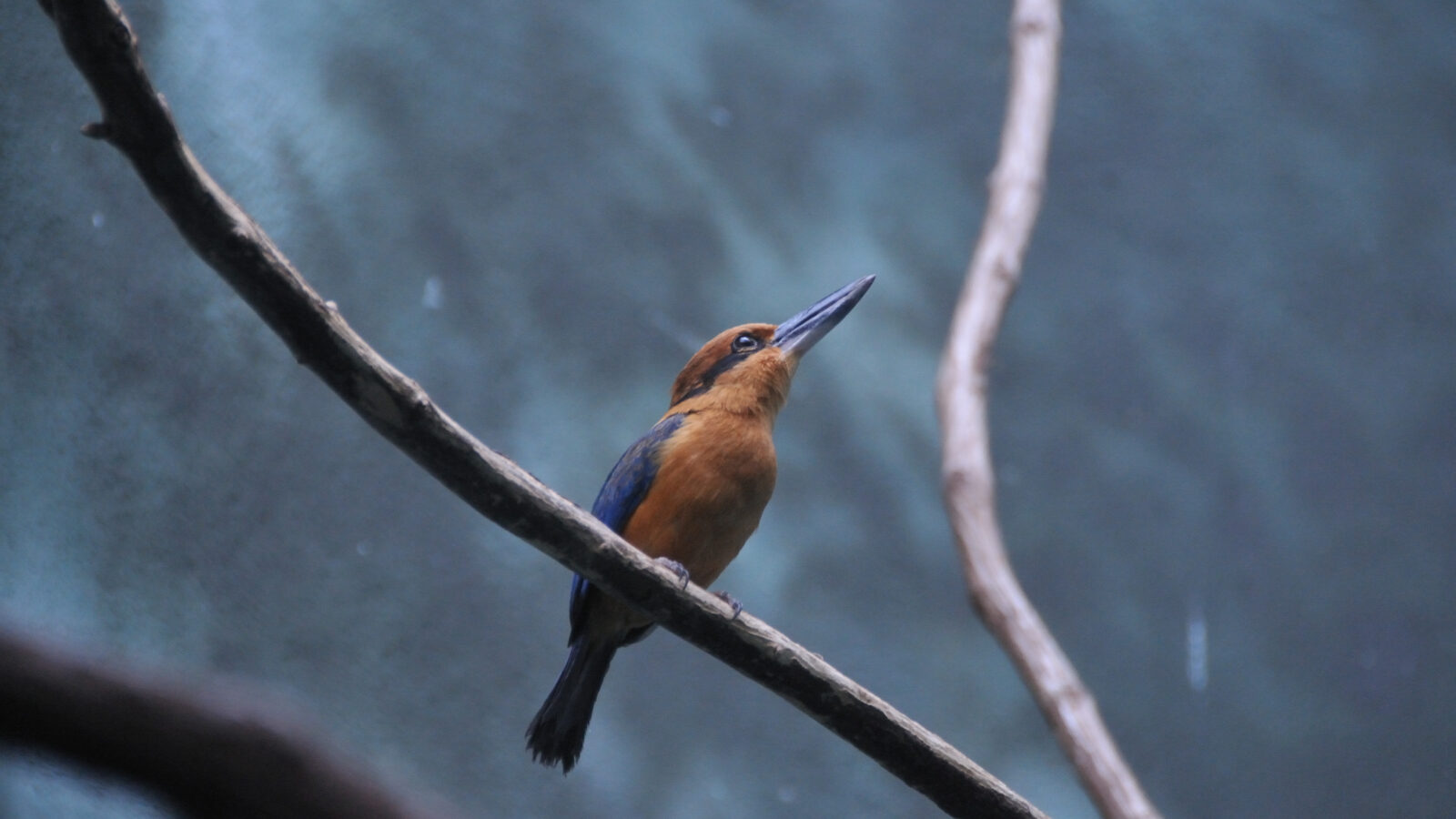
CSP: Yeah, it does. I was in Florence for a study abroad program, focusing my coursework on Italian Renaissance art and literature. But I had also brought Pound’s Cantos with me, knowing that he was in Italy. I tried to read the whole thing while I was studying abroad, so I had that in mind. Thinking about kind of my own positionality as a not-quite American poet abroad and thinking about “treason” from a decolonial perspective: like I said, I was trying to subvert these dominant narratives about Guam and American poets. In terms of the “solid wire mesh,” I didn’t actually have Pound in mind there. It’s an image I use in other poems throughout my work about the Micronesian Kingfisher, about birds being trapped in zoos. So I guess I was thinking of different spaces of entrapment. At the time when I wrote this poem, I was much younger and was just trying to juxtapose these various images, and honestly, I didn’t think about it in this way until you just asked me this question. But I could totally see how it’s all just weaving together in my imagination when I was 21 years old.
RV: I wanted to stick with education for a bit since we’ve already hit on that theme. I believe I’ve heard you say that it was during college, and perhaps also during your M.F.A., that you were exposed to a lot of modernist writing, and, on the one hand, you seem to have had a lot of formative experiences as a writer through this exposure. But, on the other hand, I’ve also heard you address elsewhere how your schooling presented literature to you as an exclusively American, or Anglo-American, product. At the end of your most recent book in the from unincorporated territory series, you even have a poem about this. In that poem, you picture yourself reading to students from a high school in Guam when you notice a student crying because, she says, “I’ve never seen / our culture / in a book before / I just thought / [we] weren’t worthy / of literature.”3 Could you talk about your exposure to this literature in college and how you were receiving that at the time, and whether you felt like it connected at all to your desire to write about Guam?
CSP: With my undergrad and during my MFA, I was fortunate enough to take a lot of great classes, both on modernist and postmodern poetry—and not just American, but also European literature. As I said before, I was always looking for Guam, looking for the Pacific and not finding it for the most part. That left me feeling very invisible and marginalized in a way. But at the same time, I fell in love with this kind of poetry and really tried to study it as deeply as I could. Even though I was very culturally removed from it in many ways, I was still inspired by it. I think one of the things that spoke to me the most was the fragmentation, the way modernism and postmodernist poetry worked with fragmented experience, or with what it meant to write poetry in a fragmented world. I felt like I related to that in a number of ways both being from Guam and from a colonized space.
RV: I was actually just about to ask you about fragmentation and the status of the fragment in your work. The preface to the first book in your from unincorporated territory series begins with a Biblical passage from John, which asks us to “Gather up the fragments that remain, that nothing be lost.”4 The line smacks of T. S. Eliot’s edict that we ought to “shore up” the “fragments” of our “ruin.” But more than that, it makes me think of Jahan Ramazani’s argument that postcolonial poets took up the tradition of the modernist fragment and took it in their own directions. Can you talk a little bit more specifically about how you use the fragment in your poetry?
CSP: Yes, I definitely would agree with that argument, and you know, quoting from the Bible was partly a reference to growing up Catholic. Guam was a very Catholic island and obviously that’s a result of Spanish colonialism. So I was trying to bring these different elements, like Spanish and American colonialism, into conversation through these fragments, whether they be from the Bible or The Waste Land. Thinking more about the fragment: my experience being indigenous and colonized and diasporic felt like a very fragmented experience. I wanted to explore that, especially in my first book, by thinking about how to reweave and recover the fragments of identity, the fragments of culture, the fragments of memory and history into a narrative that is not necessarily moving towards wholeness or completion, or a deterministic past or future, but really trying to dwell within the fragment and to see what can be recovered. And that’s also about saving space for the silences between the fragments and the blank spaces in memory or the archive. So the fragment gave me a way, not only to think about the line or the stanza as these kinds of fragmented spaces, but also to think about the space of the page as those kinds of silences or gaps in the narrative.
RV: The other form that I’ve been thinking about a lot in your poetry is the opposite of the fragment, and that’s something like the epic. You’ve got another quote in one of your books from Charles Olson’s The Maximus Poems. The specific line that appears there is “let them not make you / as the nation is.”5 This raises all sorts of questions for me about the epic and its relationship to national identity. Can you talk to the idea of epic and nation? Do you see from unincorporated territory as a modern epic about Guam?
CSP: Yeah, it definitely is. I was thinking both about the epic and the long poem. I was reading the Cantos; I also really loved T.S. Eliot’s Four Quartets and The Waste Land; and I studied HD’s Trilogy and William Carlos Williams’s Paterson. I loved all these book-length, serial poems. I was also thinking in relation to the epic, partly because I wanted to tell a story about a place; Williams’s Paterson became one of my models for how to write about place in a way that is very expansive, that is epic in a sense. And then I also think that, for my MFA, I had two years to write a thesis and that was my first book. I got to the end of those two years, and I was like: I have so much more to say and so many more stories to share about Guam and about CHamoru experiences. That’s when I started to really think about: what if I push the form in a way similar to how these other writers have done? These multi-book, lifelong projects? That was actually where the “from” in the series comes from. In earlier iterations, the book was just called unincorporated territory, and I was just going to write one book and move on. But then, when I got to the end of that book, I realized the story continues. I was also inspired by Simon Ortiz, a Native American writer, and his book from Sand Creek, which uses the italicized “from” to indicate a kind of excerpt. I just love that idea: thinking about the excerpt as bringing together the fragment and the epic. Part of that, too, was my effort to take this tiny island, which was not on any literary maps that I could locate at that time, and to make the argument that Guam is deserving of an epic. I was inspired by Derek Walcott, who has written postcolonial epics about the Caribbean. But Guam is not yet a post-colonial nation, right? It’s not a sovereign, independent state. So I started thinking about what a decolonial epic would look like—an epic about a place that is still colonized, that hasn’t reached that postcolonial moment. This fragmented, excerpted epic then became the space where I could explore what that story might look like from an unincorporated territory.
RV: Within the last several years, there has been an emerging critical discourse about both indigenous and Pacific modernisms. Before this conversation, you directed me toward Matthew Hayward and Maebh Long’s New Oceania: Modernisms and Modernities in the Pacific, in which they and the other contributors consider what it means for Pacific writers to take up the frameworks of modernism in responding to the waves of modernity that were hitting these islands throughout the twentieth century. It is a really complex set of relationships that ensue, and one sign of this complexity is the many different terms—“indigenous,” “Pacific,” “Oceanic,” “Micronesian”—we could use to organize such a discussion. But I’m wondering if one way to approach the question of how your work might contribute to something like a Pacific modernism would be to start with Guam and the conditions around its “modernity.” How would you describe those conditions?
CSP: What’s interesting about Guam is that Guam was really the first place in the Pacific to experience modernity. That was in 1521, when, during Magellan’s circumnavigation of the globe, he discovers Guam, and Guam becomes the first place in the Pacific known to Europeans. It becomes the first place that’s part of this modern world, it becomes the first European colony in the Pacific, and it becomes the first place missionized by the Spanish. A lot of that is just its geographic location. It happens to be on the equatorial current that the Spanish galleons took, so it also became a strategic location for them within the Spanish trade. As a result, Guam really becomes the first modern island in the Pacific and, to me, that obviously coincides with the history of imperialism and colonialism. And so I think the fragmentation in CHamoru culture, and in Guam history, goes deeper than in other places in the Pacific and creates a more profound complexity in terms of CHamoru identity and subjectivity. In many ways, I think if you’re going to talk about modernity in the Pacific, you have to start with Guam because that’s where it started, though a lot of discourses about this do not start with Guam because Guam is often invisible, even within Pacific studies.
RV: In their more recent work, Hayward and Long discuss their reservations about how scholars end up applying the word “modernism” to everything—at a certain point, it becomes its own sort of imperialism to swallow up everything under this rubric. So they insist there that, if we were to talk about such a thing as a Pacific modernism, we should place an emphasis on the first word, “Pacific,” instead of the second word, “modernism.”6 Building on this sort of thinking, we might then ask: what can a “Pacific” modernism, or even a “CHamoru” modernism, do that other modernisms can’t?
CSP: That’s great point about the application of the term modernism. For me, I think about how modernism—as a framework, as a theory, as a methodology, and as a literary tradition—has influenced Pacific literature through many of the ways we’ve already discussed. But I also think about, from the perspective of a CHamoru modernism, how that influence has been articulated and even critiqued through a CHamoru lens, through CHamoru voices, through CHamoru literature, history, aesthetics, and so on—which means that my version of modernism will always look different than another writer’s experiments and aspirations. I think that’s partly because there’s not just one way that modernity has impacted different parts of the world. That impact looks different in different places. There are multiple modernities that have shaped Guam, whether it be Spanish modernity or American modernity, and then there’s a plethora of CHamoru responses and expressions shaped by this history. So I think we could argue that there are CHamoru modernisms.
In my academic book,7 I think about the relationship between indigeneity and aesthetic expression as a way to tackle this history of modernity, of colonialism. But with all that said, I think there are certain core traditions and customs that we define as CHamoru. These are our deepest values that we share in common. And so, I think about how some of those customs inflect our understandings of modernism. For example, our most important cultural value is called inafa’maolek, and this is an epistemology as well as a belief that all people, things, animals, and ecologies are interconnected in a vast kinship network. I feel that this interconnectedness has shaped how I view modernism in the sense that we do have this fragmented world and these fragmented identities, but there are also ways in which everything is still interconnected. Through this epistemology, I can see these fragments in a way where they’re not necessarily separate. And then through poetry, I can bring them into kinship and discover new articulations of indigeneity.
: :
Endnotes
- Craig Santos Perez, Habitat Threshold (Omnidawn, 2020), 18.
- Craig Santos Perez, [guma’] (Omnidawn, 2014), 22–23.
- Craig Santos Perez, [åmot] (Omnidawn, 2023), 128.
- Craig Santos Perez, [hacha] (Omnidawn, 2017), 7.
- Craig Santos Perez, [sacha] (Omnidawn, 2017), 53.
- Maebh Long and Matthew Hayward, The Rise of Pacific Literature: Decolonization, Radical Campuses, and Modernism (Columbia University Press, 2024), 15.
- See Craig Santos Perez, Navigating CHamoru Poetry: Indigeneity, Aesthetics, and Decolonization (University of Arizona Press, 2022).
Robert Volpicelli