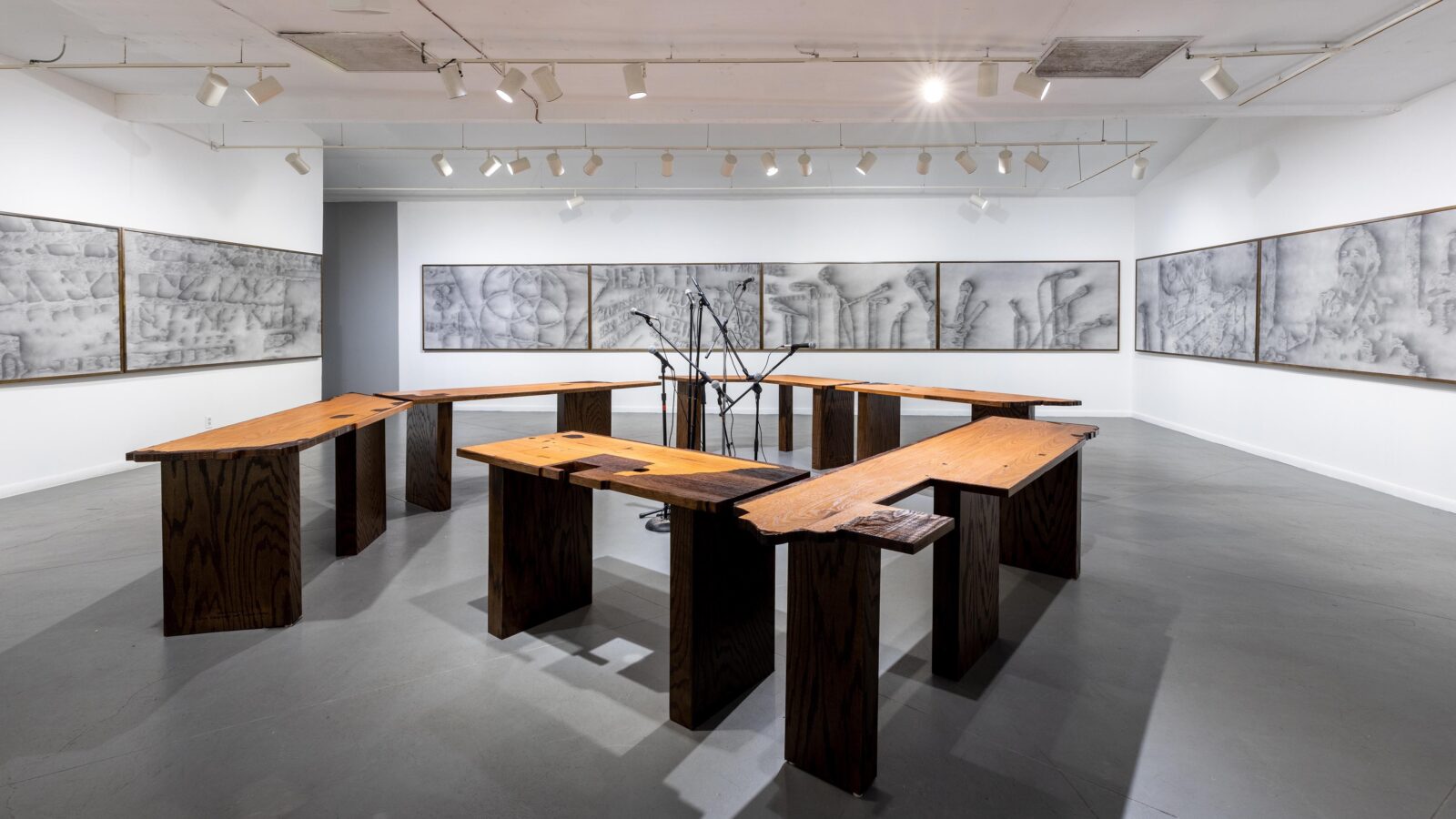
Nick Vaughan and Jake Margolin make art that mines pre-Stonewall queer stories across the United States. Deeply researched both in the archives and through oral histories and community engagement—the best stories are often passed down word of mouth rather than captured in library stacks—their art celebrates these stories as a historical foundation for imagining queer futures. As part of their 50 States project, Nick and Jake have worked with communities from Louisiana to Colorado, from Wyoming to Arkansas, on transformations of local queer history into wide-ranging installation and performance art. In their current work, they engage with their own community in Houston both to archive the past and to build ceremonies for the future.
In their presentation for the Gulf Coast Artist Showcase for ASAP/16, Nick Vaughan and Jake Margolin led attendees through a series of beautifully curated encounters featuring art works, performances, historical research, and community-based programing. This panoply of cultural artifacts-in-the-making culminates in their ongoing project, Town Meeting, 1978 – 2028. Dedicated to the gathering of queer Houstonians (literally thousands!) which occurred at the Astro Arena in 1978, the original Town Meeting was part of a budding movement that would ultimately lead to the creation of queer institutions in Houston such as the Montrose Center and the Montrose Clinic. In the increasingly repressive era of the present, Nick and Jake commemorate and honor the memory of this LGBTQIA+ movement past, while also fostering the possibility of a convening that will carry this movement into the future.
Nick and Jake kicked off the Town Meeting symposia over two days in June 2025 at Arts League Houston. This gathering of approximately 30 presenters strategized how best to look ahead to the 50th anniversary of the Astro Arena Town Meeting in 2028, bypassing normative art-world timelines in which, for instance, museum shows are scheduled years in advance. Working with artists, art historians, archivists, and community elders, the continuing work of Town Meeting, 1978—2028 is to bring together a plethora of resources to imagine the shape of a queer Houston to come. This kick-off event culminated in an “Open Space Session” dedicated to setting community agendas and planning collaborations, which looked to sustain and pay forward the collaborative and community-based spirit of that initial intervention.
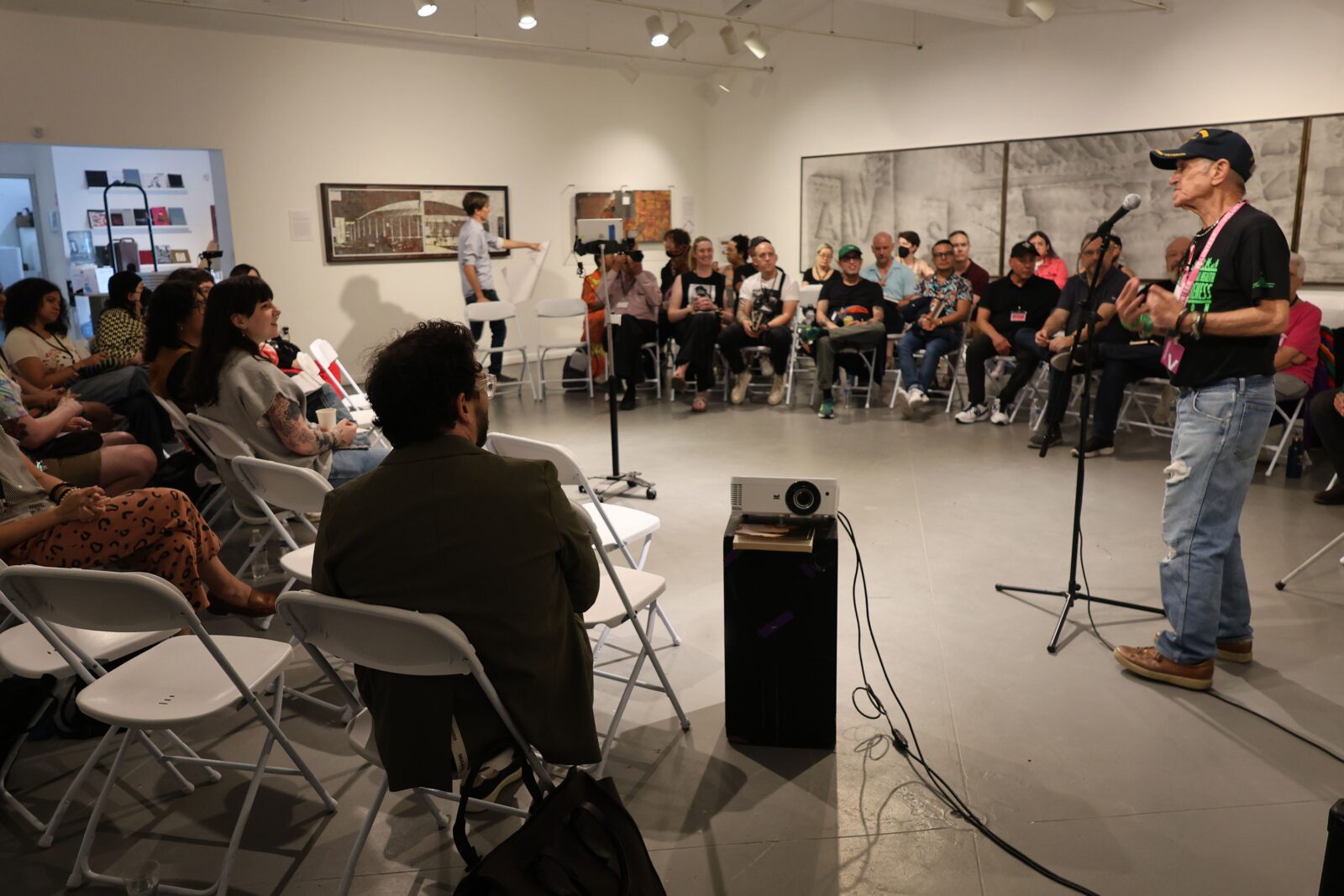
There is a distinct poetics involved in the way Vaughan and Margolin produce, represent, and discuss their shared artistic practice. At ASAP/16, their showcase presentation was at times intentionally circuitous, meandering among and between images, personal anecdotes, and poetic citations to provide a holistic glimpse into the depth of an artistic idea or process; at other times, the presentation could be self-effacing, foregrounding their embeddedness and indebtedness to a larger queer community by highlighting the work of others. In a flurry of opening slides, their project was introduced with a series of tentative titles: “Fallability as a Superpower, or The Gap, or Be the Glass Darkly, or I don’t know what we’re doing and that’s why it’s good, or Unresolved Motion, or Community Inconclusive, or On the absence of answers.” Each title rhetorically diffuses the pressure to immediately perceive, understand, and relate among the audience. Within the context of a conference on “Worldmaking/ Worldbreaking,” they offered instead a vision of their practice as one focused on constituting a multiparous space—or world—of questioning and uncertainty into which the audience is warmly invited. The effect of this invitation was enhanced by the counterpoint of their alternating voices; through a variety of rhetorical strategies and performative approaches, Nick and Jake enacted a “meta-theatrical” and poetic commitment to the multiple and the incomplete in speculations about what the world could be and look like.
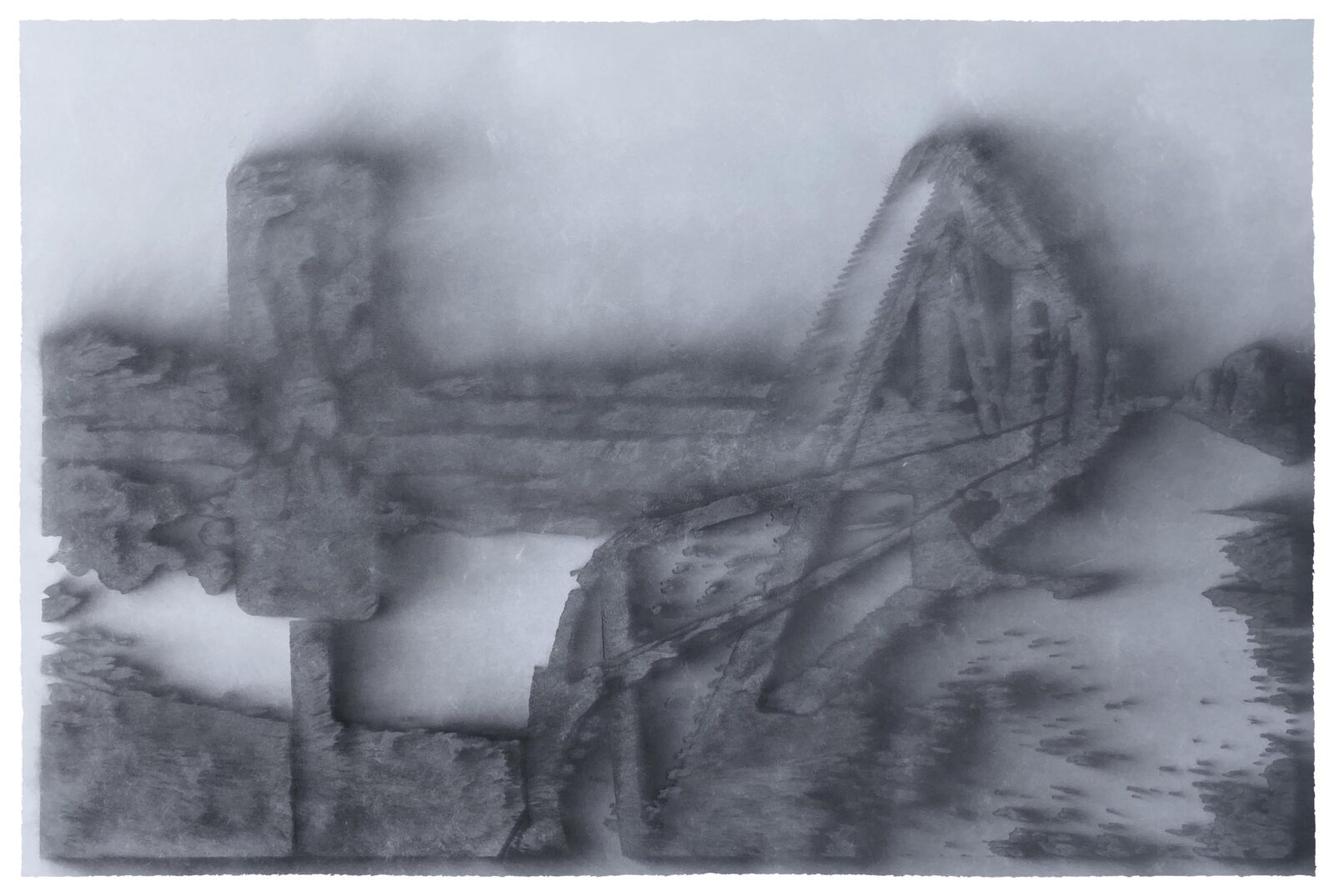
To bring us into this mode of presentation, Nick and Jake started with their series of “wind drawings.” Each drawing is the product of a uniform set of erasures. First, they begin with a photograph, taken by Nick and Jake, that foregrounds a lack of context, such as a structure no longer standing or obscured in some way (erasure 1: of context). They then proceed to compress the image and create a black and white file that heightens contrast and reduces grayscale as much as possible (erasure 2: of dimension). The compressed images are used to create stencils which enable the transcription of those images onto large sheets of paper using loose charcoal powder. Finally, once the scene is set, Nick and Jake use gusts of wind created by an industrial air compressor to erase the image, leaving only traces of its original form (erasure 3: what the pair of artists call the “ghost image” or the “memory of an image”). What was most striking about this process was the sense of immersion in the play of memory: with the “wind drawings,” Nick and Jake foster a heightened sense of the blur between pain of loss and joy of renewed or transformed presence. This theme served as a nucleus around which the wide range of pieces comprising Town Meeting 1978—2028 was organized.
The blend of stencil making and photographic manipulation is common among Nick and Jake’s creation of serial artworks, thematically plumbing the cavern of affects and meanings which exist in the blur between joy and pain, loss and renewal. One of the most striking visual representations of this theme is their series of “geographic portraits” called Cut Maps, the product of an extended fascination with maps. Here, beginning with maps of the state of Texas, Nick and Jake excise the portions representing land and leave only the snaking, entangled, and vein-like portrait (what they call “arterial networks”) of Texas’ transportation infrastructure. These maps are then photographed against a black backdrop to again create a heightened sense of visual contrast. This process is a framework for representing, in new and unexpected ways, a number of subjects, such as the multitude of gay and lesbian bars (some still in operation and others not) that can be found across the state. In this way, Vaughan and Margolin pay tribute to the history of queer establishments in Texas while gesturing, representationally, to the possibility of forging new connections from that genealogy.
Both within and beyond Town Meeting, 1978 – 2028, Vaughan and Margolin have cultivated an extensive body of work that geographically spans a large portion of the United States (making art and/or doing research in Alabama, Arkansas, Colorado, Oklahoma, California, Illinois, Kansas, Kentucky, Louisiana, Missouri, New York, and Utah), in addition to serving as an homage to the queer arts scene in Houston. The wide-ranging aspirations of their larger creative project were communicated most clearly in their discussion of the Rendezvous Center for Art, a non-profit organization they founded to “to foster public understanding of the contributions of the LGBTQIA+ community by supporting the creation, public presentation and social engagement programming of interdisciplinary artwork that examines the rich diversity of queer experiences.” To that end, Nick and Jake are aiming, beginning in 2027, to commission artworks from queer artists representing each of the 50 states in an effort to collectively build a greater understanding of the queer world being un/made in the United States.
Nick and Jake have forged a distinctly generative partnership built on a genuine love and care for the lives of queer people of all backgrounds. One of the most affecting anecdotes demonstrating the guidance of this love came towards the end of their showcase. Lingering in a reflection on whether their worldmaking practices were more focused on creating worlds for the living or for those who have passed on, Nick and Jake briefly described a performance lecture, one they have enjoyed giving at various events, about Houston’s drag scene in the mid-1970s, exemplified by Mary’s Naturally, a Montrose grocery store turned gay bar that they called “Houston’s equivalent of the Stonewall Inn—a fulcrum of organizing and so much else.” The performance lecture was inspired by the work of the photographer Janice Rubin, and especially photos she had taken of young queer figures, prior to the arrival of the AIDS crisis, who were later afflicted by the disease (here, they mentioned a photograph of the performer JJ Farmer taken by Rubin in the backyard of Mary’s). Reflecting on this underrecognized history and describing their own post-performance rituals, the creative pair concluded their showcase with this image: “Whenever we perform the lecture we record it and afterwards invite audience members to share stories of loved ones who were felled by HIV/AIDS into the recorder and then late at night go and sit in what used to be that backyard—now it is the paved over parking lot of a bougie coffee shop—and we play the recording for whatever ghosts might be listening.”
: :
Zora Duncan