Since the fall of Roe v. Wade, access to reproductive care in the United States is under severe threat, and procedures once considered routine are now illicit in many parts of the country. Equally disturbing is the threat of censorship, not just regarding abortion, but also pregnancy, miscarriage, and contraception, subjects that are typically considered part of everyday discourse but are now increasingly suppressed, forbidden, and in extreme cases, criminalized. Such restrictions on freedom of expression and education reach even deeper than bans on specific procedures, since they aim to render everyday human experiences invisible, unspeakable, and ultimately, inconceivable. They indicate a broader authoritarian logic in which the control of information is used as a tool to shape and inhibit collective action and political will. This political logic is palpable in the state of Idaho, where I spent five years teaching at the flagship public university as the only art historian on the faculty. After the U.S. Supreme Court’s Dobbs decision in July 2022, the Idaho legislature immediately passed one of the most draconian abortion bans in the country, which was soon followed by a law declaring it a felony for a non-parental adult to assist a minor in crossing state lines to obtain an abortion, the first of its kind to target so-called “abortion trafficking.” These extreme restrictions prompted an exodus of healthcare workers and the shuttering of women’s health clinics and maternity wards, endangering pregnancies across the region, a classic parable of unintended consequences.
While interstate transit and medication shipments can prove difficult to track, education—especially when it takes place in classrooms and on campuses, where witnesses and whistleblowers abound—is more readily monitored and weaponised, particularly against the backdrop of systematic defunding and nested regimes of dataveillance. These techniques landed in my inbox in September 2022, when I received an email from the general legal counsel of my then-employer, the University of Idaho. The message contained a campus-wide legal memo advising faculty and staff to remain neutral, if not completely silent, on topics related to abortion and contraception. The university’s advisory ostensibly responded to a new state law declaring it a felony for state employees to “promote” abortion or contraception on campus, or to provide information on how to access such services—despite the fact that contraception still remains legal in the state of Idaho. Taken to a logical extreme, any discussion of abortion or contraception could potentially constitute “promotion,” and thus faculty and staff were instructed to avoid these topics as much as possible, regardless of context, their professional role, or area of expertise.
Besides sparking outrage and confusion, this legal memo immediately triggered the removal of any art works depicting abortion and contraception from exhibitions in state-funded institutions, including at least one community college art exhibition, and certainly countless other exhibitions and events that were censored preemptively. This assault on free speech and academic freedom has fundamentally shifted the politics of representation in the state, by determining not just what can be said or shown publicly, but also where, when, and by whom. Beyond making abortion and contraception taboo, such laws invoke the spectre of moral crime, in which discussion denotes intent, and ironically, any depiction of the so-called facts of life constitutes an existential threat to life itself.
Even more ironically, when I received this chilling legal memo in my inbox, I had just arrived at the former home and studio of the American artists Edward Kienholz (1927–1994) and Nancy Reddin Kienholz (1943–2019). This was my first trip to the Kienholzes’ sprawling compound on the banks of Lake Pend Oreille, located just beyond the town limits of Hope, Idaho (population 100) in the state’s northern Panhandle. My visit was the culmination of multiple years of research for an exhibition (which, fortuitously, was planned to open at a museum right across the Idaho border at Washington State University) focusing on the Kienholzes’ relationship to the inland Northwest.
In 1973, a year after they and began their multi-decade collaboration as romantic and artistic partners, Ed and Nancy relocated from Los Angeles, California, to Bonner County, Idaho, the second northernmost county in the Idaho Panhandle. It was a homecoming of sorts for Ed, who grew up on an eastern Washington farm near the Idaho border, spent many summers on Lake Pend Oreille, and maintained family roots in the area. The Panhandle is widely admired for its stunning mountainous landscapes, but since the 1970s, it has also earned a reputation as a hotbed for far-right extremism and separatist groups, particularly white supremacist and anti-government militias. Unsurprisingly, it is also one of the most deprived regions in the country when it comes to reproductive care; in fact, the main hospital in Bonner County lost its maternity ward in 2023 when its obstetricians fled post-Dobbs, forcing pregnant patients to travel over forty miles to receive medical attention.
Considering how Kienholz spent his early life in the ultra-conservative inland Northwest before relocating to Los Angeles, it is perhaps no coincidence that his work often takes aim at moral injustice and political hypocrisy. Abortion was no exception. A decade before Roe was argued before the Supreme Court and sixty years before it was overturned, Kienholz created one of his most unflinching depictions of gratuitous violence, The Illegal Operation (1962), a lifesize sculptural tableau showing the grisly aftermath of a back-alley abortion. Tragically, Kienholz’s work is just as damning and relevant now as it was in 1962. Even more disturbing is the fact that today, exhibiting and even discussing this work in his home state could be deemed as illegal as the procedure that it graphically depicts.
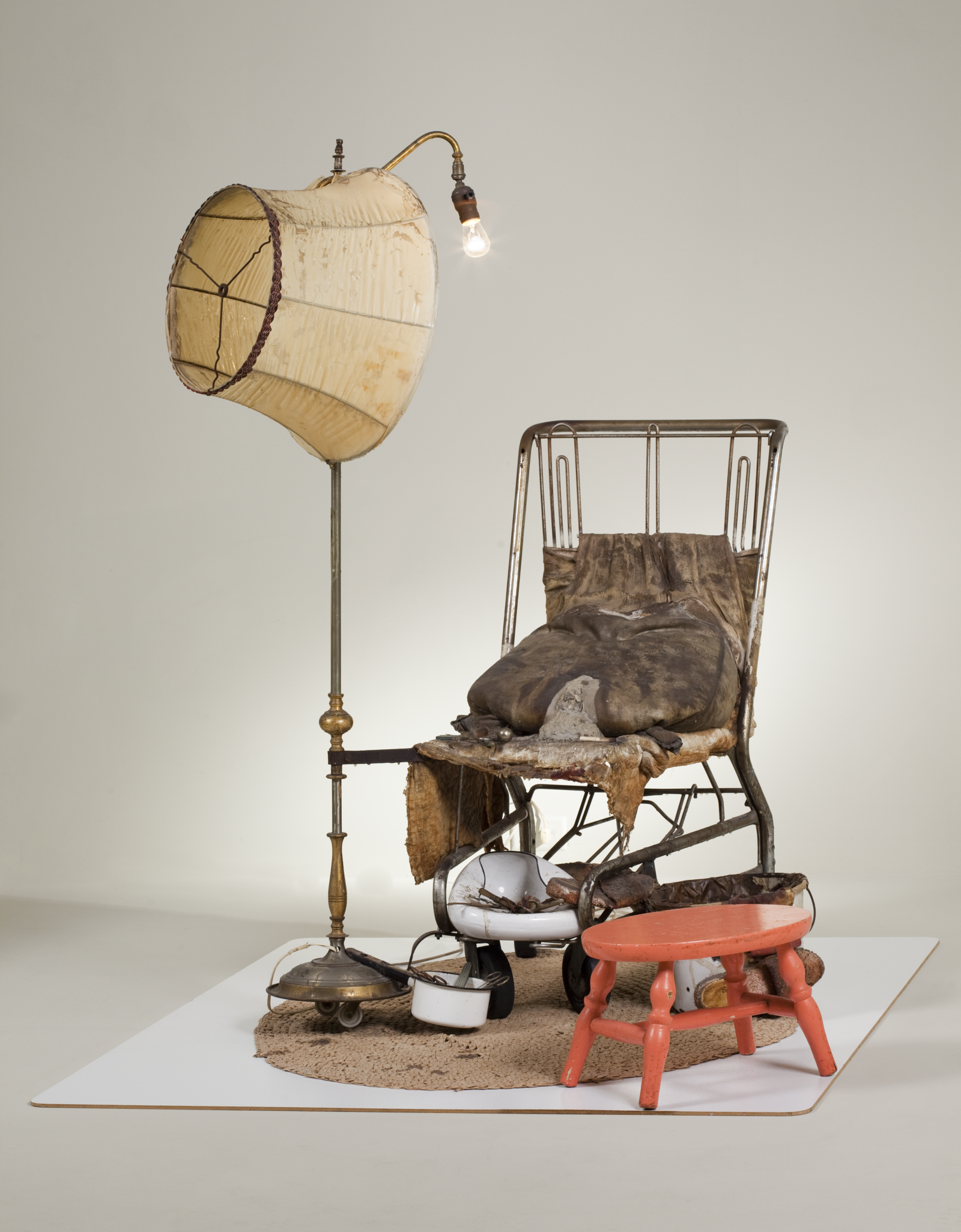
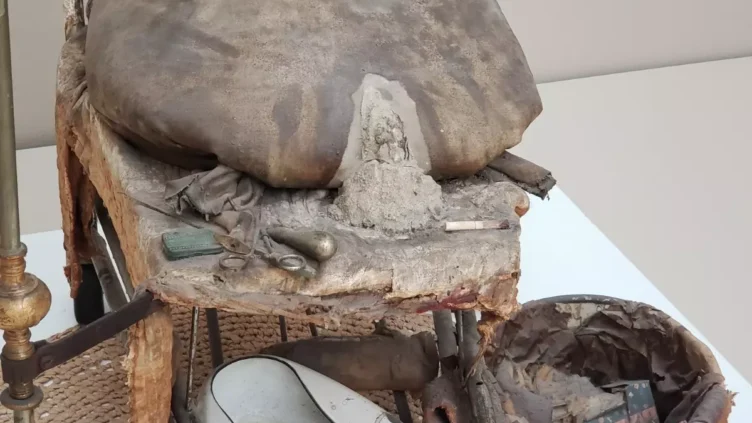
A literal nature morte, The Illegal Operation conjures the scene of a makeshift operating theatre. Judging from its state of dereliction, the surgeon has recently departed, while the patient’s body is substituted by a sack of cement slumped in the center of a metal wheelchair that seems to have been adapted from a dismembered shopping cart. This wheelchair-cum-gurney is strapped and bolted to a floor lamp, its tautness echoing how the sack’s excess fabric has been stretched around the chair’s thin metal slats, emphasising themes of restraint and bondage. The cement sack is marred by a small cut from which its contents spill forth, forming a small pyramid of industrial surplus. The only index of the surgeon’s presence is a half-smoked cigarette, left casually next to the incision site. Strewn about the base of the wheelchair are a white metal bedpan and saucepan filled with dirty and rusted surgical instruments and a metal paint can stuffed with what appear to be bloodstained rags that are tinged brown from oxidation. Wedged behind this gory paraphernalia is a single fuzzy pink slipper streaked with grey cement, yet another piece of evidence, this one belonging to the patient/victim, suggesting her rushed, or perhaps fatal departure. A coral-colored wooden stool stationed in front of the wheelchair offers the amateur surgeon a perch during the operation, and we can envision him (or her) exhaling cigarette smoke into the pregnant woman’s stomach and groin as he worked. The glare of a bare lightbulb enhances the mood of coercion, impropriety, and violation, more befitting a torture chamber, fetish porn, or a post-mortem than a medical procedure.
By staging the abortion as a crime scene scattered with relics of the abortionist’s dubious tools and techniques, The Illegal Operation also functions self-reflexively as a grotesquely ruinous parody of the artist’s studio—and thus positions Kienholz himself as the abortionist. Viewed allegorically, the surgeon’s paraphernalia—scissors, scalpels and knives—stand in for paintbrushes, mixing sticks, or sculptor’s chisel; the used rags are soiled with oils and turpentine instead of blood; the cement sack refers to the technical supports for painting, sculpture, or both combined; and the presence of an actual paint can consolidates this constellation of analogies. Furthermore, by casting the artist as abortionist, the tableau also anticipates its own criminalization in an uncanny foreshadowing of the current legal prohibitions in Idaho.
A West Coast artist who came of age during the triumph of the New York School, Kienholz was acutely aware of the Promethean model of heroic (presumed white and male) creative subjectivity identified with Abstract Expressionism, and much of his own adopted persona was an attempt to subvert it. In this sense, it is also tempting to read The Illegal Operation’s grisly flourishes metonymically, referencing the celebrated techniques of the movement’s leading lights—the liquid splatters of dried cement as stand-ins for Pollock’s drips, the sack’s surgical slit as a play on Newman’s “zips,” while the soiled sack and rags give new meaning to Frankenthaler’s signature “soak and stain.” But if The Illegal Operation is a stand-in for the artist’s studio, and the artist himself is the perpetrator of this horror, rather than a mere bystander, what are we to make of such a self-implicating gesture?
Streaked and stained, slumped and twisted, stuffed and leaking, wrapped and bound, The Illegal Operation offers a condensed summary of the violent and sordid sculptural aesthetic Kienholz developed in the late 1950s and 1960s, most famously in life-size tableaux like Back Seat Dodge ’38 (1964) and Five Car Stud (1969-1972). In particular, The Illegal Operation anticipates Five Car Stud’s ethically ambivalent spectacle of racist violence—ostensibly, the castration of a Black man at the hands of a sadistic white gang. Both works solicit a voyeuristic, and potentially complicit gaze, assumed to be white like the artist himself. Yet, unlike these better-known works, The Illegal Operation refuses to depict its human subjects, opting instead for allegorical and indexical traces of the patient/doctor dialectic. Notably, the pregnant body is signified through an industrial material typically found on construction sites rather than in domestic spaces like bedrooms or even institutional spaces like hospital wards. The sack is tightly bound to another “industrial” object, the wheelchair converted from a shopping cart, the everyday technical support for the feminized realm of consumer culture. Kienholz’s refusal to depict the body was, perhaps, symptomatic of the event that inspired The Illegal Operation, when his wife underwent a life-threatening back-alley abortion.1 Even so his choice of substitutions suggests a critique of patriarchal systems of social reproduction that bind women, quasi-industrially, to the domestic sphere, with potentially fatal consequences.
By transfiguring his wife’s personal trauma into a spectacle for aesthetic consumption and then abstracting and anonymising her body as a banal industrial material, Kienholz’s tableau not only publicizes a deeply private (however common) experience, it likens pregnancy to a form of “public works,” like poured cement on a construction site, as well as with consumer culture, via its bondage to the shopping cart. This analogy between human reproduction and capitalist production and consumption resonates with long-established patriarchal tropes in which women’s bodies are regarded as vessels for political and economic growth. It also responds more specifically to what many cultural historians of postwar American gender and sexuality have described as the widespread politicization of all aspects of domestic life as part of an ideological campaign to stabilize the model of the white, middle-class nuclear family, reinforce heteronormative gender roles, and of course, police non-reproductive and non-normative sexuality in the interests of postwar liberal consensus and Cold War imperial expansion.2 The Illegal Operation literalizes and weaponizes this breakdown of public and private, forcing into plain view an experience that typically, and forcibly, is kept hidden and subterranean due to social and legal prohibitions. In turn, by flipping the prurient gaze of the audience against itself, Kienholz converts intimate shame into a spectacle of state-sanctioned, industrial-scale body horror.
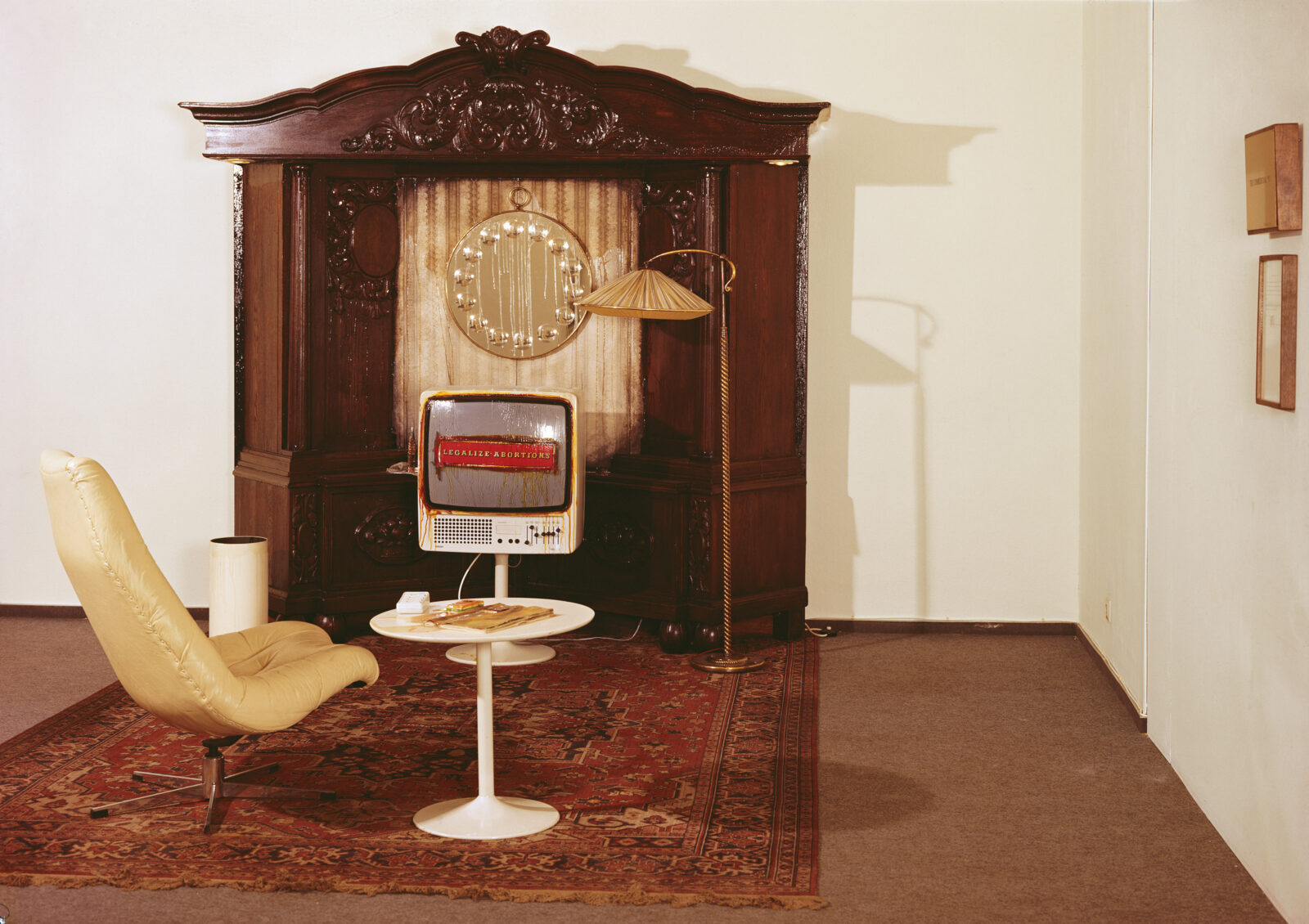
The ambiguous ethics of The Illegal Operation come into clearer view when considered alongside a second abortion tableau that Kienholz completed in the lead-up and immediate outcome of Roe v. Wade in January 1973, the same year he and Nancy moved to Idaho. Like The Illegal Operation a decade earlier,The Commercial #2 (1971–73) is a domestic scene that positions abortion and its criminalization at the collapsed intersection of public and private. Ed Kienholz initially created The Commercial #2 in 1965, as part of his Concept Tableau series of conceptual proposals. He executed the work in 1973, in the immediate lead up to and aftermath of Roe’s passing. Like its predecessor, The Illegal Operation, The Commercial #2 also frames the politics of abortion as a matter of contingent spectatorship: a question of not just who is watching, but when, how, and where. The tableau is staged within the archetypal Cold War interior of the middle-class living room and organized around the focal point of a television set, the exemplary postwar mass medium. Once again, Kienholz literalizes the breakdown of public and private experience as a violent confrontation, this time by streaking the TV monitor with a resinous, blood-like substance and intercepting its broadcast with an unusual “commercial”; in fact, a self-produced bright orange bumper sticker attached to the glass screen that bluntly demands: LEGALIZE ABORTIONS. When the television is switched on, the screen glows with blue static, uncannily illuminating the sticker’s slogan. Here, the television offers around-the-clock access to public discourse and consumer culture, like a portal to “the commercial” realm. Kienholz exploits its role as domesticated mass media to advertise his message, much in the way The Illegal Operation scrambles public and private experience to generate a visceral condemnation of moral hypocrisy.
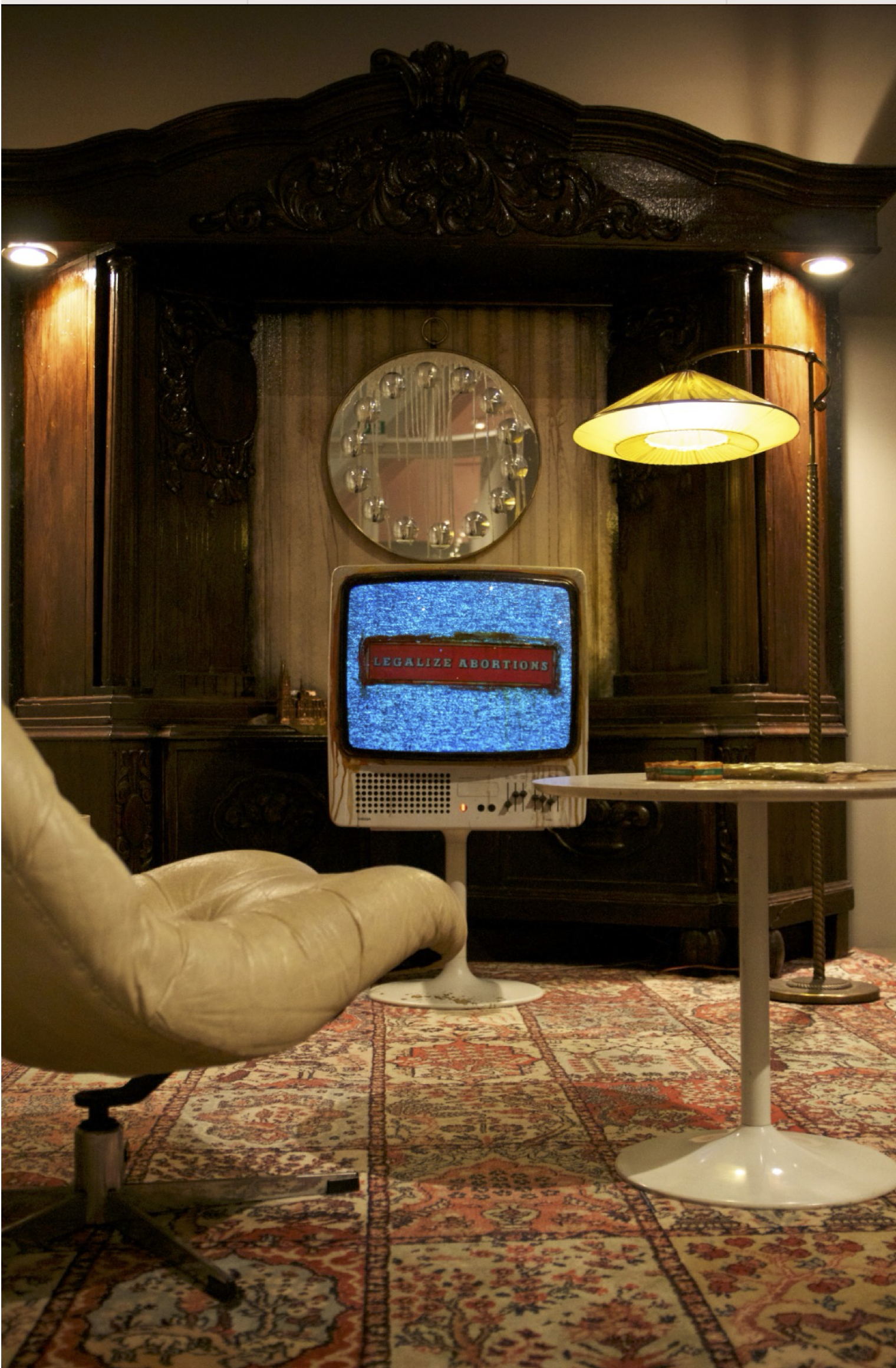
The Illegal Operation and The Commercial #2 both discursively reframe abortion, converting it from a “women’s issue” to a problem of representation and, specifically, a problem of representational politics in the public sphere. Situated historically from “before” to “after” Roe, the two works could be seen to function chiastically: whereas The Illegal Operation publicizes a private episode, distributing individual shame across the social field, The Commercial #2 domesticates the public debate, driving the debate home, into the living room. Neither work questions whether abortions will occur—its existence as a procedure is accepted as an inevitable fait accompli. Instead, the problem is one of whether and how abortion can be represented when it is proscribed both legally and culturally. In both cases, abortion figures as a kind of litmus test for postwar liberal consensus: a limit case for what is considered beyond the pale, what cannot be said or shown in a supposedly modern, advanced, liberal democracy. More subtly, both tableaux prompt a consideration of the tension between abortion access and abortion discourse—in other words, between the right to bodily autonomy and privacy versus the right to free speech, questions that continue to animate the abortion debate post-Roe.
While both tableaux confront the viewer with what can’t be shown and say what can’t be said in public, The Illegal Operation is far more gratuitous and outraged. This earlier tableau conveys a sense of fury and frustration that links the horror of the back-alley procedure to the moral stigma surrounding it, offering a stark reminder of the lingering climate of the McCarthyite 1950s and its interrelated modes of coerced conformity. Moreover, the work’s lingering suggestion that the eponymous operation was botched prompts a deeper consideration of whether individual responses to structural problems are doomed to fail. Kienholz, who hailed from a part of the country closely identified with radical forms of individualism, often in direct opposition to the state—libertarianism and separatism, survivalism and doomsday prepping—exposes the violent limits of self-reliance under the patriarchal state, a situation for which the only possible antidote is mutual aid.
Yet, in the wake of recent prohibitions on abortion-related speech in Idaho and elsewhere, we must question to what extent The Illegal Operation’s visual rhetoric of disgust—the brute materiality of its slitted sack and blood-soaked rags—could be interpreted as the “promotion” of (safe, legal) abortion access or, to the contrary, as a flat condemnation of abortion altogether—akin to the caricatured distortions circulated by anti-abortion activists. Does The Illegal Operation take aim at legality, morality, both, or neither? Likewise, a counter-reading of The Commercial #2 could regard it not as a literal endorsement of abortion but rather as an ironic critique of feminist pro-choice messaging, spun here as a crude extension of postwar consumerism and the cult of possessive individualism in the wake of the sexual revolution. In essence, both works are conceptually unstable, historically and culturally contingent, and ethically ambiguous—which only makes them more relevant today. Confronting rather than concluding, unsettling more than advocating, raising more questions than they claim to answer, Kienholz’s abortion tableaux demand to be critically discussed in ways that remain resistant if not utterly anathema to anti-democratic prohibitions on free speech.
In light of the criminalisation of abortion across the U.S., as well as the attendant gag orders, trigger laws, bans and censorship, Kienholz’s voyeuristic, self-implicating, and disorderly visual rhetoric proves infinitely troubling to a status quo bent on flattening if not purging all forms of criticality, dissent, and ambiguity from public discourse. By sublimating the fetishized spectacle of the pregnant body and placing it in dialectical tension with coordinated positions of patriarchal power—the state, the medical establishment, the mass media, and of course, the observer (whether politician, surgeon, husband, policeman, relative, impregnator)—Kienholz demonstrates that these figures are not passive bystanders, they are complicit in the violence on display. The enduring political stakes of his work reside in its complex and ambiguous entwining of public and private; its linking of the rhetorical and discursive to the material, physical, and affective; and its unflinching insistence on the blood and guts of lived, embodied experience despite complicity and contradiction. Kienholz was a provocateur, most certainly, but his insistence on confronting realities that are politely hidden from public view is an act of enraged solidarity that we should continue to learn from.
Like Kienholz, I had to leave the state of Idaho in order to do my work, and like him, that work has been ineluctably shaped by the censorship and repression it faced. Over the past two years, we’ve watched as classrooms, campuses, teachers and students across the United States, not only in Idaho, have been thrust onto the front lines of intersecting culture wars, and education has once again figured as a bellwether for fascism’s rising tide. Of course, abortion is not the only subject facing censorship—simply naming the legacies of slavery and settler colonialism, intersecting histories of struggle against oppression, the existence of LGBTQ+ people, and perhaps most virulently, Israel’s ongoing genocide in Gaza is to risk suppression, defunding, censorship, even prosecution. Kienholz’s work offers critical traction while navigating these discursive paradoxes. Beyond just showing abortion and the violent consequences of its criminalization, his tableaux muddle and destabilize the lines between public and private, victim and perpetrator, subject and viewer, individual and collective, artist and abortionist, even right and wrong, in favor of ethical ambivalence and historical contingency. By forcing us to look at what we would rather ignore, the work confronts us with our own complicity in state-sanctioned violence, so that the bloodshed and our role in it can never be sanitized—an enduring allegory for the stakes of art and education under fascism.
: :
Endnotes
- Kienholz frequently invoked his wife’s abortion, but never named her, perhaps in a half-hearted attempt at protecting her privacy. She was most likely Mary Lynch Kienholz, third wife and mother to their two children. My thanks to the team at LA Louver Gallery—Lisa Jann, Managing Director, and Lauren Graber, Head Archivist and Research Specialist—for relaying this information.
- See for instance, K.A. Cuordileone, Manhood and American Political Culture in the Cold War (Routledge, 2004); Cynthia Enloe, The Morning After: Sexual Politics at the End of the Cold War (University of California Press, 1993), Elaine Tyler May, Homeward Bound: American Families in the Cold War Era (New York: Basic Books, 1988).

Johanna Gosse