In 1972, Susan Sontag identified the seduction of “fascinating fascism” in American culture.1 Here, I look to the allure of the image of the fetus as fascinating fetalism. While “fetalism” is a medical term describing the persistence of fetal characteristics in the body after birth, here it persists in the body politic. Sontag’s description of the fascist seduction as a process of “purification” that transformed “sexual energy into ‘spiritual force’ for the benefit of the community” aligns with the values of the self-described pro-life movement in America.2 In contemporary political fetalism, the “fetus” has been held up as a salvific new life for religious pro-life campaigners, and as an unborn citizen and taxpayer for hard-headed politicians. Both constituencies wield political power. In 1994 Lauren Berlant scathingly observed that America, once “a nation made for adult citizens,” had become “one imagined for fetuses and children.”3 That imagining was re-imagined in 2022 by the Supreme Court, which overturned the Roe v. Wade precedent.
Today’s cultural infantilism and opportunistic political fetalism is satirically illuminated by the work of the “Lowbrow” or “Pop Surrealist” artist Mark Ryden, whose work makes nostalgia queasily absurd, as if the process of retrieving the past necessarily produces strange glitchy artefacts. Ryden’s work is ideally suited to illustrating features of fetalist rhetoric, particularly its evocation of a lost America of sound norms, moral values, and innocent pleasures, represented as a theme park toy store.
Ryden redeploys cherished images of American history as if they were misunderstood—“lowbrow”—Hallmark sentiments. While Ryden says with calculated disingenuity that he approaches “sentimentality, nostalgia and kitsch” without artworld irony,4 the work is a hive of irony, its cheery old-timey archaism framing its alarming effects as if they were unintended consequences. His polished oil painting technique, pleasingly archaic in itself, rustproofs the ironies. This nostalgic world is populated with wan White Jesuses, pop celebrities, Barbie dolls and suffusions of Barbie doll pink,5 Alice in Wonderland (she of exemplary naïveté and a conventional turn of mind nevertheless prone to hallucination), Abraham Lincoln (the historical model of statesmanlike virtue), and gleaming spreads of raw meat (that index of American affluence and manliness).6 Lincoln is like an odd player in a small-town patriotic pageant gone wrong. In The Grinder, for example, a painting in Ryden’s “Gay 90s”series (2010), Lincoln grinds bloody meat for a young girl at a café table: this is no ice-cream parlor. The disruptive title cues resurgent historical speculation about Lincoln’s sexuality, given the gay hookup app Grindr launched in 2009.7 Lincoln is a meat grinder where we might have expected an organ grinder, or perhaps a different kind of organ: this is “great man history” tragicomically beset by castration fear.
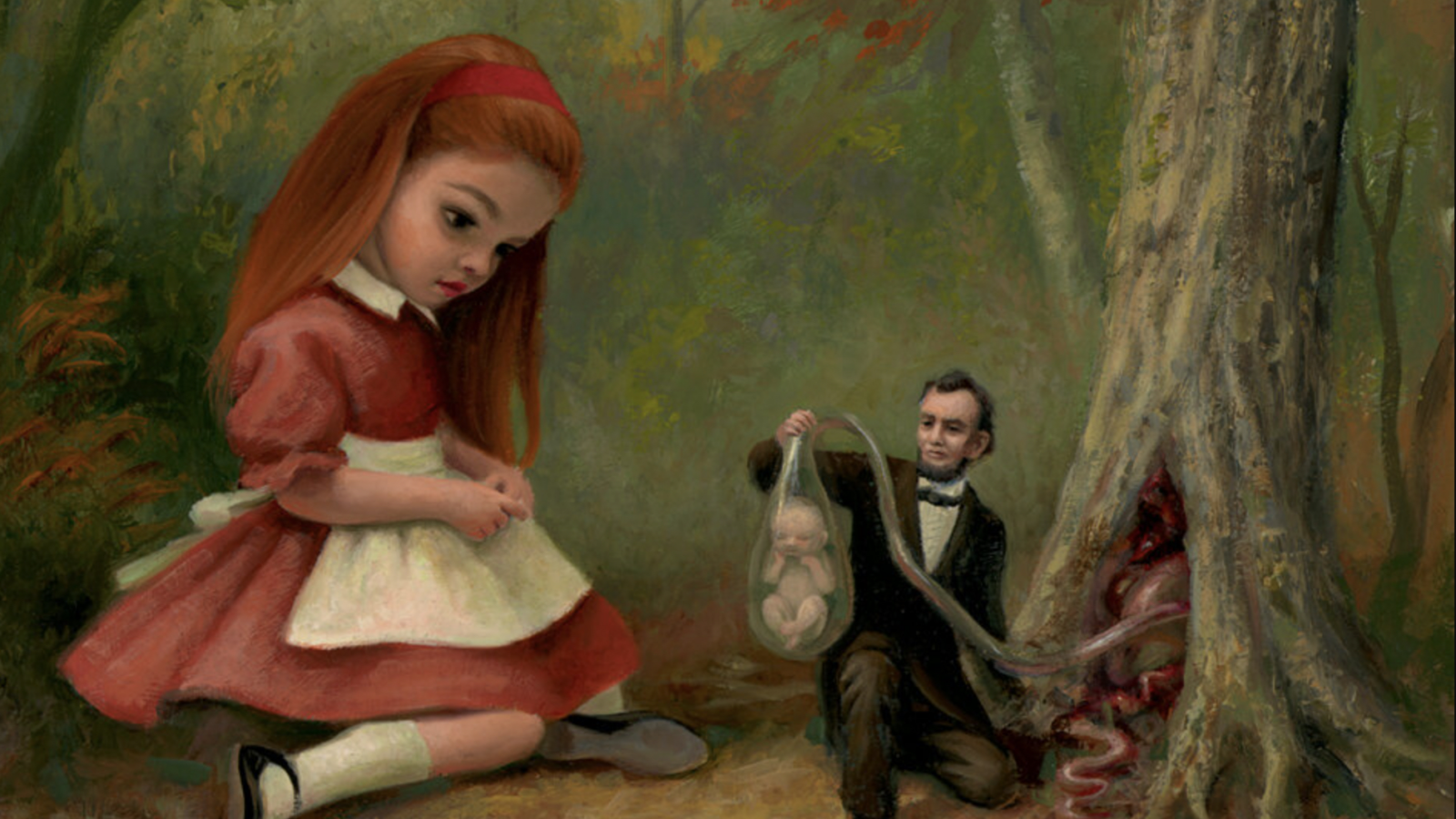
Rather than meat, in Fetal Trapping in Northern California (2006), Lincoln offers Alice a full-term fetus in its amniotic sac, pulled out of a hollow tree like a stillborn dryad (feature image, above). Alice in Wonderland is a saturated overdetermined personification of the “child,” whose perplexed innocence is deployed by Lewis Carroll to give an element of absurd disproportion to philosophical questions about the discontinuity of the self and instability of identity. Of course, the author might have substituted Alices for anyone else, just as he can make her, as a growing child, enormous or tiny. She is there to serve the narrative. As does Carroll, Ryden often inserts Alice as all-purpose naïf into perplexing situations.
Here Ryden’s Alice, like Carroll’s Alice, must confront a situation that she could not hitherto have imagined: the abortion debate. Abortion was a topic in the January 2006 Senate hearings on the appointment of Samuel Alito to the Supreme Court. Perhaps Lincoln’s gift evokes the pro-life movement’s deceptive use of several months-old babies to represent—to idealize the appearance of—late-term abortions.8 The situation is ambiguous: is this an allegory of Honest Abe as pro-life campaigner confronting Alice with a cautionary tale, or is he a backwoods abortionist? What historical imagining is at stake?
: :
Woman = Nation
In her 1994 essay, “America, Fat, the Fetus,” Berlant addressed the way the image of a pregnant woman was a reductive stereotype elevated to a “national category” in whom “nature” meets “nation” to gestate culture.9 Today she takes the form of the “tradwife,” breeding against that right-wing bugbear, the plummeting birthrate.10 In 2002, the Joint Economic Committee of the Republican Party released a study expressing their instrumental concern: since abortion depletes the future labour force, who will pay for the elder generation’s Social Security and Medicare?11 (Darker questions suggest themselves: who will “man” the military-industrial and prison-industrial complexes?) The fetus then is an economic unit in some fiat economy of flesh. It can be mustered as an emblematic protector of the American body politic against immigrants characterized as criminalized bogeymen who take away American jobs. The current right-wing template “Project 2025” would address that “replacement” fear by banning abortion and restricting access to contraception, relegating woman-as-child-bearer to the home. In such narratives—what Berlant called the “fetal imperative”—the personhood of the fetus takes priority over the woman’s.12 This was borne out in 2007 Supreme Court opinion that “the State’s interest in promoting respect for human life at all stages in the pregnancy” could outweigh concern for the woman’s health.
: :
Seeing the Fetus
In Ryden’s painting, Lincoln’s gesture is unclear: is he acting in his capacity as lawyer, holding up the fetus as evidence of national moral decline since Roe v. Wade? Is he a stand-in for the Supreme Court originalist Samuel Alito, whose argument in the Dobbs v. Johnson decision was that since abortion wasn’t a constitutional right in 1868 it couldn’t be one now? Is Lincoln cuing Alice to the heated talking points: when does life or selfhood or “ensoulment” begin? Should the viability of a fetus be taken into account? And, here, why must Alice be shown the fetus at all?
Whether “gory dead” or “dreamlike space-floating,” anti-abortion campaigns assume that the image of the fetus is in itself effective messaging.13 In the 1970s, ultrasound technology enabled the fetus to be seen in utero.14 By early 2023, twenty-seven American states required abortion providers to make an ultrasound available to the abortion seeker, and six states required the provider to show and describe the alien foggy image which is often indecipherable to the client: pointing out features such as heart, limbs, and sometimes the sex.15 In reality, such visual imaging has little effect on a woman’s decision.16 The ambiguity of Ryden’s Alice’s gaze may be an index of the dilemma of being made to look: is it directed at the fetus, or averted? Ryden’s fetus may also raise a racialized fear that has brought the extreme Christian pro-life movement into alliance with the Ku Klux Klan and neo-Nazis to promote meretricious arguments: the Fourteenth Amendment is cited to justify abortions in the case of Black women but to deem them murder in the case of White women.17 Perhaps Alice is being shown evidence of a pro-life dream of normative normcore whiteness incarnate.
Views of “life before birth” were first promised in the mid 1960s by Lennart Nilsson’s famous photographs of eighteen and twenty-week fetuses on the covers of LIFE Magazine (1965) and Paris Match (1966). It was a false promise, since Nilsson’s subjects were the product of ectopic pregnancies, miscarriages, and abortions, floating in preservative chemicals rather than amniotic fluid. Nilsson posed his subjects for sentimental effect: putting a thumb in the mouth as if the fetus were practising suckling. That separation of the fetus from any maternal body made the fetus a somehow autonomous being,18 so that, as Berlant pointed out, an “entire culture” was enabled to identify “with, and as, a fetus.”19 Yet that very identification induces anxiety in a certain subset of man, who feels that in order to save his own personhood he must rescue the fetal personhood with whom he identifies.
Enter, then, the white male rescuer. In 1983, the paleo-conservative Christian pop star Pat Boone made an anti-abortion video, a hodgepodge montage of stock footage of ultrasounds, gambolling babies, and meadows, with children’s voices singing “let me live.” In his voice-over, Boone recounts his dream of “thousands maybe millions” of singing unborn children, pleading for their life “from their mothers’ wombs.” Boone’s chorus finds a direct riposte in Nick Cave’s music video for Ryden’s Gay 90s project, which features Cave singing a sinister version of the song “Daisy Bell (A Bicycle Built for Two).” While “Daisy Bell” evokes a simpler wholesome past, Cave’s doleful delivery undoes the ice-cream truck tinkle of the tune. Cave’s version is shadowed by its uncanny predecessors: the first computer-simulated voice on an IBM 7094 computer (1961) and the dying computer HAL in 2001: A Space Odyssey (1968). In Cave’s video, ashen, blood-tinged, sharp-toothed, early term fetuses float in isolated containers in outer space darkness, the demonic double of 2001’s “Starchild.” Identical, they might be those cloned monstrosities produced by the “unnatural” science of pro-life imagination.20 Certainly, they are far from Boone’s choir of pretty babies. Far from being autonomous, the fetus only gets voiceover, not voice.
: :
Into the Woods
To return to Fetal Trapping in Northern California: Lauren Berlant’s 1991 essay about an episode of The Simpsons brings together Lincoln, trees, and hallucination in apposite ways. In “Mr. Lisa goes to Washington,” Lisa Simpson writes a prize-winning essay on America imagined as a forest, in terms that chime with pro-life fetal pathos: the “powerful nation” of “mighty oaks,” grows from “tiny saplings,” “so fragile, so pure,” “trembling towards the sun.”21 Lisa’s naïve vision is shattered on a trip to Washington, where she witnesses a corrupt congressman taking money from a logging industry lobbyist. Devastated, she seeks the guidance of “Honest Abe” at the Lincoln Memorial, but her voice is drowned out by a “cacophony of national-popular need.”22 In this context, I propose that Ryden’s painting works as a variation on what Berlant calls Lisa’s “infantile” allegory.23
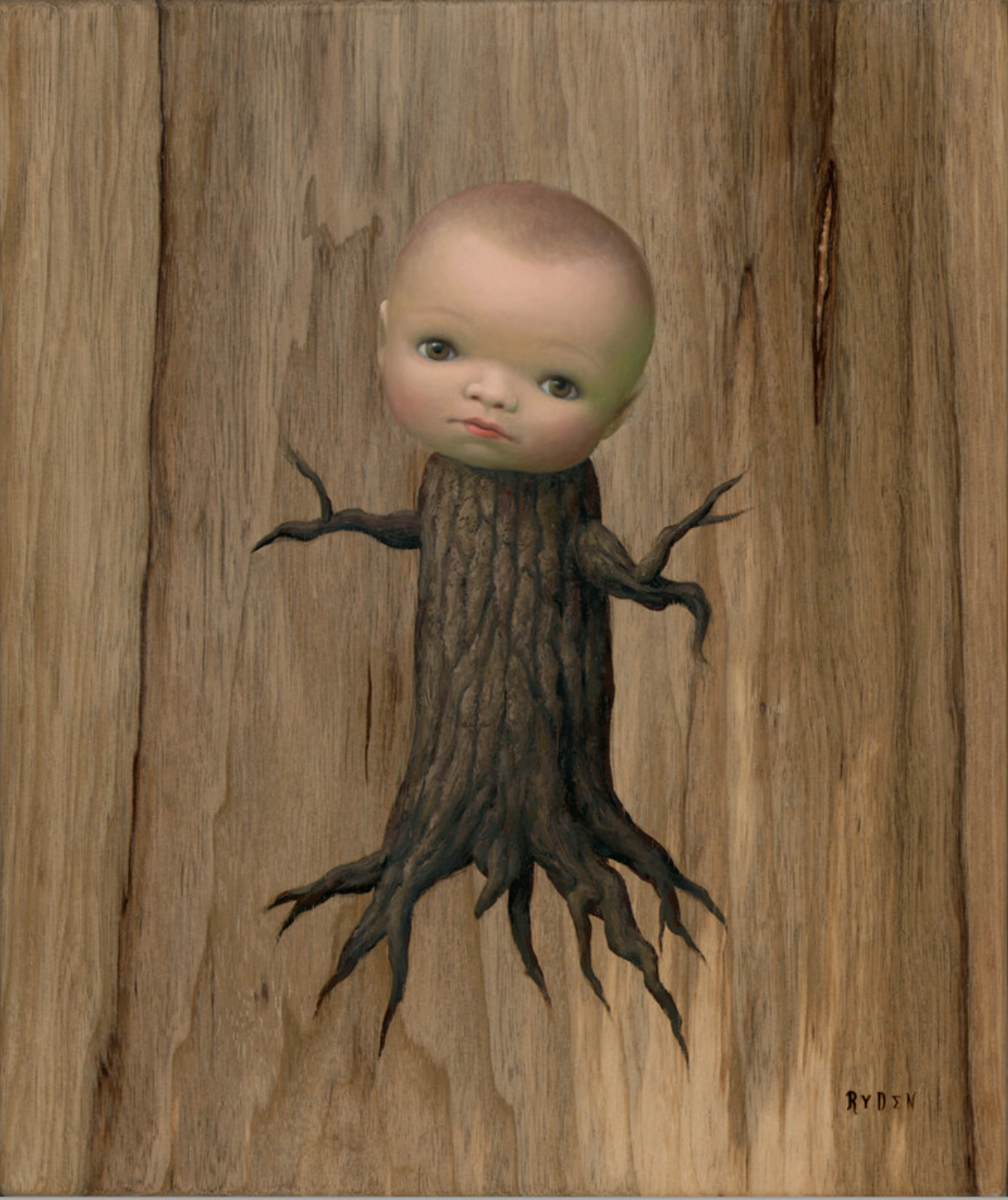
Fetal Trapping was one of Ryden’s series of paintings, “Tree Show,” which had been prompted by the Bush presidency’s permission to log the giant Sequoia National Forest: a triumph of lobbyism. Another Tree Show painting, Stump Baby (2006), a tree stump with a human baby’s head, could emblematize both Lisa Simpson’s endangered early-term forest and the “pro-life” movement’s enduring fear that “unnatural” reproduction technologies (in-vitro fertilization) and genetic engineering will create monsters (figure 2).24
In her novel Oryx and Krake (2003), Margaret Atwood envisioned a near future of industrial scale cross-species genetic engineering, producing human-animal hybrids for purposes of organ harvesting. So much more “sensible,” it is explained with soothing irony, than having a “for-harvest child” “stashed away in some illegal baby orchard.”25 Perhaps Ryden’s endangered forest harbours just such a rogue operation. Ryden describes woman as the “divine feminine” who sees “the earth and all its inhabitants as entities to be revered and cared for” and recognizes “individual human beings as more important than . . . capitalism and competition.” And yet his images perplex any such stereotypes.26
In 1994, Berlant described anti-abortion imagery as an American “political fantasy at the end of history.”27 In alluding to Francis Fukuyama’s “end of history,” a neoliberal fantasy of America as the realized state of universal satisfaction that Hegel had once envisioned, Berlant warned against any such “overidentification” with “national icons.”28 Ryden’s work, however, does just that. He has produced a history painting for our times, for an America become Americana, for monuments become souvenirs.
: :
Endnotes
- Susan Sontag, “Fascinating Fascism,” in Under the Sign of Saturn (Vintage, 1981), 93.
- Sontag, “Fascinating Fascism,” 93.
- Lauren Berlant, The Queen of America Goes to Washington City: Essays on Sex and Citizenship (Duke University Press, 1997), 12.
- Dina Gachman, “Sincerely, Mark Ryden,” Interview Magazine, May 2, 2014.
- Ryden and Mattel Corporation produced a “Barbie Capsule Collection” in 2022.
- Matthew B. Ruby, and Steven J. Heine, “Meat, Morals, and Masculinity,” Appetite 56, no. 2 (2011): 447–50.
- Detailed by C.A. Tripp, The Intimate World of Abraham Lincoln (Free Press, 2005).
- Barbara Duden, “The Fetus on the ‘Farther Shore’: Toward a History of the Unborn,“ in Fetal Subjects, Feminist Positions, ed. Lynn M. Morgan and Meredith Wilson Michaels (University of Pennsylvania Press, 2016), 21.
- Berlant, Queen of America, 87.
- Nancy Foner, One Quarter of the Nation (Princeton University Press, 2022), 162–3.
- Loïc Wacquant, “Class, Race & Hyperincarceration in Revanchist America,” Daedalus 139, no. 3 (2010): 74–90.
- Meredith W. Michaels and Lynn M. Morgan, eds. Fetal Subjects, Feminist Positions (University of Pennsylvania Press, 2016), 1.
- Rosalind Pollack Petchesky, “Fetal Images: The Power of Visual Culture in the Politics of Reproduction,” Feminist Studies 13, no. 2 (1987), 263; J. L. Fischer, and Y. Ville, “Fetal Facebook: Historical Representations of the Fetus between Art and Science,” Ultrasound in Obstetrics & Gynecology 33, no. 1 (2009), 1–4.
- Malcolm Nicolson and John E. E., Fleming, Imaging and Imagining the Fetus: The Development of Obstetric Ultrasound (Johns Hopkins University Press, 2013).
- Clair Wills, “Quickening, or How to Plot an Abortion,” LRB 45, no. 6 (16 March 2023), 22. This data may have changed since the Supreme Court’s striking down of Roe v. Wade in June 2023; see https://www.guttmacher.org/state-policy/explore/requirements-ultrasound.
- U. D. Upadhyay, K. Kimport, E.K.O Belusa, N.E. Johns, D. W. Laube, and S.C.M. Roberts, “Evaluating the Impact of a Mandatory Pre-abortion Ultrasound Viewing Law: A Mixed Methods Study,” PLoS One 12, no. 7, July 26, 2017.
- Carol Mason, “Minority Unborn,” in Fetal Subjects, Feminist Positions, Carol Mason, Lynn M. Morgan, Meredith Wilson Michaels, eds. (University of Pennsylvania Press, 2016), 164–6.
- Petchesky, “Fetal Images,” 268.
- Lauren Berlant, Queen of America, 88; Petchesky, “Fetal Images,” 278.
- Ryden delights in unnatural methods: a baby delivered by Cesarean section from Lincoln’s head (Birth of Venus, 1998) or from a parsnip (The Birth 1994).
- Season 3, Episode 2, of The Simpsons, “Mr. Lisa Goes to Washington,” originally broadcast on Fox (US), September 26, 1991; Berlant, Queen of America, 41.
- Berlant, Queen of America, 56.
- Berlant, Queen of America, 42.
- IVF is abhorred as it wastes fertilized embryos; see Institute of Medicine, Science and Babies: Private Decisions, Public Dilemmas (The National Academies Press, 1990).
- Margaret Atwood, Oryx and Crake (McClelland and Stewart, 2003), 23.
- Berlant, Queen of America, 99; Dina Gachman, “Sincerely, Mark Ryden,” Interview Magazine, May 2, 2014.
- Francis Fukuyama,The End of History and the Last Man (Free Press, 1992).
- Berlant, Queen of America, 62.

Elizabeth Legge