In Audre Lorde’s famous construction, the master’s house must be dismantled by a different form of signifying. Those without access to power—to master discourse, whether because of race, gender, sexuality, economic status, nationality, religion, or other forms of identity that those with power seek to exclude—use code. This is as familiar to parents as it is to abortion activists, but what is sometimes less visible about code switching is its embedded aesthetic appeal. Counter-hegemonic communication requires the ability to get attention—to entrance—but only for the right audience. To the master, codes must slide by unnoticed. To the collaborator, they must hit the mark. In this way, codes not only signal directions of counterdiscourse but also define in-groups and out-groups, those whom the message is for and those we hope might say, in the tagline the android “hosts” of Westworld are programmed to use when confronted by evidence that threatens their limited view of reality, It doesn’t look like anything to me.
In a similar fashion, abortifacients— plants used to manage reproduction in networks outside of conventional patriarchal settings—can fly under the radar of structured medical practice.1 Passed between collaborators quietly, plant knowledge was functional resistance to patriarchal consolidations of medical expertise, empowering women to take back autonomy. Abortifacient knowledge can be passed quietly between people who need it. Like codes more generally, abortifacients need to look and feel at once like nothing—something entirely ordinary and unremarkable—and like something: something, that is, with the power to effectuate change. Thus abortifacients can often be beautiful, aesthetically compelling. This is an essay about that beauty and about the coded resistance it has provided feminist communities.
To set a framework for our journey through time to demonstrate that the aesthetics of abortifacients and the codes around them have always been with us, whether we have chosen to see them or not, we begin with Toni Morrison as theorist and novelist, though we will eventually turn from her work toward the ancient past. In the first line of her very first novel, 1970’s The Bluest Eye, Morrison coined a phrase and a concept that has reverberated through the decades: “Quiet as it’s kept, there were no marigolds in the fall of 1941.”2 This sentence consists of two parts—a cultural expression or “saying” and a fictionalized historical fact about marigolds, the second of which we’ll return to later in this essay. The cultural expression “Quiet as it’s kept,” in its capture of the secret that is nevertheless “kept”—meaning transmitted, albeit carefully, in community—has gone on to become the title of contemporary books and exhibitions as well as a catchphrase for understanding the relationship of Blackness and American history.3 In other words, it went viral before going viral was a thing.
Morrison subsequently described this opening line in her lecture “Unspeakable Things Unspoken: The Afro-American Presence in American Literature,” framing it as an utterance made by Black women that she herself picked up in childhood and understood to signal a paradox: “It is a secret between us and a secret that is being kept from us. The conspiracy is both held and withheld, exposed and sustained.”4 This description highlights the nuances of in-grouping and knowledge-sharing: such practices offer information that marks community, yet the fact that such information is only somewhat accessible protects it from interception by a wider audience. “What, then, is the Big Secret to be shared?” Morrison asks. “A botanical aberration,” she answers.5 What she is referring to here directly contrasts the book’s structure, which, divided into four sections, Autumn, Winter, Spring, and Summer, would seem to highlight seasonality, life cycles, and generativity—all that is cyclical and regular in nature. Morrison instead draws our attention to the aberration in these cycles, temporal rifts created by violence.
The second part of Morrison’s opening line—“there were no marigolds in the fall of 1941”—then points to a deep and structuring absence intimately related to a specific moment in history at the birth of the Civil Rights movement, making “quiet as its kept” refer, at least in part, to the burden placed on Black bodies throughout America’s gestation, birth, and growth.
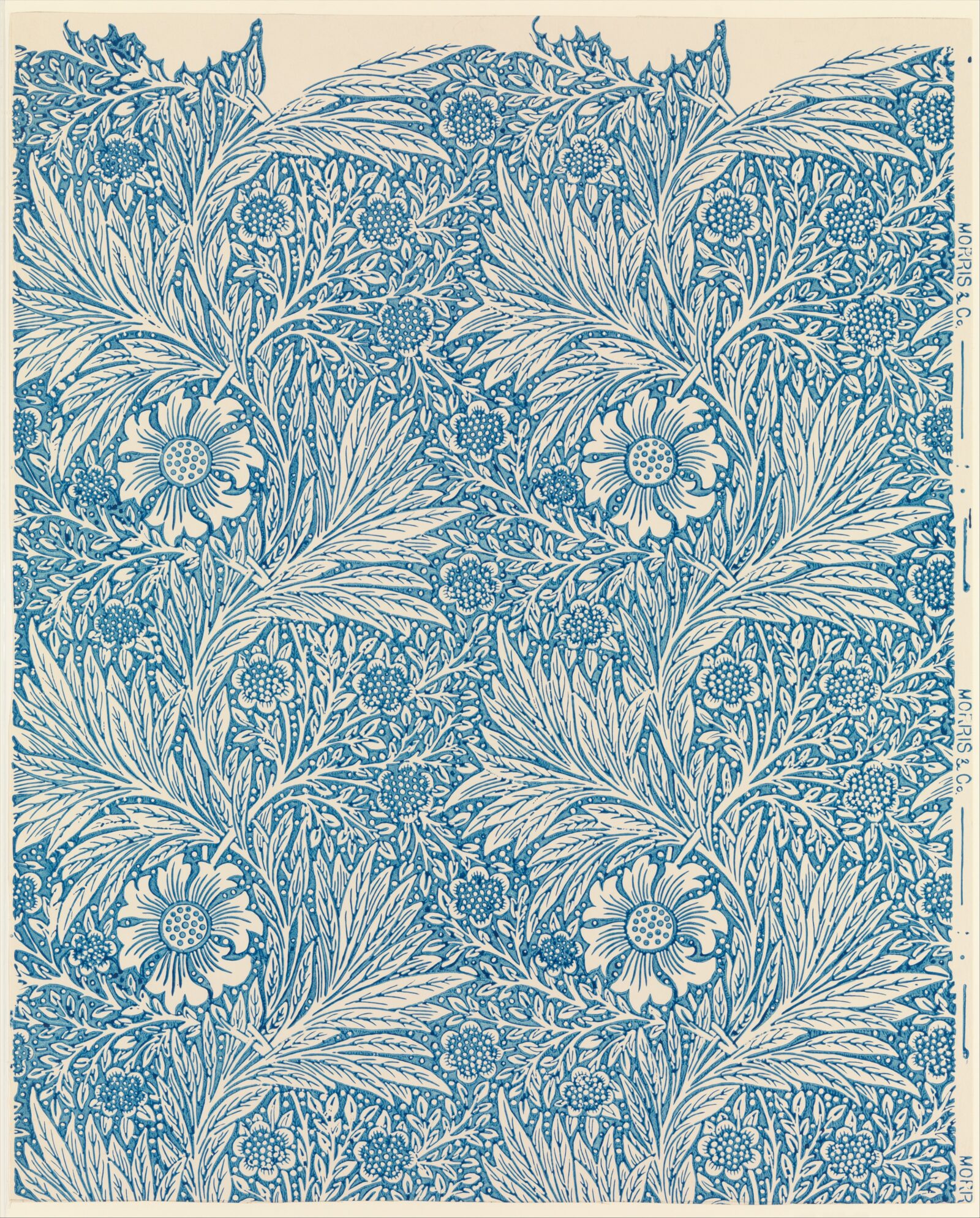
Yet that this absence is of marigolds also points to something else. As you may have already guessed, marigolds are medicinal and can be used to manage menstrual pains and to abort a pregnancy, among other uses. Their lack in the opening of The Bluest Eye parallels its protagonist Pecola’s lack of options, following her rape and subsequent pregnancy, for reproductive care of any kind, including but not limited to the right to decide not to continue to be pregnant. But only a reader in the know, a reader watching for codes, would pick up on this insight. Absent for Pecola, their presence on the page draws the reader’s attention and curiosity.
The Bluest Eye is as interested in folk remedies and medicinal plants as it is in reproduction in general and menstruation, gestation, and delivery in particular—and abortion lurks just under the surface of this overall discourse about the body in its health and wellness. To briefly list a few examples: Pecola’s surname is Breedlove (!); Claudia, the narrator, explains her revulsion with dolls by sharing that “I had no interest in babies or the concept of motherhood. I was interested only in humans my own age and size, and could not generate any enthusiasm at the prospect of being a mother” (25); a key scene in the novel depicts Pecola’s first period; after a moment of horrific harassment (identified as rape by Morrison6) from gun-wielding white men who spy on him as he loses his virginity, Cholly, Pecola’s father, calls his desires “aborted”(153); M’Dear, a “competent midwife and decisive diagnostician” who lives in the woods provides humane medical care to the book’s characters (140); in contrast, when Pauline, Pecola’s mom, delivers Pecola at a traditional hospital, she experiences horrific racism at the hands of white doctors who deny her pain and even her humanity (“They deliver right away and with no pain. Just like horses,” one doctor says to the other, referring to Pauline’s blackness [140]). And rooted through all of these references are the plants overflowing the novel: marigolds, forsythia, crocus, sunflower, dandelions, and asafetida have all been used as abortifacients and emmenagogues (substances to stimulate menstruation) in different periods and contexts (along with their other medicinal uses). Morrison thus decorates her novel with medicinal plants that people who might not be able to trust doctors could share amongst themselves. Not only describing this plant life as bordering both domestic and public green spaces but also personifying flowers as potential life seeking to grow—“Right before the entrance to the park was the large white house with the wheelbarrow full of flowers. Short crocus blades sheathed the purple-and-white hearts that so wished to be first they endured the chill and rain of early spring” (120)—the novel constructs the larger context of folk remedies, midwifery, and plant-based medicine as central to a characterization of Black communities.
By the end of the tale, Pecola’s chosen siblings—Claudia, our narrator, and her older sister, Frieda, both children themselves—become the only characters who seem to offer her genuine support. Trading their meager savings for marigold seeds they hope will offer good tidings for the baby’s survival, they nonetheless are unable to get the flowers to bloom, a parallel to Pecola’s gestation, which ends in premature birth and the death of her baby. At first, Claudia believes all of this is her fault, but later, reflecting back, she understands the harm the larger structures they live within have wreaked, taking accountability off her own shoulders and asking the reader to consider placing it on theirs: “I talk about how…it was the fault of the earth, the land, of our town…the land of the entire country was hostile to marigolds that year… and when the land kills of its own volition, we acquiesce and say the victim had no right to live” (234). Identifying these structures means showing the consequences of their violence (“it’s much, much, much too late” is the final line of the novel [234]), but embedded in even this desolation is a recipe for self-sufficiency and possibly even hope. Eyes on the marigolds, Morrison may be suggesting to us in her devastatingly gorgeous prose. Psst, pass it on.
These strategies—the aestheticization of codes, the transmission of underground information to suggest forms of freedom, the dissemination of plant knowledge to empower women to gain agency around their reproductive health—are not new. They date back to antiquity. For instance, in the late 7th c. BCE, Greek-speaking colonizers, who settled in the North African territory of what is now the modern nation-state of Libya and built up a city that bears the Greek name Kyrene (latinized as Cyrene), struck silver coins with an image of a silphium stalk—the city’s primary commodity—on the reverse. Growing, harvesting, and trading the plant, which offered manifold remedies, had filled Cyrene’s coffers and established its fame. According to ancient writers, silphium, like Morrison’s medicinal plants, could be applied as a remedy (pharmakon) to treat everything from alopecia, colds, and mange to jaundice, pain, and warts. It was also used as a contraceptive and abortifacient (on these applications see Theophrastus, the Hippocratic Corpus, Pliny the Elder, Dioscruides, and Soranus). At the same time, several ancient Greek plays performed for large civic audiences recount the role of elite women in bearing progeny to uphold the state—from Praxithea’s speech in Euripides’ Erechtheus about coming to terms with her children belonging, ultimately, to the city of Athens to Elektra’s emphasis on women’s value resting solely on their capacity to bear children. At minimum, these passages point to patriarchal state control of women’s bodies and their reproductive and maternal choices. We can thus infer that women sought quiet means by which to circumvent such restrictions. Circulating widely and used for a variety of ailments, silphium offered just such a means. And that the image of silphium also circulated widely on coins is especially important.
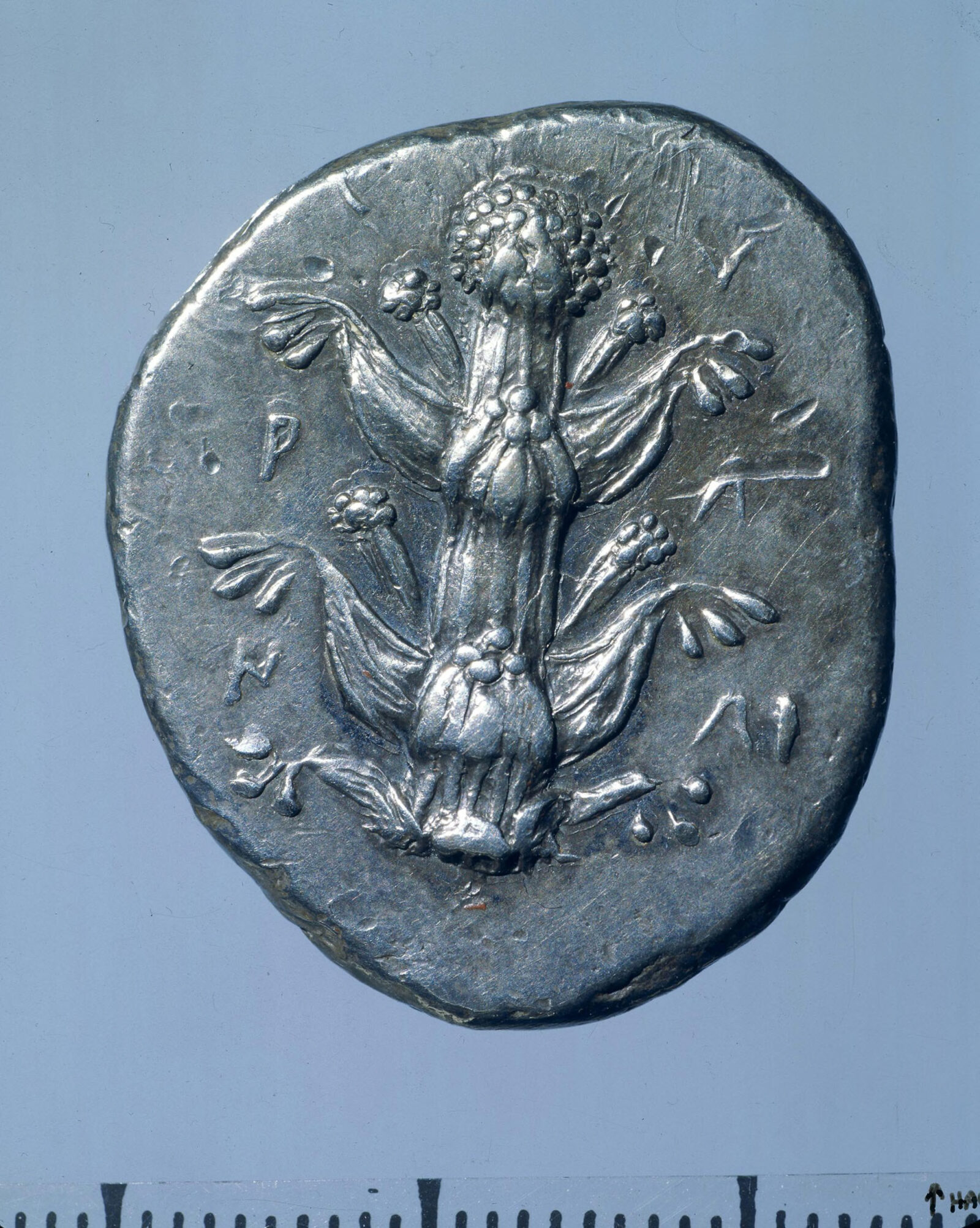
These coins served economic, aesthetic, and informational purposes—as wide-traveling currency, as a serialized depiction of the plant recording its constituent parts, and as a testimony to the wide-ranging healing capacities of those different plant parts. Acting as code that was disseminated broadly and below the radar, these bright, shiny, tangible objects of value looked good while doing this critical work. Traversing its diameter, tiers of leaves and flowers peel away from a single stalk to fill the coin’s area. Struck into the silver, the die mark emphasizes the plant’s complex texture—rows of twisting, three-pronged leaves and clumps of round flowers reach out from a thick, fluted stalk. Holding this coin would not only emphasize the weight of its metal, but also the grooves and curves of its image under fingertips, so that one might come to know about silphium through sight and touch. Gathering a handful of such coins multiplies these plant images, approximating dosage by grouping coins. And as these sensorially stimulating objects moved across the wider Mediterranean and its contact cultures, they brought many different people into contact with images of the silphium plant. As with marigold, nothing about the plant’s name or image belies its specific uses, so the coin expands knowledge of silphium across a broad population while keeping specific knowledge of its use quiet.
Just as ancient authors wrote about silphium’s applications and history, so did early modern authors writing in Italian, French, German, and Dutch in the sixteenth-eighteenth centuries. They both looked back to Greek and Latin references and situated silphium within the globalizing early modern world, analyzing silphium’s history and possible disappearance as a lens through which to explore practical and philosophical implications of possible species extinction as well as the contrast between knowledge gleaned from reading and that from observing the natural world. The plant’s disappearance seems to have marked, for some, the equally disappeared empirical fortunes of Cyrene—just as a species might come and go, so might an empire. While the loss of silphium removed one possibility for herbal reproductive management that had long been available to women, its disappearance also emphasizes the inherent weakness of even powerful empires, a reassuring idea to those seeking to live outside of imperial control. On the one hand, silphium’s markets were largely controlled by empires; on the other, its widespread circulation enabled the plant to reach individuals who could use it to act on their own bodies.
By marking Cyrenaian coins with images of silphium, artists mobilized a state commodity to circumvent state regulation of women’s bodies, circulating knowledge of the plant and its capacity for reproductive management. The aesthetics of these coins no doubt also played a role in their widespread dissemination, so that today in the absence of the silphium plant itself, we retain knowledge of it through these images. Seeking freedom even within repression, artists, writers, activists and organizers continue, quietly yet fiercely, in this tradition today. And in 2026, quiet as it’s kept, there are marigolds.
: :
Endnotes
- For example, scholars including Jennifer L. Morgan and Londa Schiebinger have suggested that, as a form of resistance within bondage, enslaved communities likely turned to plant-based contraceptives and abortifacients to address a spectrum of reproductive management needs, though such practices often elude archival certainty. Morgan speculates that enslaved people in the Americas had access to abortifacients and were likely practicing reproductive control as a form of refusal, though Morgan also highlights the complexity of fully tracing this possibility. Using the framework of agnotology—the study of what is deliberatively left out of the archive—Schiebinger suggests that gaps around abortifacients may, to some degree, be intentional, themselves a form of proof—“not merely the absence of knowledge but an outcome of cultural and political struggle.” We see modeled in the sharing of plant-knowledge among Indigenous and enslaved Americans in the early modern period modes of collective resistance that offer alternative pathways to that of federal or state-granted permissions. See Jennifer L. Morgan, Laboring Women: Reproduction and Gender in New World (University of Pennsylvania Press, 2004) and Londa Schiebinger, “Agnotology and Exotic Abortifacients: The Cultural Production of Ignorance in the Eighteenth-Century Atlantic World,” Proceedings of the American Philosophical Society 149, no. 3 (2005): 320.
- Toni Morrison, The Bluest Eye (Plume/Vintage, 2005), 12. Hereafter cited parenthetically in the body of this essay.
- Though the phrase was used as a title before Morrison popularized it (for example, for a Max Roach album recorded in 1959), Morrison’s use was certainly the genesis of many 21st century borrowings, including by J. Brooks Bouson, who used it as a title for a book on Morison (Quiet as It’s Kept: Shame, Trauma, and Race in the Novels of Toni Morrison); the 2022 Whitney Biennial, which was titled “Quiet as It’s Kept” and described as offering “dynamic works [that] reflect the challenges, complexities, and possibilities of the American experience today”; and Ja’Tovia M. Gary, who uses the title for her 2023 short film “response” to The Bluest Eye.
- Toni Morrison, “Unspeakable Things Unspoken: The Afro-American Presence in American Literature,” Michigan Quarterly Review 28 (January 1989): 20.
- Morrison, “Unspeakable Things,” 21.
- Morrison, “Unspeakable Things,” 23.

Leila Easa
Jennifer Stager