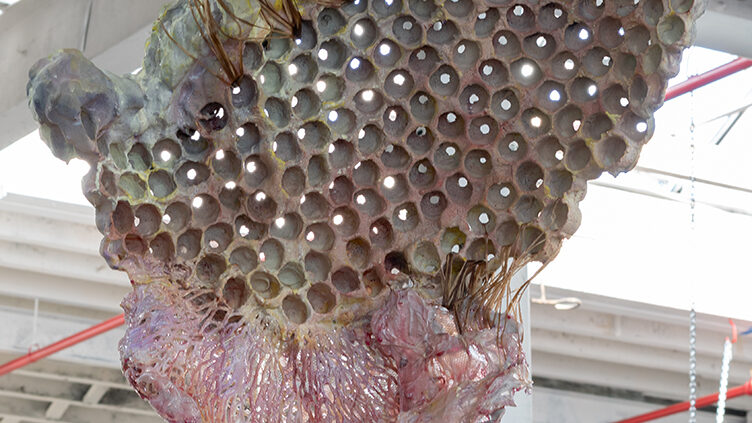
It is hard to describe abortion as a form of sexual freedom. Writing of art and abortion in 2009, when abortion was still legal across the country, Jennifer Doyle expressed this difficulty with eloquence. Abortion stories are “aggressively silenced,” especially those, as Doyle wrote, in which abortion is narrated as a form of freedom, of “sexual entitlement.”1 Because abortion has long been defined as a criminal act, there persist engrained limits to its representation and to the affects that may accompany such representations. Since Roe v. Wade was overturned in 2022, these limits have been made more acute, reinforced with recourse to the same legal history that the 1973 decision sought to reinterpret. It is a vicious cycle. Historically understood to be illicit, abortion continues to be difficult to integrate into what Doyle calls “a story about sexuality, desire, and the body.”2 To put this another way, there remains today the need to find forms for the licit history of abortion.
In two current series of sculptural work by Lydia Nobles, I see an artistic practice that does just this. As I Sit Waiting (ongoing since 2019) pairs interviews and sculptures to tell abortion stories. Pleasure Trophies (initiated in 2022) emphatically links sexuality and freedom. Together, the series indicate an often-obfuscated historical intertwinement: that of the criminalization of abortion and the criminalization of non-procreative sex. Through their visual language and eccentric materiality, Nobles’s sculptures recall the form of legalized violence historically authorized to seek out and punish these crimes—the witch hunt.
Nobles began working on As I Sit Waiting in 2019, when twenty-six plaintiff states, municipalities, providers, and advocacy groups including Planned Parenthood successfully challenged the first Trump administration’s proposed “Conscience Rule.” At the time, Nobles wanted to honor the outcome with twenty-six sculptures. Had it been upheld, the rule would have allowed healthcare providers—from nurses and doctors to insurance companies—to refuse to provide care, including contraception and abortion, on religious and moral grounds. Much has changed since then. The US Supreme Court’s Dobbs decision overturned Roe v. Wade in June 2022. Trump was reelected in 2024. Today, to seek obstetric care in the U.S. is riskier than ever, and has been fatal for many women, especially in the twelve states that ban abortion outright and in those that have bans based on the “viability” of a fetus.
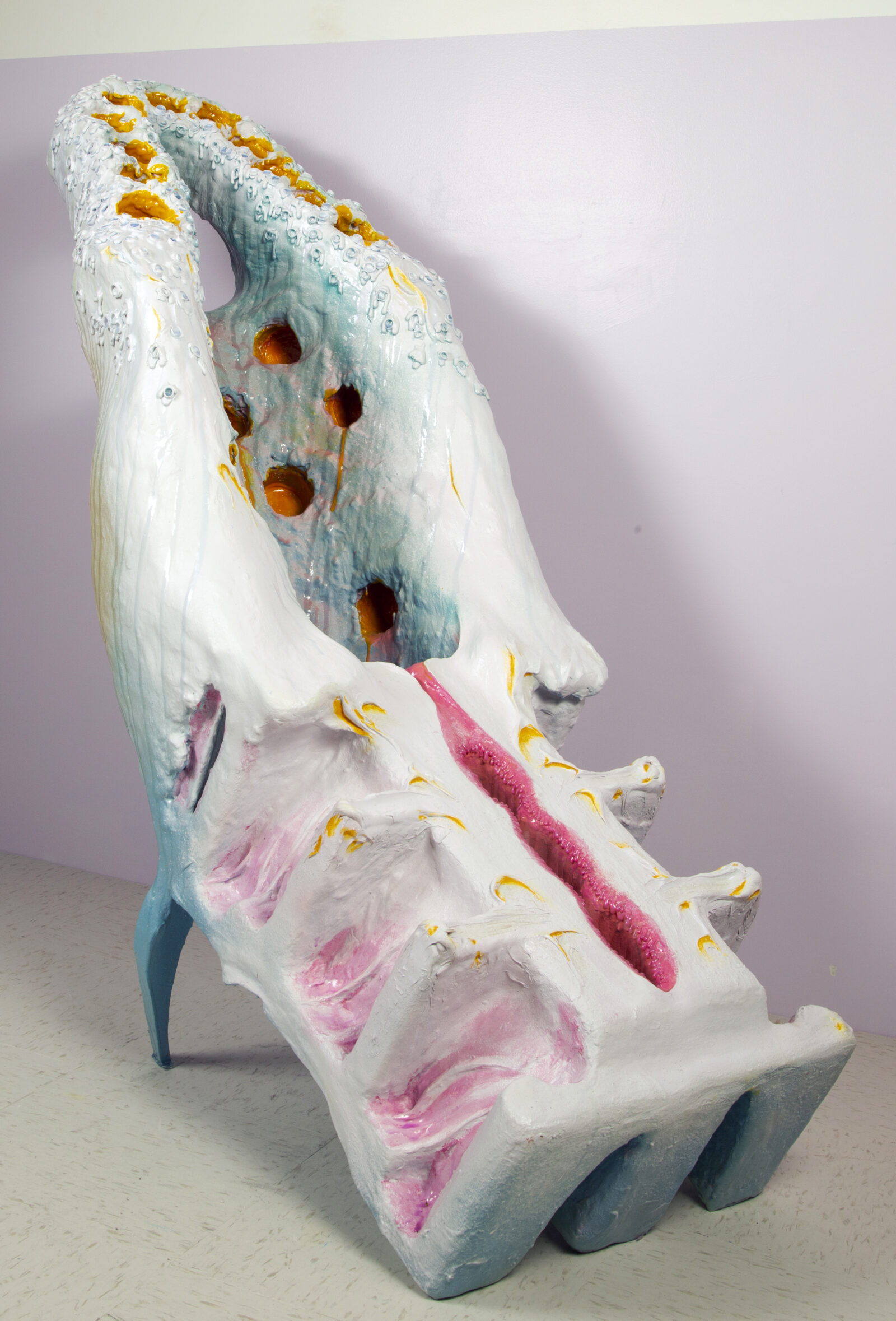
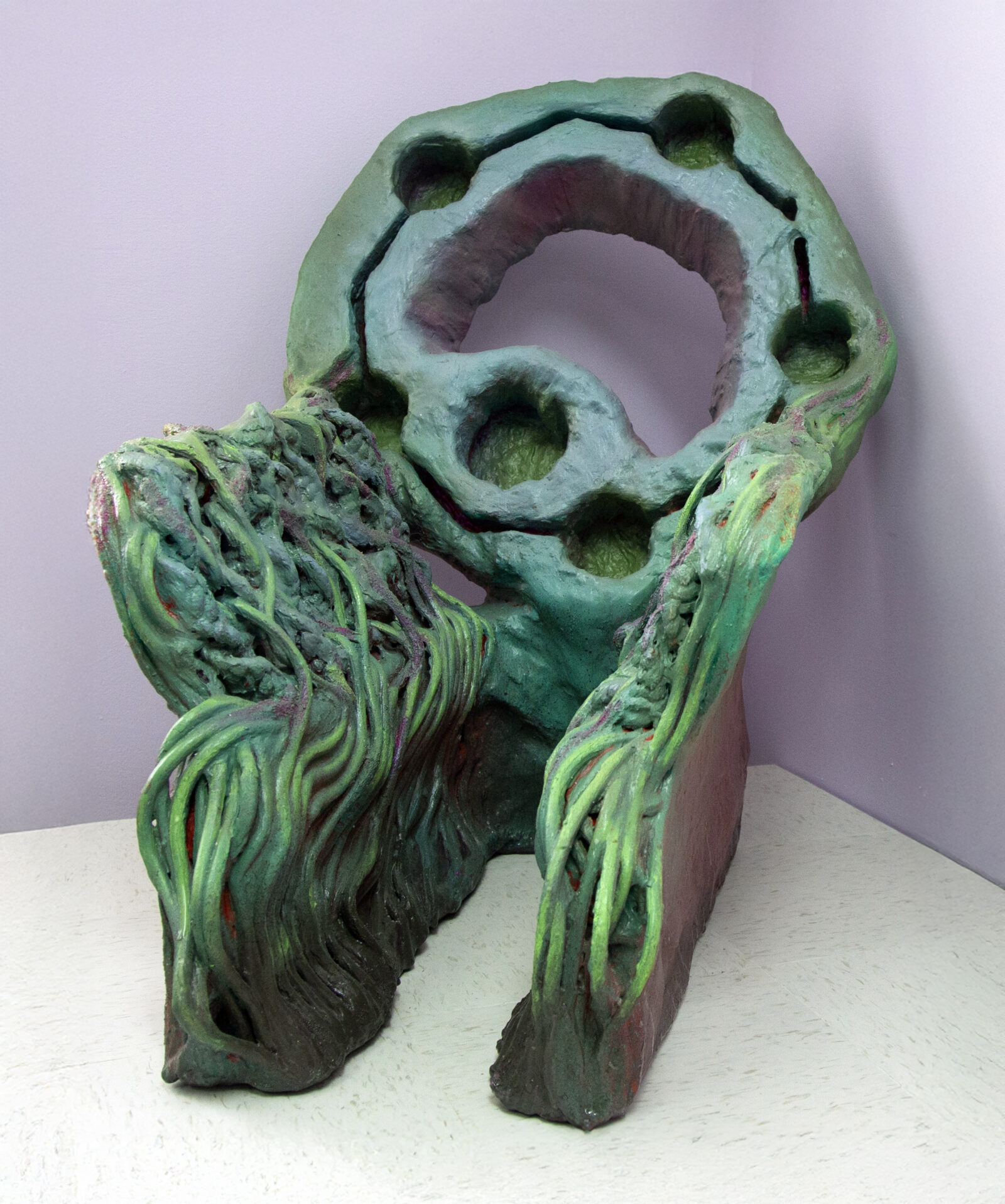
Now, Nobles thinks of As I Sit Waiting as ongoing. She has completed twenty extraordinary sculptures and, as of December 2025, two more are in-progress in her East Harlem studio. Each is an uncanny chair or seat that maintains the space in which vulnerable bodies might sit or recline, soliciting a range of affective responses, from tension to exuberance, from pain to disgust to joy. Each sculpture is named after someone who wanted or had an abortion and responds, in its materiality and form, to a conversation Nobles had with that person. And each sculpture speaks, as I have suggested elsewhere, with a vocabulary of inclination, accentuating overlooked and understated postural comportments of waiting, sitting, laying, and lying. Julie (2022, figure 1) leans back gently into space, a narrow seat coated in thick synthetic paste, painted white with blushes of pink and blue, and balanced on two little legs. Half-orbs secreting golden liquid indent its back and headrest. A candy-pink crevice undulates in three connected ovals down its base. Jade (2022, figure 2) squats low to the ground. Shimmering medusa-green acrylic, inflected with purple and pink, coats every eclectic surface. Its armrests are draped in tangles of rubber tubing; its backrest is full of holes.
As I Sit Waiting carefully draws out the association of understated actions like resting and reclining with disparaged, all-too-often depoliticized, and in every sense patient forms of life. In 2023, the series was censored on the grounds that to speak of abortion is “to promote” abortion, a turn of phrase that encapsulates what Doyle called the “aggressive silencing” of abortion stories, especially those that touch on sexual freedom. Even as the moment of optimism that accompanied the beginning of As I Sit Waiting has faded, Nobles continues to work on it—and is now doing so in tandem with her Pleasure Trophies.
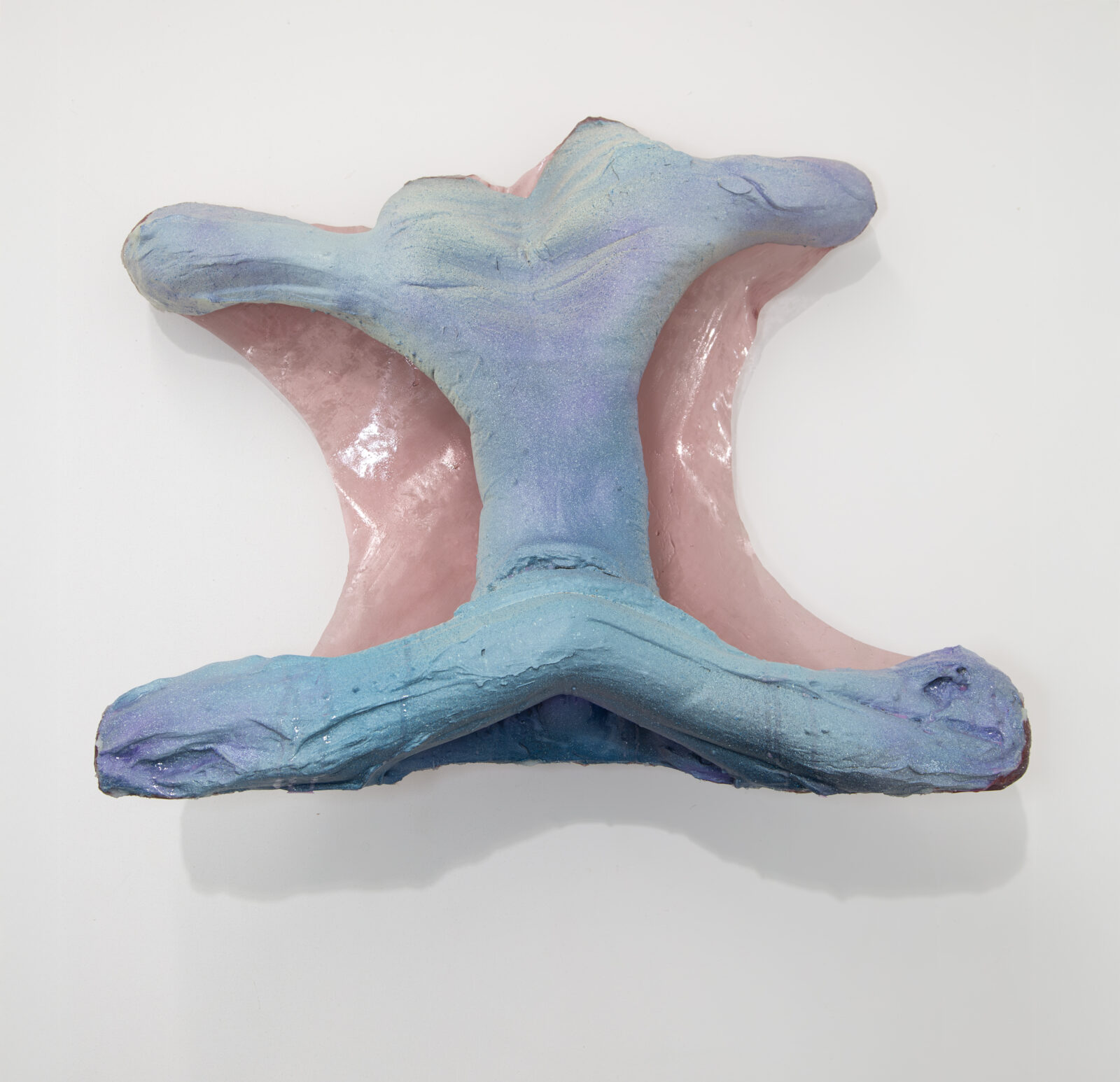
In contrast with the sense of prolonged temporality and postural inertia of the sculptures in As I Sit Waiting, the Pleasure Trophies are defiantly insubordinate. They pulse with unbeholden pleasures. Using many of the same materials as in As I Sit Waiting, Nobles’s Pleasure Trophies translate the weight that would ground a bottom to a chair into the suspension of sensuous partial bodies. She mounts them high up on the wall, covetable prizes of a hunt without precedent. Pleasure Trophy II (2024, figure 3) is at once ethereal and insistently corporeal, delicate and engorged. A translucent veil of pink silk, hardened with clear acrylic, lies behind a plump foam appendage that splays out gently and shimmers in Nobles’s signature palette of pastel-purple on the cusp of baby-blue, medusa-green, and pink. Consistently working with colors, materials, and shapes that read “feminine,” Nobles embraces feminizing stereotypes to the point of rupture. She shamelessly invigorates a feminist tradition of the “abstract erotic.”3
These two overlapping series, As I Sit Waiting and Pleasure Trophies, index a fraught historical moment in the United States, one that led up to the Supreme Court majority’s “inescapable conclusion” in Dobbs that “a right to abortion is not deeply rooted in the Nation’s history and traditions.” “On the contrary,” asserts Justice Samuel Alito, author of the majority opinion, “an unbroken tradition of prohibiting abortion on pain of criminal punishment persisted from the earliest days of the common law until 1973.” He repeatedly makes an altogether obvious yet prejudiced statement: Before Roe v. Wade, “abortion had long been a crime” (emphasis Alito’s). He presents nearly thirty pages of excerpts from legal documents that chronicle how “the vast majority of the States enacted statutes criminalizing abortion at all stages of pregnancy.” “‘Liberty,’” he muses, “is a capacious term”—but “does not protect the right to an abortion.”4
How to tell the licit story of abortion that inheres in this legal discourse? Which is to say, how to uncouple an altogether traditional practice from the tradition of its criminalization? Nobles’s work responds to this perplexity. Her arresting sculptural forms reconnect the practices of abortion and sexual freedom criminalized under the so-called common law that tacitly upholds Alito’s argument: the witch hunt. For although it is commonly used today by men in the uppermost echelons of economic and political power to name a threat to their own sense of impunity, the phrase witch hunt is, in fact, “deeply rooted” (to use Alito’s phrase) in history and tradition. A witch hunt is explicitly a matter of sex. As Silvia Federici has shown, witch hunts were first and foremost about ensuring social reproduction by violently policing sexual freedom.5 History and tradition define a “witch” as any woman who does not participate in—or submit to—social reproduction. That the phrase witch hunt has been so preposterously coopted in the present is just one more of the nefarious ways in which the history and tradition of women’s rights are obfuscated.
Throughout the sixteenth century across Europe, and as what came to be called the Americas were colonized, the witch hunt “literally demonized any form of birth-control and non-procreative sexuality.”6 Abortion and “sexual perversion”—a synonym for non-procreative sex, whether the practice of “heretical” sex for pleasure or the use of contraception—became acts of “female crime” and “reproductive crime” of which witches were accused.7 In Europe and its colonies, contraception and abortion—of which miscarriage was understood to be a form—became punishable as capital crimes. Women—especially poor or old or unmarried women, unmarried women who got pregnant, married women who did not, and certainly women who wanted neither to marry nor get pregnant—were first recognized as “legal adults” only in order that they could enter courts of law and be sentenced to imprisonment, torture, and death “under charge of being witches and child murderers.”8 The witch hunt, as Federici argues, was “promoted by a political class . . . preoccupied with population decline and motivated by the conviction that a large population is the wealth of the nation.”9 Women who did not contribute to this political-economic project by marrying a man, bearing his children, and performing unremunerated labor to ensure their wellbeing, were seen not simply as socially incorrect but immoral. In the service of the nation’s wealth, the witch hunt “condemned female sexuality as the source of every evil.”10
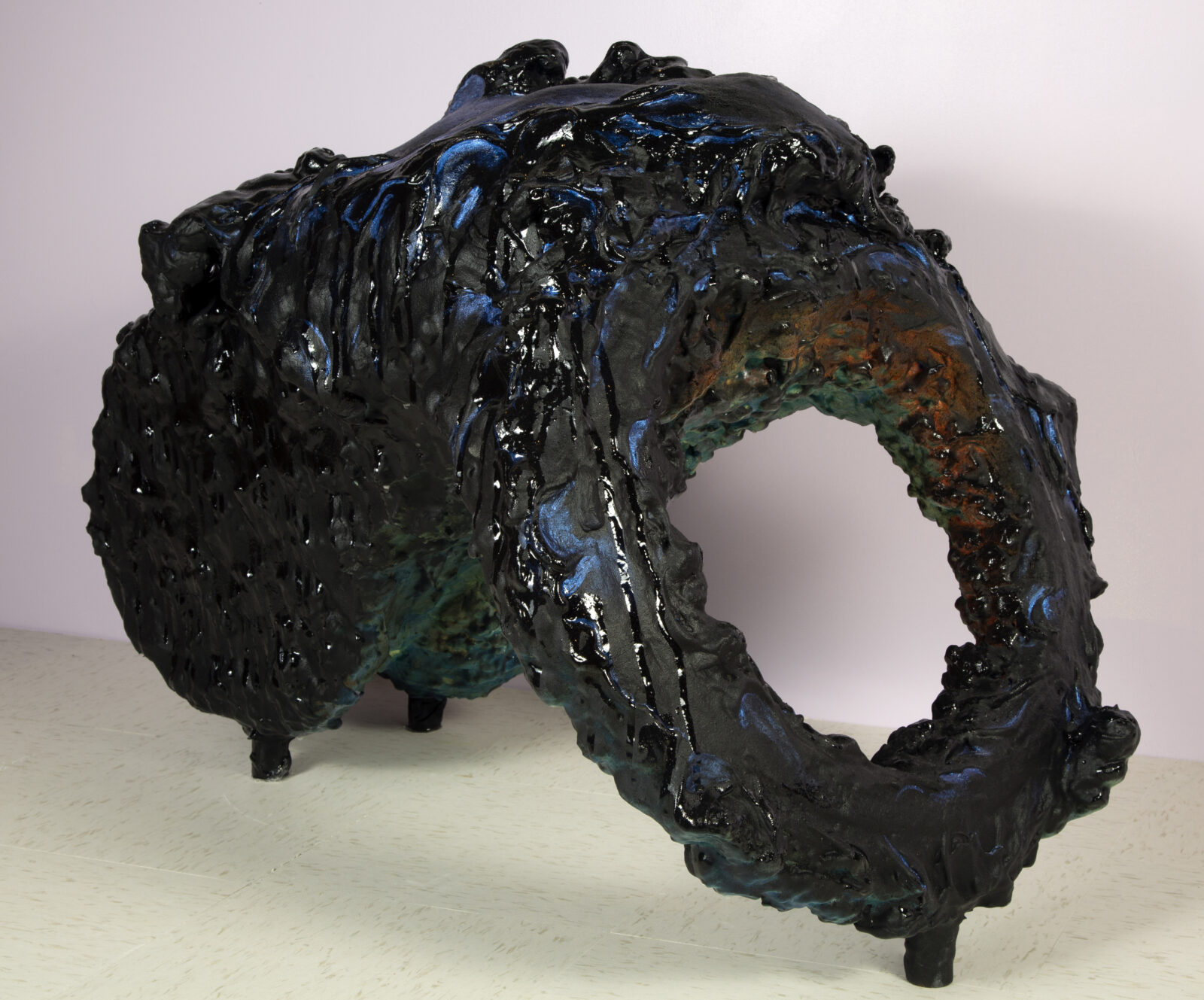
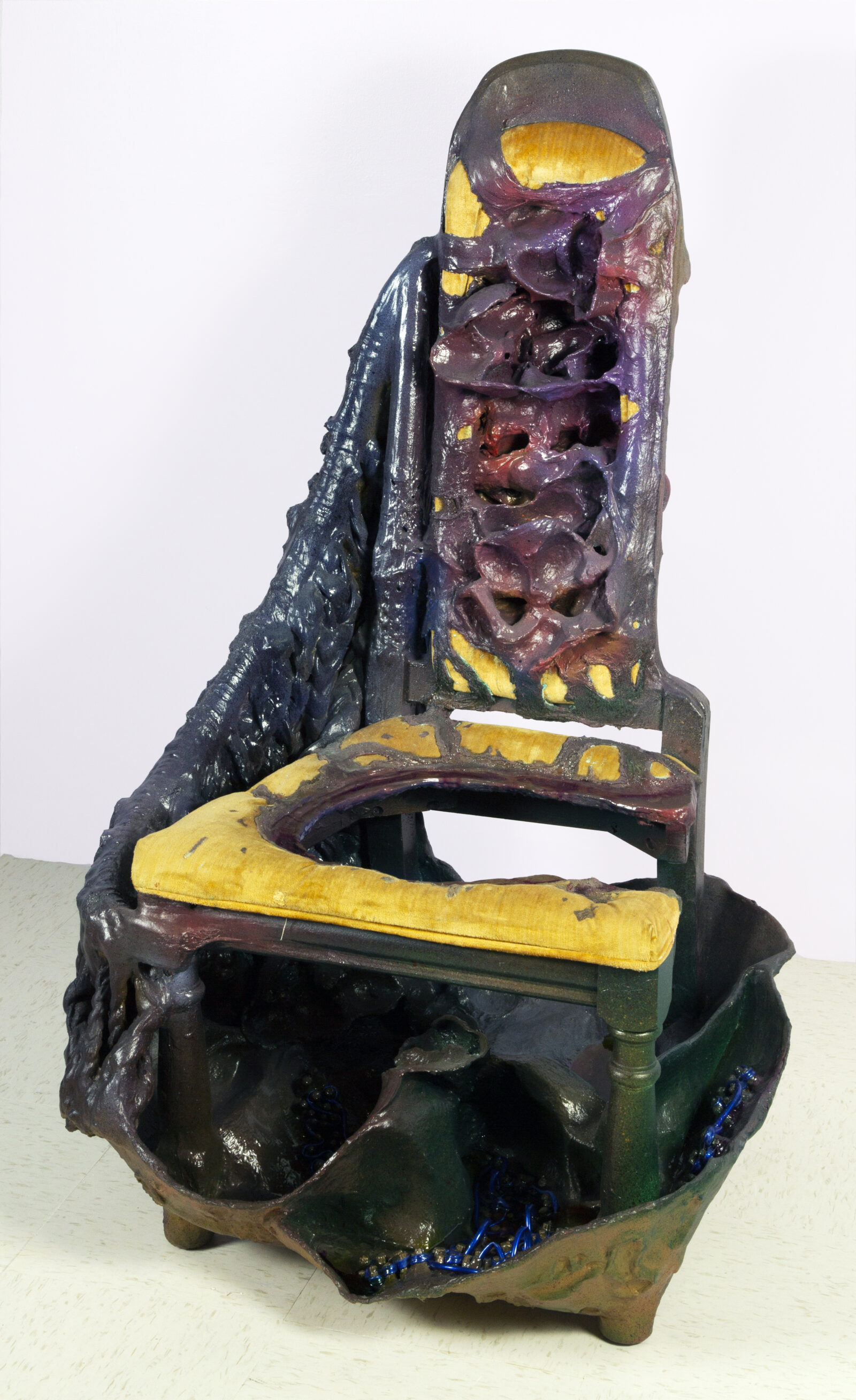
Nobles’s sculptures exhibit the continuity of this history in the present.11 As I Sit Waiting does so in modest yet uncanny seats that maintain, in the absence of bodies, space for those variously “condemned” (to use Federici’s verb) by the legal tradition. Velvette (2022, figure 4) is a short three-legged seat with an iridescent dark green underside and knobby black surface. Without arms and without a back, it is an uncanny spatial remainder of a supine body laid out vulnerably in space. Ginger (2022, figure 5), a salvaged wooden chair with worn velvet upholstery, is missing parts of its narrow back and seat and partially encased in opalescent purple resin. Loose braids of rubber and thin lengths of rope, coated in thick acrylic paint, wrap around and dangle from its single arcing arm. Blue rubber tubing threads through little nubs of resin protruding from a veil that wraps around it, giving the impression of being burnt or melted but also sheathed. These sculptures defy their own material fragility. They patiently persist.
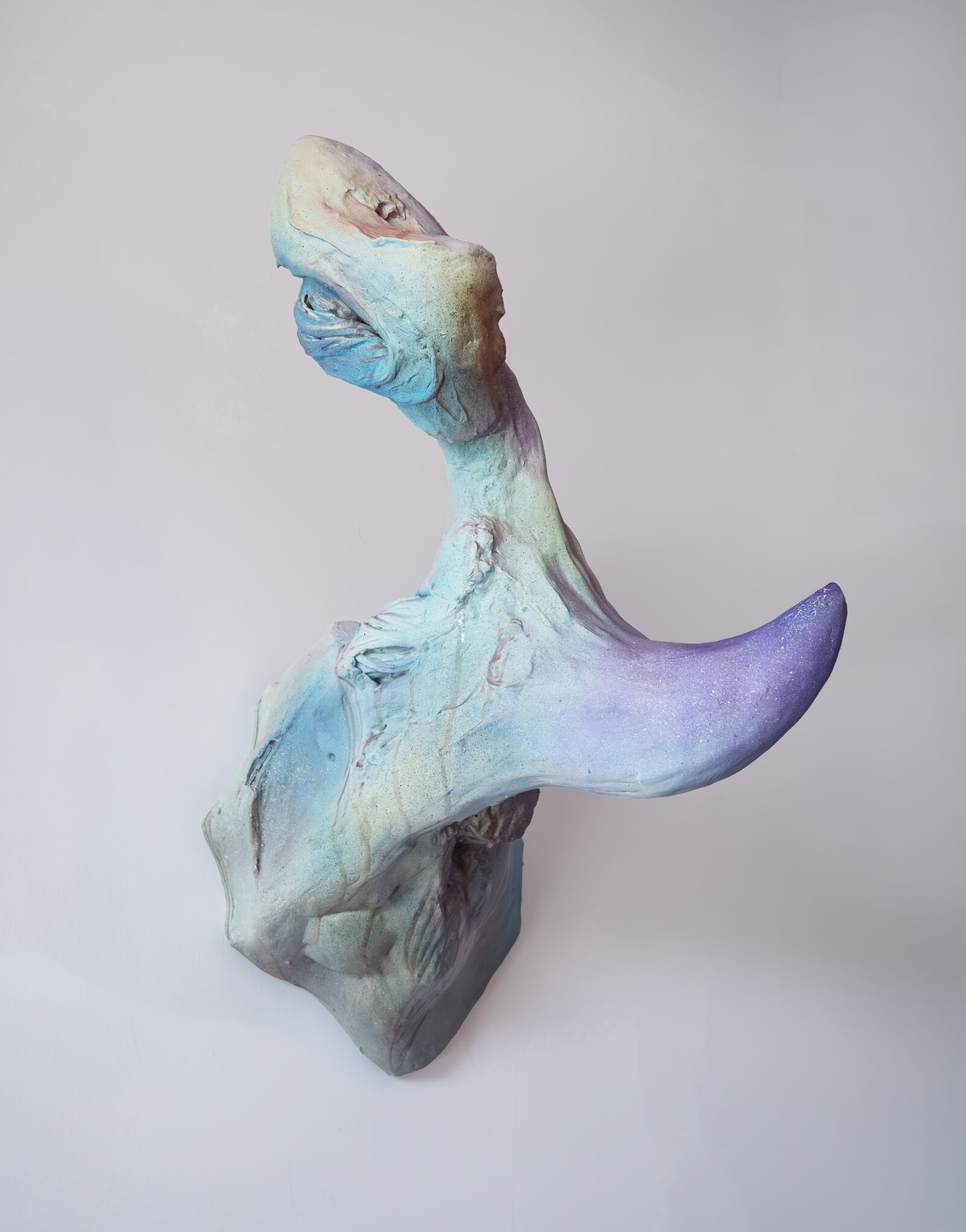
In contrast, Pleasure Trophy I (2024, figure 6) extends brazenly into space, at once probing and softly contoured. Thin rivulets of glossy pink resin drip from a bulbous upper protuberance. Lower down, its horn glitters. Pleasure Trophy I points to pleasures with no relation to the history and performance of hunting trophies. If potency, as opposed to impotence, is often signified in a trophy, then the Pleasure Trophies possess a potency that remains free of the demands of social reproduction and the law.
Nobles’s sculptures lend legibility to what I want to call Alito’s witch hunt. They register a conjunction, at the center of his “Opinion of the Court,” between the punishment of reproductive freedom and sexual freedom. There is only one woman named in Alito’s 100-page account of “deeply rooted” tradition: Eleanor Beare. In August 1732, Beare was tried and convicted for performing abortions. Alito cites her lawsuit as it was recorded in the pages of The Gentleman’s Magazine, an eighteenth-century London periodical equivalent to a contemporary lifestyle magazine interspersed with assorted news—a highly questionable source of legal authority.12 Specifically, and without any hesitation or further comment, Alito refers to Beare’s punishment. This is how he cites from The Gentleman’s Magazine: “Eleanor Beare was convicted of ‘destroying the Foetus in the Womb’ of another woman and ‘thereby causing her to miscarry.’ For that crime and another ‘misdemeanor,’ Beare was sentenced to two days in the pillory and three years’ imprisonment.” Having placed scare-quotes around the antiquated vocabulary of abortion that he chooses to cite, Alito then integrates reference to Beare’s punishment into his own text as though he judges it to be just. To be pilloried was a brutal, frequently fatal form of punishment. It was also the punishment of witches.13 Head and hands locked within a single plank of wood, the pilloried person is put on display, exposed to humiliation and violence by the public. It is altogether telling that in his account of history and tradition Alito omits something that The Gentleman’s Magazine reports in detail: On August 18, 1732, Beare’s first day at the pillory, “the Populace . . . threw such quantities of Eggs, Turnips, &c. that it was thought she would hardly have escap’d with her Life.” The euphemistic “&c.” (etcetera) no doubt included stones.
In the spirit of Judith Butler’s recent plea to carefully read executive orders in order “better to explain what they are saying and doing with the language they use” and to “build a counter-discourse,” I want to draw attention to what Alito does not cite by close reading his source text. As related in The Gentleman’s Magazine, Beare stood accused by one man, Nicholas Wilson, of giving him poison to kill his wife (who was present, ironically, to back up his accusation at the trial). He asked for it, he admits, because “I was young, and could not take my Liberty for fear of having Uneasiness with my Wife” (his “Liberty,” it would seem, was adultery). Beare stood accused by a second man, John Clark, of taking payment to perform abortions; of having “Reward,” as the court emphasized, for “these wicked Practices.” In recounting this story, Alito ignores Beare’s contestation of both accusations—and does not indicate that it clearly didn’t matter if these men were lying: “Gentlemen,” the council for the court commanded (for of course there were only “Gentlemen” to speak to in this court of law), “to destroy the Fruit of the Womb carries something in it so contrary to the natural Tenderness of the Female Sex, that I am amazed how ever any Woman should arrive at such a degree of Impiety and Cruelty.”14
It does not interest Alito that no such judgement of “Impiety and Cruelty” was brought to bear on “Ch—r, a young Man” (anonymization original), who raped Beare’s acquaintance, Grace Belfort. Alito also does not cite from the passage in The Gentleman’s Magazine that makes clear that Belfort then sought an abortion from Beare, and that Belfort in fact took the stand openly to say so. Nor does Alito indicate that Clark exposed Belfort for seeking an abortion from Beare because he was apparently envious of the money that exchanged hands—not “amazed,” to recall the court’s adjudication, at the “contrariness” of her sex.
Neither the court at the time, nor Alito in the present, worries about the correlation of “Liberty” and adultery, or about the role of money in the accusation of Beare, nor—most maliciously—about the rape of Belfort, to which Beare responded with what could also be called a form of “natural Tenderness.” Alito lets his gavel rest on Beare’s punishment, but leaves all of this out. His citational strategy obfuscates a history of sexual violence while making light of the violence of the historical punishment exacted—precisely because, as I see it, the Dobbs ruling affirms the tradition by which women’s bodies are violently regulated.
Alito ends his summary statement thus: “It is time to heed the Constitution and return the issue of abortion to the people’s elected representatives,” assenting, “That is what the Constitution and the rule of law demand.” The problem with “heeding” what Alito calls the “rule of law” is that doing so sustains the history and tradition of violence that constitute it. In this sense, Alito’s “inescapable conclusion” that the right to abortion does not have deep roots in history and tradition contains a lie. Another story “about sexuality, desire, and the body,” to recall Doyle, can still be written here.15 In the two mere lines that record Beare’s voice, The Gentleman’s Magazine recounts how she (“Prisoner”) implored Clark: “I would have you speak the Truth.” In what form could such truth take shape? Pursuing a tradition that includes Grace Belfort, As I Sit Waiting articulates honest and vulnerable answers—met, after the Dobbs ruling, with censorship. The Pleasure Trophies, in contrast, are souvenirs from a history of “Truth’s” unwritten past. They affirm pleasures that refuse to be subject to the prurient and pernicious interpretation of the law—and of its enforcers. These Pleasure Trophies may be impious, but they are not cruel. We need more of them.16
: :
Endnotes
- Jennifer Doyle, “Blind Spots and Failed Performance: Abortion, Feminism, and Queer Theory,” Qui Parle 18, no. 1 (Fall/Winter 2009): 41; revised and excerpted in Doyle, Hold It against Me: On Difficulty and Emotion in Contemporary Art (Duke University Press, 2013), 28-39. Doyle is writing about Aliza Shvarts’s Untitled (Senior Thesis) (2008).
- Doyle, “Blind Spots,” 41, 46.
- Jo Applin, ed., Abstract Erotic: Louise Bourgeois, Eva Hesse, Alice Adams (Courtauld Institute of Art, 2025). The exhibition builds on the vocabularies Lucy R. Lippard developed in an exhibition and eponymous essay, “Eccentric Abstraction,” Art International (November 1966): 28-40. See also Jo Applin, Eccentric Objects: Rethinking Sculpture in 1960s America (Yale University Press, 2012).
- Justice Samuel Alito, “Opinion of the Court,” in Supreme Court of the United States, Dobbs, State Health Officer of the Mississippi Department of Health, et al. v. Jackson Women’s Health Organization et al., Certiorari to the United States Court of Appeals for the Fifth Circuit, No. 19-1392 (argued December 1, 2021, decided June 24, 2022), https://www.supremecourt.gov/opinions/21pdf/19-1392_6j37.pdf. All in-text citations of the majority opinion are searchable in the Dobbs PDF; Alito begins his post-summary statements with the assertion: “Not only was there no support for such a constitutional right until shortly before Roe, but abortion had long been a crime in every single State,” emphasis original; The list of excerpted statutes criminalizing abortion from 1825 to 1952 in the United States and the “Territories that became States” are found in Appendices A and B.
- Silvia Federici, Caliban and the Witch: Women, the Body, and Primitive Accumulation (Penguin Classics, [2004] 2021).
- Federici, Caliban and the Witch, 97.
- Federici, Caliban and the Witch, 39-41. Federici emphasizes, “the most important difference between heresy and witchcraft” was that “witchcraft was considered a female crime” (196).
- Federici, Caliban and the Witch, 98.
- Federici, Caliban and the Witch, 199.
- Federici, Caliban and the Witch, 216.
- As Federici and many others have shown, the history and tradition of abortion are far longer standing than the history of abortion’s criminalization. Federici connects the latter concretely to Europe’s colonial history and the rise of capitalism, noting that the introduction of capital punishment for “reproductive crime” aligned with the first arrivals of Portuguese ships transporting enslaved people from the west coast of Africa to Europe (97). Mary Fissell, in contrast, traces an even longer history of men’s fears of women’s independence. See her Pushback: The 2,500-Year Fight to Thwart Women by Restricting Abortion (Seal Press, 2025).
- “The TRYAL of Eleanor Beare of Derby, on Tuesday Aug. 15, 1732,” in “The Monthly Intelligencer” of The Gentleman’s Magazine 2 (1732) 931–32; digitized by the Internet Archive. Except for when presented as cited by Alito, all in-text citations of Beare’s trial are from this source. Anna Greer offers a legal reexamination of Dobbs with reference to Eleanor Beare in “Women Seldom Make History and Tradition: Patriarchal Originalism in Dobbs,” DePaul Journal for Social Justice 17, no. 1 (December 2023): 1-58.
- Federici, Caliban and the Witch, 115, 106, 204; witches were also paraded in “bridles” caging their heads and forcing down their tongues; shaven and dunked naked under water in cages made for the spectacle; restrained in iron chairs under which fires were lit and tortured with needles; raped; and burned at stakes.
- With regard to performing abortions, what Beare seems to contest while on trial (for her voice is stifled in the recorded proceedings) is not that she practices abortion, but rather that she profits from taking payment.
- Doyle, “Blind Spots,” 41.
- My thanks to Leila Easa, Jennifer Sichel, Aliza Shvarts, and Jennifer Stager for thoughtful comments on this essay.
Caroline Lillian Schopp
