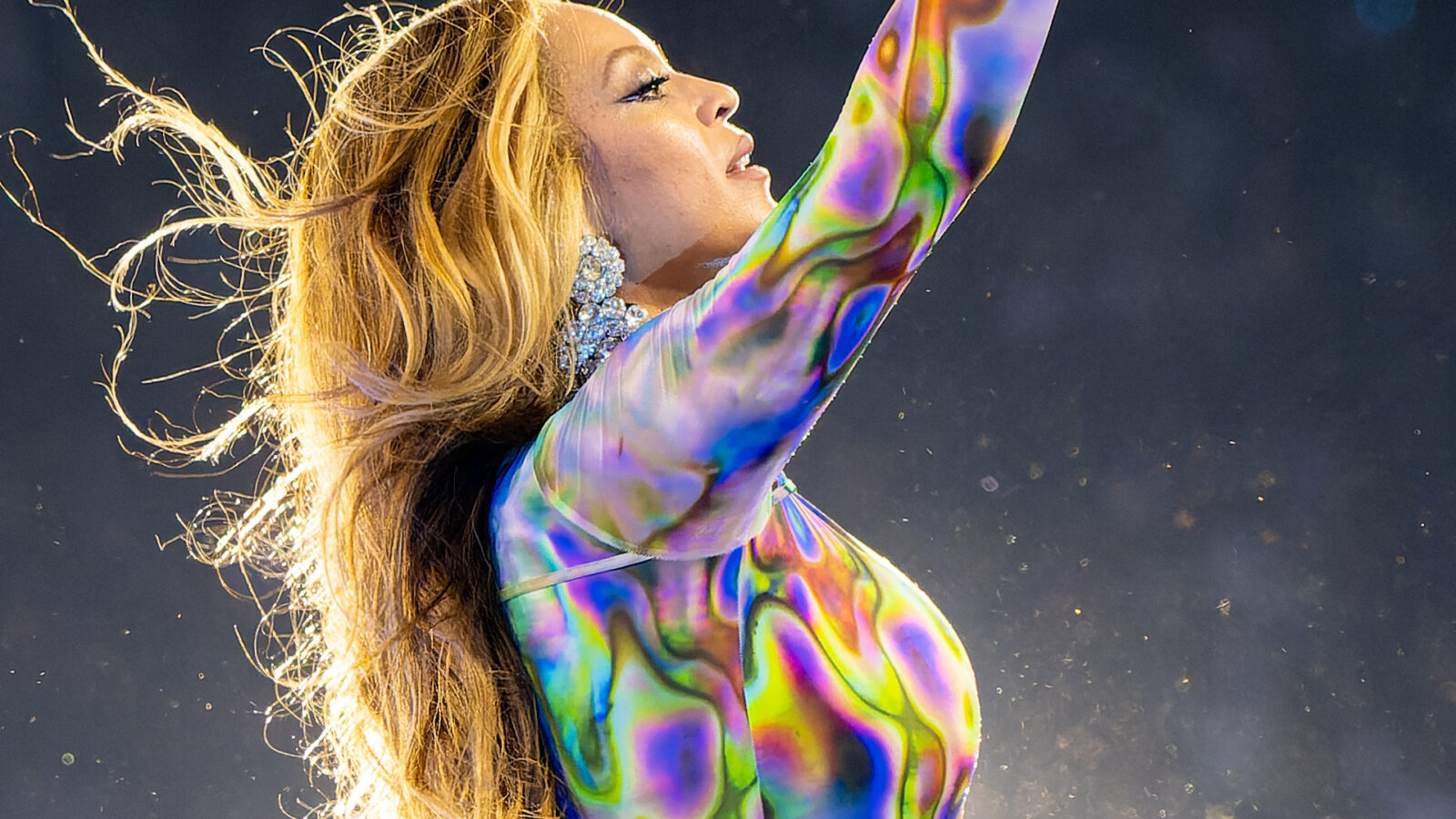
In October 2024, Beyoncé joined presidential nominee Kamala Harris at a rally in Texas to voice her support for reproductive freedom. In her brief remarks, Beyoncé asserted that she was participating neither as a celebrity nor as a politician, but as “a mother who cares deeply about the world my children and all of our children live in, a world where we have the freedom to control our bodies, a world where we’re not divided.” Here Beyoncé explicitly links her lived experience as a mother of three children (Blue Ivy, born in 2012, and twins Sir and Rumi, born in 2017) to her conviction that personal dignity and bodily autonomy are vitally important, especially in a post-Dobbs America. These values were reflected in her 2022 album Renaissance, a masterwork that many have called “a love letter to black queer culture.” With the release of this 2022 album and its ensuing world tour, Beyoncé cemented her role as a mother to many in LGBTQ communities.
Beyoncé’s version of motherhood—one that draws from cultural history while responding to the present and looking toward the future—represents a version that is deeply needed during this time of great reproductive restriction, including that of abortion rights and autonomy. Beyoncé’s flexible and wide-ranging motherhood encompasses biological child rearing, drag mothering/othermothering, and chosen mothering, and she platforms those who have been ignored by mainstream culture. In her rejection of oversimplistic binary categories, including those of mother/child, she performs and embodies paradoxes—joy and pain, celebration and resistance, vibrancy and violence, among others—that break us free of the static categories that structure the oppression of women, children, people of color, queer people, trans people, and those who fall into multiple of those categories, among others. Through this vision, Beyoncé offers us a chance to think about reproduction in a liberatory light. At a time when mothering is becoming compulsory and abortion made illegal, Beyoncé’s version of the mother represents transgression and liberation in its creation of new queer forms.
The term “mother” in drag ball culture refers to the leader of a house or family, a matriarch who guides house members both on and off the ballroom floor. At every show on her Renaissance World Tour in summer 2023, Beyoncé was introduced by ballroom legend Kevin Jz Prodigy as “the Iconic mother of the House of Renaissance.” With this title, Beyoncé took her place alongside legendary house mothers, including Crystal LaBeija, Dorian Corey, Avis Pendavis, Paris Dupree, and La Duchess Wong, whom Michael Roberson calls the five “freedom fighters” of ball culture. Like these historical mothers, Beyoncé provides maternal inspiration and support to her birthed and chosen children that manifests in a variety of ways: modeling self-love in the face of hatred, affirming the connection between the sensual and the divine, and knowing how to share the spotlight. While one could argue that Beyoncé toes the line of appropriation as a straight cis woman who takes on the language of trans and queer communities, I assert that her embrace of ball culture not only highlights the experiences of exhilaration and exclusion in trans and queer communities, but also introduces us to forms of mothering that may not be immediately legible to a wider, mainstream audience.
Beyoncé has long been an icon in LGBTQ spaces, but with Renaissance, she created, in Jenna Wortham’s words, “an ode to Black queer and trans history.” A celebration of pleasure in a moment marked by the COVID-19 pandemic and the increasing disregard for human rights of the most vulnerable all around the world, Renaissance borrows from a number of musical genres that are central to queer, Black, and queer Black communities, including, as Janell Hobson notes, “Chicago house, Detroit techno, Harlem ballroom, Jamaican dance hall, New Orleans bounce, London garage, Lagos Afrobeat, and the nostalgic echoes of 1970s disco, ’80s funk, pop and early hip-hop.
Ball culture, in particular, is a source of inspiration for Renaissance. Many were introduced to this subculture through Jennie Livingston’s 1991 documentary Paris is Burning, which follows Black and Brown “gay men, drag queens and transgender women” in the ballroom subculture of 1980s New York. FX’s series Pose (2018-2021) has shared with a new generation a fictional (but historically grounded) celebration of Black and Brown ball queens in the 1980s as they confront rejection from families of origin, the AIDS epidemic, and a capitalist system that feeds on racism, misogyny, and transphobia. Yet the origins of ball culture stretch back to the late nineteenth century. New York was often ground zero for these practices, and by the 1920s, Harlem had become an important center for Black people of all gender expressions (as well as non-Black people who were interested in watching).
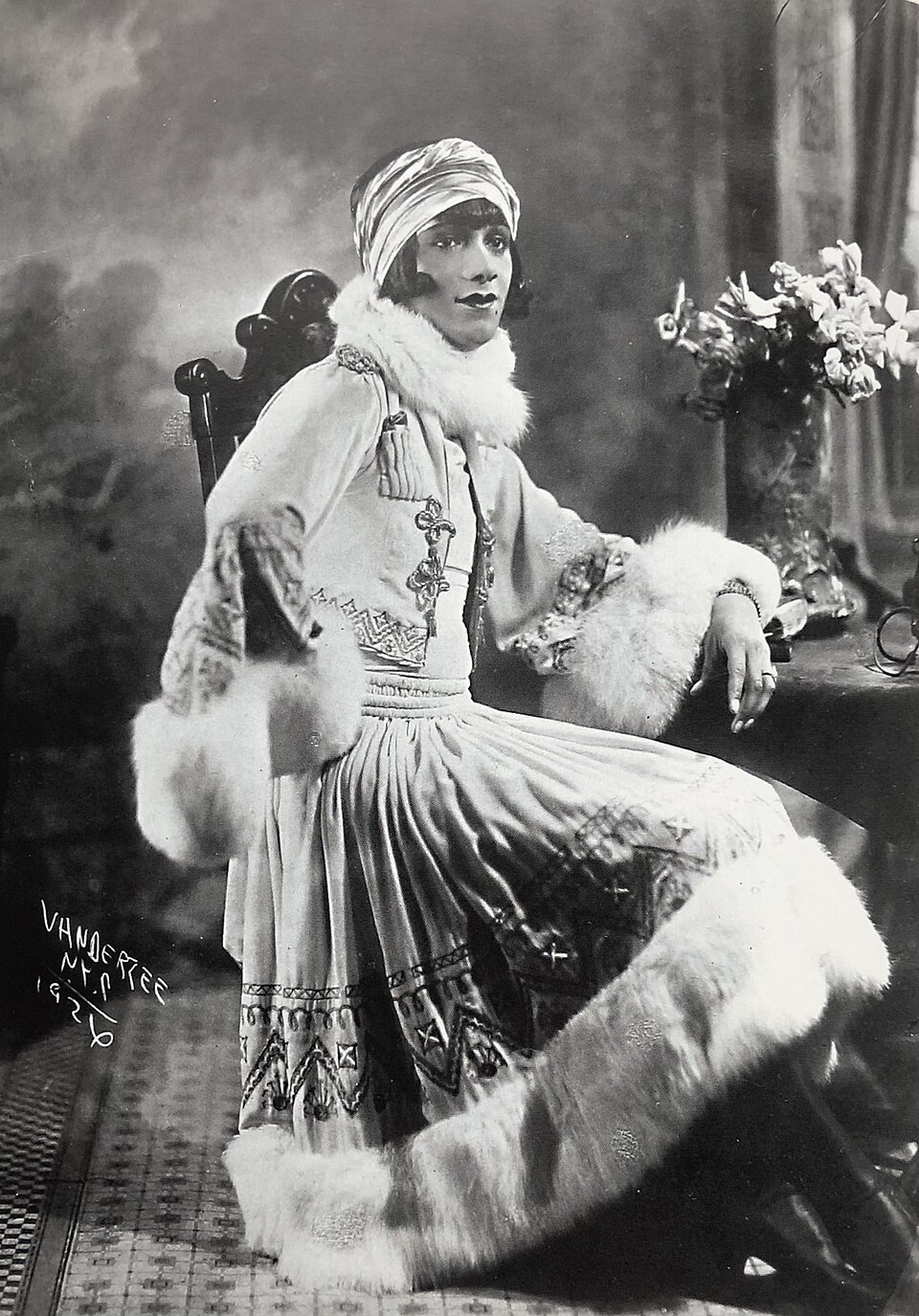
Indeed, Beyoncé’s album title is an allusion to the Harlem Renaissance, that time of Black cultural flourishing in the early 20th century when, as Langston Hughes famously put it, “the Negro was in vogue.” Beyoncé pays homage to this subculture that celebrated gender and sexual fluidity and created spaces for performing identities that did not fit into binary understandings of identity categories like race, gender, sexuality, and class.
Ballroom culture is structured around houses, or families, as Laura Smythe explains: “[E]ach participant is a member of a specific ‘house,’ or ballroom unit, that has its own leadership and rules. Each house is governed by a house mother and/or father, as well as board members, a treasurer and various other hierarchical couples that can include prince and princess or duke and duchess.” House mothers are especially vital to young trans and queer people who have been rejected by their families of origin. They provide emotional stability and support, help them prepare to walk categories in the balls, and nurture their personal and professional growth. Ricky Tucker writes that house mothers aim to “pass on the valuable lessons they’ve learned over the years . . . [and] to end the cycles of trauma inherited from children’s biological mothers.” Even for people outside of ballroom culture, this more expansive notion of mothering is familiar through the practice of othermothering in Black communities. Citing the work of Patricia Hill Collins and Rosalie Riegle Troester, coauthors Brandon Andrew Robinson, Amy L. Stone, and Javania Michelle Webb note that “othermothers, or women who assist biological and adoptive mothers in mothering, are central to the institution of Black motherhood. These othermothers often include sisters, aunts, and grandmothers, whereby women play a central role in raising and caring for all children in Black extended families.” Such mothering practices that “deconstruct biological primacy and heteronormativity in the family” are also present in both Latina and Indigenous communities. This flexible understanding of who can mother resists the sexist and homophobic ideologies that underpin notions of “traditional” family structures.
Encouraging others and offering them an opportunity to shine are integral parts of motherhood, both in and out of ballroom culture. The lexicon, choreography, and aesthetic of ballroom culture permeate Renaissance, but instead of simply taking from the culture or claiming the culture as her own, Beyoncé collaborates with several artists from the scene and gives them room to share their brilliance. Kevin Jz Prodigy, the Philadelphia-based ballroom commentator whom Beyoncé called the “heartbeat” of the Renaissance World Tour, has been a legend in the ballroom scene for nearly three decades. Voguers Darius Hickman, Carlos Basquiat, and Honey Balenciaga were featured dancers on the tour.
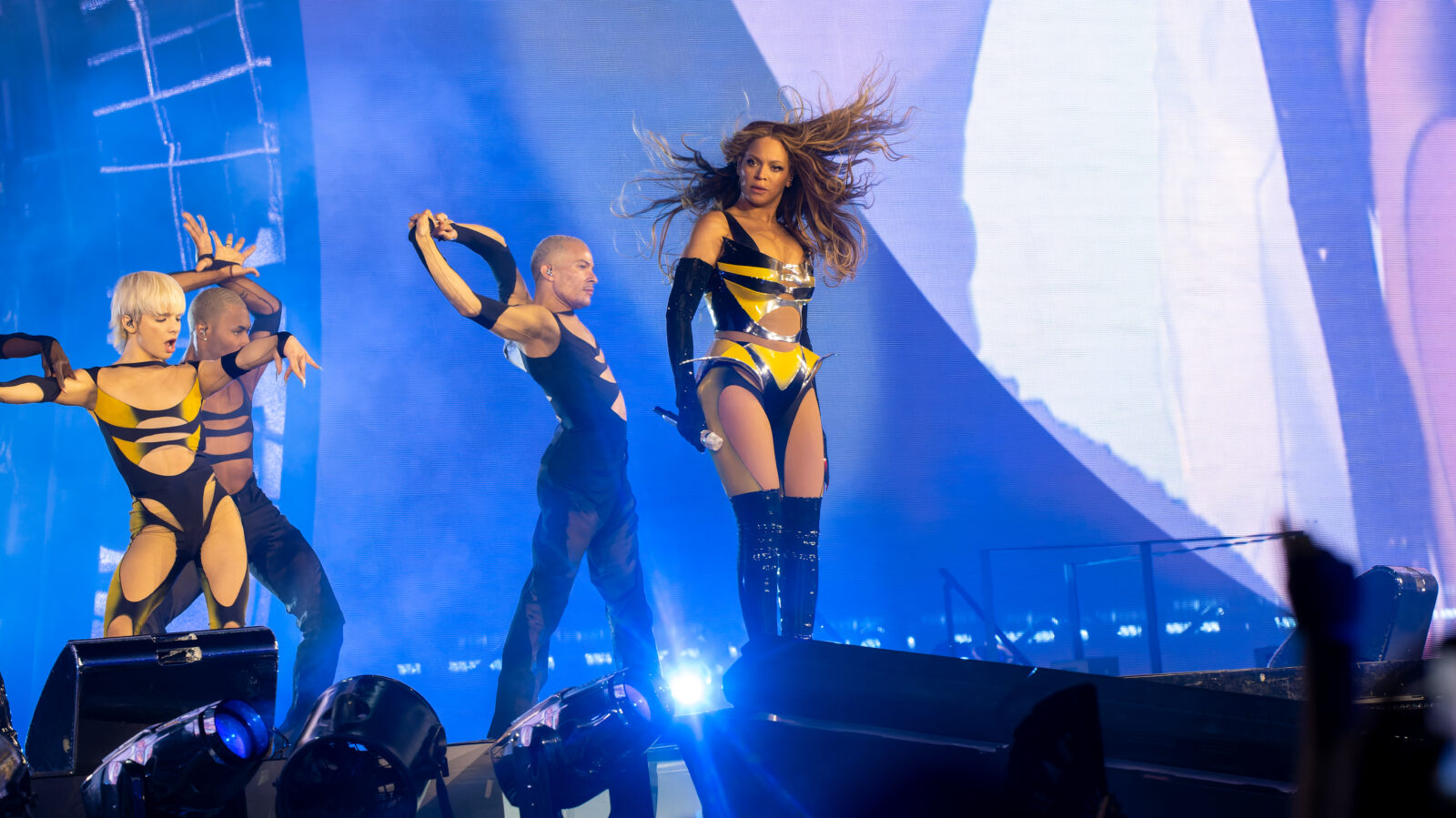
Trans actress and advocate TS Madison is sampled on the album’s second track, “Cozy.” Kevin Aviance is a “renowned drag icon performer, musician, and club personality” whose 1996 hit “Cunty” is the backbone of the album’s 15th track “Pure/Honey.”
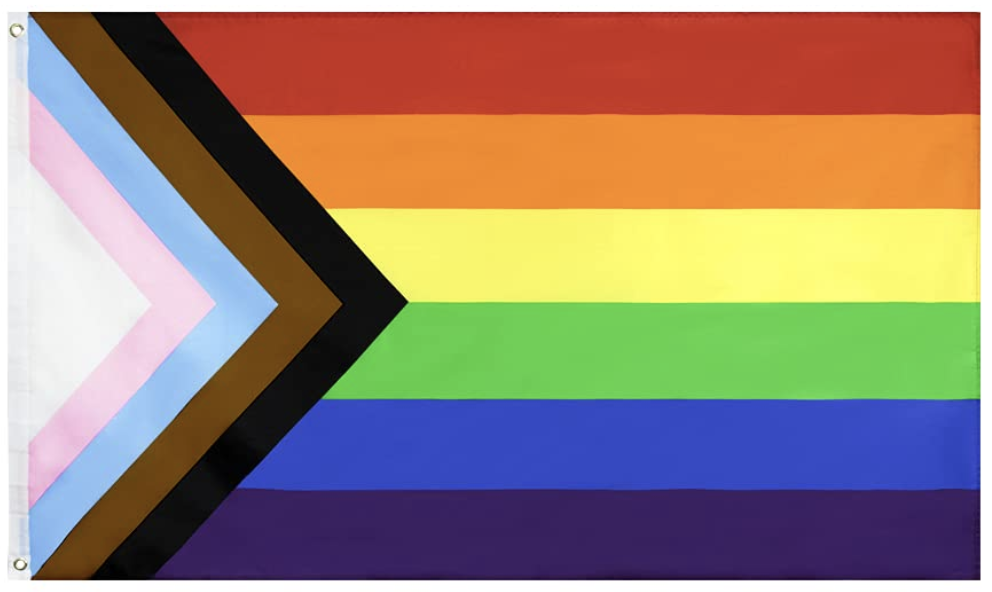
The presence of TS Madison on Renaissance is particularly important in terms of the representation of the joy and the pain of ballroom culture. In “Cozy,” Beyoncé channels a speaker who loves herself, never mind the haters: “Comfortable in my skin/Cozy with who I am.” Beyoncé also pays tribute to the progress pride flag, designed in 2018 by nonbinary artist Daniel Quasar: “In addition to the traditional rainbow flag designed by Gilbert Baker, the progress flag adds the colors of the trans flag, which was originally designed by Monica Helms. It also adds Black and brown stripes to symbolize people of color.”
Behind the driving house beat, we hear TS Madison’s memorable lines: “I’m dark skin, light skin, beige / Fluorescent beige, bitch, I’m Black!” TS Madison’s expression of Black pride on “Cozy” is a memorable sound bite, but the story behind it is profound. In 2020, Madison recorded a 12-minute video in response to the murder of George Floyd. She recalls:
That video was me arguing with America. We as Black trans people know that it’s our responsibility to stand up and fight against the injustice against George Floyd. But Iyanna Dior is a trans woman who was beaten in the same city, in the same week almost, and everybody was blaming her for being trans and all of these Black people were beating her in the store.
While George Floyd’s death made international news, the beating of Iyanna Dior did not receive the same attention. A Black trans woman living in St. Paul, Minnesota, Dior was attacked by a group of Black men and women after accidentally bumping into another car while moving her friend’s vehicle. She sought refuge in a nearby convenience store, but the store employee refused to help. Dior’s beating, which was caught on the store’s surveillance camera, raised awareness about the prejudice and violence that trans Black women face, even in Black-majority spaces. As she shared in a 2022 Essence interview, Madison affirmed her multiple intersecting identities as a Black trans woman: “I was just so sick of people not understanding that I’m Black. I don’t want to hear anything about this LGBTQIA stuff in this moment of Blackness. It’s not separate; I’m that and Black at the same time.” TS Madison’s life and work, as well as her presence on Renaissance, encapsulate both the triumphs and the struggles that Black trans people, especially Black trans women, face. Trans culture is vibrant because of, not in spite of, the physical, emotional, and spiritual violence its members experience.
Kevin Aviance’s cameo on Renaissance is another reminder of the ways in which LBGTQ+ culture, and ballroom culture, in particular, are shaped by multiple intersecting oppressions. Aviance has been part of the ball scene since the 1990s, and the hit sampled by Renaissance, “Cunty,” is from 1996. In ballroom culture, “cunty” is a compliment given to someone who walks in their power unapologetically. As Aviance described in an interview: “Cunty is an anointment from God . . . Cunty is a feeling. It’s something that comes over your body that you are given and you feel it. You know how to walk, you know how to talk, you know how to be, you know how to dance. You know how to feel fab about yourself and you don’t need anyone else to verify it for you.” But Aviance’s encouragement to love ourselves is rooted in an intimate understanding of the violence that queer folk experience. In 2006, he was beaten by four young men outside of a gay bar in New York City, an attack that left him with “a broken jaw, a fractured knee and neck injuries.” Despite his injuries, within days he participated in New York’s Gay Pride parade, telling the crowd: “Gay pride is not about pride— it’s about protest, at least this year it is . . . And I think that’s where we have to shift gears and stop the celebration [because] we’re now defending for our lives.” Since then, Aviance has continued his performing career, but he has also become an advocate for queer and trans people. For Aviance, and for so many Black people in the ballroom scene, the pursuit of artistic excellence and the creation of a safer world for members of historically marginalized groups are intertwined.
In addition to highlighting the fierce and revolutionary mothering modeled by queer and trans people who have contributed to ballroom culture, Beyoncé expands our understanding of what motherhood could be by paying tribute to an othermother who was central to her personal and artistic development: Uncle Jonny. The nephew of her mother Tina Knowles, Uncle Jonny helped to raise Beyoncé and her sister Solange. Upon the album’s release, Beyoncé posted the following dedication on her website: “A big thank you to my Uncle Jonny. He was my godmother and the first person to expose me to a lot of the music and culture that serve as inspiration for this album . . . Thank you to all of the pioneers who originate culture, to all of the fallen angels whose contributions have gone unrecognized for far too long. This is a celebration for you.” Worth noting here is her use of the word “godmother” here as well as her acknowledgment of “fallen angels” whose contributions have not been acknowledged. The joy of this album, characterized by the iconic song “Break My Soul”—in which nonbinary rapper and bounce queen Big Freedia urges us to release our anger, mind, job, time, trade, stress, love—and the wiggle— is infectious. And yet, as LeeLee James, a mother of the Royal House of LaBeija in Denver, reminds us, “there’s a lot of pain and trauma that is behind a lot of what people are glamorizing, and it is a disservice to just pick and choose the parts of ballroom culture that people find beautiful while ignoring the histories of pain that have led to that culture being the beautiful thing that it is.” Celebrating only the parts of ball culture that make us feel fabulous is a problematic erasure of the violence that many in the community experience. Uncle Jonny died of complications from AIDS when Beyoncé was 17, and at the GLAAD Awards in 2019 she shared what his life and death meant to her: “Witnessing his battle with HIV was one of the most painful experiences I’ve ever lived . . . I’m hopeful that his struggle served to open pathways for other young people to live more freely.”
Uncle Jonny’s presence on the Renaissance World Tour was substantial. At every performance, the last image projected on the screen after the performers had left the stage was a photo of Beyoncé’s mother, Tina Knowles, and Uncle Jonny. Tina Knowles said of the photo: “I am 38 years old he is 40 we are at a club he made this dress for me it was so cute! It’s my Lena Horne look!!” This back story illuminates one of the album’s fiercest lines: “Uncle Jonny made my dress/ that cheap spandex she looks a mess,” Beyoncé raps in her hit song “Heated.” It’s a remarkable bar that works on many levels: it affirms her uncle’s loving presence in her life; it praises his aesthetic sensibility; and it critiques the girl who made the mistake of showing up wearing the shoddily made fast-fashion dress. Mothers might be nurturing, but they also know how to throw shade. Beyoncé reminds us that mothers are multidimensional and human, despite the tendency to view them as divine, self-sacrificing figures who are beyond reproach.
This capacious sense of mothers and mothering is what we need today amidst renewed decimations of the right to decide when and how to become a mother. Even in many progressive communities, motherhood is often construed as a primarily biological process that occurs within the context of a heteronormative family. Renaissance counters these restrictive understandings of motherhood through its inclusive redefinition of mothering as a practice of nurturing that is available to all, regardless of gender, sexuality, age, or race. Particularly in this moment of political regression to which state-imposed restrictions on bodily autonomy are central, Beyoncé’s queering of motherhood helps us to imagine an alternative world of possibility, pleasure, and liberation for all.
: :
Sarita Cannon