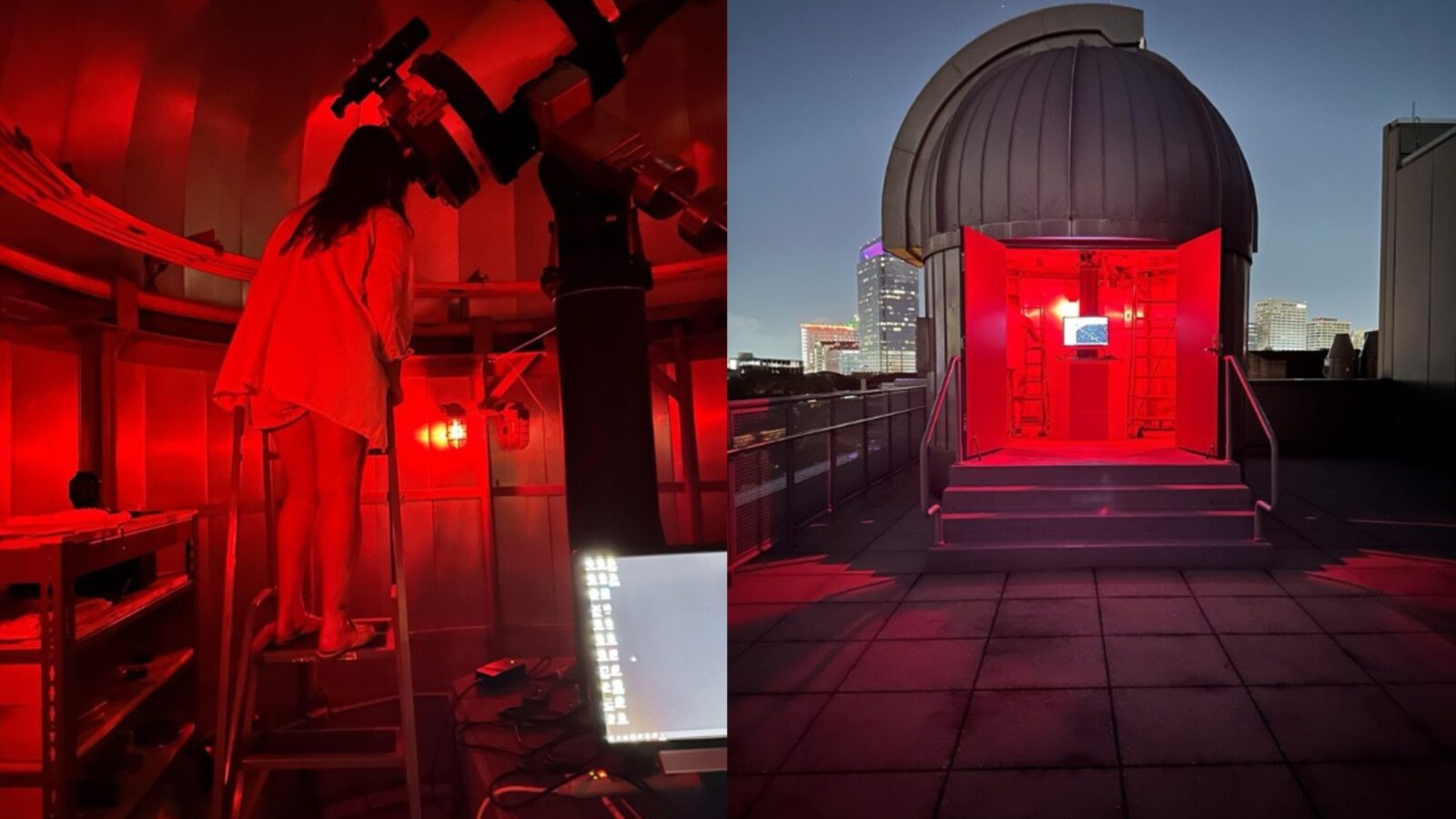
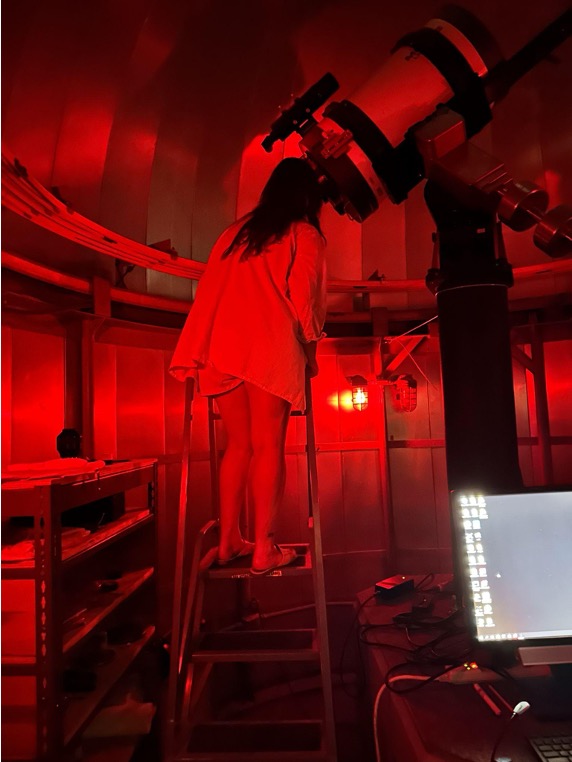
It wasn’t until half the crowd had stopped talking that I noticed that a woman was dancing. The rest of the crowd hummed on, enjoying the opening party of ASAP/16. We were at the Midtown Arts & Theater Center Houston (MATCH), at an installation called “Spectral Field” (September 20–November 8, 2025) by the Iranian-American plasma artist Anahita (Ani) Bradberry, whom I was to interview the next day. The dancing figure wove through a curtained spiral that shrouded two glowing poles of red neon. As she moved, the crowd parted slowly. When she stopped, the applause was at first hesitant, reflecting uncertainty as to whether the performance had ended. I approached. “I look forward to chatting with you tomorrow,” I told her. She looked confused, until a taller woman stepped out from behind her with an amused look on her face. “Oh, I’m Ani,” she replied, pleased at having so successfully eluded attention. (The dancer, as it turned out, was Isabella Mireles Vik; her performance was largely improvised in response to the exhibition.)
This small misrecognition felt instructive. Bradberry’s work plays with ambiguity, with when an event begins and ends, and with the outer boundaries of light, which escape clear demarcation, shifting and emerging in relation to other things. As she concealed herself through a public performance, her work explores elusiveness (unknowability, opacity) that can form, paradoxically, under bright light. Since Édouard Glissant’s For Opacity, much has been written on opacity as an aesthetic and political mode, and on the pleasure that racialized minorities may feel when eluding attention, by rendering one’s interiority opaque, a pleasure that comes from the refusal to reduce oneself to what is knowable, transparent, and assimilable. (I am thinking here of Anne Anlin Cheng’s reading of Roger Caillois and of Anna May Wong’s performance of Shosho in Piccadilly.) Yet Bradberry turns the attention to opacity within light itself, thereby questioning the tendency to equate light with transparency and knowability. I call this luminous opacity.
To work with neon is to work with too obvious signification. Neon evokes modernity: the glow of light above a ramen shop or brothel, the sensory allure of advertisements that hypnotize and distract, masking the emptiness of the commodity. In “Spectral Field,” however, neon is taken out of messy, glowing alleys and streets and placed within a large, spare room with windows that span two walls. Bradberry’s groupings of abstract rigid lines in hues of red and blue, seven in total, are scattered across the space. Without a recess or entry, they lose their referential function (to the promise of noodles, or women), and these luminous forms must now stand for themselves. “Spectral Field” thus invites us to meditate on light itself.
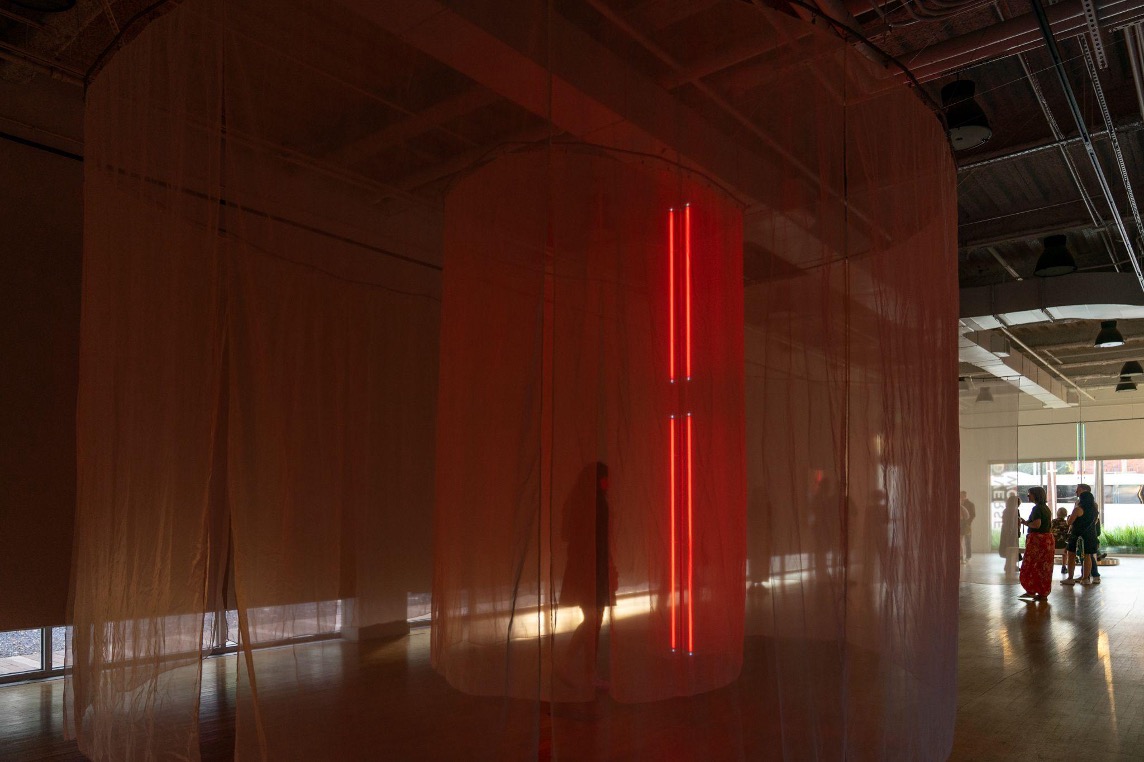
(Midtown Arts & Theater Center Houston, September 20–November 8, 2025).
Dusk, for example, plays with the shape of light. Two rigid rods of red neon extend upward from the floor, covered by two layers of diaphanous curtains, spaced far enough apart that viewers can walk between them. The piece emanates a glow that is caught by each successive layer of curtain, forming two concentric red halos cut into by the bodies of other viewers, like dark puppets impressed upon the material. Light is revealed as an indefinite medium, without clear boundaries, defined only by its containers: the glass tube, the curtains, the room, and rival light sources which can extend, alter, or diminish it. Light, often associated with an immaterial presence that reveals/discloses its surroundings, is here an ambiguous body whose shape emerges from the outside pressures of glass, fabric, and persons who press up against it to see.
The viewer is also a container who catches and holds the light by interpreting it. In an earlier work, Preventive Patrol (2017), two horizontal bars of blue light are placed around a foot apart, shining above the black ground while bodycam footage of a protest plays. The piece lucidly evokes the unblinking cruise lights used on D.C. Metropolitan Police Department vehicles to deter what they call “would-be criminals.” By substituting slender tubes of glass for police presence, Bradberry draws attention to what is perspicuous nevertheless—what one sees even if the car and officer are absent. A body trained to fear the police may still have a triggered response to the stimuli, haunted by the collective memory of state violence.
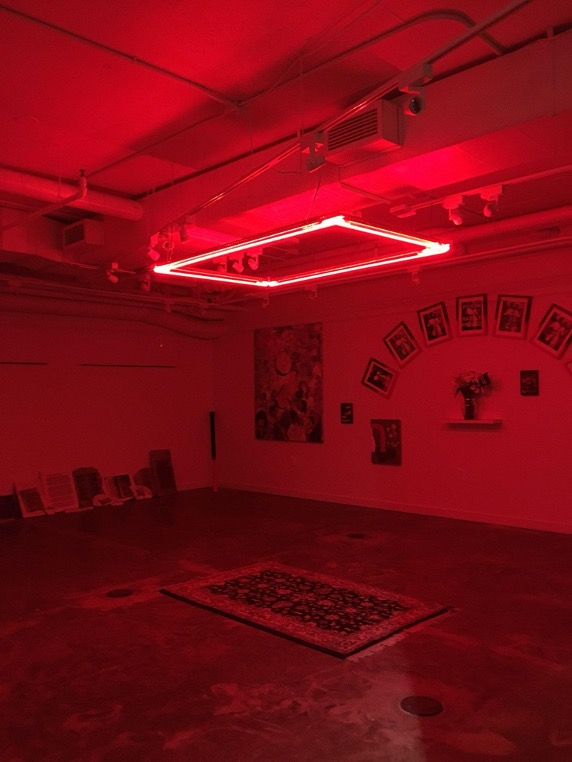
Bradberry began exhibiting her work in Washington, D.C., in 2017, the year that Donald Trump signed Executive Order 13769, otherwise known as the “Muslim Ban,” which revoked 60,000 visas overnight and placed Iranian-Americans hypervisibly at the fore of national public discourse. Her early work grapples with this state of being in which one is violently surveilled and yet completely misunderstood, particularly in her domestic representations of Iranian-American life. In Loom (2017), a glowing orange-red rectangle of neon is suspended over a Persian rug. The piece captures the heat of attention, a warning glow of light atop and surveilling a familiar object. At the same time, neon only traces the rug’s exterior, rendering its outline conspicuous while casting its intricate pattern into unintelligibility. In the stark, neon rectangle, Bradberry demonstrates how hypervisibility (rendered by light or by too-obvious signification) produces blindness.
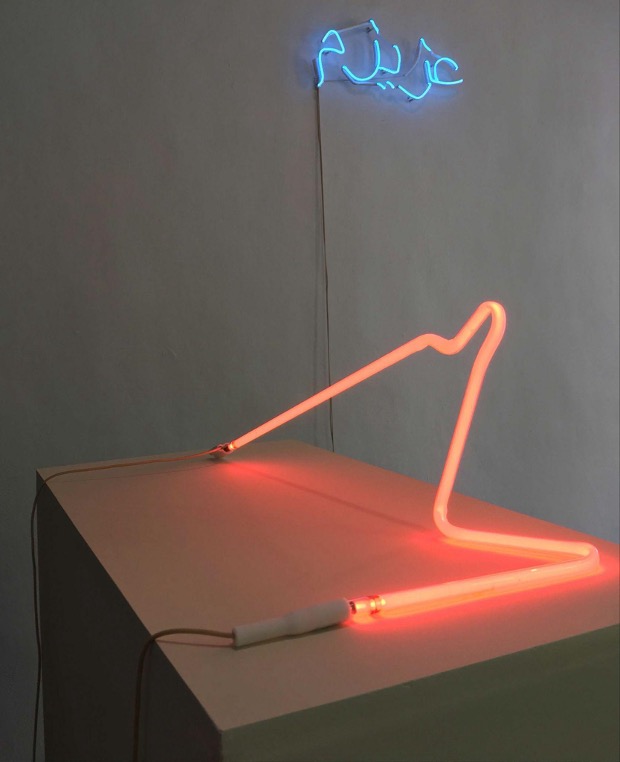
Nevermind, Azizam (2017) is a collaboration between Bradberry and two other Iranian-American artists, Alexandra “Rex” Delafkaran and Sheida Soleimani. The multimedia exhibit—dotted with Delafkaran’s ceramics in organic forms, Bradberry’s lambent dawdling neon sculptures, and Soleimani’s collages—invites viewers visually and sensually into “a range of Iranian-American” experiences. (The catalog text asks viewers to imagine “entering the room” as “indistinguishable combinations of saffron, Chanel No. 5 and black tea steep into the senses” and to “dole out kisses to every cheek in the room.”) Azizam, a neon blue sculpture, is hung from the wall and shaped into a Farsi word meaning “beloved,” or “sweetheart” or “dear.” The piece, a familiar form literally in an unfamiliar light, calls attention to the way that intimate words and things are shrouded with a kind of opacity for the second-generation immigrant (the child of immigrants inhabits a space once familiar and strange, write Bradberry and Delafkaran in the exhibition text, “never quite understood or understanding”). The word written in light does not present blinding perspicuity as much as a palpable and intimate unknowing.
Back in MATCH, as the applause trickles down, I take some time to walk through the installation. “Spectral Field,” curated by Ashley DeHoyos Sauder, presents perhaps the most abstract of Bradberry’s works. It is funded by the Simons Foundation’s Science, Society, and Culture division, which brings artists and scientists together to produce “experiments” that present new ways of thinking about the universe. This installation is inspired by an engagement with the work of Christopher M. Johns-Krull, a professor of physics and astronomy at nearby Rice University. Bradberry shadowed Johns-Krull as he studied the spectra of light emitted by stars, revealing their chemical composition to understand how the universe came into being. Light traveling towards one has a blue shift; traveling away, red.
Two stars bracket the entrance to the gallery, one blue, one red. The Start of All Things (2025) has a blue hue, its lines extended outward, spaced evenly in between, while The End of All Things (2025)’s cramped lines on the top and bottom convey a point that spreads outward and lines that recede to a point. The effect is of light coming toward the viewer, and receding.
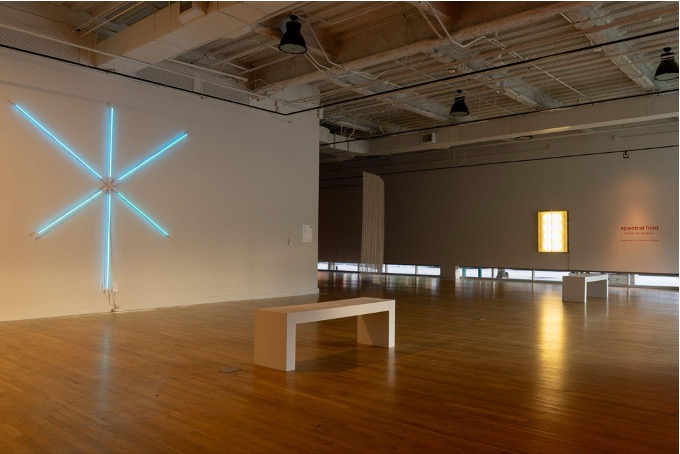
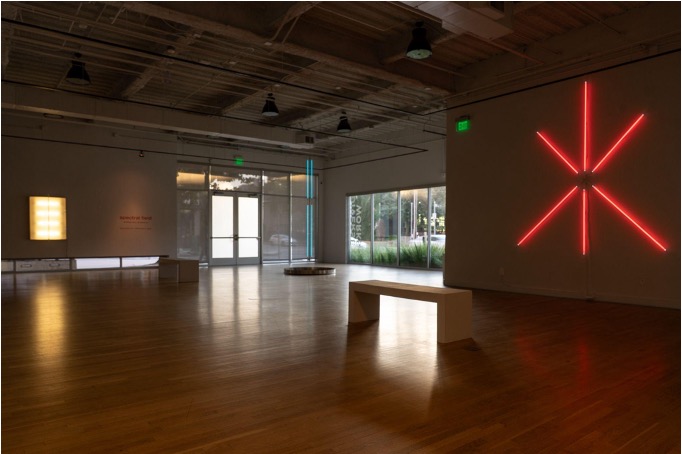
Figs. 5 and 6: Installation view of Anahita Bradberry, The Start of All Things (2025) [left] and The End of All Things (2025) [right], from “Spectral Field” (Midtown Arts & Theater Center Houston, September 20–November 8, 2025).
Standing between these two star(t)s, viewers are reduced to a coordinate in space and time. Between the universe at its expansion and at its death, they are at the temporal coordinate of now, the universe expanded but not yet receded. Although on Earth we most often encounter three states of matter—liquid, solid, and gas—plasma is the material of our sun, and the state of matter that is most abundant in our universe. To think of plasma in this cosmic frame is to feel the smallness of the human world. The sheer mass and scale of light that these pieces call up strips away the too-obvious significations of neon, leaving the viewer feeling a cosmic insignificance. This is, perhaps, the most extreme instantiation of Bradberry’s luminous opacity: a light so bright that meaning disappears.
: :
Moya Li