Lisa E. Harris introduced herself to the audience gathered for her artist presentation at ASAP/16 with a knowing caveat: “It’s a thing to have a bio.” Harris, an artist whose multimedia practice incorporates vocal performance, theremin, new media, and movement, among other forms, introduced herself instead through a series of roles generally left off the CV of the professional artist: a support to those in her community, a pet mom, the owner of a phone. An operatically trained soprano, she also described herself as having “run away from being a singer.” Yet her voice served as something of a vector of presence throughout her presentation, its shifts evidence of the registers of expression that become accessible when one refuses narrow professional categories of participation. In this spirit, as Harris used improvisational techniques to negotiate herself, as well as the fact of this particular audience (some apparently friendly faces, some—myself included—anonymous conference attendees passing through from out of town) in this particular place (an auditorium on Rice’s campus, in her home city of Houston), the pace of her vocalization shifted, as did her mode of address, moving between the conversational and the virtuosic.
In Harris’s broader practice, presence grounds an expansive approach to interlocking themes of place and memory. In D.R.E.A.M. = A WAY TO AFRAM, the first work she introduced, the place in question is speculative and memory ancestral. D.R.E.A.M. = A WAY TO AFRAM is an ongoing project exploring dreaming and sound as modalities of Black liberation; she developed the concept of Afram during a COVID-era residency with Ballroom Marfa. Tasked with the peculiar situation of making art in a moment when the future of live audiences was uncertain, Harris responded by practicing what she called “deep listening in the void,” tuning in to what became audible in the wide-open spaces of Marfa, Texas, as well as within the peculiar social rhythm of lockdown. One can hear traces of Harris’s relationship with the late Houston-born composer Pauline Oliveros; Harris is a trained facilitator of Oliveros’s DEEP LISTENING® methodology.
“Afram” arced from a playful phrase repeating in Harris’s mind to an alternative African America that offers a liberatory space for Black rest. D.R.E.A.M., the methodology by which one arrives at Afram, is an acronym for Diffraction, Restoration, Electromagnetic Analogue of Mass. The ongoing project has resulted in collaborative, immersive installations at Ballroom Marfa (2023) and DiverseWorks Houston (2023). At Ballroom Marfa, Harris shared a nine-hour guided dreamscape called Sleep on It, and the sound installation Dream Machine, a collage including spoken fragments of Harris’s own dreams. Listeners were invited to take respite within these sonic worlds, which played within a sculptural environment awash in warm light and adorned with windchimes and soft furniture, including two pieces produced by sound artist Maria Chavez.
As Harris described D.R.E.A.M. to the group assembled at ASAP/16, her voice picked up, assuming a musical sense of urgency. She then reintroduced herself with a list of what she makes, delivered over a recording of herself singing. In keeping with the details of her shadow-biography, her extensive list wove together the everyday, the absurd, and the speculative, including remedies, balms, and soups; compositions, juice, smoothies, frames, and change (coinciding with an image on the projector of a crockpot filled with coins); money (“that’s an affirmation”); massive objects reclining; excuses; “new childhoods every day.” Working, as she does in some of her live performances, to keep time with a video playing beside her, she paused to observe when she had fallen out of sync with the accompanying media. This, she noted, was an opportunity for rubato: the musical technique of reclaiming time through a change of pace, in this moment a slowing-down.
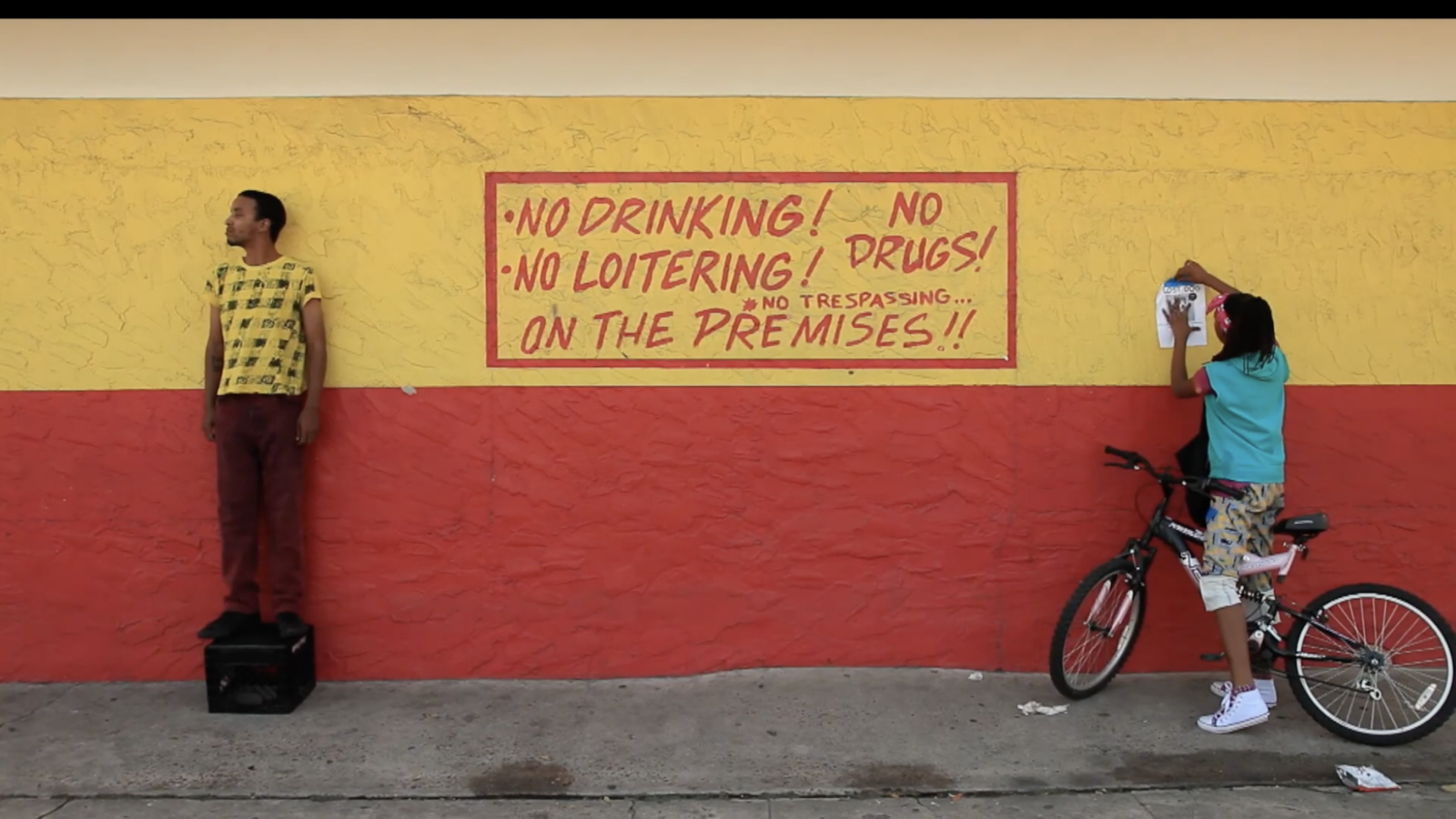
The question of how to document slowed time motivates Harris’s operatic work Cry of the Third Eye, the third act of which Harris screened as a conclusion to her presentation. The work comprises three parts, filmed between 2011 and 2020; it can be screened as three videos, or, in its live iteration, viewed as a multimedia performance during which Harris accompanies the videos with live vocals and instrumentation. In this work, the place documented is Houston’s Third Ward, and memory serves to collect details of that space and its inhabitants during a decade of ongoing gentrification. The Third Ward is a historically Black neighborhood that abuts Downtown and the Museum District. Within its present boundaries are both the University of Houston and Texas Southern University, as well as Emancipation Park, which under Jim Crow was the only public park where Black residents of the city could gather.
Like other historically Black neighborhoods in the American South (New Orleans’ Seventh Ward, or Walltown in my own city of residence, Durham, North Carolina), increasing interest from developers and the rising price of housing have displaced the Third Ward’s historical population and shifted the architecture, built and social, of the area. Harris follows her intergenerational cast, who are variously interviewees, actors, and collaborators, from 2011 to 2015 to 2019. The Third Ward itself serves as a character, too, animated through images of its in-betweens: the patches of undeveloped land along which its inhabitants walk and bike, the guts of its houses, a digital mock-up of a building to come.
In the first act of Cry of the Third Eye, gentrification is already underway, as we learn from both Harris’s vocal score and her conversations with resident Anne, a wealth of local history. By the third act, “The Last Resort,” filmed in 2019 and 2020, Tamirah Collins, whose (metaphorical) search for her lost dog opens the first, is now in college and speaks with Harris over Facetime. There is a sense throughout this final section of the work of loss confronted, rather than anticipated or corrected. The grammar of protest gives way to elegy, as well as the question of what comes in its wake. Anne takes Harris on a search for a manhole where a murdered woman’s body was found. Harris captures the last day of her beloved dog’s life, including a heartbreaking clip of herself singing the pet “Amazing Grace” at the vet’s office in his last minutes. The camera traces a street-level view of partially demolished buildings, college athletics facilities, and chain businesses, the soundtrack giving way to a non-diegetic piano number in which Harris asks a lover to promise to love her “forever and a day,” amid the cyclical inevitability of life’s many endings. Tamirah laments her childhood, its carefree innocence now behind her as she confronts adult responsibilities.
Within but also between these clips, the everyday of the Third Ward and its residents persists, and Harris’s opera finds music as much in the strange ordinary details of that place as it does in its notable losses. One interstitial scene depicts Harris depositing fifty pounds of recyclable cans in a sorting machine, set to a rap delivered over staccato a cappella vocalizations: “Don’t tell me what you can’t do/tell me what you can do.” Jhannia Mitchell, who enters the work in the second act as an uncertain toddler, in the third becomes a force, dancing and hamming it up for the camera. At one point, she dances atop a set of stairs where she was depicted standing in act two; those stairs, we learn, are set just above the manhole sought out by Anne, the history of brutality and the joyous promise of the future layered within the same space. Mitchell runs down the changing streets of the Third Ward screaming and, via some delightfully crude animation, is depicted riding her bike up and along the telephone wires that crisscross the neighborhood. Her childlike irreverence extends Harris’s own playful sense of humor, which itself is a source of form for the opera, and for Harris’s work more generally.
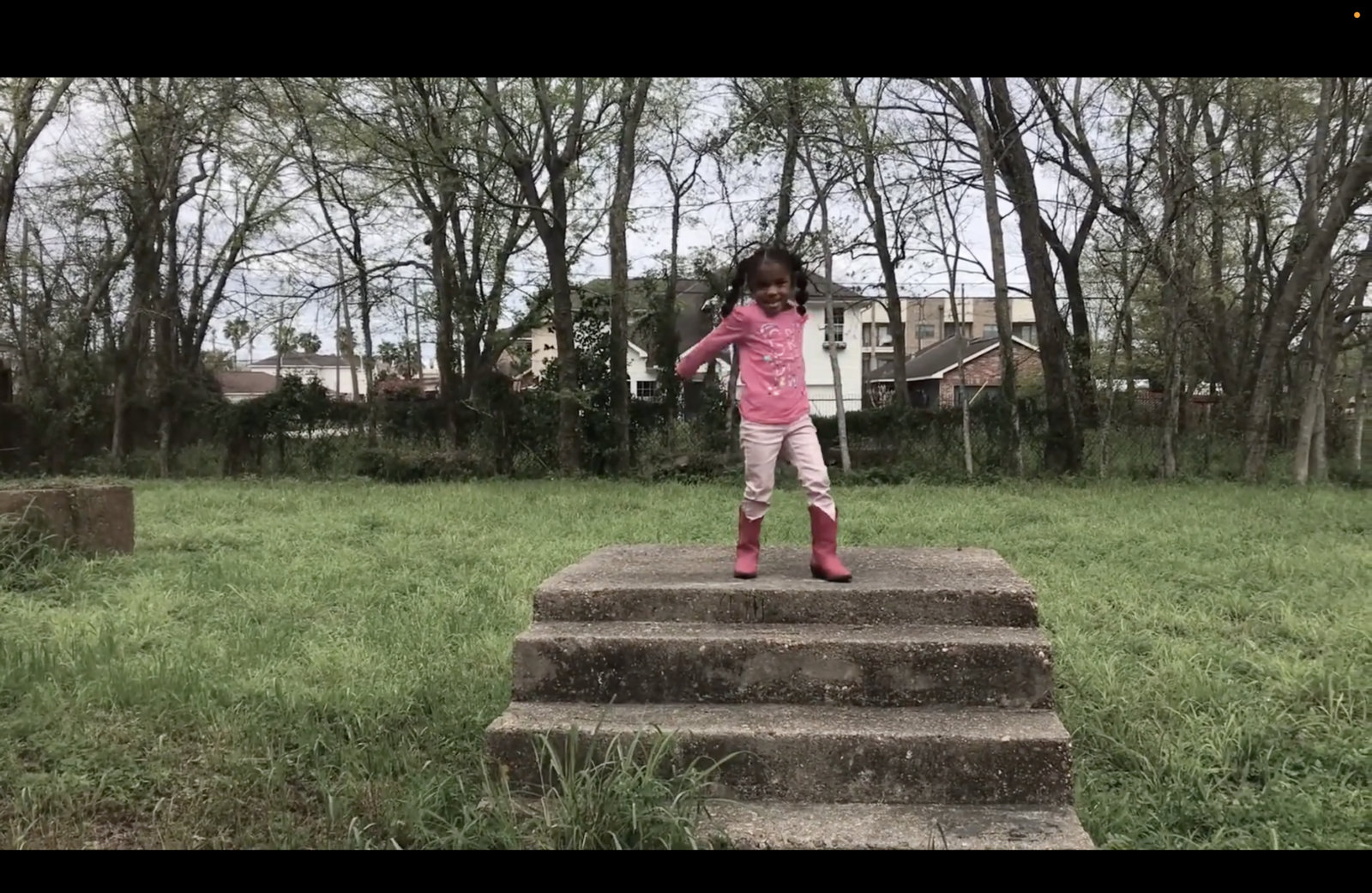
The opera closes with an image of Mitchell playing Harris’s theremin, gleefully experimenting with its space-age sounds as the camera lingers for a beat after she announces “cut.” Like Harris’s presentation, Cry of the Third Eye knits together registers of expression from the sincere to the critical to the utterly sideways, all of which combine into a presence attuned to music’s many forms—and the many forms taken by everyday kinship in a gentrifying neighborhood.
: :
Thea Ballard