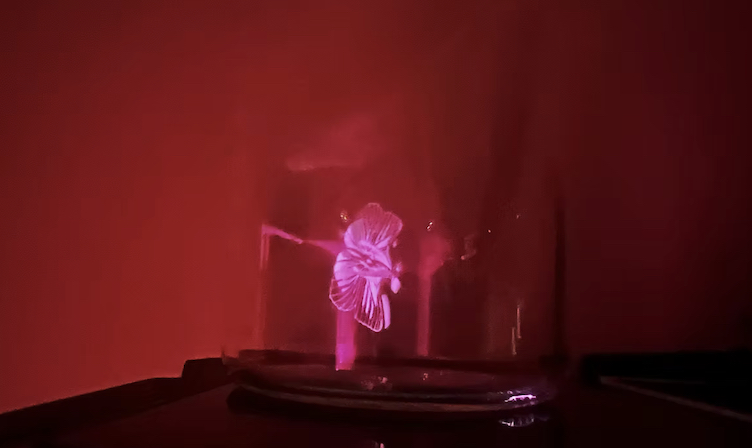
What might happen when a Venus Butterfly bioprint (Figure 1) twitches with the synchronized pulse of heart muscle cells embedded within its wings? The bioengineered forms that emerge in my work, like the Venus Butterfly, are uncanny and speculative, existing beyond familiar narratives of bodily control, particularly biomedical storying often imposed upon female bodies. Bodily reconstruction becomes a creative material practice through experimentation, failure, and the subjective reading of signals from what has been dubbed “semi-living” matter.1 In other words, vital material transformation is cultivated through a contemporary practice of tech-mogrification, through ritualized care and iterative dialogue with the still unknown/unseen—what I call “laboratory craft.”
My spellwork, developed in biomedical contexts as an artist-researcher, is conducted through structured attentiveness (called “protocol”), which is a costumed, highly intentional set of actions through which a kind of relationality with my materials is carefully maintained.2 Witching the scaffold describes a practice of biofabrication that is situated within science, while resisting its most narrow aspirations ultimately rooted in purity culture. Instead, I cultivate stranger, more embodied, and more ontologically rich biofutures from suspended cells and suspended disbelief.
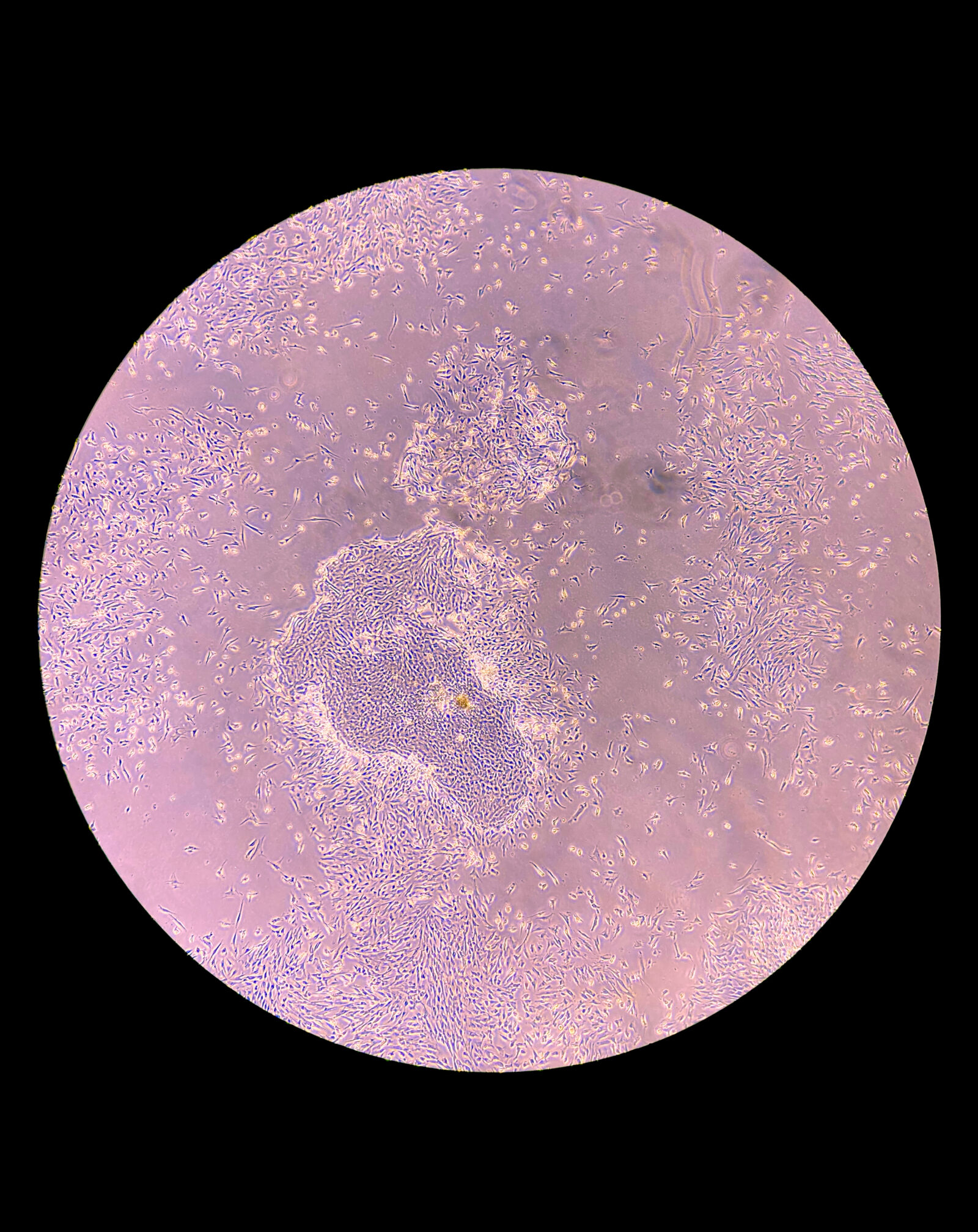
The reconstructed body begins in suspension: cell suspension. A vibrant cohort of living cells float in a phenol red liquid medium comprised of nutritive sugars, proteins, salts, and other substances. Tissues have not yet materialized from free-floating cells to 3D scaffold to cohesive construct; they must first adhere to the bottom of a flask or petri dish to begin their mitotic expansion. For now, they hover in an interstitial space between what was (their source) and what may come to be.
Producing the cell suspension is part of a process called passaging, carried out after in vitro cells have grown into a monolayer of fused tissue. This one-cell-thick layer is then soaked in dissolution enzymes which quickly break down the cell membranes to detach them from one another and dislodge them from where they had grown fixed to the interior surface of their container. Passaging is carefully timed to avoid cell death, allowing the integrated tissue to separate into individual, clear orbs without dissolving them completely. It thus marks a transition from fixed to fluid matter—from a progressive, lively state to suspended animation. In a biotechnology lab, such “bodies” are routinely held in these amorphous states. Their structure, function, and identity are alphanumerically coded and stored as potentialities derived from once-whole organisms.
Working within a requisite biosafety cabinet, which is a ritually prepared clean space, I passage my cultures of menstrual-derived cells to experiment with where I might influence them to transition next. Long, millilitre-demarcated pipettes are waved back and forth in my gloved hands, from tube to flask through a field of HEPA-filtered air, as I dispense measured amounts of cell suspension into sterile vessels to create new cultures. Other times, I may blend the cells into a syringe full of gels prepared for use in a 3D bioprinter, creating potently animated bioinks. Sometimes, I put the cells into cryogenic stasis, a frozen slumber within tiny screw-top plastic vials submerged in liquid nitrogen, only to conjure them back by thawing, to revivify later for new sets of experiments.
Viable cells can reorganize in curious, unfamiliar ways, especially on creative scaffolds designed to coax new structures into being. In my practice, I approach cell culture and tissue engineering processes as a provocation: individuated, disembodied materials have the capacity for new assemblages beyond typically desired biomedical outcomes. By working between lab protocols and an art practice grounded in feminist performance and body politics, my bioengineering becomes a rich conceptual space for re-authoring bodies, by biochemically instigating non-normative morphologies.
: :
The Reconstructed Body as Shapeshifter
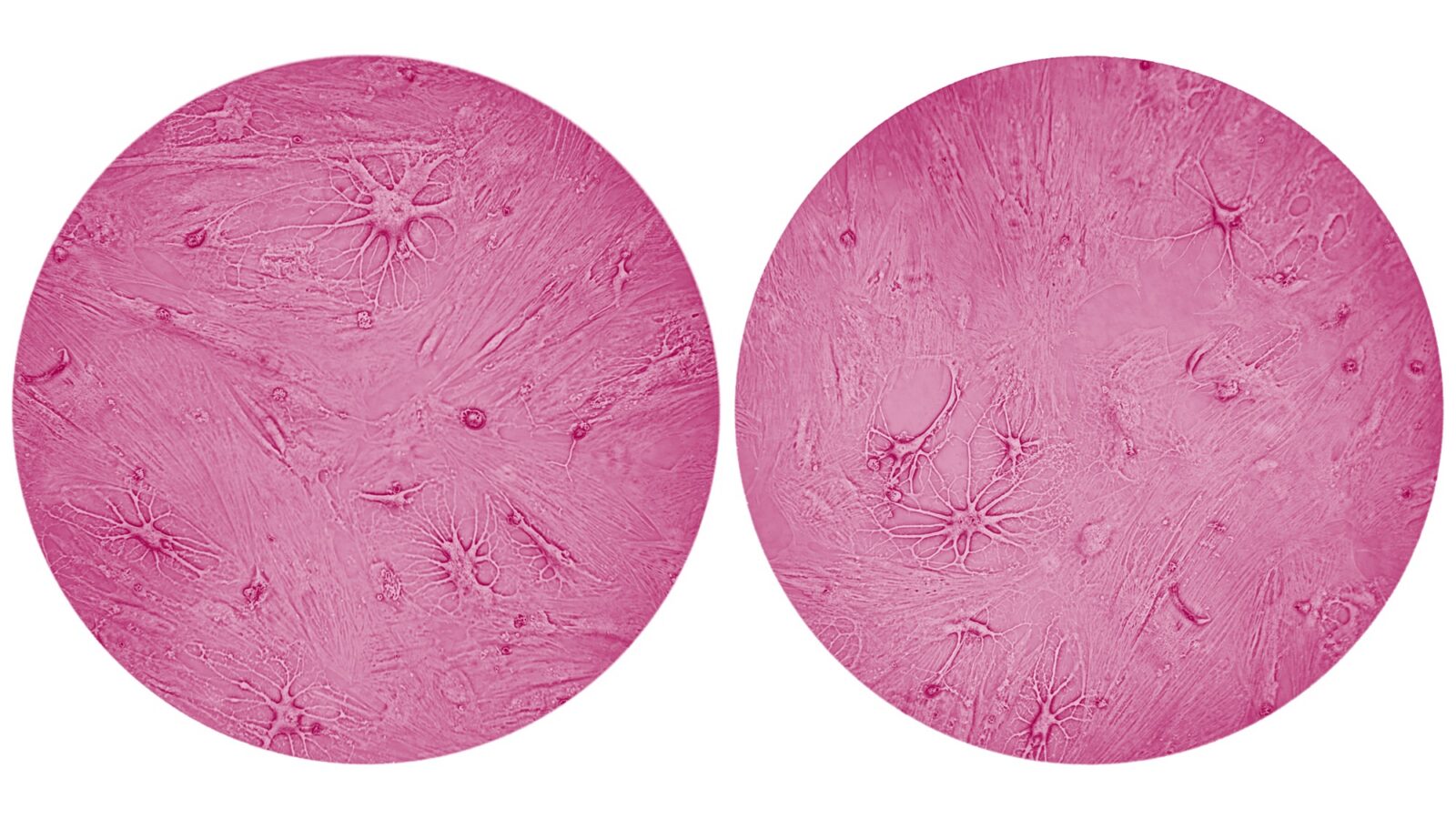
The reconstructed body is a transitional entity that ontologically morphs at the cellular level first. The menstrual-derived cells I use, sourced from my own leaky body, have nebulous characteristics. They may spontaneously differentiate to neuronal precursors called astrocytes, for example, without any biochemical prompting from me. Other times, they form islands of one morphological type within a larger colony of another, indicative of their heterogeneous mix. Yet other times, they simply give up the ghost with no clear cause of distress. These cells are grown within controlled conditions but are compelled by other factors that sometimes resist an easy explanation. I may call forth their autopoietic agencies through specific nutrients and growth factors, but the “will” to perform (or not) resides within them. Their curious shapeshifter qualities lend well to my projects with reconstructing organs and tissues for speculative future bodies.
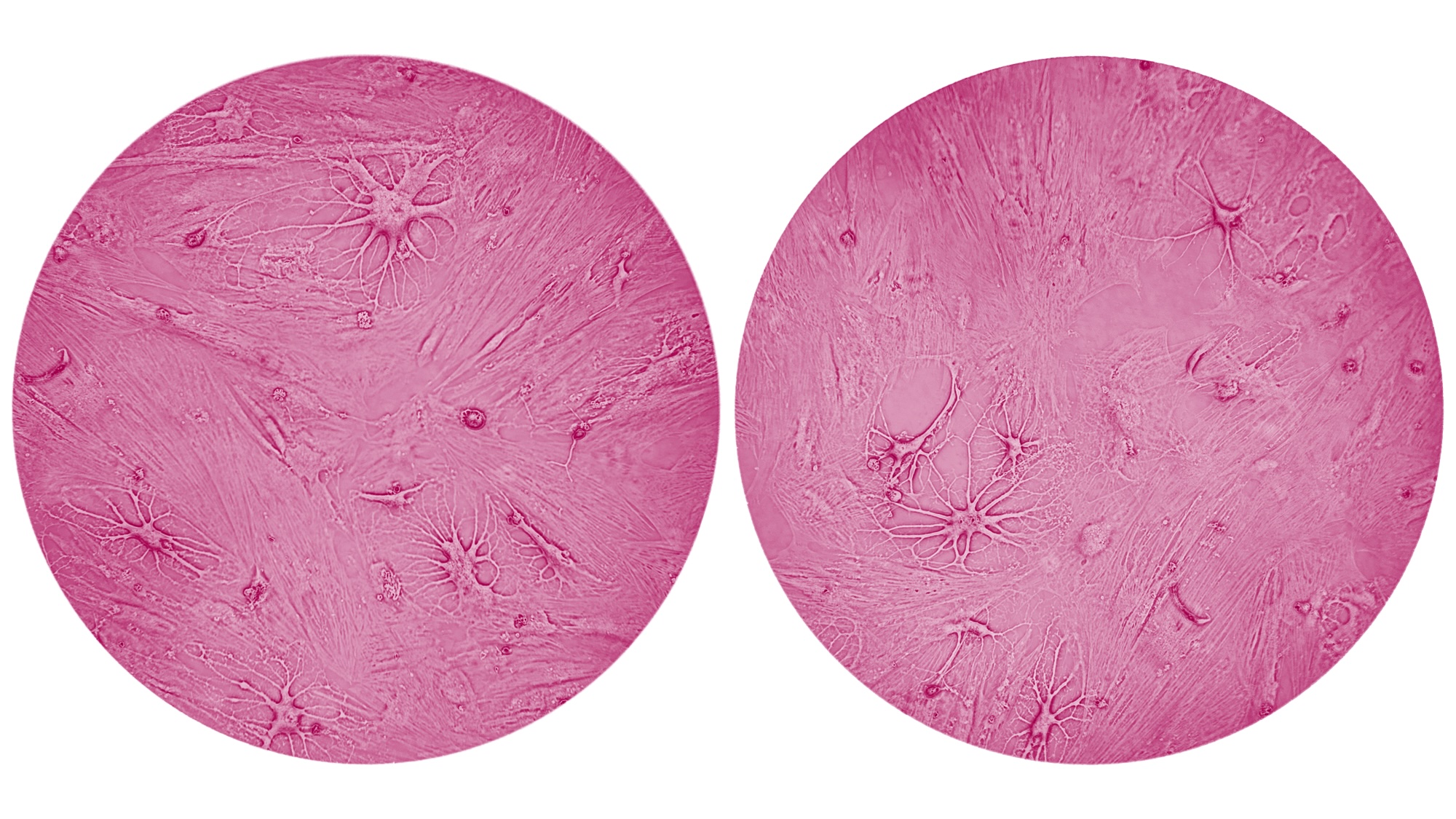
The healing and remaking of tissues function through microprocesses of becoming other than what was. And physiological transformation is likewise the recompositing of existential meaning: healed wounds leave scars of negotiation between life and death. Pregnancy, for example, embeds stretchmarks in skin that has been pulled to its limits; lightning sigils of silvery tissue streak in lines across the body to story the flesh, visibly changing identity. The body repairs itself from one imperfect state to another, an artful morphogenesis.
To reconstruct, from a tissue engineering perspective, is to induce this sort of state change. Cells that originally formed together in one configuration are disassembled, redistributed, ejected, or extruded into another shape. The original form is renegotiated through practices of ritualized maintenance and care. Tissue reconstruction is thus a material spiritual practice of shapeshifting, following María Puig de la Bellacasa’s reading of Susan Leigh Star: refusing the reduction of complex entities into singular categories, and instead noticing and inhabiting ambivalent spaces between classifications.3
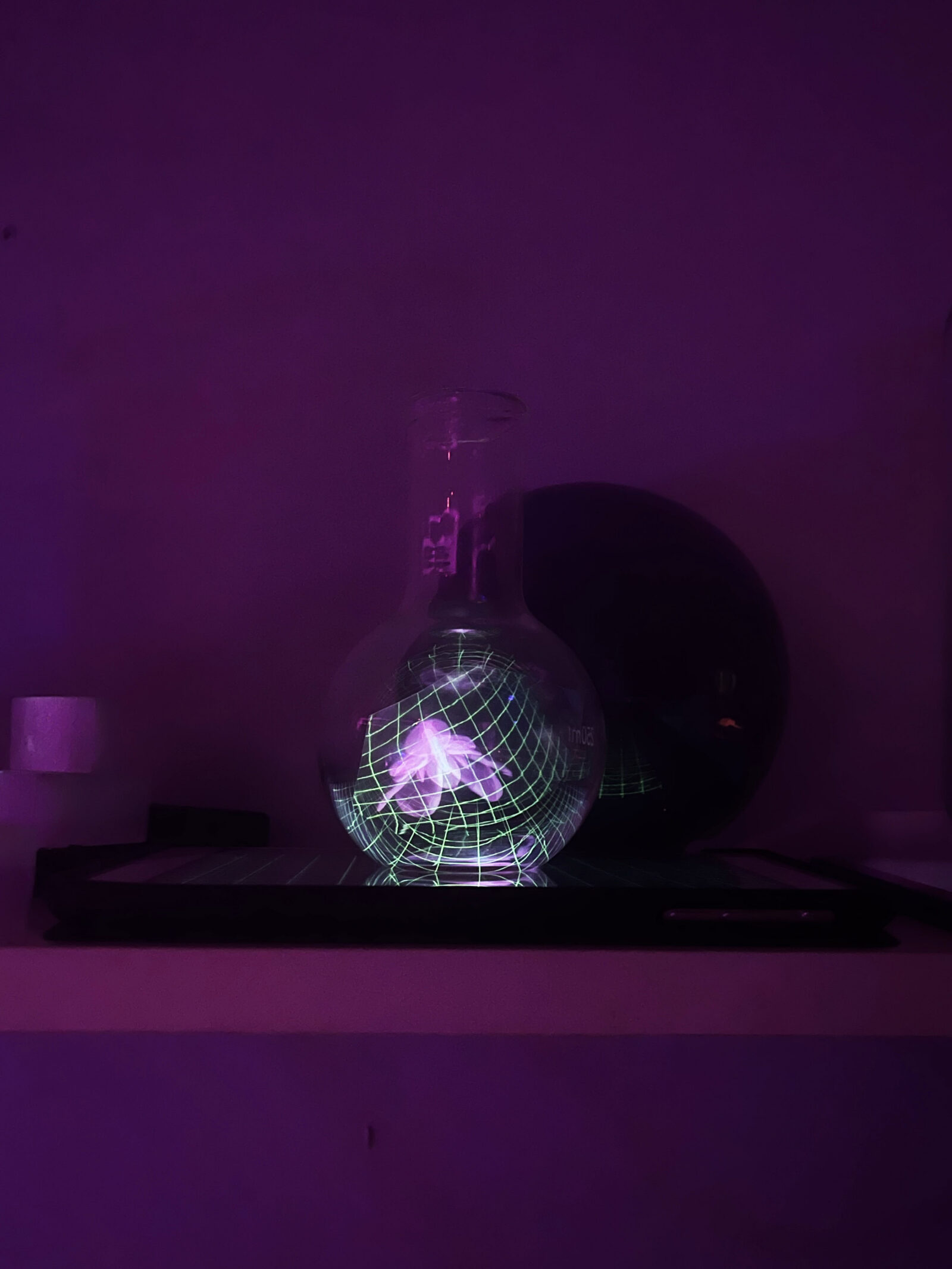
Under the ultraviolet glow that solidifies the bioprinted gel, and to the mechanical music of the printer moving across x, y, and z axes, fragments of possible life are arranged into forms that have never existed. My interspecies constructs, such as the Venus Butterfly or the orchid-clitoris, trouble notions of familiar bodies, queering and transmuting them. The bioprints may also contain my stem cells differentiated into other cell types: neuronal or cardiac, imbuing the new organ structures with capabilities beyond their native forms.
In my work, bioprinted organs are characterized by material quirks and contingencies: partially dissolved, suspended, and reassembled. They become creative variations of the original, crossing over tech thresholds into aesthetic alteration, bearing the marks of passage through syringe tips, enzymes, liquid, and wavelengths of light. I use these contingencies to imagine and design provocative ways of reconstructing bits of bodies that could inhabit new morphological identities in uncertain futurescapes. They represent a new ontology, emerging through my witchy-informed bioengineering skill.
: :
The Lab as a Ritual Chamber of Care
The standard tissue culture laboratory is bureaucratically imagined and formally instituted as a space of control: as sterile as possible, rationalized through risk assessment, and engineered toward repeatability. However, labs do not represent neutral containers of scientific truth; they are highly constructed spaces shaped through hierarchical chains of organizational procedures and canonized beliefs.4 Authority is derived from the management of contamination and standardization of outcomes. Despite this, when working closely with organic or living matter, the lab is a more unstable space. The machine-supported, semi-living forms must be interpreted and cared for through repeat gestures that are both technical and affective. The affective nature of experiments becomes amplified when working with one’s own body materials.
To culture cells means committing to a schedule of obligations: feeding, warming, rinsing, passaging, waiting, watching for signs of stress or contamination through microscopic scrutiny, and adjusting conditions in response—weekends be damned. These procedures are, ultimately, acts of devotion to entities whose needs can be anticipated but not fully scripted in advance. The practitioner learns to read subtle shifts in colour (a pH indicator), fluid opacity, adherence, growth rate, and shape. A flask of cells speaks through these signs, and the work depends on learning how to notice them, developing an individually-attuned cellular fluency.
Within the biosafety cabinet, movements are choreographed: gloves are sprayed with ethanol, tools arranged to support the stasis of a purified field of air, bottles opened and closed with care to preserve asepsis. Pipettes hover without touching any surface, tilt into flasks, and release. This space requires specific preparation and some adherence to a logical sequence. It is, literally, a threshold practice where one passes from the ordinary room into a protected zone of encounter with transient beings.
For my technofeminist practice, such a poetic reframing matters. The history of biotechnology has privileged extraction and optimization, obscuring the labor that experimentation depends upon. Maintenance work—the cleaning, feeding, record-keeping in lab notebooks, troubleshooting, and emotional fortitude to begin again after (almost certain) failure—is relegated to the background, in favour of sensationalized innovation narratives. However, care work in the lab makes the discoveries possible; it isn’t secondary to technoscience but rather, its occult infrastructure. To re-imagine the lab as a ritual chamber of care is to bring such technical labor to light, to demonstrate that technical maintenance work is epistemically significant.
This is even truer when the tissues have emerged from my own body and remain entangled even after physical separation. In culturing menstrual-derived cells, I am not working with anonymous/anonymized biomatter but with an intimate substance that resonates with cyclical time and culturally devalued associations. Menstrual blood, typically cast out as waste or taboo, becomes my temporal and meta-physical basis for speculative organ reconstruction. The ritual chamber of care, then, functions in part as a site of symbol reversal. Material that has long been dismissed (and occulted) is instead cultivated as powerfully generative. The lab is a place where abject material becomes a source of profound knowledge and futurity.
To perform and aestheticize care in this setting doesn’t necessarily sentimentalize living matter. Indeed, cells die or get regularly tossed in the biohazard bin. In-progress scaffolds collapse in temperatures too warm to keep their gelatin substructure solidified. Contamination can maddeningly appear after days or weeks of labor. But care persists precisely because the outcomes are uncertain. It does not guarantee the success of experiments but instead is positioned as an ethical stance towards material/life’s precarity. Thus, the lab is copasetic with spaces of feminist maintenance practices and embodied knowledge production: the kitchen, the studio, the sick room, the home altar. All these are protected circles for enacting repeated, skilled, very personal, and often under-recognized rituals of conjuration and craft. The tissue culture lab joins this matriliny when understood as a space where tenuous, possible bodies are painstakingly coaxed from amorphous appearance into partial existence.
: :
Bioprinting as a Divinatory Act
Divination is widely perceived as an act of deciphering a fixed future. More accurately, though, it is a method of reading patterns, noting tendencies and symbolic or eventful relations (synchronicities) during times of uncertainty. It is, ultimately, subjective meaning-making. To refer to the earlier terminology I used: it is a technique of interpreting contingencies. Bioprinting, in my practice, works similarly.
Each bioprint begins from a coded design to build a wet, floppy scaffold through a sequence of precise coordinates. What results from the print never entirely resembles the initial plan. The printer translates digital instructions through multi-speciated bodily matter (vegetal alginate, porcine or bovine gelatin, human cells, etc.), so the translation/transmutation is unstable. Bioinks swell, slump, drool from the needle, collapse, jump out of line, or unexpectedly hold. Cells cluster, differentiate, or succumb to shear stress and perish. Photo-crosslinking the bioink with UV works to stabilize a gel form but can also mutate live cells. Moisture, weather, viscosity, material percentages, timing, and extrusion pressure all shape the final form. Bioprinting does not neatly commandeer matter into new forms; one must consult with matter as an agent, through trial after trial after trial. Each print is a record of how semi-living materials respond under specific conditions, and the next time may be different. The scaffold is, therefore, a suggestion for another way that matter can become. It is an ontological construct (Figure 5).
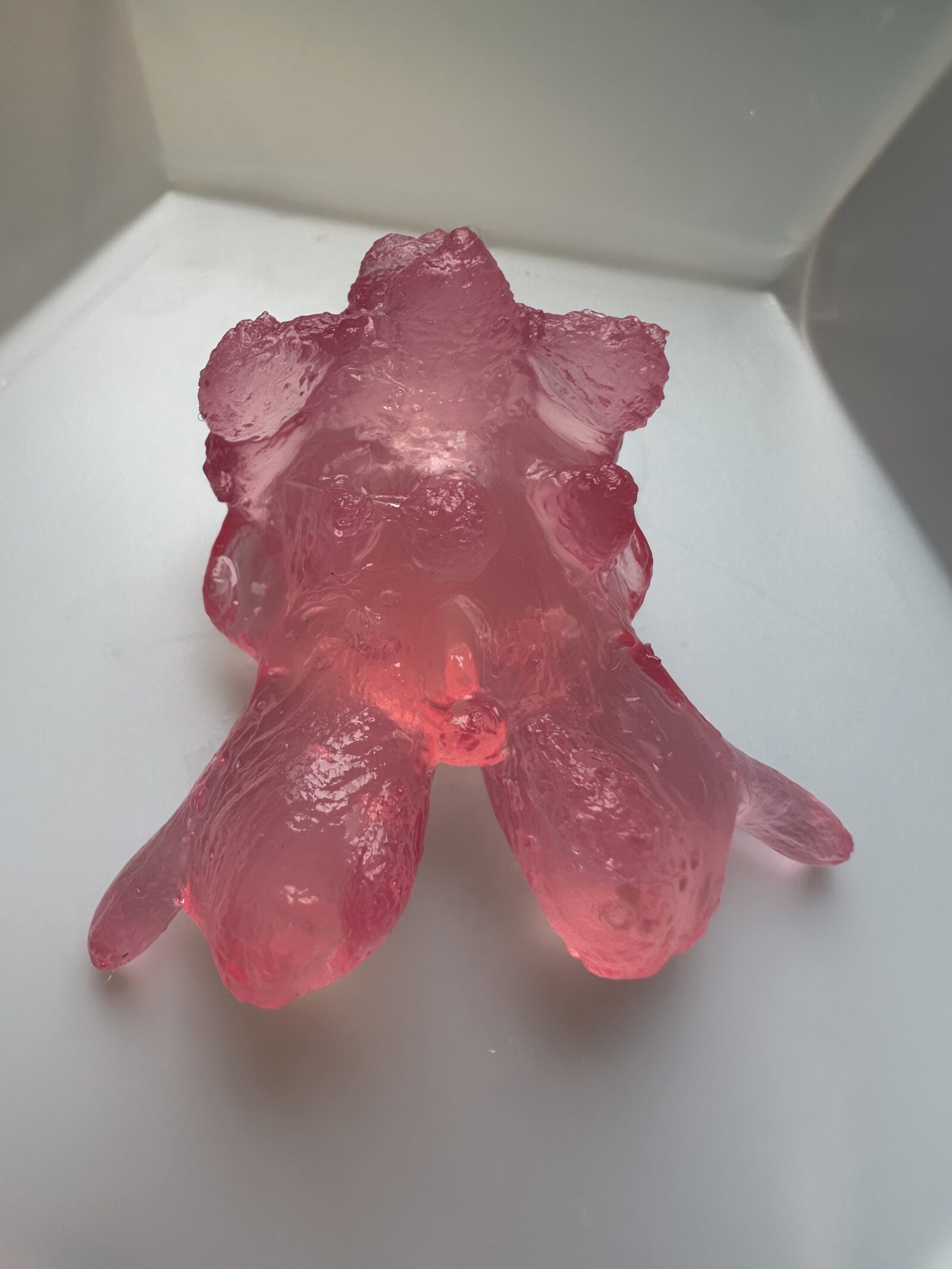
I understand my bioprinted forms—such as the orchid-clitoris, vulvar-lepidopteran, bat-human auricle, and other non-normative constructs—as something beyond sculptural propositions. They inquire as to how far the body can be weirdly conceived, when cells, gels, and structures are encouraged into quivering, unfamiliar things. One might say that a print operates as a spread of cards, or other -mancy: an arrangement of latent possibilities that have become perceptible to the skilled reader.
In my work, this is a political and aesthetic matter, both. Mainstream bioprinting attempts to be efficacious, cost effective, scalable, investor-worthy. A feminist approach is interested in other questions: What kinds of bodies are imagined when pure function is not the starting premise? What could reconstruction mean outside of normativity? Bioprinting, as a divinatory act, facilitates an initiatory encounter with the never-before and the not-yet.
Through such a lens, the bioprinter serves as a mediating device between intention and emergence, code and wet matter, desire and material response. Its movements along the x, y, and z axes lay down filamentous evocations, each layer depositing a question into its programmed matrices of space. The wobbly architectures that result are evidence that the body is more morphologically and meaningfully open than biomedicine yet admits.
Witching the scaffold reframes mystified scientific practices as direct, personalized, and affective practices, while shifting feminist material culture from representing possible bodies toward materially prototyping and rehearsing them. The artworks do more than critique biomedical normativity from outside it; they use material processes to manifest and test how bodies might become otherwise.
: :
Endnotes
- Considered “semi-living” because the liveliness of the tissue and cell constructs are entirely dependent on laboratory infrastructure and broader systems of support. For more, see: Oron Catts and Ionat Zurr, “Semi-living Art,” Signs Of Life—Bio Art and Beyond (MIT Press, 2007): 231-247.
- This practice has been developed through access to biomedical laboratories via art-science partnerships: the Central Nervous System Repair Lab (Hodgetts Lab) in partnership with SymbioticA at The University of Western Australia; the Graça Lab at the Gulbenkian Institute of Molecular Medicine at the University of Lisbon, in partnership with Cultivamos Cultura; and the Wegmann Lab at DZNE/Charité Berlin University Research Hospital, in partnership with Art Laboratory Berlin. These sites have enabled me to work autonomously within scientific research environments as an artist-researcher, while bringing methods, questions, and material propositions of artistic practice into those spaces.
- Maria Puig de la Bellacasa, “Ecological Thinking, Material Spirituality, and the Poetics of Infrastructure,” Boundary Objects and Beyond: Working with Leigh Star, edited by Geoffrey C. Bowker, Stefan Timmermans, Adele E. Clarke and Ellen Balka (MIT Press, 2016): 47-68.
- Bruno Latour and Steve Woolgar, Laboratory Life: The Construction of Scientific Facts (Princeton University Press, 1996).

WhiteFeather Hunter