A friend recently told me that she discarded childhood photos of herself in a homemade ghost costume. “The way the seams of the sheets lined up over my head looked like a Ku Klux Klan hood,” she lamented. But it wasn’t a coincidence by any stretch. The “White Sheet Ghost” belongs in the dirty laundry of white supremacy’s history. Every Halloween, headlines pop up in the national news about costume controversies that mark confusion about whether or not a ghost costume looks too much like Klan regalia, or outrage that a group—usually high school or college students—has dressed up as the Klan for a party. ProQuest’s database is heavily peppered with them: in 1993, two California teenagers won a costume contest after they donned the hood and pretended to lynch a classmate in blackface; the Halloween after 9/11 saw an uptick of white supremacist costumes at fraternity parties, with at least three universities having to launch investigations; in 2016, Citadel cadets claimed they were dressed as “Ghosts of Christmas Past” despite their costumes looking a great deal more like Klan hoods; and, in 2022, an Ohio police precinct dressed their mounted unit’s horses up like ghosts.1 As one resident pointed out, “You go back and look at pictures of the Ku Klux Klan, it’s like the exact replica of what the horses looked like.”
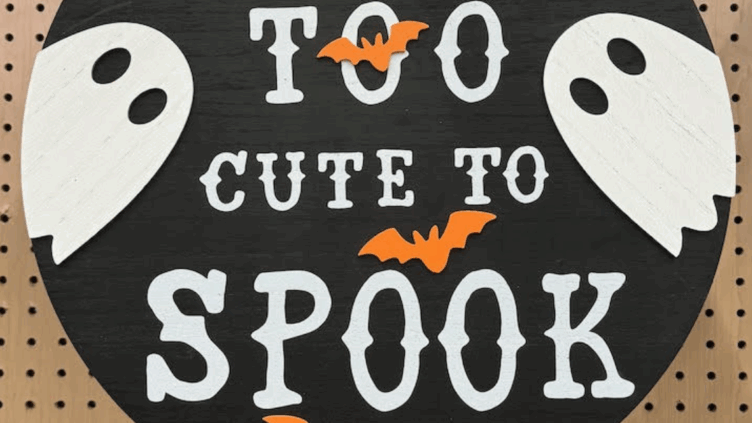
The white sheet persists as one of the most common decorative motifs for sale on box store shelves and displayed on front porches across the United States this past Halloween season, as it has for years. Americans’ taste for the sheet has been explained as a holdover from an earlier historical period that relates its popularity to pre-20th century burial shrouds. More recently, the bedsheet-ghost figure has leaned into twee trends on social media around beloved Hollywood film franchises like Beetlejuice and Halloween. Those referents, however, do not make the painted shiplap signs at Walmart that depict flocks of little ghosts and read “Too Cute to Spook” any less historically fraught, culling up a reminder that “spook” circulates in historic texts as a racial slur. “Spook,” David Marriott finds, “reveals a connection between race and terror, magic and surveillance, idolatry and power; as a verb it makes visible the impenetrable unseen that our self-deceptions bid us master and so keep us at a remove.”2 The white sheet ghost costume and “spooky season” are synonymous in this way and others, blanketing over the anti-Black images and epithets that would—should—make Halloween harder to celebrate in the United States. Like a “spook,” Avery Gordon insists that a ghost “is not the invisible or some ineffable excess. The whole essence, if you can call it that, of a ghost is that it has a real presence and demands its due, your attention.”3 Scholars like Gordon and Tiya Miles—who have examined the sociological and historical dimensions of ghosts, respectively—teach us that an American haunting is always a racial [and] capital enterprise.
Very little academic literature exists on the history or aesthetics of Halloween costuming, let alone on the holiday’s problematic racial inflections. Critical attempts to route the history of the shrouded figure to a pre-American past often conveniently overlook how American racial formations are and have always been a major aspect of Halloween’s commercialization. This essay addresses these omissions by unveiling the White Sheet Ghost (also known as The Bedsheet Ghost) as an American racial signifier. Building on Marxist frameworks that situate “haunting” within the context of American racial capitalism and historical trauma, I push back on parallel theorizations that praise a “ghost” as a literary or aesthetic practice which illuminates “uncanny” aspects of modern life. The ghost of which I speak is real, has an explanation, and, in the case of its mistaken identity, is a tie that binds Halloween to white supremacy. Halloween ritualizes consumer engagement in American racial aesthetics and hastens the historical erasure of white domestic terrorism. All one must do is look back at the eyes that peer out of the sheet, and cast a gaze down at the feet beneath it to see plainly how and why.
: :
The Ghost & The Sheet
Re-seeing how the sheet and the Klan are entwined lays bare what Americans choose to forget about their second favorite holiday. American Halloween prioritizes kinds of novelty and shock value borne of what is most readily available and then the most easily discarded—and disregarded—the next day. Between the early and mid-20th century, Halloween costumes were made either out of crepe paper or recycled materials, ensuring they would always be disposable. Crepe paper ushered in what was likely the first fast-fashion craze in the United States, replacing expensive textiles with inexpensive textile-like paper that one could craft into elaborate outfits for pennies on the dollar. The king of the crepe paper industry was Dennison, which was also the most prominent American purveyor of prefabricated holiday decor in the first half of the 20th century. For decades, the Dennison Manufacturing Company published catalogs called The Bogie Book to instruct consumers on celebrating Halloween and Thanksgiving with the company’s merchandise. The 1917 Bogie Book, perhaps the most prized by contemporary collectors, contains a two-page spread of a dance hall is lined by crepe paper versions, each with a pointed head. A few pages later the Book insists a sheet is hardly the cheapest or quickest costume option, assuring readers can “use paper bags to slip over . . . boys’ heads or the Ku Klux Klan head-gear.”4 That Klan hoods might just as easily fit the bill as paper bags on the eve of the Tulsa Outrage of 1917 demonstrates more than a casual link between holiday costume play and racial costume play. In fact, both Halloween and bedsheet ghosts provided essential alibis and reference points for the Klan’s terror.
The association between Klansmen and ghosts is far from coincidental, even if the origin of Klan regalia is a point of contention. Many historians have concluded that the Klan took up the sheet and hood to represent the Confederate dead. Others, like historian Elaine Frantz Parsons, contest this claim by citing the influence of carnivals, minstrelsy, and European Easter parades. Before Reconstruction, there was little homogeneity in the KKK’s regalia. The success of D.W. Griffith’s Birth of a Nation in 1915 freely advertised the white sheet outfit with eye holes and a conical hood. A mail-order catalog for such robes soon circulated. From this point forward, the all-white robes became the standard uniform of the Klan’s rank-and-file.5 Unsurprisingly, news stories across the 1910s and ‘20s captured a tendency for Klan costumes or Klan-like gatherings to happen at Halloween parties. Halloween thus provided a circumstance for lynchings of Black people who have gotten in the way of white enjoyment. In October 1922, for example, a U.S. Army newspaper reported that a Halloween party at an Officer’s club on the Coblenz, Germany Army base was such a “huge success” that the “Ku Klux Klan gathered en masse at the club . . . and when one colored gentleman refused to keep the place given him he was hung to the old apple tree”, and the hundreds who witnessed the lynching dispersed before police arrived.6 The Klan robe has made it into the news around Halloween every single year since The Tulsa Outrage—often as an outrageous costume, sometimes as a symbol of violent acts, and occasionally as a sign of American ingenuity. In October 1977, a Chicago Tribune feature on costume shops celebrated one in particular because “when an order for 20 white nun’s habits was in danger of not being filled, a quick-thinking stylist remembered a stash of Ku Klux Klan robes.”7 No wonder such a solution could be taken in passing when Louisiana’s Joint Legislative Committee on Un-American Activities received national attention in 1965 for stating that the Ku Klux Klan was a political action group “with a certain Halloween spirit” that filled the need for citizens to express “frustration with the current national administration.”8 The Klan possesses a spirit, indeed.
Whether or not the Klan dressed up as ghosts of the Confederacy, the striking resemblance between Klansmen and ghosts has made its way onto American courtroom dockets, where lawyers and Klansmen deployed the sight (or citation) of a “ghost” to sway criminal and civil proceedings in the Klan’s favor. In 1946, for instance, an order of the Klan filed an appeal to a Georgia court ruling that would revoke their charter by arguing, through administrative trickery, that they had not had an active charter since 1944. Because a board of trustees governed the chapter instead, they proclaimed, “You can’t do this to us—for we are not as the others are—we was, we were, but now we are not—we are ghosts!”9 What is inconsistent with the argument that the resemblance between Klansmen and ghosts started only once the regalia was standardized by the success of The Birth of the Nation, is how often ghosts were the subject of questions and testimonies presented to the Congressional joint select committee that investigated the affairs of insurrectionary states in 1871 and 1872. Historians H. Grady McWhiney and Francis B. Simkins closely tracked references to ghosts in a 1951 article for the Negro History Bulletin to question the mythmaking that led both other historians and the Klan itself to believe “idle Negroes thought they had seen ghosts” when they encountered the Klan. They argued the portrayal of victimized Black communities as being afraid of supernatural forces rather than physical violence served to obscure the Klan’s brutal tactics of racial intimidation and oppression.10 McWhiney and Simkins thus wondered, “Can it not be concluded that the supposed ghostly effectiveness of the klansmen was an afterthought invented to fit into the white man’s inherited stereotype of the American negro?” The white sheet fits this narrative like a glove.
The resemblance between bedsheets and Klan robes is all over the print record, but I will stick to snapshots from news coverage of Klan activities in Connecticut, where I lived while researching this essay, to show that the white sheet has been the Klan’s stable signifier for over a hundred years. A 1922 article from The New Britain Daily Herald spoke of a recruiting campaign in nearby Southington by the Knights of the “Invisible Empire” (a local sect of the KKK). The article’s author believed that “Since there have been no bed sheets or pillow cases reported missing, it is not though[t] that they had any perceptible degree of success.”11 The sheet simply never faded from news coverage. By the 1980s, local and national papers offered up headlines about changes in New England’s KKK leadership with quips like “Northeast Klan Turning Over a New Sheet.”12 A 1984 profile of Connecticut’s Imperial Wizard-Elect in The Boston Globe described then Shelton-resident James A. Farrands as “a wisecracking Former Boy Scout Leader” who sent “his white Klan sheets out to a ‘Jewish laundry.’”13 More recently, a 2023 editorial in the Hartford Courant proclaimed that “it is time to take the sheets and hoods off the 21st-century Klansmen” who now wear business suits to hide in plain sight.14 There are thousands more examples that all tally up to the conclusion that a “white man” in a “white sheet” is a strong indicator that one may be encountering a Klansman. Alas, what many historians, theorists, and critics can seem to agree on is that the more mainstream white supremacy is, the less likely a Klansman feels he must hide his identity under the sheet.
: :
The Eyes & The Feet
Waves of amateur, craft, and mass-produced art objects and decor pieces featuring the white sheet ghost always seem to enter into commercial circulation amid rising tides of white supremacy. As I drafted this essay in early fall, my Instagram feed is filled with children in ghost costumes, dogs and cats in ghost costumes, and homes decorated with ghost costumes. Bits of the films that played on repeat in my ‘90s childhood home cue up again in my mind’s eye. And now, memory snags on the eyes and the feet—those places where the sheet does not stretch, or where holes interrupt the folds in its fabric; places where the white body that gives form to the sheet ghost appears. In Halloween (dir. John Carpenter, 1978), Michael Myers impersonates a victim by placing the victim’s glasses over the eyes of a ghost costume. In Beetlejuice (dir. Tim Burton, 1988), Lydia Deetz holds up a Polaroid of her home’s deceased former residents disguised in bedsheets to remark “no feet” the moment she realizes they’re not flesh-bound mortals. And then, of course, The Peanuts, covered in white sheets with black holes for eyes and brown shoes shuffling beneath in It’s the Great Pumpkin Charlie Brown (dir. Bill Melendez, 1966). Hardly a disguise in any of these films, the ghost costume opens up opportunities to haunt, to taunt, and to terrorize.
In each, the eyes beckon notions of white surveillance—either through judicial or extrajudicial policing—while the feet are suggestive of the free-floating mobility of white bodies. Michael Myers, whose first-person perspective the audience inhabits through the eyes of his mask, polices the sexuality of the teen girl he slays while impersonating her boyfriend dressed up as a ghost. The couple who attempt to haunt the home of The Deetz Family take up sheets in their first efforts to adjudicate who has a right to the property. The Peanuts, all dressed in ghostly frocks, jeer Linus as he chooses to spend Halloween waiting for The Great Pumpkin. Across the spectrum of these assorted texts, is both a doting relationship to the aesthetics of the Northern U.S. in autumn, sure, but there is also an indication that even though some ghosts cannot pass through walls, they can do and judge as freely as they please. Their feet—the only thing that can distinguish one ghost from another—walk them to treats, but there is no shortage of tricks along the way. As innocent as the enjoyment of these other white sheets might seem, I am always reminded of Fried Green Tomatoes (dir. Jon Avnet, 1991), when Idgie Threadgood confronts a local police officer about his involvement in KKK activities by saying she’d recognize his “clodhoppers” under those “white sheets” anywhere.
When you are hunting white sheets instead of specters, only some things hold from the rich scholarly tradition we have on haunting. Yes, as Avery Gordon puts it, “Ghosts are characteristically attached to the events, things, and places that produced them in the first place; by nature, they are haunting reminders of lingering trouble.”15 And, yes, as Tiya Miles puts it, ghosts “are historical entities, fragments of the remembered past spirited into our present time in order to disrupt the Now.”16 However, what racial/capital truths come from investigating the historical circumstances of a haunting, the exact opposite can be true from a haunting’s simulation. In the last chapter of Ghostly Matters, Gordon sorrowfully concludes, “The nation closes its eyes neither innocently nor without warning,” committing itself “to be blind to the words race, class, and gender.”17 The white sheet ghost recalls for us that not only are some people’s eyes wide open to these words, but they also do not linger on them or, worse, see them as opportunities for violence. Therefore, my wager is that the white sheet ghost motif replaces the Klan’s visual absence during times of heightened white aggression. In this ebb and flow, The Klan and The Ghost are a binary star system around which visions of hyper whiteness rotate. The violent white project given body and form by the white sheet is hardly innocuous. It is laundered through and by American popular culture in the very fabric that has given—and continues to give—casual and committed racists plausible deniability. The white sheet ghost is not an incredible form “showing up” to haunt us, in the phrasing of Gordon; rather it is an invitation for historians and theorists to show up where the historiography is stunningly silent about issues that might indict our personal consumer interests and rituals.
Whenever I feel I am being too hard on Halloween hobbyists, I consider a Business Insider article’s suggestion in 2022 that when we encounter a white sheet ghost and think, “That looks like a Klan robe,” we consider the context or the intent behind it.18 While this journalist may have asked for us to approach such a prompt with generosity, scholars ought to double down and push back. At the close of Haunted Life, David Mariott sums that Frantz Fanon defined memory “as the horizon of revolutionary hope and politics, as a rupture of time without end but within time’s ending” in paradigmatic texts that continue to inform the way scholars talk about colonization and racism.19 Reframed, there can only be racial redress so long as we have a memory of racial distress. It is a mistake to wave off Halloween as a set of timeless traditions, and not, say, a ritual rife with signifiers that have forgotten meanings. As I revised this essay across 2025, the forceful erasure of diversity programs and initiatives has left critics, historians, and activists with a responsibility to remember and resist the history of white supremacy. The white sheet may seem like a frivolous item, but pulling it back is in and of itself a revelation. Should someone notice the resemblance to Klan regalia—whether they have been educated in the symbols of white terror by a talk show, tabloid, or textbook—and proceed to cut holes into a sheet anyway, how little do they care about the history of American racial violence? Or, if that same someone does not see the resemblance at all, how is that an invitation to recollect such a history alongside them?
: :
Endnotes
- “Halloween Regrets // Klan Props Hit of the Party: [FINAL Edition].” Pantagraph, October 31, 1993, ProQuest; Vern E. Smith, “A Hateful Halloween,” Newsweek, November 19, 2001, ProQuest; Yanan Wang, “Citadel Cadets Punished for ‘Ghosts of Christmas Past’ Costumes Resembling KKK Hoods,” The Washington Post, January 26, 2016. Accessed September 19, 2024; and Peggy Gallek, “Likened to KKK: Ghost Costumes on Ohio Police Horses Cause Controversy” The Hill, November 2, 2022. Accessed September 19, 2024.
- David Marriott, Haunted Life: Visual Culture and Black Modernity (Rutgers University Press, 2007), 1.
- Avery Gordon, Ghostly Matters: Haunting and the Sociological Imagination (University of Minnesota Press, 2008), p. xvi; Eleanor Dumfries, “Paper Frocks: Pretty Fancy Dresses Made of the Improved Crepe Paper,” Los Angeles Times (November 25, 1894), 20.
- The Dennison Manufacturing Company, Dennison’s Bogie Book (1917), 24.
- I built this compact summary out of the already compact summative account offered in Alison Kinney, “How the Klan Got Its Hood,” The New Republic, January 8, 2016.
- “Hallowe’en Party at Officers’ Club is a Huge Success,” The Amaroc News, October 29, 1922.
- Cheryl Lavin, “”Where to Get Garbed for Halloween: Where to Get Garbed for those Halloween Shenanigans,” Chicago Tribune (1963-1996), October 14, 1977. ProQuest.
- “The Klan and the Halloween Spirit.” New Journal and Guide (1916-), August 28, 1965, ProQuest.
- “Hooded Knights of the Klan Ghosts since ’44, they Claim,” The Chicago Defender (National Edition) (1921-1967), Jul 13, 1946. ProQuest.
- Grady H. McWhiney and Francis B. Simkins, “The Ghostly Legend of the Ku-Klux Klan,” Negro History Bulletin 14, no. 5 (1951), 109–12.
- “KKK in Southington,” The New Britain Daily Herald, May 25, 1922.
- James V. Healion, “Northeast Klan Turning Over New Sheet.” New Pittsburgh Courier (1966-1981), Feb 07, 1981, City Edition. ProQuest.
- Steven Marantz, “The Klan Finds a N. E. Wizard: ‘I’m a Businessman, You might Say,’ Says Connecticut’s James Farrands.” Boston Globe (1960-), Nov 16, 1986. ProQuest.
- Gary Franks, Our 21st-Century Klansmen no Longer have Sheets and Hoods, 2022, Hartford Courant. ProQuest.
- Gordon, Ghostly Matters: Haunting and the Sociological Imagination, xix.
- Tiya Miles, Tales from the Haunted South (University of North Carolina Press, 2015), 13.
- Gordon, Ghostly Matters: Haunting and the Sociological Imagination, 207.
- Palmer Haasch, “TikTokers Are Being Called out for a ‘ghost Photoshoot’ Trend That Critics Say Reminds Them of KKK Robes,” Business Insider, September 26, 2020. Accessed September 28, 2024.
- Marriott, Haunted Life: Visual Culture and Black Modernity, 235.
M. Stang
