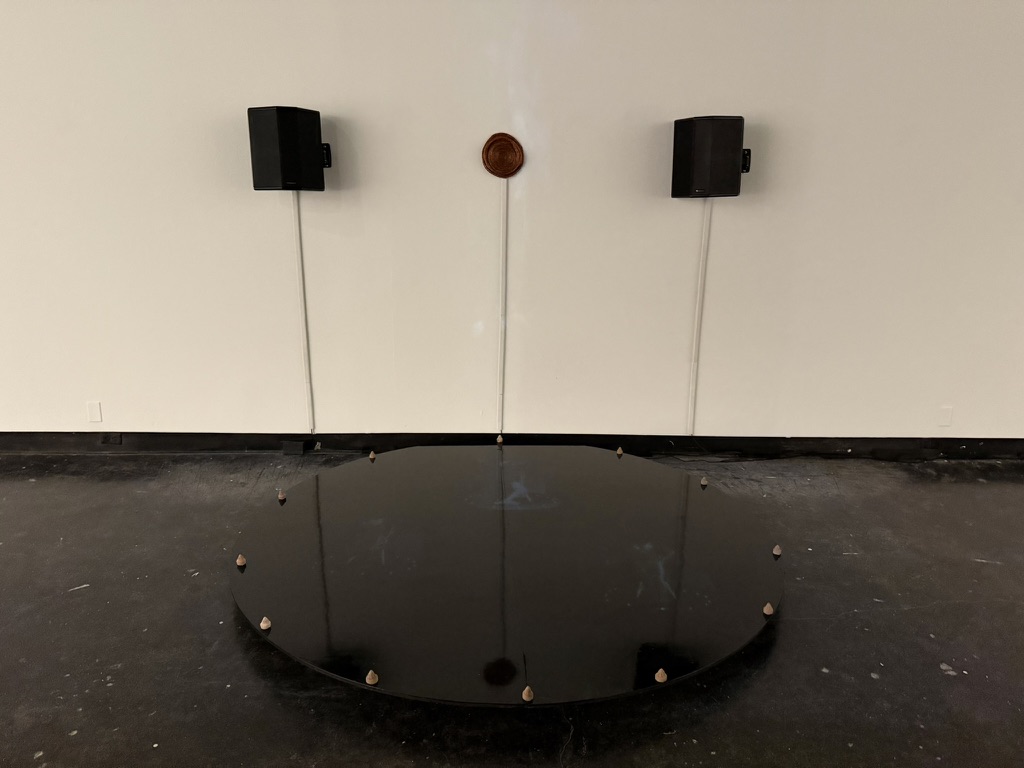
Entering the scene of Makeda (Christopher Paul)’s Temporal Estrangement: A Path to No Place (2025), I am immediately plunged into its speculative and sensorial worlds. A braided copper wire basket is centered between two speakers, altering its vibrational frequencies to emit a low rumbling noise, subsequently altering the anatomical interiority of me, the witness. The sonic frequency level is set to Schumann Resonance (about 7.83 Hz), the center and heartbeat of the earth. This low rumbling now reverberates inside of me, in synchronization with the earth. The sonic becomes haptic and enfleshed—a synesthetic intimacy and infusion.
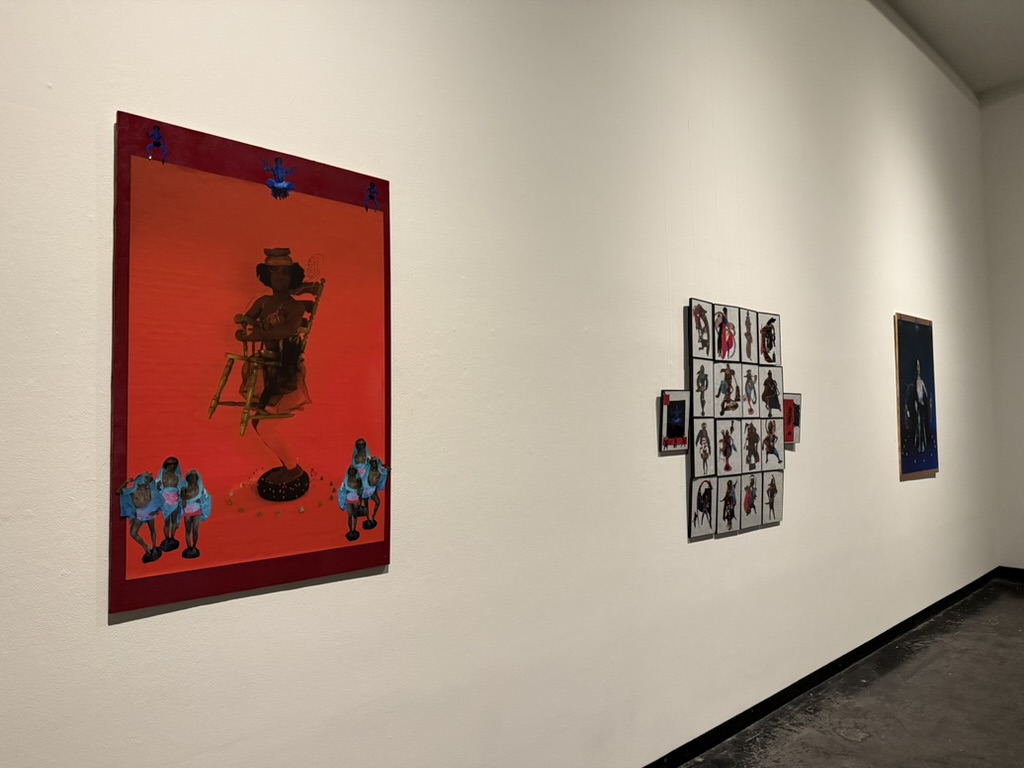
Makeda (Christopher Paul) (she/they), Houston-based queer Gullah Geechee and Korean artist, ecstatically investigates speculative modes of transcendence, interrogates the category of the “human,” and moves towards unfixed subjectivities beyond Western time, space, and corporeality. Their exhibit, Temporal Estrangement (Lawndale Art Center, October 17—November 15, 2025), invites its visitors into speculative worlds emanated from self-portrait collages—engaging the traditions of Mahayana and Theravada Buddhist art, alongside Black queer Southern dance performance (J-Setting), and Afrofuturist soundscapes—creating an invigorating sensorial landscape that plays with the speculative and the visceral.
As Paul discussed in their artist talk as part of the ASAP/16 showcase, their work offers otherwise modes of being beyond what they identify as “the confines of the human.” Holding histories of transatlantic slavery, surveillance, and carceral and state-sanctioned violence, Paul attests that “[t]here is so much proof for dystopia in this body, in this world…to endure the shadow of historical violence became a mythological approach.” Paul thus brilliantly argues for the need to turn towards speculation. When those historically colonized, enslaved, and otherwise dispossessed have been severed from the full status of humanity, Paul thinks with Jayna Brown on Black speculative thought to explore the “autonomy of new speculative bodies of being” that exceed the figure of the human altogether.1 Paul enters these speculative modes of being via transmigration, which they define as the “process of us all leaving the body and entering another,” into what Jayna Brown refers to as the “no-place.”2 The “no-place” becomes the grounds out of which erotic and mythological reconfigurations of being are conjured, collapsed, and (re)created. Entering the “no-place,” Paul asks, “what subjectivity arises in this void?”
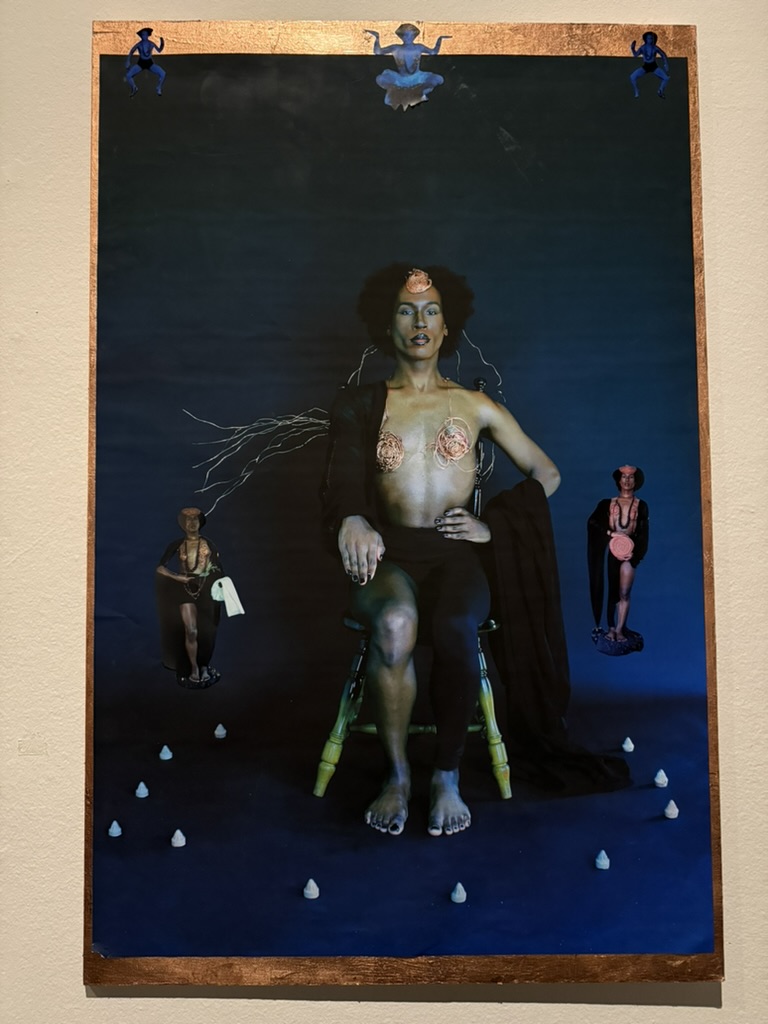
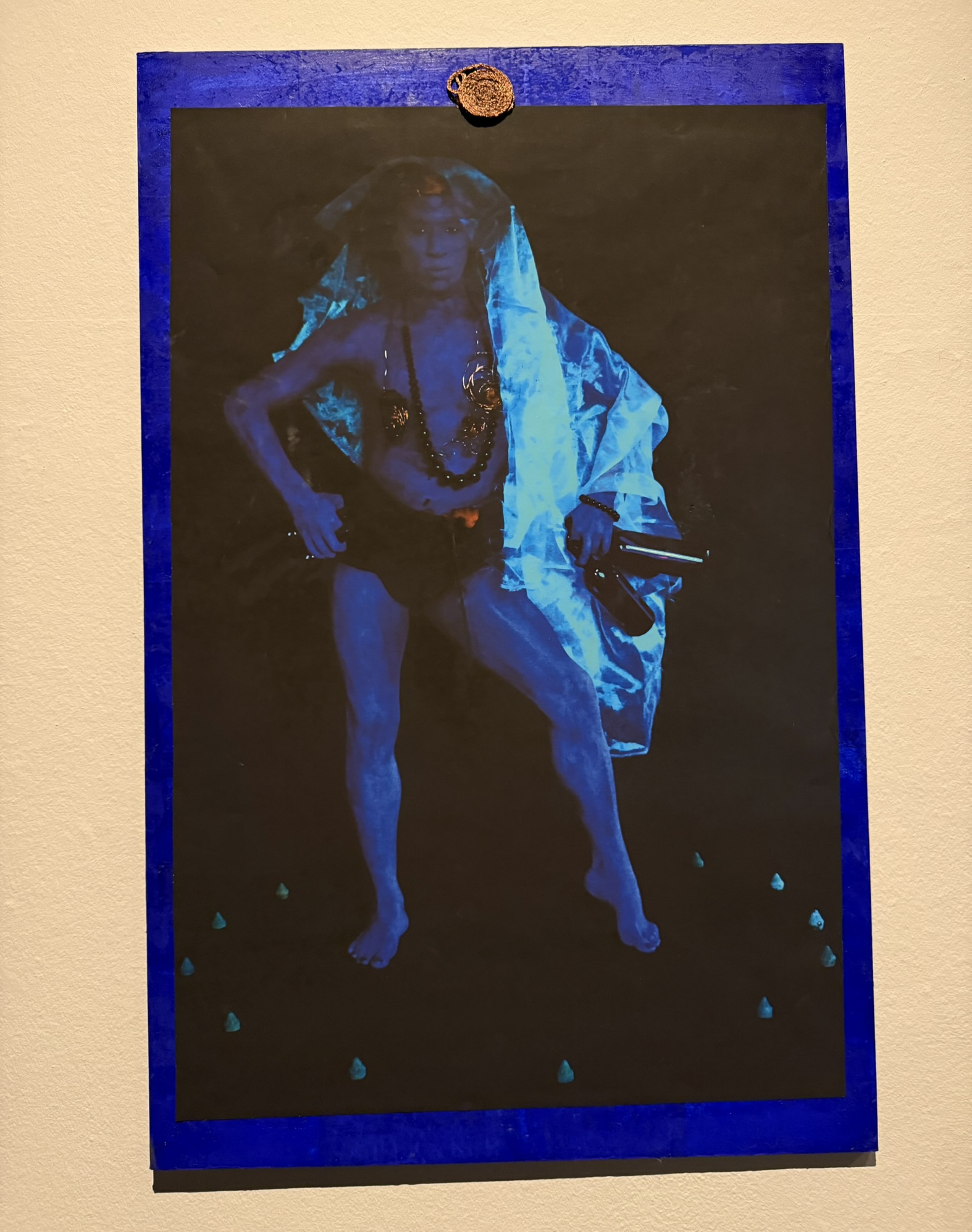
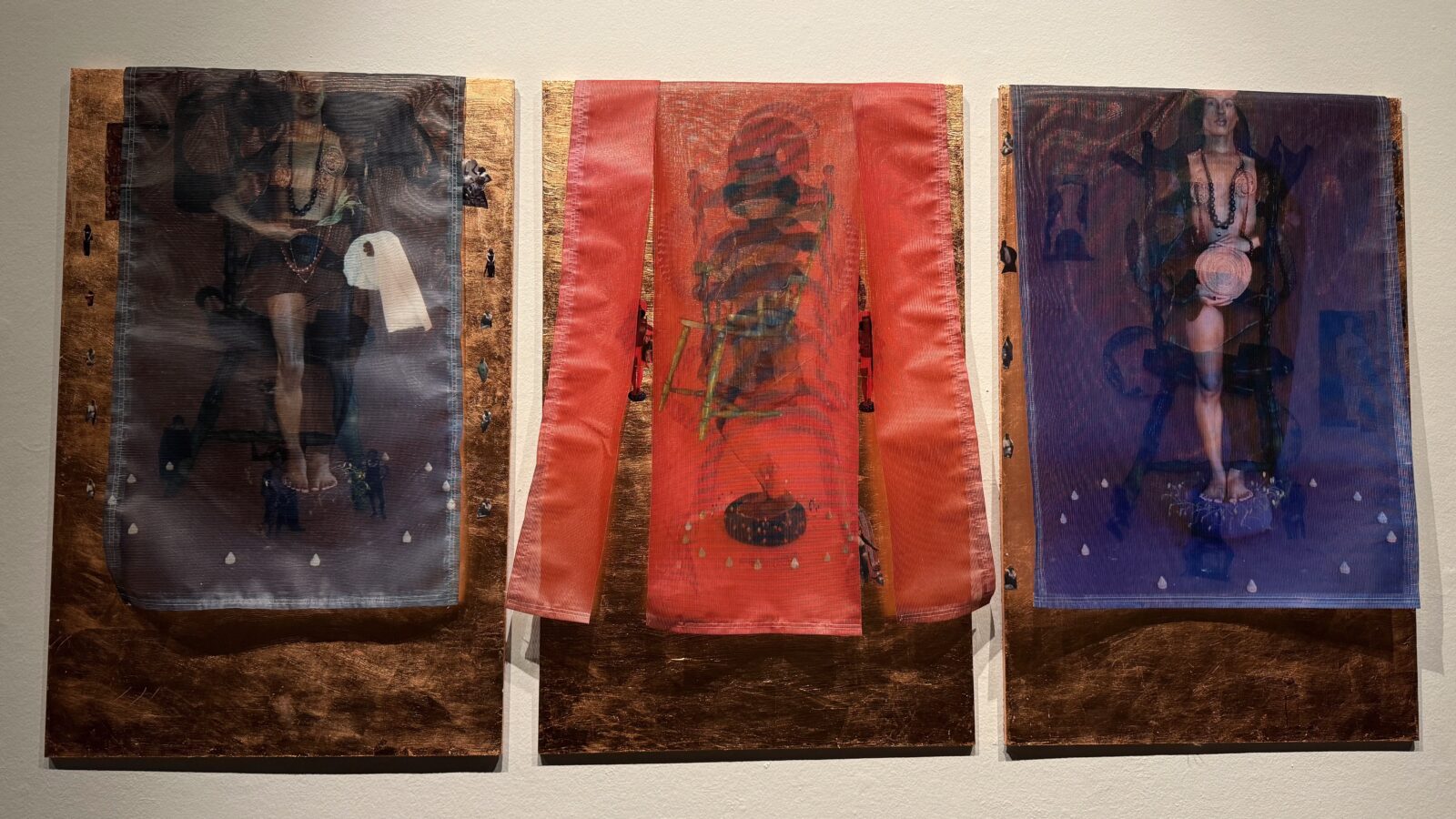
In their self-portrait collages, Paul recreates the primordial Buddha, Vairokana, who Paul describes as “the highest Buddha in the Buddhist lineage of all the Buddhas that have walked and been and lived.” Vairokana is known to be formless, omnipresent, and eternal—a durational formlessness that lends itself to a malleable and shapeshifting capacity, enfleshed by Paul in every iteration and recursion of their form. Paul reflected in an interview with me, “When I look at these characters, I don’t see them as myself . . . I find them to be spirits, of me . . . Maybe past lives of me, maybe future, or beyond past, beyond present, beyond future.” Such a speculative transtemporality dissipates the self beyond the individual container of the human and towards a collective and mythological sense of self, traversing multiple temporal planes within and beyond the here and now.
In the tradition of Tibetan thangkas and Korean t’aenghwas, Paul emphasizes the significance of negative space in this practice of portraiture. The figures to the left and right of Vairokana, disfigured and grainy, sit submerged in the abyssal negative space of these portraits. Paul names the figures’ disfigurement a sort of “nonhuman biology,” lending itself to a transfiguration of form beyond the human. Paul becomes Vairokana becomes Paul, eliciting a glitched and recursive haunting that possesses the viewer. When the human is dictated by notions of self-possession, what does it mean for the witness to become a vessel for (spiritual) possession? Paul suspends her audience into a possession that throws the humanist assumption of bounded individualism into flux, and scatters and rearranges the molecularity of the self into an erotic dissolve and cosmic unknown.
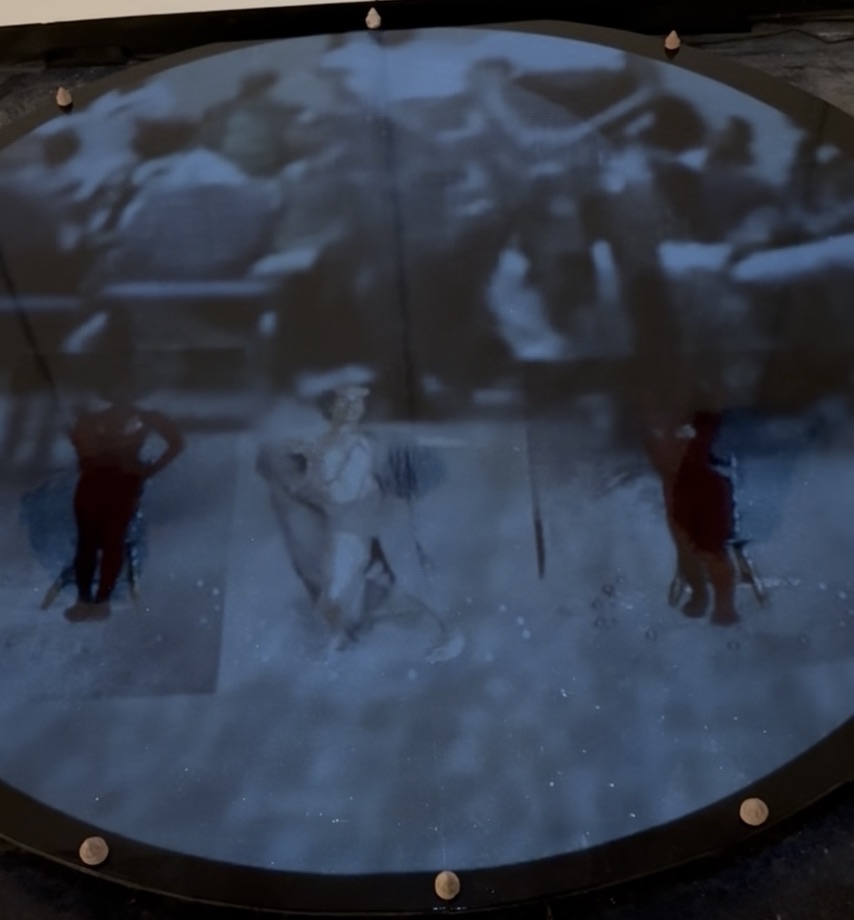
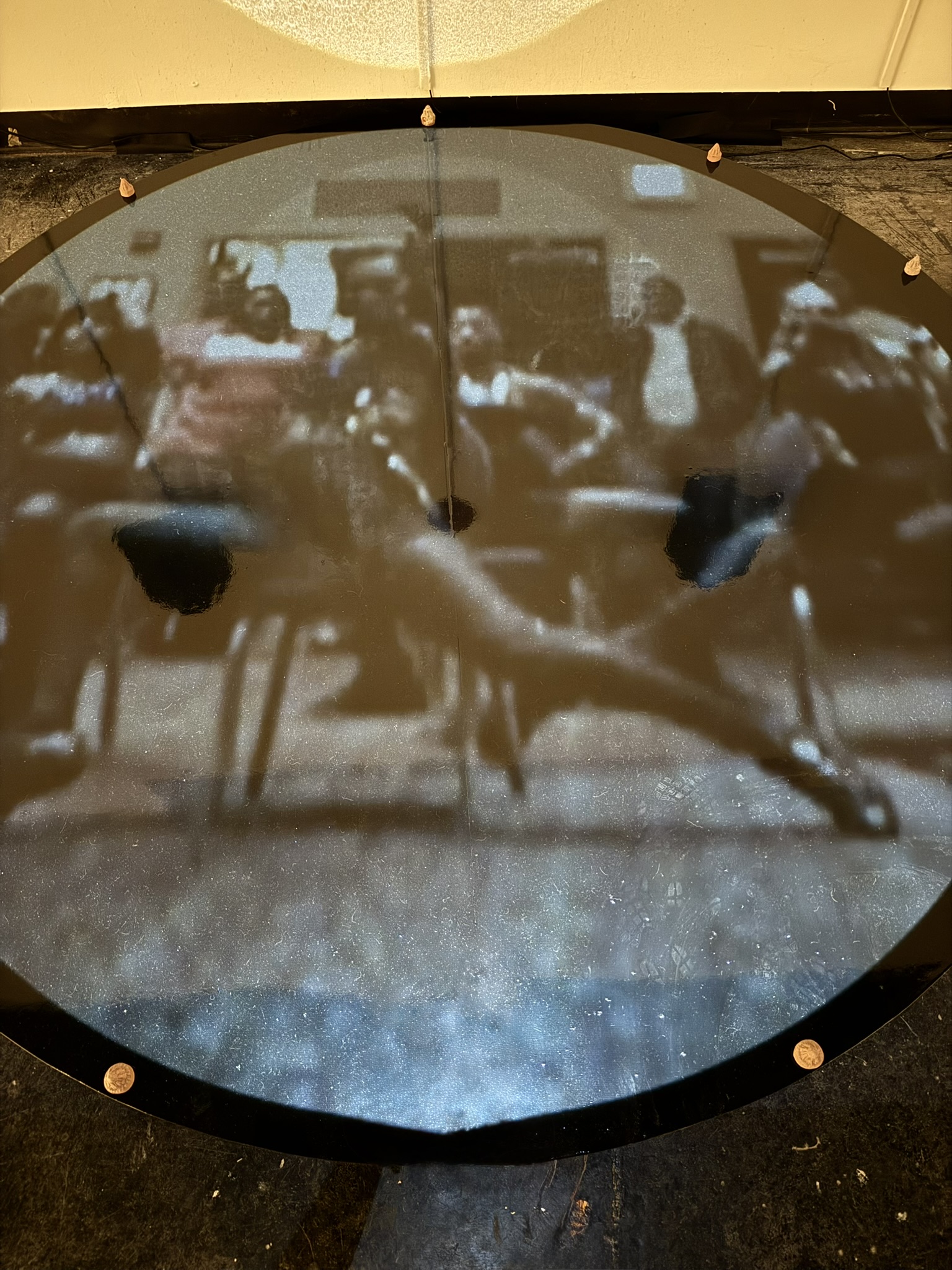
The composition and formations of thangkas and t’aenghwas are similarly taken up by the Black queer Southern dance performance known as J-Setting. J-Setting originates in Atlanta, Georgia and is derived from HBCUs. It commands its audience with powerful body and arm thrusts and movements, characterized by marching, precision, unison, and gender fluidity, taken up and developed in underground queer spaces—engaging in what Paul identifies as a call and response dialogue deeply entrenched in an African tradition. In a projected video installation, Paul layers a moving self-portrait of Vairokana that blurs into a video of a J-Setting performance in Atlanta, collapsing deity with dancer who enter a seamless merging and condition of exhaustion, what Paul identifies as a “state of transcendence” through which a multiplicity of bodies culminate into one beyond the singular figure of the human. She explains, “You become so detached with your body, you become in line with everybody else.” This merging and detachment lends itself to a collapse of the individual that becomes multiplicitous, performing an erotic that disrupts the tyranny of the individual container and requires a participation in a collective consciousness. “Black queer bodies become transcendental figures,” declares Paul. Enmeshed in a collective across multiplicity—dancer and deity, performer and chair, human and nonhuman—the audience transcends, too.
Reflecting on thangkas, J-Setting, and their own creative practice, Paul stresses the significance of circles. Her exhibit conveys a circular narrative in which one can begin at any point, each piece seamlessly taking you to the next, full circle. In her self-portraits, the Buddha Vairokana is encircled by stupas, a hemispherical domed structure that traditionally houses sacred relics, including remains of Buddha. Paul arranges the stupas cyclically in each painting and offers physical stupas that surround the black circular platform that screens the video projections. “Each [stupa] is of the Buddha’s life,” explains Paul, linking stupas and its cyclic ring formation to the notion of infinity and past lives, figuring herself as conduit and reincarnation. In this (no) place of the void, ancient deity, reincarnated dancer, and spectral witness transmigrate into cosmic fusion and infinity loops, an indistinguishable and ceaseless dissolve of the phantasmic body through which ancient mythological cosmologies and contemporary performance practices congeal across collapsed temporalities.
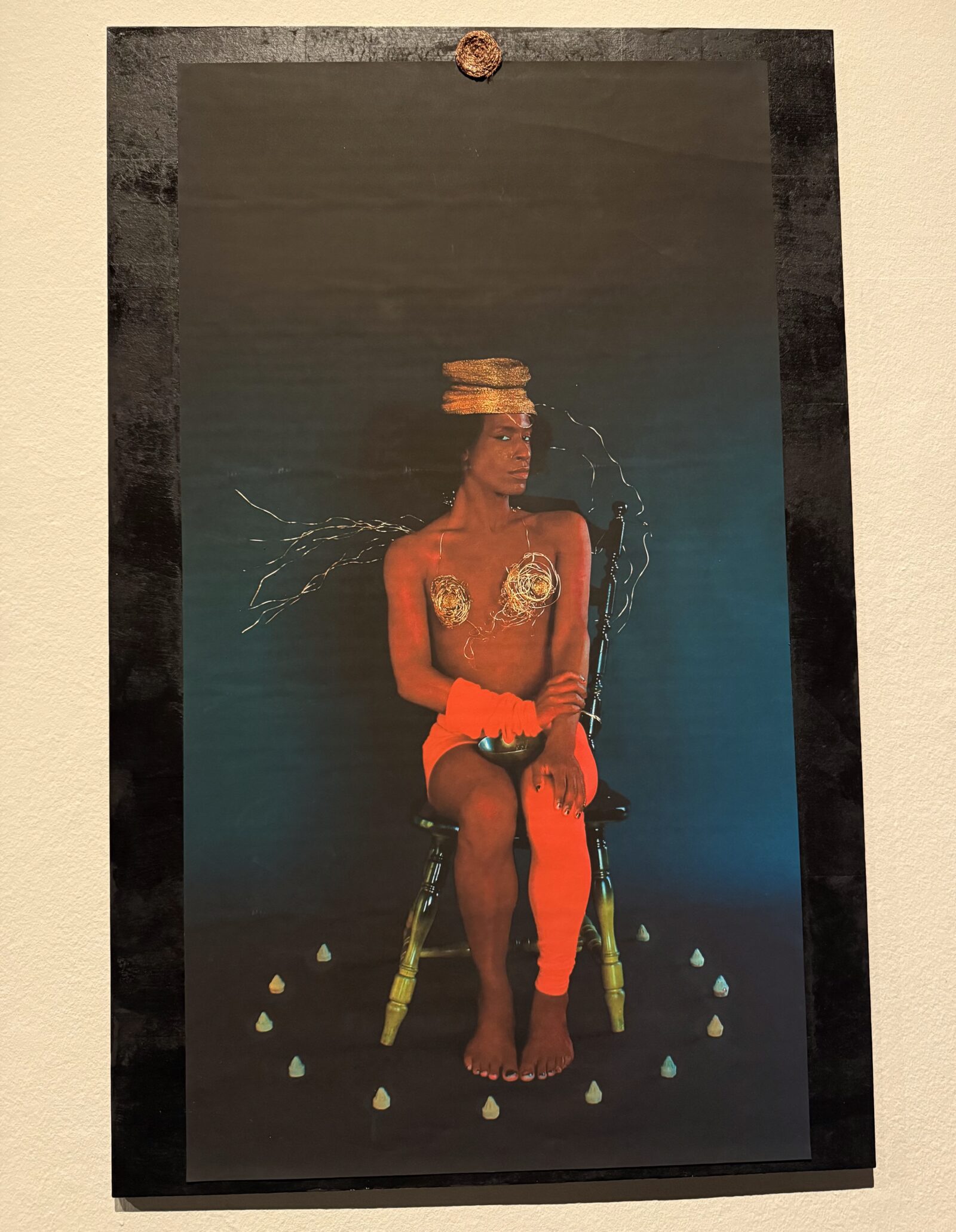
Paul declares the need to “dematerialize on physical states,” ushering us towards a dissolution that breaches the bounds of the human. As Paul is in the process of transitioning, she shared that taking hormones alters and enhances her emotional state, shifting the state of her work altogether. Noting that she will change as she continues to develop this work, her hope is that her viewer can transition in thought alongside her. Paul is intimately attentive to the ways that her environment is infused into her work and into her transitioning. In her collage portraits, Paul utilizes braided copper wire baskets as copper breast plates. When reflecting on the process of creating the braided copper wire baskets, Paul and her team shared that their initial intent was to braid the copper wire like sweetgrass, according to her Gullah Geechee heritage, into flat circular figures. However, they noted that the copper refused to be flattened, pressing against and tensing their hands and fingers to exhaustion, demanding to take shape, becoming a spherical and dimensional basket. Such a hapticity of a collective touch lies in both the hands who braid and the copper who touches back. Paul and their team shared, “[the copper] was truly autonomous . . . We had to surrender again, to the material.”
Adorning herself in what became copper breast plates, Paul profoundly draws from the elemental to facilitate a transitioning beyond the sexed and gendered figure of the human, utilizing copper breast plates as an elemental aesthetic of gender and sexual transgression. Merging copper, a vital trace element found in every tissue of the body, with her physical form, Paul slips into and assumes the form of copper, becomes copper, becomes element—entangling the elemental with the fleshly and throwing the form of the human into panic. Collapsing copper with the corporeal, Paul offers and inhabits a metamorphosis of form that dissolves into an erotic amalgamation of the elemental.
Entering the work of Makeda (Christopher Paul), the witness is invited to become undone—to enter a dematerialization and spectral haunting that absorbs and alters their interiority, subverts their sensorial impulse and molecular makeup, and plunges them into void space inhabited by past / past/present / future/present / future/past entities. This visit entails an evacuation of their body and dissolve into an infinite flux in the cosmic unknown.
: :
Endnotes
- For further discussion and examination of the production of the category of “the human”—and the barring of those enslaved, colonized, and indentured from the full status of humanity—see Sylvia Wynter, “Unsettling the Coloniality of Being/Power/Truth/Freedom: Towards the Human, After Man, Its Overrepresentation—An Argument,” CR: The New Centennial Review 3, no. 3 (2003): 257-337.
- Building on Wynter, Jayna Brown turns to Black speculation, arguing “that because black people have been excluded from the category human, we have a particular epistemic and ontological mobility . . . there is real power to be found in such an untethered state—the power to destabilize the very idea of human supremacy and allow for entirely new ways to relate to each other and to the postapocalyptic ecologies.” See Jayna Brown, Black Utopias: Speculative Life and the Music of Other Worlds (Duke University Press, 2021), 6-8.
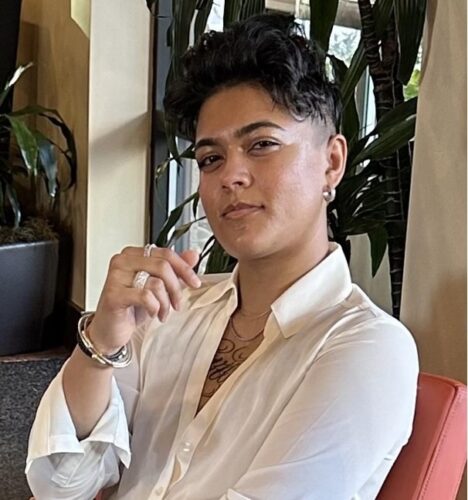
Istifaa Ahmed