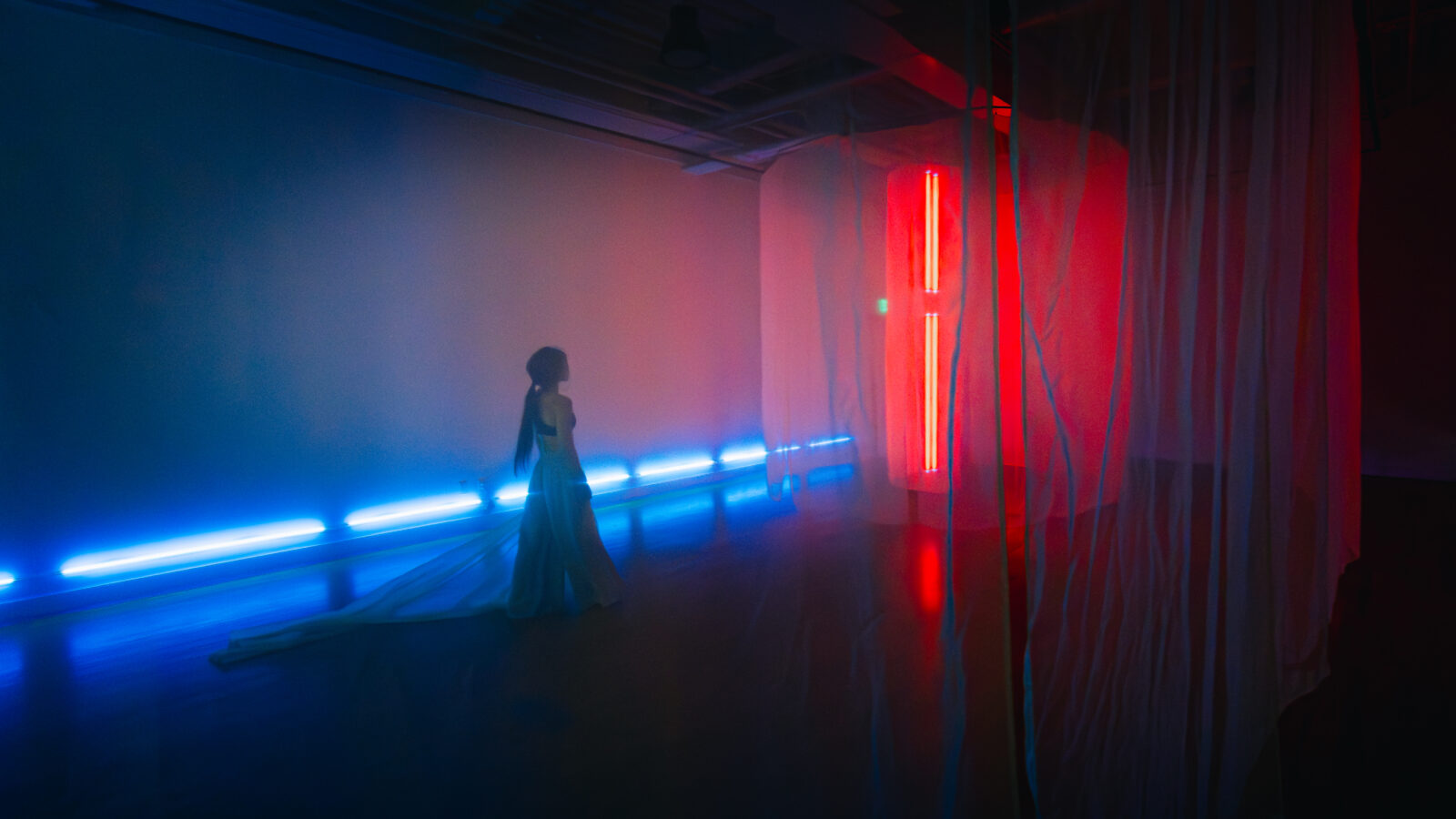
This cluster of essays engages with the work of regional artists who presented in the Gulf Coast Artist Showcase that ran throughout the 16th annual meeting of the Association for the Study of the Arts of the Present (ASAP/16), held in Houston, Texas, from October 22—25, 2025. We gathered in Houston under the conference theme of “Worldmaking/Worldbreaking,” deploying ASAP’s trademark slash as a means of representing the ambivalence of living on and making art in the present: the twinned cravings, in the face of multiple overlapping crises, both to craft utopia and to burn it all down.
That ambivalence was also registered in Houston as a city whose proximity to the Gulf Coast puts it on the frontlines of climate change, at the same time that its economic foundation in the oil and gas industries fuels global warming. It was also registered in Houston as a city often ranked the most diverse in the nation, making it both a sanctuary in a red state and a target for authoritarian retaliation. The artists in the Gulf Coast Artist Showcase—drawn primarily from Houston, Texas, and New Orleans, Louisiana—work across a diversity of media but have similarly been at the forefront of worldmaking when repressive forces are aiming to break queer, trans, and diasporic worlds.
The nine essays to follow each engage with one of the nine artist talks that composed the Gulf Coast Artist Showcase and were presented at the black box Lois Chiles Studio Theater at Rice University’s Moody Center for the Arts. Moya Li writes about plasma artist Ani Bradberry, whose installation at DiverseWorks also provided the site for ASAP/16’s opening reception. Istifaa Ahmed discusses the work of Christopher Paul, who remediates Black trans experience through diverse media forms. Waleska Solorzano reports on the work of Ida Aronson, whose collaborations in New Orleans include the creation of an earthen mound bridging Indigenous pasts and futures. Thea Ballard discusses the operatic work of Lisa Harris in the context of the gentrification of Houston’s historically Black Third Ward. Sarah Buckner lays out how Kristina Kay Robinson’s performance and installation work speculate an alternative world in which an 1811 uprising of enslaved people marching towards New Orleans was successful in establishing a free republic. Tara Holman explores the visual work of Lovie Olivia, who aims, in her own words, “to tell a black story through material.” Jered Mabaquiao outlines the culture of care developed in the collaboration among four poets and language workers who presented collectively at the Showcase: JD Pleucker, Mariposa Tejada, M. Miranda Maloney, and Stalina Villarreal. Zora Duncan investigates how the artist duo of Nick Vaughan and Jake Margolin speculatively archive queer communities throughout the United States. Finally, Paloma Checa-Gismero’s bi-lingual review elucidates Saúl Hernández-Vargas’s remediation of Mexican relics in the borderland context.
Each of these artists—and each of the essays engaging with their art—both refer to the specificity of the Gulf Coast context and provide maps for moving through our fragile and chaotic present, making and breaking worlds along the way. The Showcase was developed in partnership with over over a dozen local arts organizations in Houston and New Orleans, including Aurora Picture Show, the Contemporary Art Museum Houston, the Moody Center for the Arts, the Cynthia Woods Mitchell Center for the Arts, DiverseWorks, Lawndale Art Center, the Museum of Fine Arts Houston, Project Row Houses, and Prospect New Orleans. I am grateful to my ASAP/16 co-chair, Hayley O’Malley, for her collaborative vision. We also wish to thank our collaborators Denise Frazier, Rachel Afi Quinn, and Sandra Zalman, for facilitating many of these partnerships and our connections with local artists.
: :
Michael Dango