Displacement, Paul Liam observes in a review-essay, is a central aesthetic in the poetics of diasporic writers, either subconsciously or not, in such a way that the exiled writer is constantly questioning their “belongingness to a new space or place.”1 This phenomenon has been borne out in the poetry of Nigerian writers who have settled abroad or pursued their creative writing studies outside of the country. Such is also the consciousness that is evident in the characterization of Romeo Oriogun’s book of poetry, Gathering of Bastards, where the speaker repeatedly questions what it means to be in an unfamiliar country and wrestles with its people: “I was at home. Yet I was at a border” (Oriogun 2023). Opposite to that consciousness, Adedayo Agarau—a Nigerian poet who has also settled abroad—embarked on an artistic wayfare of documenting the dismal events that have long plagued the city of his home-country, Ibadan, from a personal, displaced, perspective.
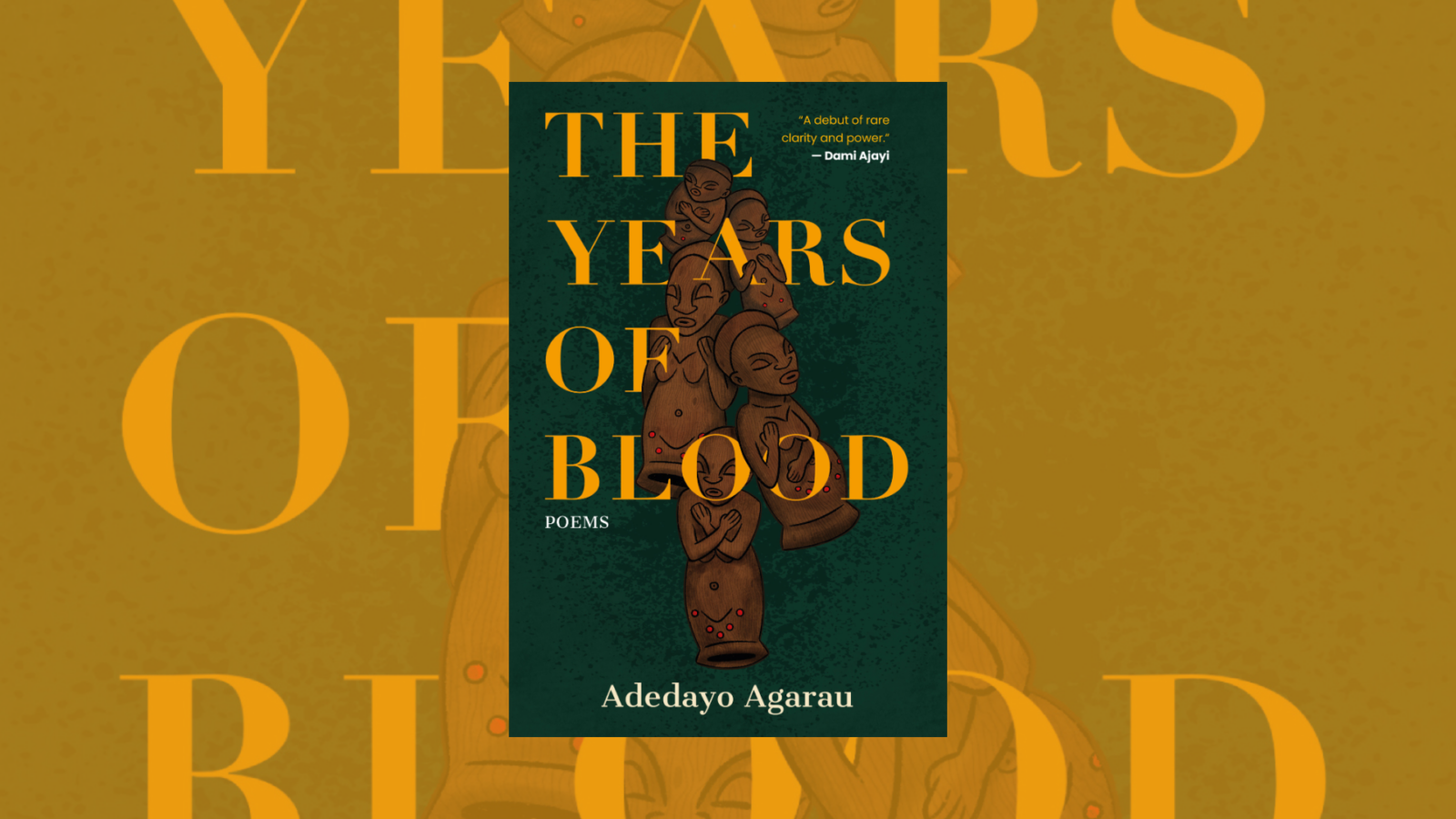
Apart from being the largest city in Nigeria, Ibadan is one of the most storied cities within Yorubaland, a place whose history is layered with traditional crafts, spiritual heritage, and customs that speak to a deep cultural legacy. Despite the depth of its histories, myths, and legends, Ibadan’s modern era has been characterized by rising insecurity, economic pressures, and displacement that belie its cultural wealth. The transition from the seemingly laborious, stern military reign in Nigeria to democratic rule in the 2000s ushered in a series of social and political upheavals such as terrorism, kidnappings, robbery, and femicide in different regions—one of which is also ritual killing for money. A local study found that 64 % of residents identified youth unemployment as prevalent, and 93 % agreed that limited opportunities are driving acquisitive crimes such as drug abuse, kidnapping, armed robbery, and rape—a pattern that reflects broader urban challenges in the city.2 It is this growing practice of ritual killing in Ibadan that Adedayo Agarau focuses on in his 2025 book, The Years of Blood.
The collection is replete with tragedies, a poetic exploration of different characters who suffer the misadventures of living in crime-ridden environments, while also interrogating local beliefs through the psyche of a boy with first-hand knowledge of these events: an autobiographical figure, a cypher through which Agarau witnesses, interprets, and reassembles private and communal traumas.
Structured into four parts and comprising forty-four poems, The Years of Blood examines socially prevalent challenges—ritual killings, witchcraft, kidnapping, and everyday violence—through a syntax that heightens the book’s aural and visual appeal, rendering the region increasingly dystopian in its ordinary rituals. This sensory precision and control is evident in moments where sound and image collapse into one another: “a girl serves us Cabin biscuits / with a jug of water—I hear a droplet of tears splashing into / the jug of water—we drink it & do not say anything. / They say the dead boy / is the family’s sunshine.” Here, the quiet acoustics of grief and the restrained visual scene transform domestic hospitality into an atmosphere of terror.
The introductory poem, “Wind”, announces the collection’s descent into tumult by articulating the central crime through a grammar of possibility, where bodily harm is depicted as an ever-present threat rather than an isolated event.
It could be me whose blood is crying. A pestle pounding
a skull in a mortar. It could be my father who is not
coming home tonight. Or sister, who is raped, her breasts
sliced clean, her pubic hair shaved, her body dumped in
a bush near Liberty Stadium. It could be my mother’s
headless body we gather around in the morning.
Where “Wind” establishes the collection’s ethical and affective stakes through a first-person conditional voice, the next poem, “Ibadan” (p. 5), attempts to sustain this atmosphere of horror by situating the speaker in a condition of acute vulnerability rather than a single precipitating event. The poem presents scenes of extreme domestic and social violence—a mother harming her newborn and a man sacrificing his wife for wealth—arranged as a sequence of nightmarish tableaux. Although the poem relies on white space and fragmentation in an obvious attempt to produce a tightly layered effect, it falters in execution and proves uneven. Much of the poem lapses into a prosaic mode of narration, leaping rapidly between disparate images and ideas in a manner that recalls familiar representations of kidnapping and ritual violence:
we no longer go to their house no longer eat the food my cousins bring
in baskets covered with hand towels
i kick a frog out of my slippers put saliva on my wound leave for school the morning i
was kidnapped
& when they found me i was standing by a NEPA pole insensible
The family’s abrupt severance from the aunt’s husband—who is framed as a ritualist (“sacrifices her for riches”)—plunges hastily into the speaker’s kidnapping and rescue at a NEPA pole. What prior events, if there’s any at all, fueled the allegation against the husband? Could he be the captor responsible for the speaker’s abduction and the ensuing child vanishings on the streets? These narrative gaps stunt the poem’s emplotment and progression that could have deepened its psychological impact. Yet, amid the ambiguities, the chilling ritual economy in Ibadan is captured clearly: communal dust-gathering for lost bodies, mothers’ grief, snatched firstfruits, wilting murals, and child deaths (“everywhere a weed grows, there is a wild mouth eating children”). In “Sókà”, Agarau redeems this sequential flaw by anchoring the poem’s narrative on a chain of events that is chronological, with an implicit quasi-religious line that questions and frowns on God’s silence:
They found dried bones of people’s children
a heap of old clothes, and over the rusty knives
gleaming in the small light leaning in through
the crack in the rough drywall of the forest,
a lizard swallows an insect and nods.
God is somewhere withering in his envelope of silence,
following a cry for help.
The poem’s subject is concretized by the way it evokes strong emotions through the visual narration of the horror of Soka forest which sparked global controversy in 2014.3 The image of the lizard appears briefly and eats before disappearing quickly. Is this a metaphorical description that accentuates a land infamous for swallowing people? Or is this the poet’s way of adding to the spooky nature of the ritual killing site? A large number of the items that were reported to be found at the scene of the site was, in turn, relayed uncannily by Agarau:
There were school uniforms
and leather bags and plastic bottles and sandals and
books and mats and bras and metal bowls and buckets
and a girl, 14, thin with homesickness, breastfeeding a child.
In another room, they found femurs, the latitude of suffering
and tenderized beef served in calabashes,
dove’s feathers, pigeons and their severed heads . . .
The formal experimentation of the collection is a delicate exercise, balancing the violence of the content with its pacing and musicality. One can see this in the deployment of virgules in “Entrance” (p. 28), the fusion of Yoruba and English with use of white spaces in “Arrival” (p. 41), and the list form in “Fine boy Writes a Poem About Anxiety”. Agarau explores with multiple styles—stanzaic, dramatic, and mostly, prosaic. “The decibels of sorrow” echo throughout the book with contemptible portions that strengthens its emotional depth. Take for example Salt Water, wherethe speaker laments:
We didn’t stop searching. Even after they found your bleached body in the river we
used to swim, your mother, in disbelief, hushed us back to the street. Michael, we don’t
go to the field anymore. They say the hands that snatched you will snatch children till
democracy arrives.
The dismay that maps the scenes in this poem is akin to the ones earlier investigated in the book, following a recurring thread of child disappearance and other mentally agitating incidents focused on violence and ritual killing motifs. The detail that goes into the woman whose abdominal cavity was sutured open—”they say a pregnant woman was hacked on College Crescent. They carved open her cavity & took the fetus”—fleshes out, with a stark and almost forensic detail, the magnitude of atrocities confronting Ibadan, its inhabitants and its environs. That horrific sight grounds the escalation of grief into something unflinchingly corporeal. Even when Agarau attempts to provide a cathartic moment in poems like “On Joy”, there’s still a somber undertone—due to the poem’s word choice—that lingers as the speaker offers his consolations: “i want to / lift the hope from this poem & give it to the dead / person’s mother, give wings to the ghost, color the /grief violet”.
In traditional Yoruba society, people believe in women with mystic powers called Àjé (witches). Contrary to the common tropes that reduce witches to cultists who possess malevolent powers to cause people anguish, the Yoruba cosmology differentiates witches into a more nuanced classification: “white witches” (Àjẹ́ funfun) are benevolent protectors; “red witches” (Àjẹ́ pupa) are neutral or ambiguous; and “black witches” (Àjẹ́ dudu) are malevolent practitioners.4 In essence, the taxonomy of these magical beings reflects a belief system in which spiritual power is morally contingent on the practitioner’s character as a person and their intent. Part of the shared affinities among the three categories of Àjé is their preternatural ability to transform into animals like cats, owls, bats or rats. Agarau’s attention to this belief is centered mostly on both Àjé dudu and Àjé pupa. In the poem “Arrival”where the speaker narrates the ordeal of being poisoned, among other things, the concept of Àjé emerges:
i wake in the turquoise blue room
the cat meowing as my great-aunty
& her company of witches gather around the baby cot
picking my body out with a needle (p. 43)
The implication that this line above and its succeeding one—“orogún kì í jogún orogún / òkò lọ mọ: ọlorun ní ńwí / pé ká sọ síbi tó dára, a rival does not inherit the assets of a fellow rival: God says we should go to a better place”—explicates is Agarau’s nod to indigenous epistemologies amid modern ritual panic. The speaker’s great-aunt and her associates, though endowed with the capacity to kill the child, refuse to do so, signaling the ethical boundaries that govern their spiritual craft. In this instance, it is not blunt violence but a precise, taxonomic probing. Witches act as folkloric scientists, cataloging and claiming the child’s essence without fully destroying it.
In “Fine boy writes a poem about anxiety,” the persona asserts:
on a sidewalk on 7th street
a dead cat is someone’s pet
in Ìbàdàn, a dead cat
is someone’s grandmother (p. 32)
One verse features a street; the other, a city. On the sidewalk of 7th street, the cat is just any cat that could have been killed by a passing vehicle; whereas, in Ibadan, a dead cat is an old woman. The context of the detail on 7th street was to be later provided in “Doomsday”(p. 39) where snow falls: “my anxiety is that the boy walking in the snow on 7th street is me”. Through this, Agarau establishes the tranquil ache of diasporic longing. In Ìbàdàn, however, his pronouncement transforms the dead cat into “someone’s grandmother”—an old woman slain for alleged witchcraft,5 rooted in documented cases that haunt Nigerian communities. Agarau’s writing thus labours to expose these inauspicious realities shadowing every elder.
In addition to its exploration of witches, the language and imagery throughout “The Years of Blood” tends towards the dream-like, and images are often unclear. A great deal of events narrated in “Brown”and “Sonnet with Severed Limbs” are inundated with oneiric descriptions that span across incorporeal entities and petrifying dreams.
—you are outside your father’s house at 3 am
hallucinating
the shadow of a skull wearing a helmet, riding a broom, saying your name—you are walking
toward the wall that is open, from which light emerges—in the light is the girl that unbuckles
a kiss from your neck & takes desire with her. (p. 72)
From the viewpoint of Yoruba spiritual frameworks, these uncanny elements read like spiritual residues—from a cultural field, not precisely about Yoruba religion—where both the real and unreal overlap. The luminous doorway, the skull-shadow can be interpreted as spaces where the living and the dead blur. It presents dreams within the lens of Yoruba cosmology, without being reducible to it, where dream sequences function as liminal spaces and identities shift. Another significant perspective to this is how these descriptions shape the structure (not just spatiality) of the poems’ movement between scenes. They refuse linearity by adopting visions, hallucinations, or dreams—thereby creating poetics of drift: memories, fears, desires, and selves collapsing into each other. This narrative arc resonates with Black surrealism’s anti-colonial roots, as in Léopold Sédar Senghor’s “mystical” Negritude, where everyday African uncanny challenges Western rationality.6 It equally fits into Fourth-Generation Nigerian poetry (post-2016), marked by postmodern drift into personal realities amid socio-political chaos, blending surrealism with African spiritualism.7 Agarau aligns with Nigerian peers like Romeo Oriogun and Saddiq Dzukogi, who fuse personal grief, migration, and surreal visions into protest poetics. Much like Agarau’s collapsing selves, Oriogun’s Nomad drifts through exile and desert metaphors as wastelands of shattered dreams, refusing linear narrative. Dzukogi’s Your Crib, My Qibla employsevocative shadows, spirits, and quivering grounds to interrogate loss and hidden desires, highlighting the eerie helmeted skull as ancestral haunting.
However, unlike these contemporaries, the blend of real and imagined events/entities in The Years of Blood pushes the poetics beyond real-life catastrophes, hinting at a certain level of Yoruba spirituality. The closest to this scope in recent publications would be Òyèkú: Mother of Death by Olumide Manuel, which explores themes of grief and mysteries that center on the realities and consciousness of man as embedded in the Òyèkú divination of Yoruba spiritual system.8 To add to the Yoruba significance and experimental form of the collection, Agarau’s poetry also code-switches between Yoruba and English, citing legendary singers such as Fela and ‘Baba N’gani Agba’ (Haruna Ishola), and interspersing his versifications with traditional wisdom:
ilu tin rì ṣaaju iji lile.
the path the lightning marked. bí ṣàngó ń p’àràbà, tó
ń fà’rókò ya, bí ti igińla kọ. take the blades from the
field of salt. sing with the flock of children. (p. 85)
The meaning and context of the proverbs, as used in the eponymous poem above, do not just only offer solace and arrogate a sense of spiritual power to the speaker, they indicate the importance of Yoruba culture even in its linguistic structure. The saying, “bí ṣàngó ń p’àràbà, tó ń fà’rókò ya, bí ti igińla kọ”, literally translates as: if Sango (the god of thunder) is killing the Araba tree and tearing the Iroko tree, it is not the same as [killing] the Iginla tree (specialized, sturdier wood)”. In essence, it signifies the limitations of power, particularly to reassure someone that a powerful force cannot destroy everything or everyone—and Agarau’s use of it in the poem positions the speaker’s pushback against evildoers, specifically reminding them of the inefficacy of their nefarious goals towards him. The next line, another proverb, is tied to similar context, further warning said evildoers to respect boundaries and apply caution: “bí ajá bá ń sínwín, á m’ojú iná” (Even a mad/rabid dog knows (or fears) the face of fire).
Such careful crafting adds to the depth and substance of the collection, even though there are moments in the book where stylistics of prose overwhelm the poetic stakes of the verses. For instance, in “Prelude to Christmas” (p. 85), the persona relates the felicitous events of Christmas with language that mirrors a literal speech: “The mothers are weaving their hair & talking about chickens. Iya Jide, who has poultry with twelve birds, says she is ready to sell her flock. They are outside the hairdresser’s shop decked in colorful bubu.”
That said, Agarau’s debut is marked by an experimental force and, at the same time, assumes a canonical posture in how it confronts the ethical and cultural tensions within Yoruba spirituality, including the societal anxieties and criminal issues surrounding ritual-related violence—all of which are delivered with remarkable clarity that positions the work within a broader lineage of socially conscious Nigerian poetry.
: :
Endnotes
- Paul Liam, “Displacement and Socio-Political Consciousness in Romeo Oriogun’s The Gathering of Bastards,” Channels TV, October 23, 2024, https://www.channelstv.com/2024/10/23/displacement-and-socio-political-consciousness-in-romeo-orioguns-the-gathering-of-bastards-by-paul-liam/.
- Adeniji Michael Olalekan and Yusuf Olanrewaju Lateef, “Acquisitive Crimes, Youth Unemployment, and Internal Security Challenges in Ibadan Metropolis of Oyo State, Nigeria,” International Journal of Social Science Research and Anthropology 8, no. 6 (2025), https://doi.org/10.70382/tijssra.v08i6.058.
- Dele Ogunyemi, “Ibadan: Shock, Horror Trail Discovery of Ritualists’ Den,” Daily Trust, March 24, 2014, https://dailytrust.com/ibadan-shock-horror-trail-discovery-of-ritualists-den/.
- Joseph Olusola Adeleye, “A Philosophical Reflection on Aje (Witches) in Yoruba Traditional Society and Education,” International African American Journal of Arts and Humanities (2020). https://www.acjol.org/index.php/iaajah/article/view/563.
- Amnesty International, “Nigeria: Escalation of Mob Violence Emboldens Impunity,” October 23, 2024. https://www.amnesty.org/en/latest/news/2024/10/nigeria-escalation-of-mob-violence-emboldens-impunity/.
- SYLVIA WASHINGTON BÂ, “The Concept of Negritude in the Poetry of Leopold Sedar Senghor,” (Princeton University Press, 1973), http://www.jstor.org/stable/j.ctt13x19xb.
- Oko Owi Ocho, “THE CRISIS OF INTERPRETATION AND THE TEMPER OF FOURTH GENERATION POETRY,” Shamsrumi.org (2023), shamsrumi.org/poetrycrisis-oko/.
- Eniola Abdulroqeeb Arowolo, “Interrogating Mysticism, Misery, and Mortality: A Review of Olumide Manuel’s Òyèkú,” The Nigeria Review (April 19, 2025), https://nigeriareview.com.ng/interrogating-mysticism-misery-and-mortality-a-review-of-olumide-manuels-oyeku-eniola-abdulroqeeb-arowolo/
Eniola Abdulroqeeb Arowolo