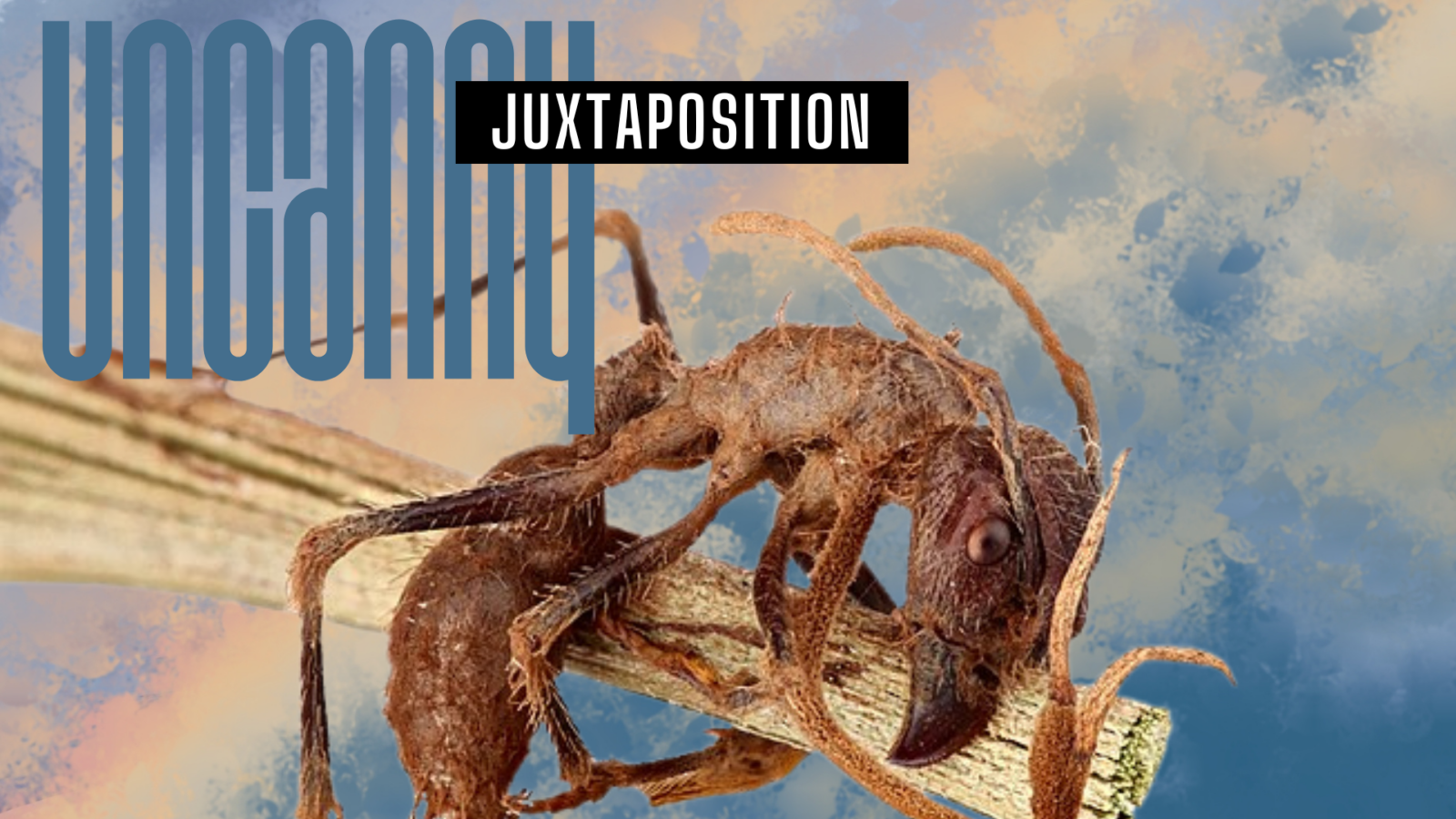
In the first two seasons of The Last of Us, a show that has been praised without irony as the best ever made from a video game, the essential questions are alluded to but never answered definitively: whom does the “us” in the title embrace? Who are our others? This might be the question of our times that we mistake for another: are our others always our enemies? The first episode lasts nearly ninety minutes, and begins with a framing device, a talk show set in 1968, then the episode skips to 2003, Austin, Texas, which descends into the fog of war. Again, we skip ahead, to 2023, a Quarantine Zone (QZ). By now two enemies have emerged: the other, the them to us, are “the infected”; but also FEDRA, a militaristic arm of the government that resembles ICE in its contemporary, malignant form: heavily armed, body-armored men who “fight infection and insurrection” (and ICE regards immigrants as FEDRA does the infected and rebellious). Starting from Boston, the dynamic duo of Joel (Pedro Pascal) and Ellie (Bella Ramsey), a father and his substitute daughter, protégé in all things violent, travel west. Traveling into the picturesque, they are captured by an iconic genre in which violence is inescapable and necessary: the Western. Attaching themselves to a succession of groups, never quite belonging to any of them, they remain a law unto themselves.
The Last of Us is a show of force, literally and figuratively.
The true hero, the true subject, the center of the Iliad is force. Force employed by man, force that enslaves man, force before which man’s flesh shrinks away. In this work, at all times, the human spirit is shown as modified by its relations with force, as swept away, blinded, by the very force it imagined it could handle, as deformed by the weight of the force it submits to.
These are the first sentences of Simone Weil’s extraordinary “The Iliad, Or the Poem of Force,” first published in French in 1940, and in translation in 1945. While her translator Mary McCarthy uses “man” and “human” interchangeably—and in 1945 “he” was the unmarked pronoun—the opening of Weil’s essay summarizes Us in so far as no person in the show, no matter their identity, hesitates to use violence, no person is free from violence, no person survives as a victim for long before becoming a perpetrator.
The force of genre overwhelms the show’s remarkable premises; by the start of the second season, the show is unambiguously a Western. Like the protagonists of many Westerns, Joel and his brother Tommy (Gabriel Luna) are veterans. They knew how to use firearms, and have experience in situations when the consequences of a mistake might be fatal. So many of us hope we will be brave, yet it is not the hope about how we might behave in a crisis that dies last. Giving us characters who have had these experiences, the show earns our trust, only to betray it. For many heroes of classic Westerns are veterans of America’s bloodiest conflict: the Civil War. In the Western, it no longer matters whether one fought for the Union or the Confederacy. In the imaginary West of the Western, the Native American is everybody’s enemy, and it is more than a coincidence that the stockade featured in The Last of Us around Jackson, Wyoming, a real city in the state of the Union voting overwhelmingly for Republicans in the last few elections, resembles a colonial fort in hostile territory. All the uninfected enemies—Fireflies, Wolves, FEDRA, Seraphites, a handful of unnamed groups falling into a generic category of raiders which can and do include members of the named groups—are structured hierarchically: they are led by generals or prophets. Jackson, by contrast, appears to be ruled by a council, and yet its citizens are no less disposed to violence, and only the neo-liberal bourgeois values on display in Jackson appear worth fighting for. It is worth recalling an infamous precis of those values Dame Margaret Thatcher provided in an interview in 1987: “Who is society? There is no such thing! There are individual men and women and there are families and no government can do anything except through people and people look to themselves first.”
“The infected” are not individuals but parts of an organism that makes every sufferer equal to their appetites. In a remarkable coincidence, the infected are powerfully described by Rachel Bespaloff in her “On the Iliad” (also written in French, also published during the war, in 1942), in her astute summary of the powerless Helen: “She is the prisoner of the passions her beauty excited, and her passivity, so to speak, their underside.” The infected are passive, quiescent unless provoked. The show’s signal failure of imagination is to abandon the creepy quality of the early encounters, when the infected seem as eager to kiss as to bite their victims, loving the living into a death-like alternative to individual life. In these early encounters, the infected have hyphae sprouting from their mouths; their kiss is a kiss of death, and vampiric, securing for their victims eternal, because communal, life. As the show proceeds, the infected become garden-variety zombies, attacking in a mass or acquiring—reacquiring?—human skills. “Clickers” and “stalkers” exhibit nothing deeply imagined about fungal life, and the “bloaters” are lumbering, more Creature-of-the-Black-Lagoon than a powerful fungal form that bullets would, one imagines, pass through without harming: for fungi lack organs and are made of one form of cell. However, the infection does not reduce the infected to what Weil claims the Trojan War reduces all its human combatants: objects. The infected must eat, just as any form of life must. Heads of a hydra-headed organism, they cannot use weapons. They fight hand-to-mouth, alive in a novel form that appears to be a fate worse than death because they lack individuality. Death is what they deserve; from our perspective, they are already further from life than death can take them. Recall one poignant moment of genuine self-sacrifice. Just a brief shot after the infected attack on Jackson has been repulsed. An older man shows his bite to someone, and then hands the witness his pistol: we are to understand that he is volunteering to be shot before the infection takes hold. This in stark contrast to what Joel does to Eugene (Joel Pantoliano), husband of the therapist Gail (Catherine O’Hara) in the second-to-last episode of the second season. Unlike the infected, the humans must resort to violence only to protect themselves and those they love; and yet violence is their preferred form of self-expression.
Crucially, the infected’s uniformity appears monstrous, because deindividuating: equality has become a mortal illness. David (Scott Shepherd), the cardboard villain—priest, cannibal, pedophile, rapist—central to the “When We Are in Need” episode in Season 1, is the only human figure with any sympathetic words for them. How much more complicated the understanding of force and community would have been if the infected were seen as a form of communal life with every advantage against us, the humans, because they value survival of the community above all.1
If the infected were the original them to which the us of the title was opposed, they become increasingly irrelevant. While the story shifts back and forth in time to redeem the final moments of Ellie and Joel, in the episodes of the second season set in Seattle, the infected dwindle in importance. Losing interest in an imagined enemy, the show becomes more of the same old, same old: humans committing gruesome acts without ever getting dirty. Even the horses never appear dusty, and Ellie treats her horse Shimmer like a late-model vehicle: just garages it. The most egregious instance is the scene of Isaac (Jeffrey Wright) torturing the “Scar” Malcom (Ryan Masson). Issac heats a Mauviel sauce pan on a Wolf stove (dry irony there, as he’s a chief among the Wolves), and then burns the skin off the back of his victim’s right hand. The next shot has the pan back on the stove. There should be skin and tissue on the bottom of the pan. Torture has become a product placement for (polished) high-end cookware.
In his introduction to the useful volume reprinting Weil’s and Bespaloff’s essays together, Christopher Benfey documents Weil’s mistranslations of her source material.2 Yet if her distortions weaken her account of The Iliad, they make her essay a more persuasive account of Us. Weil does not see the complex ethical imperatives that are central to Bespaloff’s reading of the epic. From her first words, Bespaloff, who had read Weil’s essay before writing her own, strikes a different tone. She sees the world of Homer’s Iliad bounded by a different horizon than the bloody sunset, so reminiscent of Cormac McCarthy’s Blood Meridian (a book sublimed in force), that Weil cannot look away from. Bespaloff begins with Hector, a hero who protects the innocents of Troy; and Joel is as close as any character gets to her vision of Trojan virtue. Like Hector, Joel exhibits, briefly, a “passion for defying destiny.” The fate of America—and in the world of the Western there is no other—is then sealed by Joel’s failure to defy it. He sacrifices the possibility of a cure for all of us, infected and as-yet-uninfected, to save Ellie. Unwilling to sacrifice Ellie, Joel guarantees that she will be among the last generation. Yet his greater sin appears to be an instance of bad parenting: he has lied to Ellie and she gets to forgive him, as if the truth still had any force. I think Weil would have salivated at Ellie’s immunity, at the opportunity to sacrifice herself to save the world. It is a choice Ellie did not get to make; Joel would not have let her make it.
In “Troy and Moscow,” her suggestive chapter comparing Homer and Tolstoy, Bespaloff observes: “Obliged to be strong or perish, man invents a new way of loving life, a more obstinate one.” The creators of Us give us only obstinate, selfish love. The powerful, mournful scenes set in Jakarta that open the second episode of the first season become no more than an exoticizing footnote.3 The focus remains on America and the bloody tropes of The Frontier. Whenever possible, the uninfected kill the infected and their human enemies at a distance: with a firearm, an explosive, a flame-thrower, trained dogs. They only get close to take revenge. The show wallows in intimate vengeance: death drawn out to maximize suffering, torture a means of ensuring that one’s enemy is abject up to the moment of death. The character most resembling Achilles, the Achaean demigod, is Abby (Kaitlyn Dever), a commander of the Wolves. Just as Achilles refused mercy for Hector, killed him and defiled his body (which was protected from defilement by the Gods), Abby tracks Joel, who killed her father, to Jackson and tortures him to death. In the final moments of the second season Abby sounds disgusted with herself, as if the failure to exterminate every enemy, real or perceived, were a weakness. She can’t believe she let Ellie live, and the season ends with her appearing to shoot humanity’s only hope at close range. The show’s systematic failures of nerve, however, undercut the convention of the cliff-hanger. I turned to the person I was watching with and said: “I bet what we heard was Dina (Isabela Merced), Ellie’s beloved, shooting Abby in the back.”
It is the strength of Ramsey’s performance that makes Ellie, the golden child, appear ordinary in her flaws, sensitive but irresponsible. But she is only sensitive to lovers and children; like every adolescent she is absolute in her values, an absolute hypocrite. Irrepressible, until Joel’s death she hardly takes anything seriously. After his death, she becomes another representative of the show’s binary ruthlessness: you are either with her or against her. In Episode 7 of Season 2, Ellie’s frantic, inept attempt to perform a C-section on the dying Mel (Ariela Barer), one of Abby’s posse, is meant to complicate the character of the show’s hero, who would also not look out of place on the battlefield before the walls of Troy. The news of Dina’s pregnancy appears to have made Ellie frantic to save the fetus of an enemy. Yet by this point in the show, we have every right to be skeptical that the better angel of Ellie’s nature has a chance against what force has reduced her to. Earlier the same day, on her journey through Seattle with Jesse (Young Mazino) to reunite with Joel’s brother Tommy, a close call: the Wolves have caught a Seraphite boy (Beau McConnell), a “Scar.” Jessie, sounding wise, observes: “It’s not our war.” He restrains Ellie from leaving their hide and attacking to save the child. Ellie argues ferociously—that she is not one for nuance could be attributed to her age—that she would come to the defense of any child, reinforcing the bourgeois truism that children are the future. When in fact there is or was only one child that was the future: Ellie. We are not meant to laugh at this instance of her breathtaking hypocrisy, but to admire her for it; the show is that pious about family values. And the inevitable happens: Jessie dies because he made an argument against love and family values in favor of community.
The 3rd episode of the first season attracted a lot of attention, but it is a survivalist fantasy, an idyll ignoring what survivors of catastrophe never have: time. The two men, opposites that attract and find lasting love, then die together to save one from suffering to live alone. They are the last of an us that includes two people living in a way no different than reclusive preppers can and do live now; and a death from cancer is ordinary; and Bill’s (Nick Offerman’s) violence is no more righteous than any other person’s. That they are queer and suburban merely reinforces the only fact the show does not shy away from: no person ever declines to take any advantage, real or perceived, afforded by the use of force; or fails to take to any opportunity, necessary or manufactured, to resort to force.
Perhaps the most moving sequence in the show so far comes in an episode of Ellie’s birthdays. Joel takes Ellie to a science museum and gives her the gift of flight; puts her in the capsule of Apollo 17, which visited the moon, and presents her with a recording of the countdown to launch. The camera looks on almost in wonder, the effects might but need not be CGI; and as it so often does, Ramsey’s performance compels. Poignant because this is only a moment of reprieve. The debts of those who have been heard to cheer, Long Live Death! are collected by the god of War: “Ares is just; he kills those who kill.”
: :
CODA
“If there is any authentic solidarity or living communion between isolated individuals, does it not lie in the hope of constructing a new reality upon the foundation of injustice and sorrow?” Though the Second World War was not yet over, Bespaloff had begun to imagine a world after the end of yet another war to end all wars. That The Last of Us refuses to contemplate what it might mean if the us of the title refers to all humankind is unsurprising, it is another common failure of an uncommon concept. All the popular contemporary visions of apocalypse conceive an us against a them, an other deserving to be terminated, as grimly as the ironic euphemism popularized by Apocalypse Now (1979) has it, “with extreme prejudice.”
Led by Maria Miller (Rutina Wesley), the Jackson council is toothless. Council votes appear unenforceable, punishments a slap on the wrist, and risk is considered an ethical imperative. The town meeting when Ellie proposes to travel to Seattle to avenge Joel resembles the sham-trial convention in the Western: the fix is in, the outcome preordained.
If a ‘higher’ law of forgiveness or caution—a desire to preserve rather than risk life to take life—exists, it is beneath contempt. When the council and town gather to hear Ellie’s proposal, Carlisle (Hiro Kanagawa) articulates the Christian position. Seth (Robert John Burke) interrupts to articulate the MAGA position: if you don’t go get them, they will come back to kill you, and laugh at you while they do. After his “not in church,” and “dykes” slur of Ellie and Dina at the New Year’s party, his soliloquy in favor of Ellie’s right to revenge rehabilitates Seth. The “us” of the title turns out to be whoever stands with you, the them is anyone who opposes, or disagrees, or is in the way of an individual’s right to choose to kill.
In his introduction to the volume reprinting Weil and Bespaloff together, Benfey offers this sober summary: “Simone Weil died on August 24, 1943, in a sanatorium in Kent, having deliberately restricted her intake of food to the rations inflicted on her compatriots in occupied France.” Her suicide made her a kind of martyr, and martyr is just a hundred-dollar word for extremist. Bespaloff also committed suicide, and killed her mother at the same time, either by accident or on purpose it is impossible say. Bespaloff had tried—but failed—to seal the kitchen doors by pushing towels against the gaps before she turned on the gas, and her disabled mother was unable to escape under her own power.
“Solidarity” and “living communion” demand sacrifice: everyone will have to give something up. The first thing to surrender is the delusion that we can continue to live as we have been living. In zoom meetings during COVID, how many times did I hear the talking heads the size of postage stamps declare that we would not be going back to normal? And yet how quickly we forgot what it meant to surrender even our freedom of movement, much less any of the excesses of free life to which we are accustomed. Consider what you cherish most: whether it be an object, an aspiration or an ideal, it is very likely that that is what you will have to give up if all of us have a chance to survive.
: :
Endnotes
- It is worth recalling Dr. Neuman (John Hannah), the second speaker, the doomsayer, on the talk show set in 1968 at the beginning of the first episode. After pointing out that fungus might evolve if the planet warms, he declares, in answer to the host’s question about what might be done if fungus take over, “We lose.” The host then announces a commercial break: “We’ll be back.” No doubt about the meaning of “we” in these two short sentences, and yet “we,” meaning humanity, is as foreign to the characters as the infection.
- Simone Weil, Rachel Bespaloff, War and the Iliad, translated by Mary McCarthy, with an essay by Hermann Broch and an introduction by Christopher Benfey, nyrb, New York, 2005.
- In the first episode, before the fog of war descends, it is Joel’s birthday and his daughter Sarah (Nico Parker) is hoping to have some kind of celebration. When the news mentions trouble in Jakarta, only Sarah knows where and what “Jakarta” is. Tommy and Joel are ignorant, incurious and glib.

Michael Autrey