On January 22, 2025, the Rose Art Museum at Brandeis University opened its entryway gallery to reveal the fantastical works of Anglo-Irish-Mexican artist Leonora Carrington. In doing so, the Rose became the first institution in New England to grant a solo exhibition to Carrington. This effort was captained by Dr. Gannit Ankori, Rose Art Museum Chief Curator and Professor of Fine Arts and Women’s, Gender, and Sexuality Studies at Brandeis University.
Carrington’s works defy categorization, often confounding curators on how to situate her within the temporal and geographic frameworks of the museum space. While much of her artistic career took place in Mexico City, Carrington’s dual English and Irish heritage heavily influenced her practice and iconography. In addition, while she is primarily considered a mid-twentieth century Surrealist artist, she continued painting into the twenty-first century and did not wholly align herself with André Breton’s prescribed Surrealist techniques, such as automatism. Dr. Ankori, in giving Carrington her solo debut in New England, transcended these oversimplified classifications of her work, allowing for a more comprehensive curatorial interpretation of the artist. The exhibition, esoterically titled Leonora Carrington: Dream Weaver, provides a fragmented narrative of Carrington’s life, addressing her upbringing in an English countryside manor, her fraught time as a Catholic student, her eventual escape from forced institutionalization, and her consequent immigration to Mexico in 1942.
Visitors to the Rose are invited to follow the prescribed clockwise circumambulation around the installation; they are greeted by the titular Dream Weaver, a delicate pencil drawing in which a precisely etched feminine figure meticulously weaves the head of a beast, the two beings merging as the beast’s tufted fur blends into the woman’s garments. This small yet complex drawing sets the tone for the subsequent works of the exhibition: as she created her oeuvre, Carrington spun the fabric of her dreams, giving corporeality to the creatures lurking in the recesses of her mind. Carrington conceived a corpus representative of a woman’s persistent claims to autonomy and boundless imagination.
Reaching across centuries to a château in sixteenth century France, Allegra Goodman’s 2025 novel Isola grapples with a similar narrative of endurance. Goodman introduces her readers to Marguerite de la Rocque de Roberval, a noblewoman with a sheltered lifestyle, replete with the finest dresses and furnishings, her faithful maid Damienne, and her close companion Claire. Her comfortable existence is wrenched from her in an instant by her cousin-guardian Roberval. Forced to accompany her guardian and his crew on a voyage to New France, Marguerite departs from her home in Périgord, bringing only a few valuable possessions and her maid. An affair with Auguste (Roberval’s secretary) leaves Marguerite, Auguste, and Damienne marooned on a small island, safe from Roberval’s wrath yet vulnerable to extreme weather, food scarcity, and disease. Goodman’s novel, like the artwork of Leonora Carrington, has an element of the fantastic, blurring the true tale of a noblewoman’s suffering in the 1500s with a captivating contemplation on the role of faith in survival. Considered together, Leonora Carrington: Dream Weaver and Isola allow us to better understand women’s resilience across mediums and millennia.
Just as the Rose Art Museum’s exhibition opens with the Dream Weaver, Goodman begins Isola with a dream. Marguerite dreams of the island birds, distantly circling as three ships approach the small parcel of land amidst the vast sea. Despite Marguerite’s cries and pleas, the ships sail on. This introduction alludes to the nuanced relationship between the protagonist of Isola and the haunting birds of her island dwelling. These birds both taunt and sustain Marguerite — she describes the uncanniness of their visages: “their faces brazen, their eyes not black like those of other fowl but blue and shrewd and mocking” (Goodman 190). She struggles to hunt them, to steal their eggs, even as she recognizes the invaluable nourishment that doing so will provide her. Marguerite sees something of herself in the strange creatures, recognizing that their blue eyes frighten her so “because they are like our own” (Goodman 191). Her endurance is inseparable from the birds’ demise and Marguerite does not take lightly the fragile ecosystem in which she finds herself.
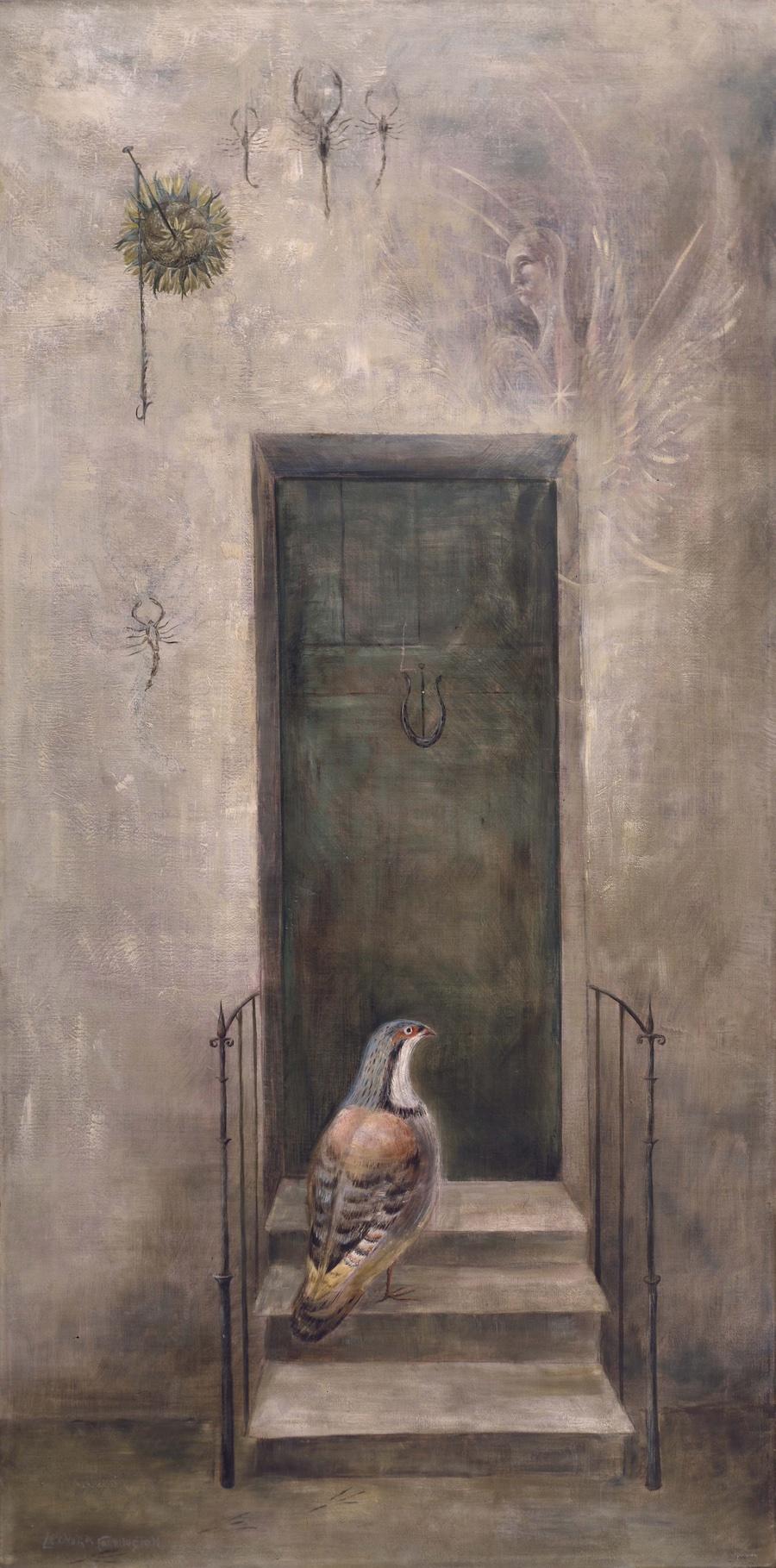
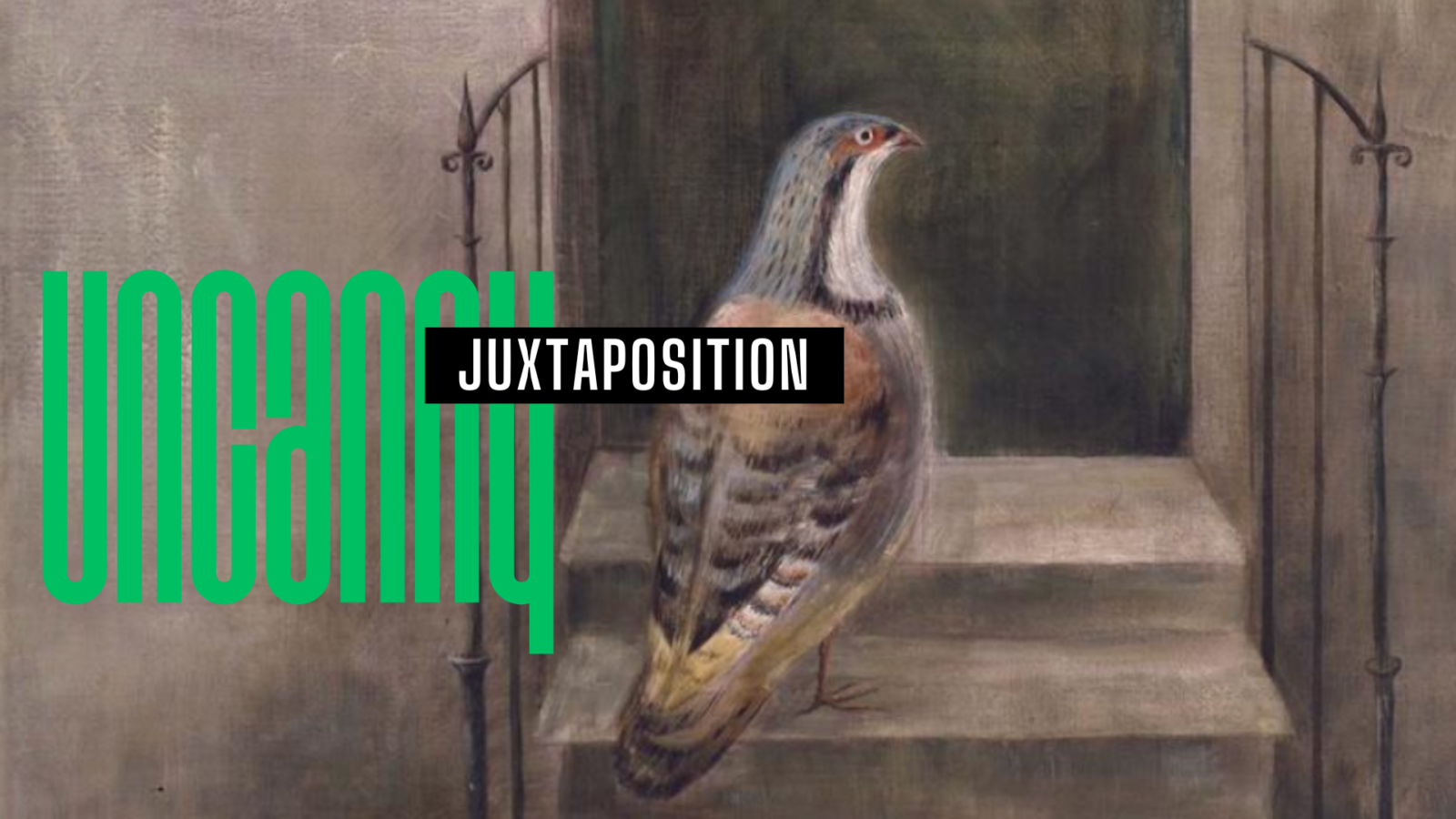
This avian motif similarly populates Carrington’s art and the Dream Weaver installation. In a 1954 oil painting titled The Last Resort, Carrington paints a large partridge — in homage to the birds of her English motherland — on the threshold of a home, accompanied by a scorpion skittering up the left side of the wall and an ethereal angel looming over the doorframe. The painting appears solemn in contrast with the lively Nunscape at Manzanillo and the vibrantly illustrated Sueño (Nephesh as the Soul in a State of Sleep); the palette of The Last Resort is subdued, the scene confined to the intimate space of the doorway and its three steps, while the bird stands nearly in profile, addressing the viewer but not quite inviting them into the frame. Dr. Ankori’s wall text tells us that the doorway is that of Kati Horna — friend of Carrington, photographer, and fellow émigré from across the Atlantic.1
Carrington’s title, The Last Resort, seems a complicated choice for a painting so evocative of friendship and connection. While it likely references Carrington and Horna’s shared immigration to Mexico City in the wake of World War II, it dually suggests that Carrington, appearing as the painted English partridge, sought safety and rest at the home of her friend and neighbor, watched over by a benevolent spirit. Readers who reach the end of Isola will witness a similar scene of homecoming, a weary traveler reaching their last resort at the domicile of a friend. The partridge’s slightly cocked head and inquisitive eye recall the sharp gaze of Marguerite’s birds; Carrington echoes Marguerite’s observation that the animal is not so different from the human.
The Last Resort is not the first time that anthropomorphic birds have appeared in Carrington’s artwork. In one of her earlier paintings (omitted from the Rose’s exhibition) Bird Superior, Portrait of Max Ernst (1939), Carrington references the animalistic alter ego of her lover and Surrealist peer, Max Ernst. The two artists began their tumultuous relationship when Carrington was only nineteen, Ernst over two decades her senior. Ernst’s reputation for volatile affairs, provocative imagery, and unconventional compositions influenced Carrington’s early adulthood; it was in the aftermath of his arrest at the outset of the Second World War that Carrington’s family plotted to have her committed to a mental health institution. Carrington and Ernst assumed animal counterparts, painting these pseudo-totems into their works. Carrington’s white horse most famously appears in her 1938 Self-Portrait (Inn of the Dawn Horse), while Ernst’s avian persona, dubbed Loplop, pervades his body of work, such as in Loplop Introduces Loplop (1930) and Loplop Introduces a Young Girl (1930).
While Carrington’s affinity for animal counterparts may have grown and developed alongside Ernst, her longstanding regard for animal life both pre- and post-dates her involvement with the Surrealist. Carrington scholar and art historian Dr. Susan Aberth eloquently articulates the crux of this matter: “Carrington forces us to acknowledge that we are animals . . . the casual way in which humans, animals, hybrids, ghosts, and mythical beings populate the same space and seamlessly interact with each other lies at the heart of her strategy to radically upend the normative.”2 While Carrington’s art certainly features human figures as well as animal, it is rarely anthropocentric; she intentionally confronts and upsets any semblance of a human-animal hierarchy in her works, inviting her viewer to reconsider the natural order of the world.
Goodman’s characterization of Marguerite’s perception of the birds’ uncanniness embodies a similarly troubled hierarchy. As her time on the island continues and the warmer weather passes into a harsh, snowy winter, she finds herself sharing the small space with a mysterious white fox, skittish deer, and ravenous bears. Upon seeing the ivory fox for the first time, Marguerite reckons that “he must have been a spirit” (Goodman 208), echoing Carrington’s belief in the close ties between animals and deities. Although the bears prove to be aggressive adversaries, Marguerite holds no hatred in her heart for the beasts: “I gazed at the white bear with awe. Not hatred, or anger, or disgust, but wonder. A knight slayed in battle” (Goodman 252). Carrington and Marguerite’s mutual interest in — to use presentist language — ecocriticism unites the two women across four centuries, encouraging present-day viewers and readers to consider the current condition of the Anthropocene. Goodman, through her unshakeable protagonist’s quest for survival, questions the divide between man and beast; Carrington’s art likewise contradicts the anthropocentric hierarchy, offering an alternative relationship between humankind and nature.
Furthermore, both Marguerite and Carrington navigate and negotiate their faith throughout their respective journeys. They share backgrounds in Christianity, yet neither woman remains unwavering throughout her sufferings. Marguerite continually questions her God’s motives, vacillating between prayerful honor and revilement at the face of the Virgin resting atop a makeshift altar. She perseverates on memorized psalms as the words concurrently offer her comfort and remind her of her cruel guardian. She is Lazarus, the prodigal son, the sacrificial lamb, continually sacrificed upon the granite slab of her isola each winter and resurrected with the first warm breath of spring.
Whereas Marguerite grapples with her religious beliefs in light of her exile, Leonora Carrington’s artistic practice allowed her to transform her Catholic trauma into a profound and fruitful exploration of the spiritual. Her works in Leonora Carrington: Dream Weaver incorporate imagery from numerous religions and belief systems. In Sueño, the wall text describes Carrington’s amalgamation of “Kabbalistic concepts of the soul and the divine” and “Egyptian symbols, astronomy, and more.”3 Her Nunscape portrays an almost comical scene of demonic nuns, dragging fish from their aquatic home and maliciously presiding over the painted land and sea. Understood together, the biographies of Carrington and Marguerite de la Rocque de Roberval exemplify how one’s relationship to faith is evolutionary, ebbing and flowing in response to life’s hardships and successes.
The two protagonists of this essay, Carrington and Marguerite, embody both a universal humanity and a distinctly feminine sense of curiosity and imagination born from struggle and constraint, bridging the gap between sixteenth century France and twentieth century Mexico. I feel fortunate to know their stories. Setting foot into the Rose Art Museum, I became keenly aware of Carrington’s own history reverberating throughout the gallery, her remarkable existence hanging on three walls. Her paintings and drawings offer but a mere glimpse of her long life, yet the curation of the exhibition insists the visitor seek further information about the artist. When reading Goodman’s vivid text, I recognized the same exigence in the character Marguerite: the reader wants to learn more. Marguerite reminds us of the importance of perseverance when all seems lost, while Carrington advises us to stretch our imaginations when reality becomes cruel.
: :
Endnotes
- Lauren Kaufmann, “Visual Arts Review: ‘Leonora Carrington: Dream Weaver’ — Surrealist Sorcery,” The Arts Fuse, April 7, 2025, https://artsfuse.org/308561/visual-arts-review-leonora-carrington-dream-weaver-surrealist-sorcery/#:~:text=In%20Nunscape%20at%20Manzanillo%2C%20a,to%20Carrington’s%20friendship%20with%20Horna.
- Susan Aberth, “Animal Kingdom,” in Leonora Carrington: Magical Tales, introduction by Tere Arcq and Stefan van Raay (Instituto Nacional de Bellas Artes, 2018), 245.
- Rose Art Museum, Brandeis University, “Leonora Carrington: Sueño (Nephesh as the Soul in a State of Sleep),” wall text.
Kristen Lauritzen
