
“The First Novel Written by AI is Here,” an article proclaimed in 2018. The author doubted AI tools could ever write a good novel but nevertheless conceded that one “might just see fragments of meaning thrown into a neural network blender.” Novel-writing thus became an early benchmark for AI’s cognitive abilities. The years since have seen the emergence of platforms specifically designed for the production of literary texts, including Sudowrite and Rytr. “Try the AI writing tool with unparalleled story smarts,” Sudowrite’s ad copy implores. “It’s amazing how ‘smart’ it is.”
Human novelists, in turn, have pointed out that the main problem with generative AI is that it’s just not, in fact, that smart. To be sure, their critique is motivated in part by AI’s threat to labor, whether in how large language models are trained on stolen archives or in how AI-generated books have come to populate Amazon’s best-seller list at amazing rates, displacing human authors being compensated for their work. But the centerpiece of the critique—as exemplified by a letter published by the Authors Guild in 2023, cosigned by thousands of authors including Margaret Atwood, Jonathan Franzen, and Michael Chabon—is an objection to the quality of AI-generated creative writing. The letter warns: “The potential of mediocre, machine-written books, stories, and journalism based on authors’ original work flooding the market poses a significant threat to the writing profession.”
It’s not just that AI corporations are stealing work produced by human members of the profession; it’s that their product can’t produce work of sufficient quality, because AI inherently lacks the touch of human brilliance. Our literary culture has long valorized the figure of the author-genius, the notion that literature is the product of unique, special people. As the conventional wisdom goes, authors produce works of literary significance both as a function of and as a demonstration of their genius.
But we should not accept the author-genius conception of literature at face value, and it should surprise us that many literary authors who defend genius against AI were also more likely to be at the forefront of deconstructing genius prior to AI. In 1967, John Barth’s essay, “The Literature of Exhaustion”—a real genesis point for the postmodern era—described what Barth felt was the “used-upness of certain forms or exhaustion of certain possibilities” within the contemporary literary culture. In the postmodern world, argued Barth, the traditional form of the novel had exhausted its own capacities to transfer meaning. But it wasn’t just the form of the literary object that Barth sought to deconstruct; at the center of Barth’s critique was a reconsideration of the process of artistic production itself, which had previously acceded to the “traditional notion of the artist,” or the “Aristotelian conscious agent who achieves with technique and cunning the artistic effect.”
Such a notion of the artist—grounded in traditional ideas of artistic genius, self-contained individuality, and Enlightenment liberalism—was one of the structures buttressing what we imagined art was capable of doing. When authors and artists, inspired by Barth’s analysis, began to seek ways of escaping the “literature of exhaustion,” they likewise began to tinker with the legacy of the self-bound creative genius. This period of transition gave rise to a series of elaborate experiments in literary form, in which literary movements adopted fringe, dissident, and avant-garde literary strategies that scarcely resembled previously accepted modes of aesthetic production. Where modernism dealt in allusion, or the referencing of one work inside another, postmodernism dealt in intertextuality or even outright, deliberate plagiarism, in both cases incorporating large swaths of texts sourced from elsewhere.
The feminist dissident and avant-garde novelist Kathy Aker exemplifies many of these experimental forms. In her 1984 novel Blood and Guts in High School, Acker plagiarized large swaths of Nathaniel Hawthorne’s 1850 novel The Scarlet Letter in a manner that not only violated traditional conventions around plagiarism but also dealt a form of literary violence to its source material. Acker stole titles, character names, and full plot points, simultaneously weaving in a deconstruction of those points of origin. She chopped things up, turned them around, made them grotesque and undigestible. For instance, she made her narrator-protagonist Janey write a book report in which she referred to Hawthorne’s male protagonist Arthur Dimmesdale as “DIMWIT” and spent large swaths of its pages textually berating him.
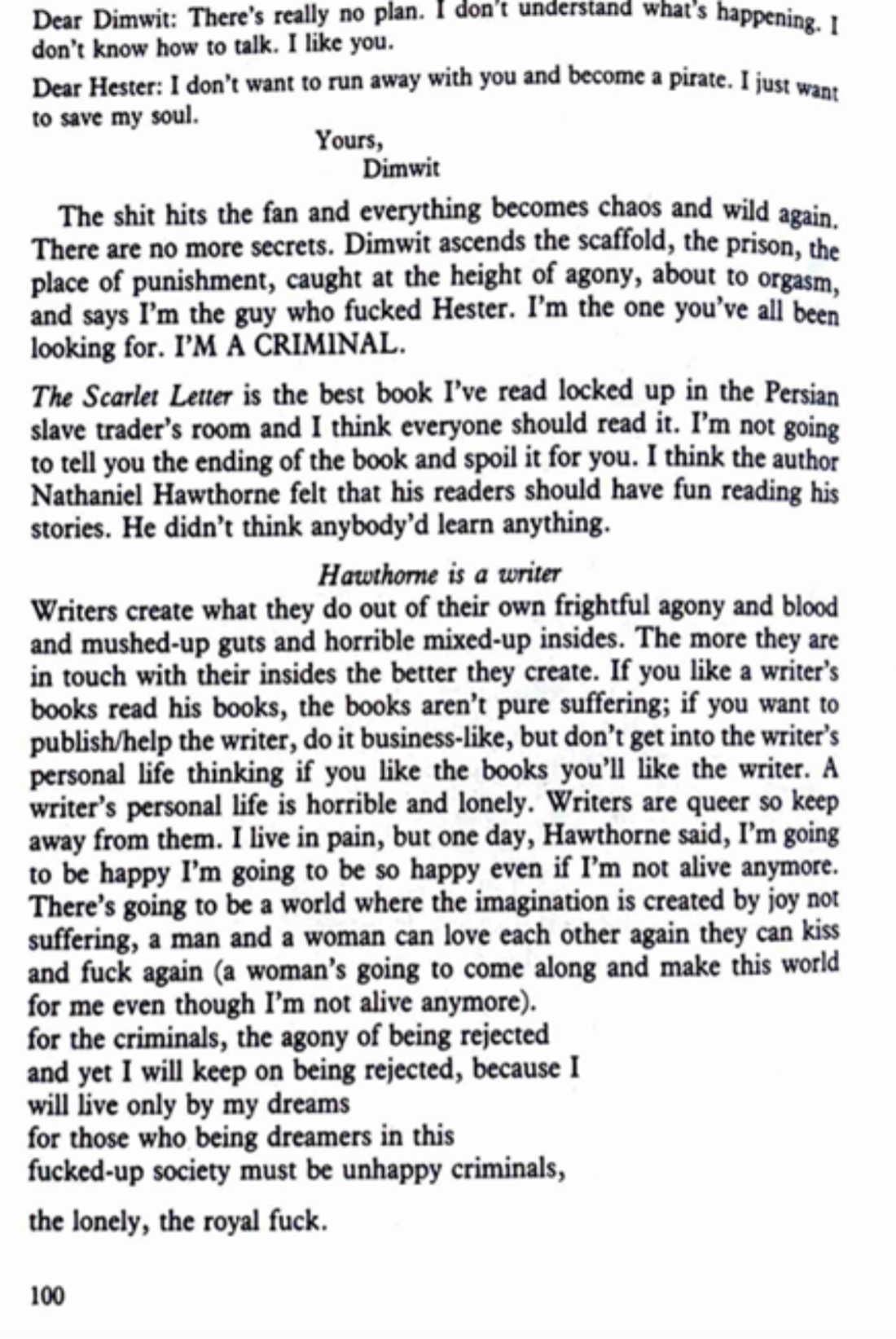
Hawthorne wasn’t the only literary figure who became the subject of Acker’s fierce critiques. Dotted throughout her oeuvre appear magisterial men of all stripes. Acker undermined these men using her trademark plagiaristic practice—her 1983 novel Great Expectations uses Dickens’s novel of the same name as a loose guiding mechanism, subjecting it, of course, to unflinching ridicule. A decade later, in Pussy, King of the Pirates (1996), Acker integrated the ethos of piracy into a formal literary mechanism by ransacking the range of Western literary tradition from Antigone to Artaud. In a moment of the novel’s awareness of itself, Acker writes: “The purpose of piracy: stealing . . . Regarding direction of sailing: Buried treasure is hidden in caves at the centers of labyrinths.”1
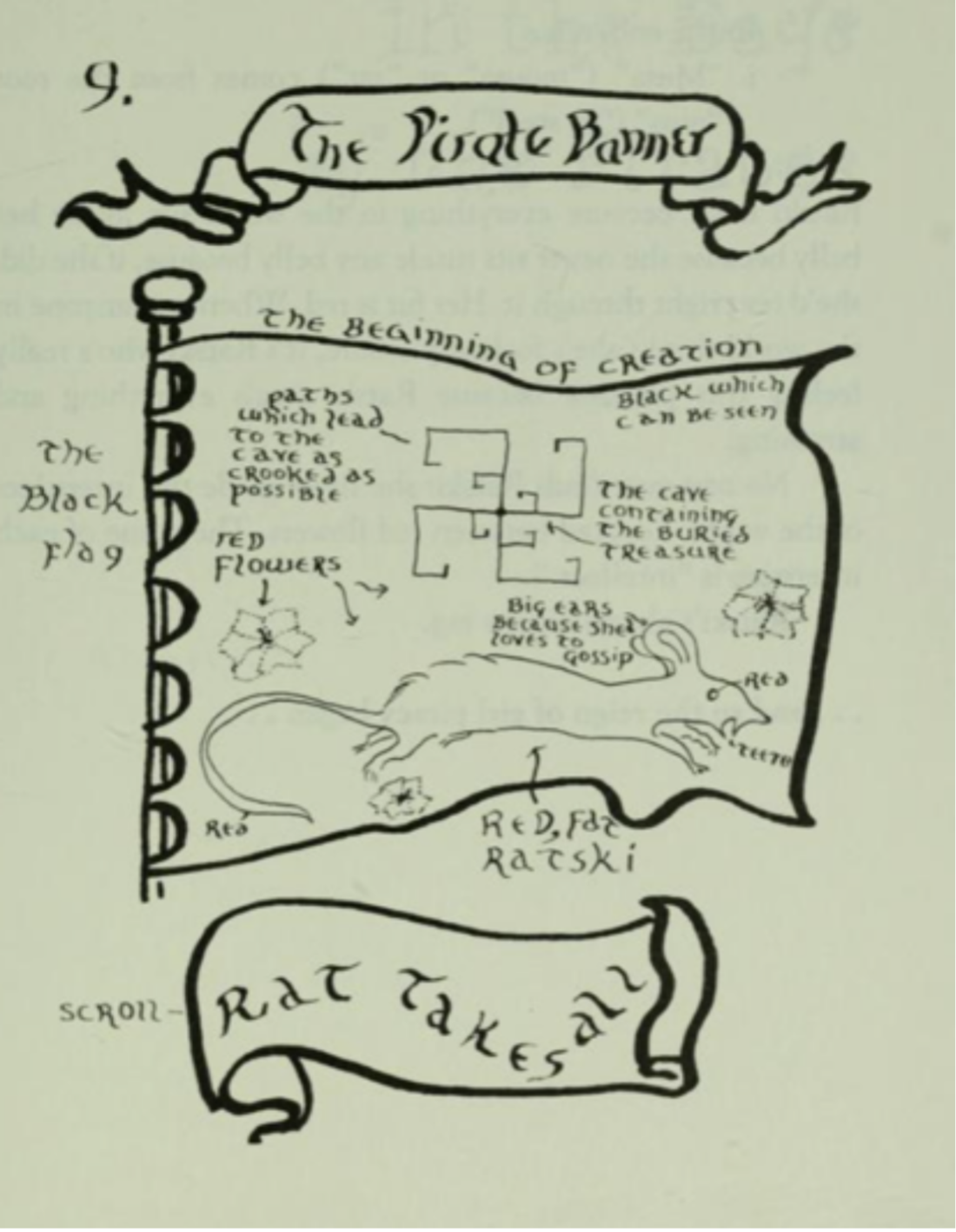
Acker leaves no doubt as to what source material is responsible for her work. Her strategy is to turn the tables—to become the dominating figure whose plagiaristic and effacing strategies incorporate not just narrative but also real authors’ real lives. Among the institutions that Acker simply won’t let stand: the sanctity of the author-genius. We should look for meaning instead, she suggests, in the act of plunder. But the real insight from Acker and her postmodern contemporaries is something deeper than a directive to steal. This insight is that there has only ever been plunder; writers bear the influence of other writers in ways that neither they nor their counterparts can control, and texts are always amalgamations of external influence. Acker provides the perfect foil to the Writers’ Guild’s handwringing about AI plagiarism—what, she asks, do you think we’ve been doing this whole time?
: :
Acker’s critique of the author-genius was motivated in part by a feminist critique of how, under patriarchy, genius was always coded as male. In the succeeding generation, patriarchy may have had the last laugh, as male postmodern authors who also seemed to attack the idea of genius came to be hallowed as geniuses themselves. David Foster Wallace, for instance, is perhaps the most famous author-genius of contemporary literature. Wallace wrote massive novels that tinkered with formal experimentation; and the plot of his most famous, Infinite Jest, unfolds as much in belabored endnotes as it does in the body of the text, displacing traditional locations of authorial expression. But unlike Acker and other postmodern authors who used formal experimentation to raise questions about the nature of authorship, formal experimentation for Wallace and his contemporaries became a mark of their literary chops. In an 1997 interview with Charlie Rose, Wallace reflected on his legacy as the experimental novelist par excellence of the 1990s: “[F]eminists are saying white males say, ‘Okay, I’m going to sit down and write this enormous book and impose my phallus on the consciousness of the world,’” related Wallace. “If that was going on, it was going on on a level of awareness I do not want to have access to.” A telling moment indeed: the markof his own genius—the length and density of his novel—is also an exercise in masculinist competition, an expression of his phallus upon the world.
Wallace died by suicide in 2008, leaving his final novel, Pale King, unfinished. In the immediate aftermath, the mythos of his creative genius colored many commentator’s responses. In a series of reflections on his death, one fan commented: “The word ‘genius’ is so overused that it is now nearly devoid of meaning. Yet I can’t think of a word that describes David Foster Wallace more accurately.” Jonathan Franzen, one of Wallace’s chief competitors for literary recognition, penned an essay with The New Yorker describing his attempts to cope, especially after Wallace’s widow had asked him to scatter his ashes on a trip Franzen took to a remote island in the South Pacific. Franzen views the suicide, at least in part, as a cruel exercise in career advancement. Confronted with the inability to formally innovate beyond what he had already accomplished, and burdened with an incomplete, unwieldy novel that had taken him a dozen years to develop only to whither on disparate computer files and notepads, Wallace took the path of least resistance to advance his career: “I imagine the side of David that advocated going the Kurt Cobain route speaking in the seductively reasonable voice of the devil in ‘The Screwtape Letters,’ which was one of David’s favorite books, and pointing out that death by his own hand would simultaneously satisfy his loathsome hunger for career advantage and, because it would represent a capitulation to the side of himself that his embattled better side perceived as evil, further confirm the justice of his death sentence.”
Under Franzen’s interpretation, Wallace’s suicide represents a disturbing entry into the legacy of the author-genius: because literary form was, for Wallace, an expression not of literary or artistic value, but rather of the value of his career and his capacity to advance it, suicide was the only act that would immortalize his genius. Instead of being evaluated for his future work, his suicide would refract across his already-celebrated first novels and cement his status as a keen perceiver of the world’s real, fundamental sadness. Wallace had played the ultimate career trump card, and Franzen resented him for it. Both Wallace, in committing suicide, and Franzen, in reacting to it, are shackled by their dedication to the mythos of the author genius.
: :
Is there a way to critique AI that does not revive this masculinist obsession with genius as the precious commodity most need of protection? Yes, there are many: AI’s harmful effects on climate, on social relations, on labor conditions for those working in fields of cultural production as well as many other fields, on accelerating hegemonic economic structures, on consolidation of public infrastructure, and much more indeed seem like constraints worthy of the type of class-level action the Authors Guild letter represents. But the letter’s authors subordinated those harms to a concern with individual intellectual displacement, a fear that slop will soon replace works of genius.
Rather than mourning the death of the author, the literary community should, like Acker, embrace an opportunity to interpret literature without sanctifying the author-genius. That may seem impossible in today’s market-fixated literary environment, but history suggests it is not. Indeed, the myth of the author-genius is a relatively recent fabrication, one that coincides with the development of copyright law in early eighteenth-century England. The first legal protection for written works wasn’t instantiated until 1710, when the Copyright Act vested a right to “the copies of Printed Books in the Authors or purchasers of such Copies.” The architects of copyright had been riding the waves of the emerging philosophical movements of the Enlightenment, which, in their conjectures and theses on culture, emphasized the rational, autonomous, individual genius above all.2 Prior to copyright, the relationship between author and work was much more nebulous. Works now regarded as paradigmatic expressions of literary genius were in their own times regarded as texts by and for the public, and subject to recasting and remixing as a culture sees fit.
Shakespeare, the archetypal author-genius, borrowed heavily from work that preceded him.3 Nor did Shakespeare himself view his texts as sacrosanct; scholars think he practiced a highly collaborative writing process, and his pieces went through many iterations before they were written down in the form we know them best now (via the publication of the First Folio in 1623, seven years after his death). “Was Shakespeare a plagiarist?” many Internet denizens have asked incredulously. This is the wrong question, because plagiarism as a legal concept simply did not exist in Shakespeare’s time. But it reveals something significant: that we cast backward our own standards for the production of culture, and we take for granted that our current standards are secure and based in something valuable.
Instead, we might learn from the past how to prioritize writing as a practice for the public, rather than an expression of private genius. Shakespeare and his collaborators are one model, liberally drawing inspiration from myriad sources to produce works that were themselves immediately subject to reinterpretation and reimagination. Or, more recently, consider the Federal Arts Project: a New Deal initiative aimed at stimulating artistic labor under one federally organized workforce, with salaried, largely anonymous artists generating art for purposes of the public good. AI’s theft from writers has naturally led to a reaction of doubling down on the rights of individual writers over their private property. But if we think of writing as public, as belonging to a culture, then we might invest in public infrastructure more than property rights. The problem with AI is that it, too, is privatized intellectual property: a commodity sold by companies rather than an infrastructure making culture available to all.
How might Acker react to the proliferation of AI texts? It’s impossible to know for sure, but we suspect that she’d react the same way she reacted to the male-dominated literary canon—finding meaning not in expression, but in plunder.
: :
Endnotes
- Kathy Acker, Pussy, King of the Pirates (Grove Press, 1996), 206.
- See Robert Mitchel, “Enlightenment Biopolitics: Population and the Growth of Genius.” Eighteenth Century: Theory & Interpretation 59, no. 4 (Winter 2018): 405–27.
- See E. A. J. Honigmann, “Shakespeare’s Plutarch.” Shakespeare Quarterly 10, no. 1 (1959): 25–33.
Ryan Prewitt & K. Wilson
