1: The Giantess
When I first saw her in 2023, I had a job that paid me to tell stories about animals and an apartment in Berlin I rarely left. Most days I was squirreled under a blanket, hate-reading a self-help column. I don’t remember the advice, but I remember the artwork beside it: a woman with a poof of yellow hair, hulking, barefoot, and surrounded by birds. She held something delicate in her hands, an egg, the smallest unit of hope.
I took a screenshot. I didn’t even know she was The Giantess. For a while she was my phone’s wallpaper, the closest I ever hoped to get.
2: Two Children Are Threatened by a Nightingale
Under a sky, eight shades of blue, two girls stand in the yard. One points a knife at a black speck, the nightingale. The other lies collapsed in the sickening-green grass. On the roof of a house, made of real wood and jutting off the canvas, a man in a suit carries a third child under his arm. Mid-stride, he reaches for the doorknob affixed to the frame.1
It’s a threshold. The year is 1936, and a nineteen-year-old named Leonora Carrington has fallen in love with this painting. Growing up, she was the kind of girl who filled the margins of her notebooks with demons and cursed women from the Celtic fairy tales her grandmother and Irish nanny told. At Catholic school she attempted to levitate and wrote backwards for fun.
“Leonora Carrington,” Mother Ignatius said, “desperate to be different.”2
Leonora would get expelled from two Catholic schools and one finishing school by the time she saw the painting with the nightingale. A year later, she fell in love with the artist.
Not-yet-divorced, German and twice her age, the surrealist painter Max Ernst was not the kind of man Leonora’s parents wanted for their debutante daughter. When Leonora told them she would never marry, that she would stay with Max, she said her father told her, “Never will my door be darkened by your shadow.”
3: Self-Portrait (Inn of the Dawn Horse)
I know the stoop I stood on at eighteen when my father refused to meet my boyfriend. That boy is long gone, but it took me years to stop knocking.
A woman can swap her debutante dress for riding clothes, but she will stay blue as a chair and pinned as a rocking horse to the wall. It’s not that deep. If you want to get out of your childhood, you have to leave the room and go outside, where a real horse gallops in the distance. If you can’t manage that, a hyena may come to your aid.
In Leonora Carrington’s short story “The Debutante,” a young woman doesn’t want to go to a ball, so she asks a hyena to take her place. The hyena, needing a disguise, rips off the maid’s face and wears it (though I wish it hadn’t been the maid). The guests at the ball are fooled until someone smells blood. That’s when they corner the hyena, who escapes out the open window.
4: Leonora in the Morning Light
The horse is in the garden of a stone white house in Saint-Martin-d’Ardèche, a village in the south of France where crickets sing at night and Leonora sings her French verbs to be and to have to the tune of “Onward Christian Soldiers.”3 That was Max’s idea. He was determined to improve Leonora’s bad French and teach her about art and make her his muse, painting her in the garden, holding onto the vines. It’s 1939, a year before the French authorities arrest Max, not for being a Nazi but for being a German, an enemy in France. When he’s taken away, Leonora is left at the house alone, where she cuts down the vines she held onto in the morning light.
By the time I saw Leonora in the Morning Light, it was 2026, and I had almost forgotten about The Giantess. The wallpaper on my phone was my dog, one of the few things that stayed. The job telling stories about animals was gone and so was the Berlin apartment. Now I lived in a one-room studio with a wobbly desk under a lofted bed. I escaped by looking at pictures of other people’s houses: an adobe kitchen in Joshua Tree, a library in Istanbul, a stone house in Saint-Martin where Max and Leonora used the walls as their canvas. They painted a green bookshelf with a dancing devil and a pig in heels. They drew red-winged creatures over the doorway. There were only a few pictures in the carousel, and I wanted to see more.
5: The House Opposite
I search “house leonora carrington,” and the first image I find is a six-room painting, a dollhouse of trapdoors and last-supper tables. The rooms pulse with women or half-women/half-trees or half-women/half-birds who are stirring cauldrons, dreaming and slipping into other worlds. There’s a horse without a muzzle, a rocking horse in the cellar.
“Houses are really bodies,” Leonora wrote in her novel The Hearing Trumpet. “We connect ourselves with walls, roofs, and objects, just as we hang on to our livers, skeletons, flesh and bloodstream.”4
After Max’s arrest, she stayed in Saint-Martin, cutting vines and going mad, drinking orange blossom water to make herself throw up. When an old friend, Catherine Yarrow, showed up in a Fiat, fleeing the Nazis, she begged Leonora to come with her. Leonora refused because she was waiting for Max to be released. But when Catherine said more could be done to help Max from Madrid, Leonora was convinced. She left the house, and all the artwork she and Max made, and got into Catherine’s Fiat with just a suitcase, etched with one word: REVELATION.
6: La Maison de la Peur
The algorithm stopped showing me pictures of Leonora Carrington houses and started
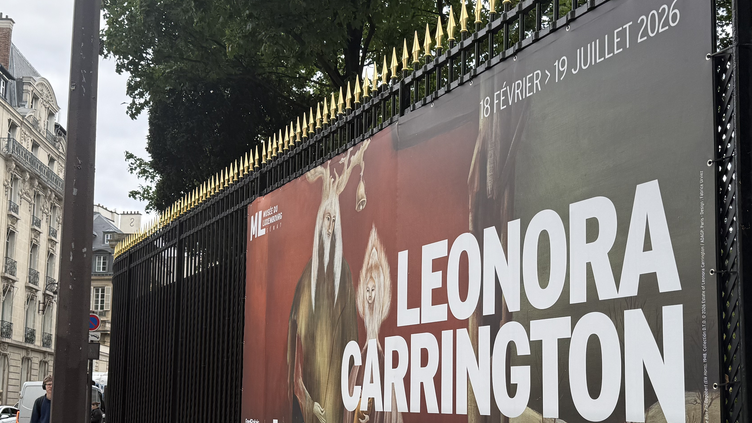
selling me something: tickets for an exhibition of Leonora Carrington’s work at the Musée du Luxembourg in Paris. Days after I saw the ad, I got a text from a relative, an almost-aunt. She was traveling to Paris with her husband, an almost-uncle. Did I have time to meet up?
I have a real uncle and real aunt, my father’s sister, who live a few hours from Berlin. Sometimes the real aunt sends warm, cheerful emails, signed love. I read them twice and don’t reply.
I wrote to my almost-aunt right away. At least I would get to see The Giantess.
7: Down Below
On the train I read Leonora Carrington’s memoir Down Below, which recounts her psychotic breakdown after Max was arrested and she left for Madrid. When Leonora arrived in the city, she began having delusions that she could stop the war. Her family was alerted when she turned up at the British Embassy, and her father sent one of his associates, who found Leonora, drugged her, and took her to an asylum in Santander.
When she woke up, Leonora didn’t know where she was. Down Below has that same dropped-in, dizzy feeling. First written in English, then dictated in French, then translated back into English, the stream-of-consciousness sentences are raw, without a sense of time.
During the six months she was kept there, the asylum experimented on Leonora with Cardiazol, a drug that induces seizures. She never had visitors, never heard from her parents, a kind of silence that can be both a punishment and a relief. A place to become yourself.
Years later, the doctor admitted Leonora wasn’t crazy; maybe she didn’t need medication. Maybe she was just having a normal reaction to losing her partner in the middle of a world war. But her parents didn’t agree. When the asylum wanted to release Leonora, they sent the nanny, a woman named Mary Cavanaugh, to collect their daughter. Warm and cheerful, Mary was the one who told Leonora Celtic fairy tales and, by some accounts, arrived at the asylum in Santander by submarine. A photograph captures her, the doctor, and Leonora outside the building. In grainy black and white, they’re smiling. Was it that bad? Were her troubles as small as a nightingale? Was the silence really so punishing?
Leonora’s parents had tasked Mary with taking their daughter to another asylum, this time in South Africa. En route, they passed through Lisbon, one of the last escape ports out of Europe. When they stopped in a café, Leonora slipped out the back door. She ran for the Mexican Embassy, where she knew someone who could help, a diplomat whom she’d met through Max.
And it was in Lisbon, weeks before Leonora sought asylum in the United States, that she ran into Max on the street. He was alive. Not only alive but engaged. And not just engaged to anyone but to the famed American art collector and socialite Peggy Guggenheim.
To be fair, Leonora was also engaged to the Mexican diplomat. She and Max needed those marriages. They knew some things more important than love: survival, and also freedom.
8: The Guardian of the Egg
The painting that brought me to Paris is The Guardian of the Egg, also known as The Giantess, that woman with a poof of yellow hair, barefoot, hulking and surrounded by birds. There is no house in this painting. The woman, the giantess, is what shelters the egg. She holds the future in her hands, and there’s the hope that whatever new life comes from it could break with what came before.
Leonora knew Paris. She lived with Max on Rue Jacob for a year, where she got to know Picasso, Remedios Varo and a circle of surrealists. Leonora loved the city, but she and Max were forced to leave after Max’s almost-ex-wife physically attacked Leonora on the street.
9: Grandmother Moorhead’s Aromatic Kitchen
Leonora Carrington’s kitchen is on Chihuahua Street 194 in Mexico City, where she painted her greatest works, including The Giantess. It’s also where, after divorcing the Mexican diplomat, she made a home with her second husband, the Hungarian photographer Chiki Weisz, their two sons, and friends, around the table. The camera follows her inside.
In the documentary at the beginning of the 2026 Paris exhibition, Leonora lights a cigarette. She sits at the table where tapestries and some of Max Ernst’s paintings hang in the background. She talks about her pets and the fairy tales she learned as a child. She stands up to water her plants.
In the next room of the exhibition are her doors, the ones from Saint-Martin that she and Max painted green with a demon and pig. Around the corner are the six rooms from the House Opposite. But there is no Giantess. The painting I came to Paris to see isn’t even here.
It turns out that Leonora Carrington sold The Giantess for £500 after she moved to Mexico City and was short on cash.5 In 2009, two years before her death, the buyer resold the painting at a Christie’s auction for $1,482,500. Today the painting is in Mexico City, in a private collection, not available for the public to see.
But another painting, the last one in the exhibition, stops me. The kitchen is red. It’s not common, in Carrington’s swirling, technicolor paintings, for the eye to rest on one color. The red is almost calming, even in a room of other-worldly creatures: a giant white goose, a horned creature clutching a broom, three hooded creatures, someone with a spiky hat sweeping up with a dustpan. My favorite, at the back table, is a guy in sunglasses and a brimmed black hat, stirring the pot with a big grin. They look like versions of demons she used to draw, the ones inspired by the childhood stories told by her Irish nanny and grandmother. But the kitchen itself, the circular table with jumbo garlic and husks of corn, is far away from any Ireland. Leonora’s Grandmother Moorhead never had a kitchen in Mexico, and Leonora only returned to England a few times, after her father passed away.
There are people who say Leonora slammed a door on her family. But she built them a room in her house. Her Grandmother Moorhead has a Mexican kitchen, and beyond the doorway, in the distance, a shadowy figure comes through the darkness and fog.
10: Surreal Spaces
In 2006, the journalist Joanna Moorhead took a trip to Mexico City. Joanna was the daughter of Leonora Carrington’s cousin, making her an almost-niece. By then Leonora was in her late eighties. She had stopped sitting for interviews and was still estranged from her family, across the ocean.
When Joanna landed in Mexico City, the airline had lost her luggage, but she had what she needed. A small piece of paper with Leonora’s number. The first morning, she made the call.
Leonora answered the phone right away and invited her over. They had tea in the kitchen and tequila after that. This was the first of many visits Joanna made before Leonora’s death in 2011. “There was space at her table for a new friend,” she writes. It didn’t seem to matter that Joanna was also from the family she left.6
Leonora objected to just one thing. On that first visit, Joanna took out a notebook.
“What’s that?” she remembers Leonora asking.
Joanna explained that she was there to write a story and needed to take notes.
“Write your story if you want,” Leonora told her. “But you’re not interviewing me. You’re not a journalist here.”7
I leave the museum and walk across the city. I’m meeting my almost-aunt and her husband for lunch, and when I open the restaurant door, they’re already waiting at the table.
She orders oysters, and I tell her I’ve never tried one. I’ve been a vegetarian for years. She takes out her camera, and I take a bite.
It tastes like the ocean, her husband says. It really does.
She puts the camera away and calls the waitress over.
One more menu, she says. For my niece.
: :
Endnotes
- Max Ernst, Two Children Are Threatened by a Nightingale, 1924, oil on wood with painted wood elements and frame, Museum of Modern Art, New York.
- Quoted in Joanna Moorhead, Surreal Spaces: The Life and Art of Leonora Carrington (Princeton University Press, 2023), 48.
- Moorhead, Surreal Spaces, 95.
- Leonora Carrington, The Hearing Trumpet (Exact Change, 1996), 17.
- Moorhead, Surreal Spaces, 168.
- Moorhead, Surreal Spaces, 8.
- Moorhead, Surreal Spaces, 9.

Kaitlin Roberts