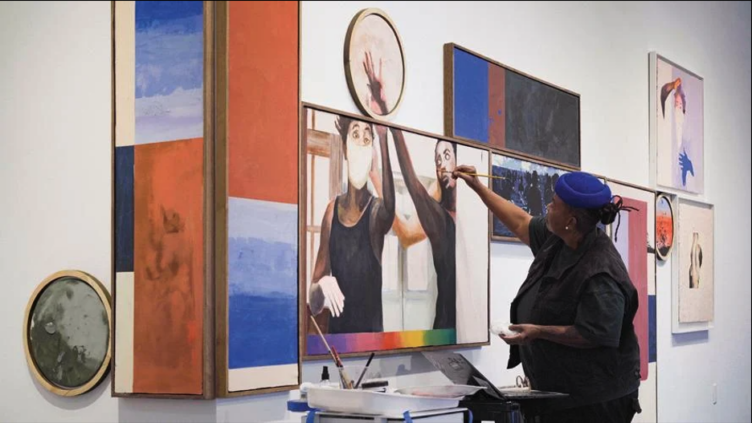
The black box theater of Rice University’s Moody Center for the Arts might seem like a puzzling place for an introduction to Lovie Olivia’s art. But it was precisely right. The performative, the kinetic, the relational, the dimensional—all legacies of theatrical experimentalism—also characterize her practice. We were here on this warm, misty Houston day for Olivia’s showcase as part of ASAP/16, and I was fortunate to talk with her afterwards. What emerged as an after-showcase interview flourished into an hours-long chat and walk around the Center’s gallery. This is one of the things you quickly learn upon meeting Olivia: the generosity of her spirit and the poignancy of her self-reflexivity.
To see Lovie Olivia’s work is to rest in a realm of requisite black fullness, made possible by her studiousness of materiality. Her attention to craft is a deeply philosophical and world-making endeavor that eclipses the purview of the visual and, instead, offers an alternative lexicon for living. We might find our entrance into the brilliance of her work in what she called, in our interview, “the fold,” which she describes as her “method of unrevealing, of stating what may be lost in the gap, of what may be lost in the fold. And that fold is beautiful, and that fold is labored, and that fold is measured, and that fold is intentional.” I see the fold as one metaphor for her fidelity to both material composition and material histories that expand across her creations.
Look with me at her 2023 piece Buoyancy.
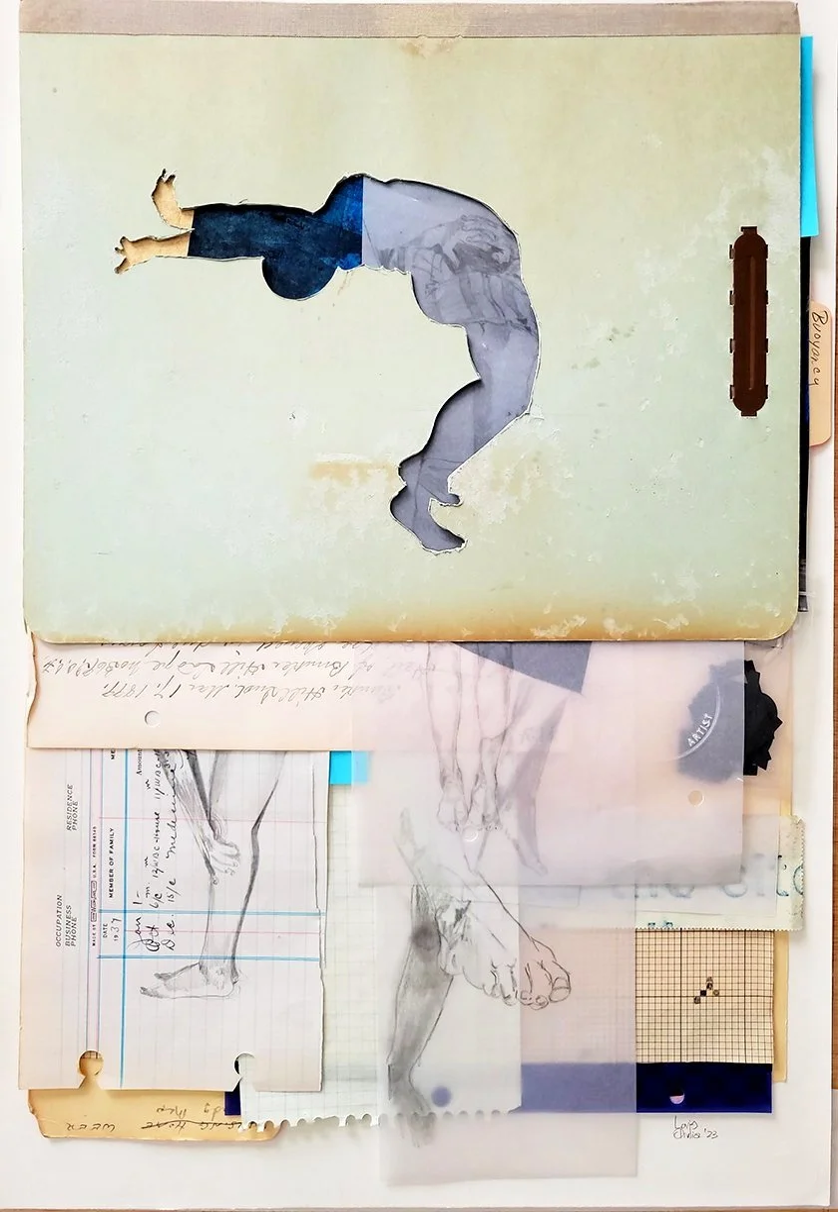
Materiality makes possible a set of interactions that revise the notion of “buoyancy,” or floating as we know it. To be buoyant is to rest without sinking. Yet there is no liquid here; there is no ocean, no water on which the body floats. There are, rather, various states of texture and cut-outs, like the manila folder, the vellum paper, the log sheet, the letter, and the grid. These are not just differently textured papers, but also varied descriptive modes that signal the enactment of measurement, description, and surveillance. To Olivia, Buoyancy deploys the “meager” folder towards “un-categorization.” I am moved by her proposition: “How far can I push and personalize ephemera and symbols of categorization?” Wading through the tenuity of category, this body floats.
To see the body in motion, Olivia asks us to attend not just to sight but also to composition and texture. This is central to her practice. For instance, in an interview with the Frist Art Museum, she describes her choice to use vellum made from calfskin and squid ink. For squid ink, the essential coloring agent is melanin—yes, that same agent responsible for the darkened hue of skin and hair. In deploying squid ink, she says, “I’m trying to tell a black story through material.” What it means to give an account or an arrangement of a set of events through materiality defies the very logic of ordering to which we are accustomed: this is a storytelling not through the collection of time, but through the collection and arrangement of materials.
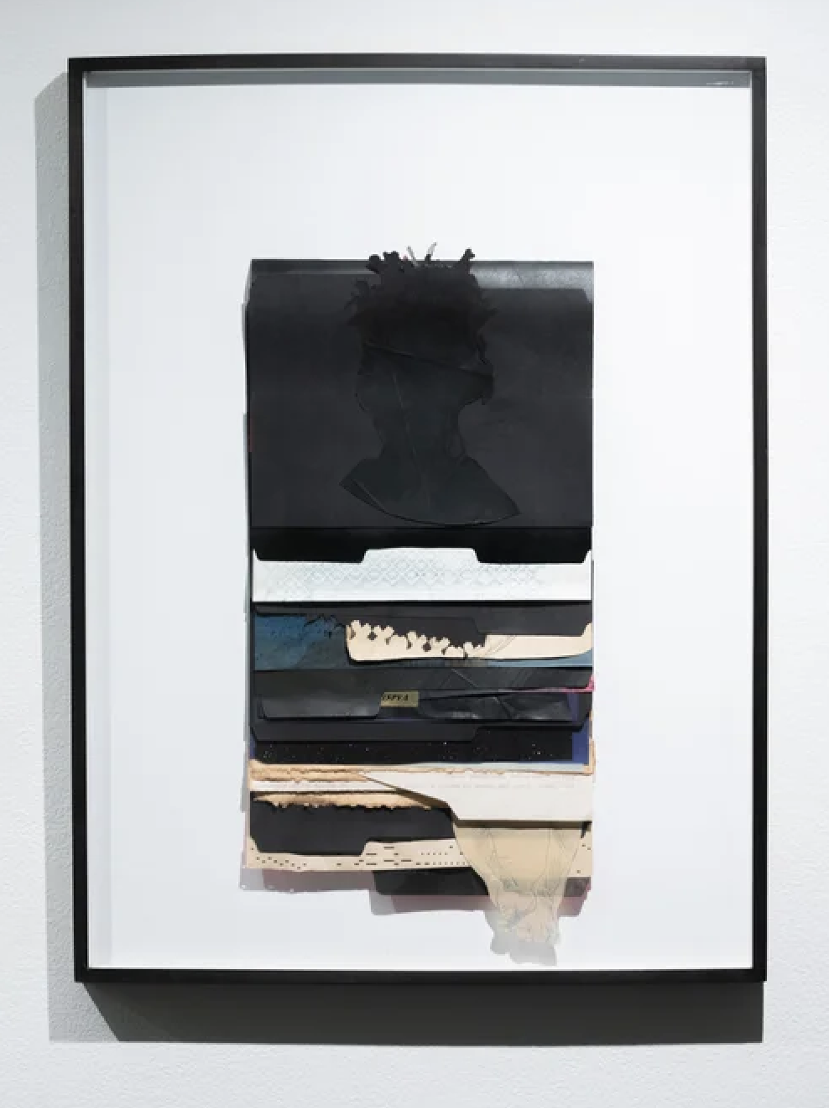
Olivia refers to herself as a “Black Queer Womanist” practitioner. Her attention to nuance and her challenge to dominant norms—of what a body is, of how a story is told—reaffirms this. In Buoyancy, in particular, she asks us to read the body differently, questioning what is inside and outside and what else depends on such a binary distinction to begin with. She brings into tension the idea of the unitary or the part through the embrace of the fold and overlay. Rather than neat containers of history or rigid boundaries of bodies, we have an exploration of the palimpsest or the overflowing.
Let’s look at two structuring techniques, the fold and the layer, in Buoyancy. See how their togetherness breaks and remakes the body as we know it. At first glance, the water stain and scrape of the topmost folder divides the frame across the horizon, perforating the body above and the bodies below. Above, we see an outstretched figure bent over at the waist, head thrown back, fingers pointed, and heels raised. Below, to the left and to the right, there are several iterations of legs; they almost hold the body up, like pillars. Much like the outstretched bent body, these lower positions feature exerted movement. In the bottom-left quadrant, the body appears folded; the faceless hands rest on the knees, evoking a familiar pose of exertion and rest. On the other side of this bent stance is a series of montages. They emerge through the layering of vellum paper. Through their overlay and outline, they share the softest touch as feet twirl and lift, extending artfully en pointe.
Each of the positions, both above and below, gestures outward, beyond the frame. In this way, these figures float, or achieve a quality of ascent beyond the indexical, descriptive, and quantifying materials with which they are made. They are not weighed down by these materials, however. They work in and through them on their journey to something more. Olivia offers a rare depiction of externality, of surface that enunciates two-dimensionality in tandem with texture and depth. This is to say, she makes the folder capacious despite the absence of an inside. Out-peaks from the folder are contents, but we witness no opening, nor bookend to suggest notions of interiority or enclosure. In fact, the silhouette becomes through the cutout, as the point becomes through the trace. These are expressions that adhere neither to ideas of triumphant ascent nor to expressions of progressive becoming. Rather, Olivia offers a buoyancy that expresses a commitment to multiplicity and working through.
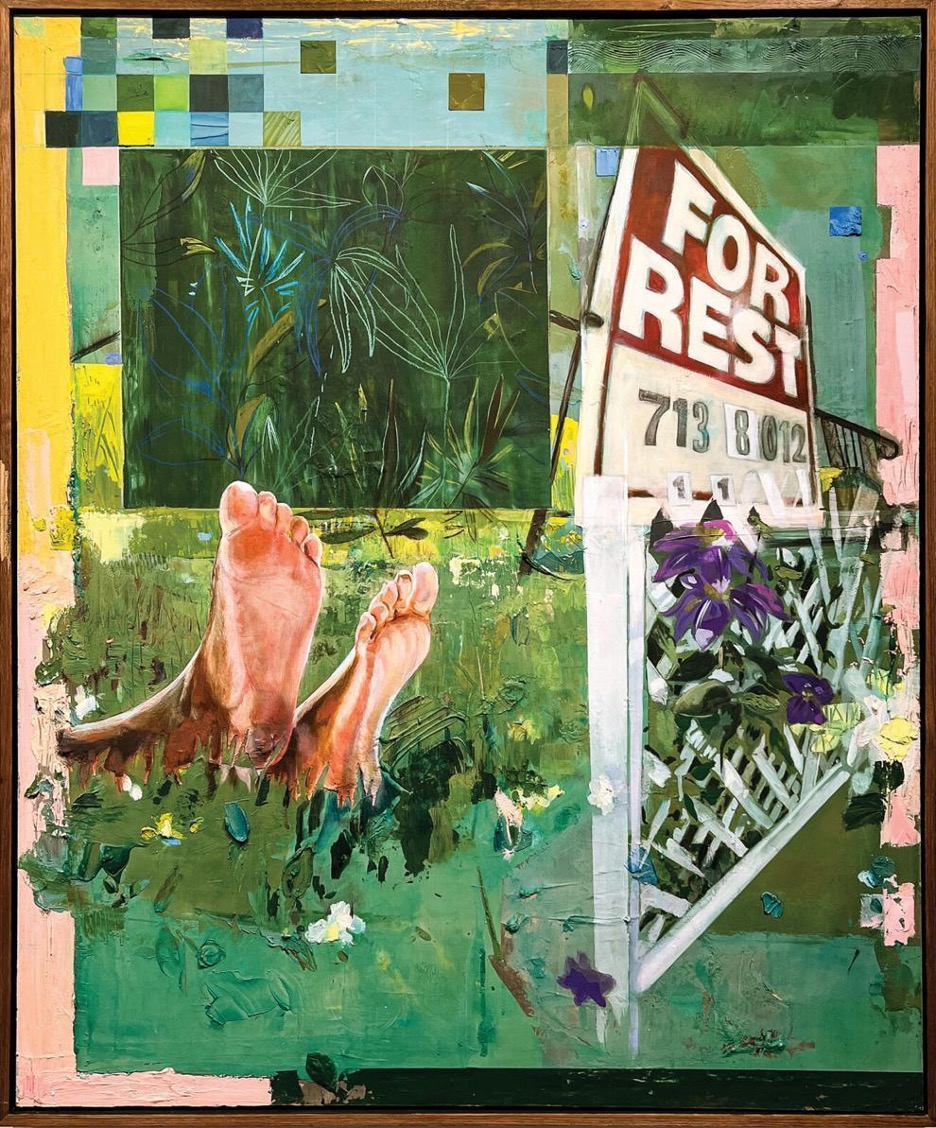
Folding might be one extended metaphor to describe the constellation of techniques Olivia deploys to tell “a black story through material.” It resonates throughout Olivia’s work, from Forest (2023) to her most recent installation, “Space Scape Cinema” (“SSC”) (2025). “SSC” expands her longtime practice with fresco, the mural technique that conjoins pigment and plaster. In this installation, she also incorporates sgraffito fresco, in which, through scraping and excavating, she reveals what’s underneath. By combining fresco techniques and deploying additive and substitutive painting and carving techniques, she enunciates depth and dimensionality as key interlocutors.
Like the fold, the scratch (sgraffito from the Italian “graffiare”) toggles the pictorial as duly syncretistic and textural; it demands an interrelationship between layers to cohere the image. And this is just one scale. In “SSC,” Olivia plays with perspective through the break of the panoramic. Nine wooden rectangle and circle panels stretch around and across the white gallery wall, some atop and beside each other in geometric amalgamation. Across the broken scene, we see abstract gridlines, bodies reaching between panels, bodies dissolving into pixelation, and faces obscured in textured lace. On one level, by breaking the panorama, Olivia eschews total perspective, and on another, by excavating and remolding, she challenges the scene’s singularity.
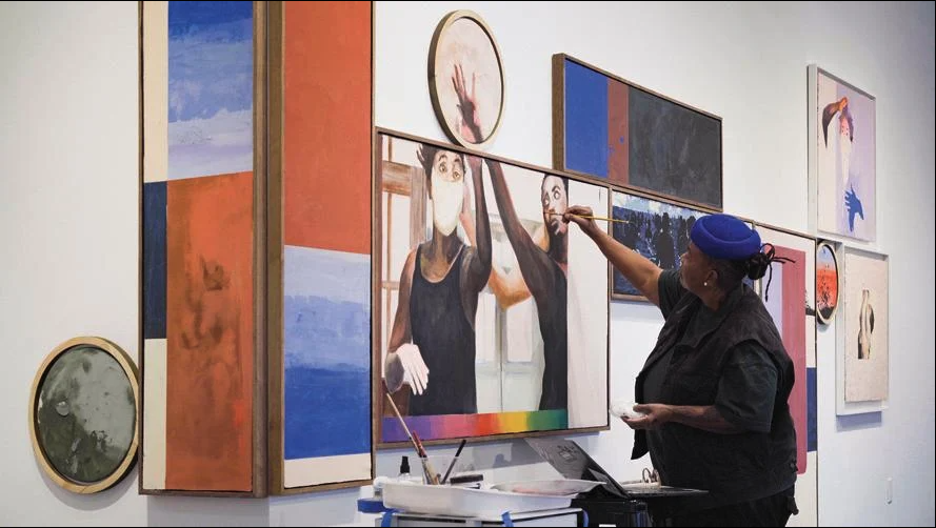
The rigor of “SSC” is that it is also a live performance; it was rendered in front of an in-person audience at Tinney Contemporary in Nashville, Tennessee. Olivia considers it something different, a change in her work. I’d like to think, however, that she has always interfaced with liveness in her creation of the mobile fresco. Its liveness lies in its paradox as a nascent monument, and this is only amplified further in “Space Scape Cinema”—a cheeky, if I may say so, call back to the cinematic moving image. Her incorporation of different fresco techniques ideates and inverts space as surround, environment, and event, through the scraping of the scene. It is a phenomenal intervention into the realist overdetermination of black images because it calls into direct focus presumed knowledge as static, rather than dynamic and evolving.
I still linger with Olivia’s stunning connection between the fresco and folder. She shared with me, “It unflattens. I’m always trying to paint light, and texture realizes light—that’s how we know it’s there.” Her attention to material across her work beckons one to consider the essential question of knowledge vis-à-vis the sensate and the made. We might call her artistic attention something like a phenomenological inquiry—that is, how do we know a body as a body? How do we know blackness, that rich thing, as belonging to our world and our senses? That is the extravagant and the ethical marriage in Lovie Olivia’s work.
: :
Tara M. Holman