If the body is a container full of thoughts, feeling, and affective resonances, then what can we make of the ways that time demands our senses spill out of, and into, us? What does it mean to care for each other as time shifts—pouring, seeping, leaking, and coagulating within and across our bodies?
The working bodies of queer, trans, and undisciplinary artists Mariposa Tejada, M. Miranda Maloney, Stalina Villarreal, and Jadine (JD) Pluecker begin to answer these questions by pushing spatial-temporal and corporeal form to a limit. On the waves of language, thought, and poetry, spanning across translation, meaning-making, and collaborative social projects, the artists foreground the intersections of Chican@, Latinx/e/o, Tejanx, and Afro-Caribbean/Dominican identity and collective care. This collective care is worth staying with. And it was performed in the very structure of the session led by Pluecker at ASAP/16. Rather than do an individual poetry reading, Pluecker invited her community into a collective performance, asking the audience for psychic and linguistic flexibility. The performance, readings, and experiences come together and ask us to be together. But this being-together takes some time—and this notion of time, as Pluecker teaches us, drawing from Lorenzo Thomas, “is a shifting liquid.”
Time, in combination with community collaboration, upholds the intrinsic function of care. This is the function of what I believe our artists embody, a form of liquid care. Liquid care, something bubbling up from my experience of the artists’ showcase, lends itself to a synchronicity, both chronic and acute. It reinforces a resistance to violent acts imposed upon queer and trans people in the wake of the slew of executive orders imposed by Donald Trump and his administration. One executive order, named “Defending Women From Gender Ideology Extremism,” was pushed forth in January 2025 that provided federal “definitions” of male and female. “Defending?” Defense against what? Defense might radiate protection, safeguard, resistance, fortification, endurance. Yet what Pluecker, Maloney, Villarreal, and Tejeda offer is a disambiguation of defense that dissolves boundaries rather than reinforcing them.
For example, Pluecker’s personal statement on translation work describes her over 20 years of experience living on the U.S. Mexico border, stating:
I am connected to the region deeply by bonds of friendship and family, and my appreciation for the beauty and the difficulties of life in the region has led me to my work as a translator. I am all too often angered and frustrated by representations of these border spaces by individuals who have spent very little time in relation to these landscapes, cities, and communities; their representations often re-affirm stereotypes and misportray the subtle textures of life along the border. I have made it a focus of my work to attempt to translate writing that upends these unfortunate portrayals and that pushes U.S. readers to re-evaluate their views.
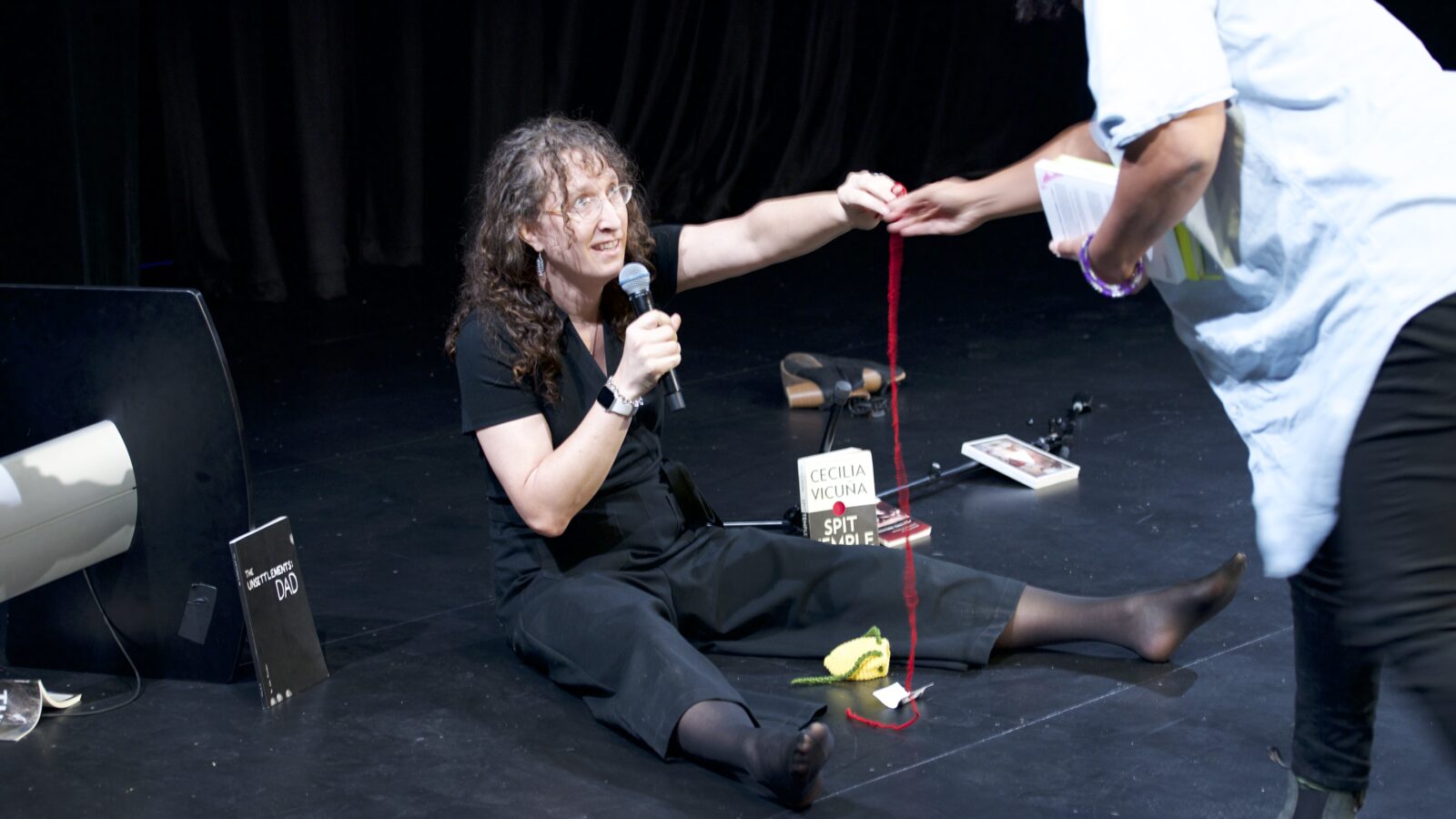
Pluecker is upending, pushing, and re-evaluating familiarity, stereotyping, and the tensions between being/doing. She embodies this tension not only in her writing but in her community practices. This everyday ambience of togetherness—braiding selves, crossing body-planes—is central to the work of liquid care. In her performance at ASAP/16, Pluecker moved freely across the theatre space, her crossing signifying resistance to conforming to objects around her: podium, mic, wire, books. Poetic embodiment crosses and delimits.
This braiding together needs to be done to make space as it should be rather than to conform ourselves to a space provided. Pleucker has shown this through her presentation style, which included a deliberative laying out of the speaker’s podium, the mic and wire, the books she brought with her on the stage. And all of the artists’ works work together to liquidate borders and what it means to be. Our artists suggest intersection,
overlap
transition
superposition
simultaneity
layering
juxtaposition
a vocabulary of multiplicity.
This twisting of poetic language is in tandem with the twist of our bodies, as a site of resistance, as a call to attention about the rigidity of form—a call to be more liquid. Perhaps, in this way, the artists here ask us to witness a stronger relationality not only with ourselves but with each other. As Chilean poet and artist Cecilia Vicuña writes, “An object is not an object. It is the witness to a relationship.” The object here is not only language, it’s not only poetry; the object is constitutive of, with/in, and around the body. This is how Pluecker, Maloney, Villarreal, and Tejada illustrate such a testimony, a witnessing.
“Passport Interrogations” by Stalina Villarreal further asks readers, listeners, and doers how to unfold into a field of legality and surveillance. Villarreal’s work invokes spectrums of inspection, documentation, inquiry, verification, identification, validation, crossing, checkpoint, permission, citizenship, displacement, and authorization. From here, we as audiences, listeners, readers come to know the orbits around both entry and exclusion, as we become a voice at the threshold—asked for evidence of a material belonging. Villarreal seems to ask: Is it not enough to stand on the soils, walkways, and airways of our ancestors? Who is resisting whom? How are we heard beyond language’s borders?
In “On the Edge of Dread” by María Miranda Maloney, artist, poet, publisher, and executive editor of Mouthfeel Press, we come to know how we ourselves evoke fear, anxiety, trepidation, suspense, tension, hesitation, unease, trembling, peril, uncertainty, vulnerability. Maloney’s work situates us at the brink before collapse, a suspended pulse between knowing and falling. In conversation with Tejeda, I had asked, “What is different about this place compared to other readings you’ve done?” They answered, “I’m not usually used to performing on a university campus, but I do like this black box theatre. A lot of my readings are usually in other spaces.” This, too, is a kind of crossing, the remix of segregated spaces in a segregated city.
In Tejeda’s reading of their poem, “Sepia Summer,” they demonstrate the blurring of memory, the nostalgia, desire, and familiarity of living in a past. This reading creates the space where color and season merge into warmth, softness, antiquity, residue, melancholy, recollection, tenderness, and fading. Sepia carries associations of vintage, timeworn, archival, preservation, stillness, shadow, and a tint of the past that bleeds into the present. Summer, by contrast, opens into radiance, light, abundance, vitality, sensuality, play, and saturation. In the lived experiences of our artists, we are attuned to the stringing of time and body as a braid that passes to and from, among and between our hands, our fingers—stretched, sometimes, to a limit to test the durability. The threads of our lives grow into cord, fiber, sequence, linkage, tether, resonance, harmony, continuity, extension, and connection. This is a vibration that holds time, tone, and body.
The breadth of the work from our artists calls for a simultaneous sense of return and forgetting as a push and pull between such social and psychic twists that spiral,
coil,
curve,
inflect,
rotate,
distort,
bend,
pressurize,
tangle,
and fold.
In these toric movements of resistance and becoming, we are subjected, transubstantiated in a structural language as metaphor. I am reminded of the bodily stretches that Pluecker had done on the floor of the theatre. “This is called the half-cobra,” she says. The term, cobra, slithers toward poise, danger, alertness, defense, grace, predation, hypnosis, and transformation. The cobra’s motion is both threat and choreography. Our artists, too, have been viewed as threatening—but they demand dancing with.
At the conclusion of the showcase, Pluecker brings together all artists under the stage lights, an invitation to be with her, to stop her, to interrupt. This disruption is functional, necessary, in order to undo the expectations set by the theatre. In the swells of language, politics, and embodiment, the final note—resurrection—returns me to Bibliomancy, which Pluecker used in performance. Audiences were asked to identify a passage at random, invited into the liquid form of thought through divination, intuition, revelation, invocation, oracle, ritual, serendipity, inscription, symbolism. This openness repositions reading as a form of fate—opening a book as a gesture toward direction or destiny.
Through this call for audiences to identify a passage, calling forth a seemingly random page, we are invited into the randomness, the liquid form of thought that asks us to engage with a divination, prophecy, interpretation, chance, ritual, superstition, consultation, serendipity, correspondence, translation. This practice gestures toward the practice of reading as a form of fate—opening a book to find direction or destiny. The readings from and of our artists embody this notion of direction, an attempt to contain the flow of being. Ultimately, our artists here construct a collective constellation that touches semiotics, interpretation, spirituality, and chance operations. This liquid care begins to embody us as we exist at the crossroads of language and the divine, where text becomes a portal into resistance, where reading becomes ritual, and to be with each other is an act of care.
: :
Jered Mabaquiao