Take a wish and bind it into string. Write the wish as concretely as possible: distill your will into a lucid sentence. Any string will do: a length of twine, ribbon, a piece of floss in a pinch. Hold it taut between your fingers and feel the desire that your wish awakens from the tips of your follicles to the curve of your lips. Tie three knots, sequentially. With this knot, I open time / With knot two, I seal it true / And with the third, the spell is sure.
This is basic spellcasting, which I posit as a form of wild writing. Framing spellcasting as writing and writing as spellcasting opens an exploration of the manual dexterity of the future. What if writing is not something we produce, but something we cast? The horizon is a craft and a labor. The question, then, is not what writing means, but what writing does.
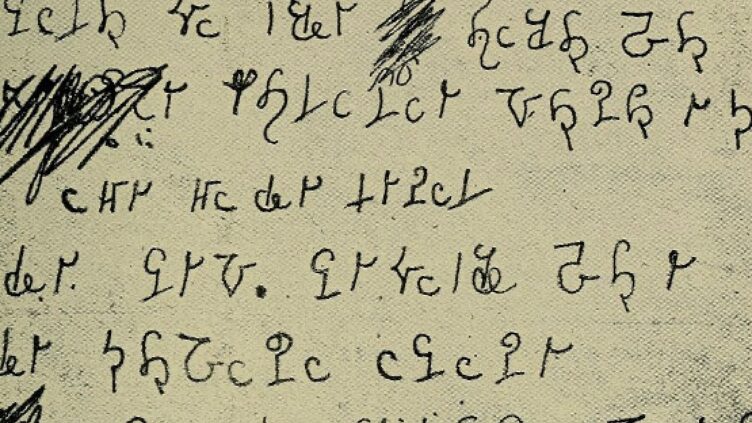
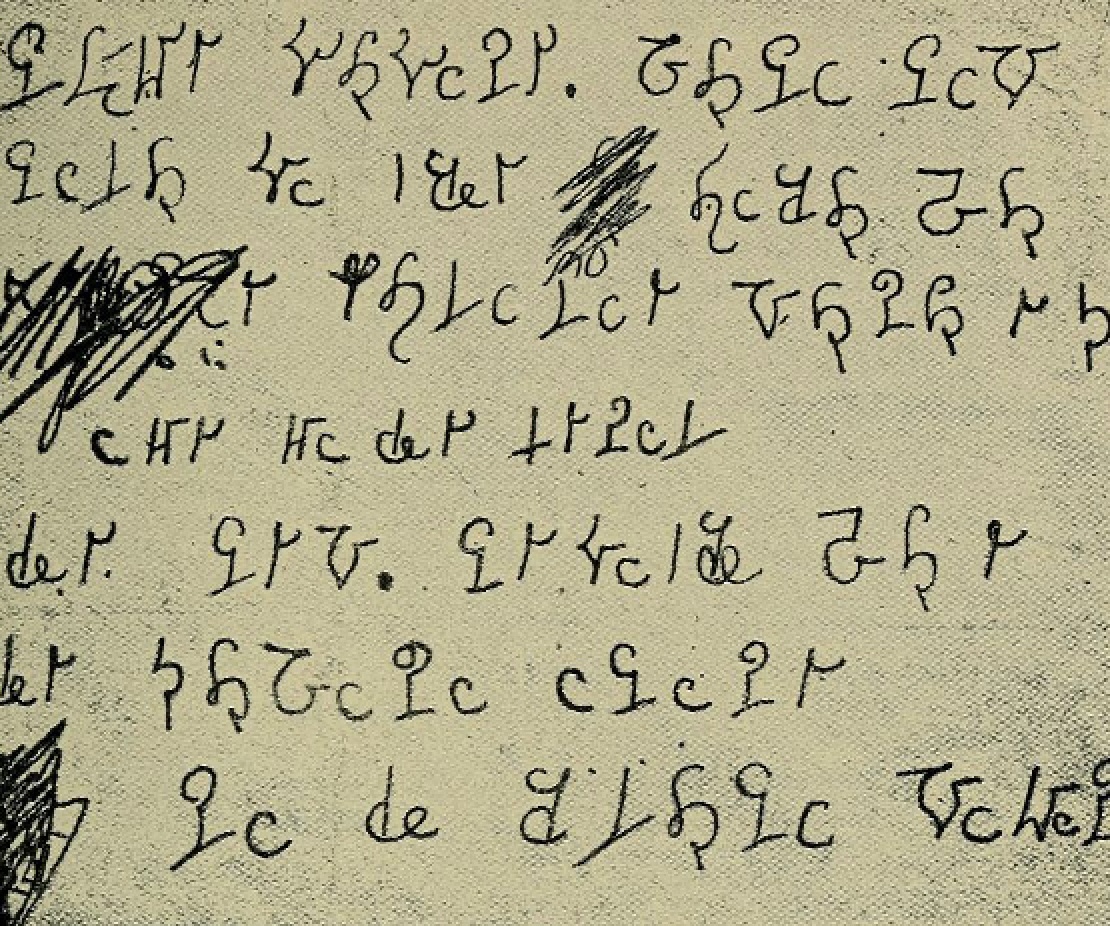
Wild writing is the name I use for a mode of inscribing with difficult, invisible, or misunderstood collaborators—spirits, muses, avatars, sleep, spiders, and other in/human assemblages.1 This includes the legacies of automatic writers and spirit writers, such as medium Hélène Smith, who channelled Martian script in the late nineteenth-century (Fig. 1). It equally extends to embodied, magical, or manual literacies: knot-tying, sigil-making, and gestural or performative mark-making.
Parallel to wild writing, spellcasting works with language, gesture, time, and space as changeable and malleable material-energetics. Author Elissa Washuta contrasts spells to riddles: whereas riddles are words deployed for intellectual intents, spells are words aligned to magical purposes.2 She continues: “A spell is a set of words meant to make magic by calling upon a deity, spirit, demon, or other supernatural power. The spell is the request; the magic is the miracle.”3 This highlights the way that wishes — desires — can be so strong that they overflow into a whole other vessel — words — in order to be contained. Spellcasting is a bewitching riddle or request. Spells crack open everything our attention spans lean into while on autopilot. In the global North where I write from, default settings would like to bend us all towards extractive heteropatriarchy, white supremacy, human supremacy, and a capitalism so entrenched it feels like (toxic) air. Spellcasting says: better to aim than be aimed.
Both words and spells are carrier bags and live forces that pressurize intention.4 Spellcasting, like other magical practices such as divination or hexing or transvection, is an alter-ability: not a superpower, but rather a sideways capacity that extends what we consider the able, correct, sane, or rational movements of the bodymindspirit, offering novel and opaque access points that are deviant to ableist orientations of the “working” body.5 This is part of the craft of witchcraft and involves entering into a practice that is different from the habitual or practiced.
Wild writing is the underbelly, sidestep, and shimmy of the ableness of language. (Eyelashes are to open and close but also to wish upon.) Spellcasting and/as wild writing are ways of shapeshifting. Below, I present four practitioners — Harriet Powers, Unica Zürn, Gloria Anzaldúa, and Aidan Wachter — who each craft a distinct approach to willful literacy, revealing the stakes of wild writing and curving signs towards casting spells.
: :
Wild writing connects to the many inflections of the word “wild”: feral, undomesticated, heathen.6 Who has been deemed able to make the literate and sanctioned mark? Who has access to it and who does not? The narrative quilts of Harriet Powers, who was born into slavery in nineteenth-century Georgia, beg these questions. Powers, who could neither read nor write, tapped into an alternate literacy with her quilts: her Pictorial Quilt (1895–98) takes us to biblical, historical, and even astral scenes — Adam and Eve in the garden; Jonah swallowed by a whale; a woman frozen in prayer in 1895; falling stars in 1833 (Fig. 2). Poet Harryette Mullen notes the code-crossing of Powers’s work: the hiding and thriving of African-American spirituality and aesthetics within the dominant Christian culture, as well as the utter interlacing of text and textile in her method.7 This is not only craft, but craftiness. Powers’s quilts ask us to consider the potency of rebelling from within the practice of mark-making, of choosing to stand outside the systems that make meaning in circumstances where meaning is bereft.
Wild writing crosses codes, rewires literacy, and tells us something about the lunar lunacy of words. Many who have communicated with spirit worlds have been associated with madness. Unica Zürn, a wild and gender-bendy writer and artist, composed Hexentexte (Witches’ Writings, 1954) as a mix of anagrams and automatic drawings that appear as bundles of hair or single-cell organisms or the frenetic electricity of writing utensils. In the way that Zürn spent her life in and out of mental institutions, we see how those connected to spirit worlds (to the un-straight line) have had to justify their access to the seams that mark death from life.8 There is the daily disablement, as feminist scholar and multifaith practitioner M. Jacqui Alexander tells us, of having one’s spiritual practice disavowed as irrational.9
Feminist Chicana writer Gloria Anzaldúa located her wild writing in words that were hybridized between English, Chicano Spanish, and Nahuatl, where writing itself was as an initiation. To Anzaldúa, writing is the Aztec lunar goddess Coyolxauhqui, who was rent into a thousand pieces by her own kin, and who Anzaldúa strove to put back together whenever she placed words on page. Creativity requires sacrifice, to Anzaldúa, and this sacrifice, the work of creativity, grants access to conocimiento, an embodied and spiritual (un-)knowing that is the very offramp from consensus reality — beyond which the knowledges of the oppressed wait, ready to spring: “work done in the night by the light of the moon, a labor of re-visioning and re-membering.”10 Wild writing is night writing. It is the activator of alternate atmospheres, methods, and patterns.
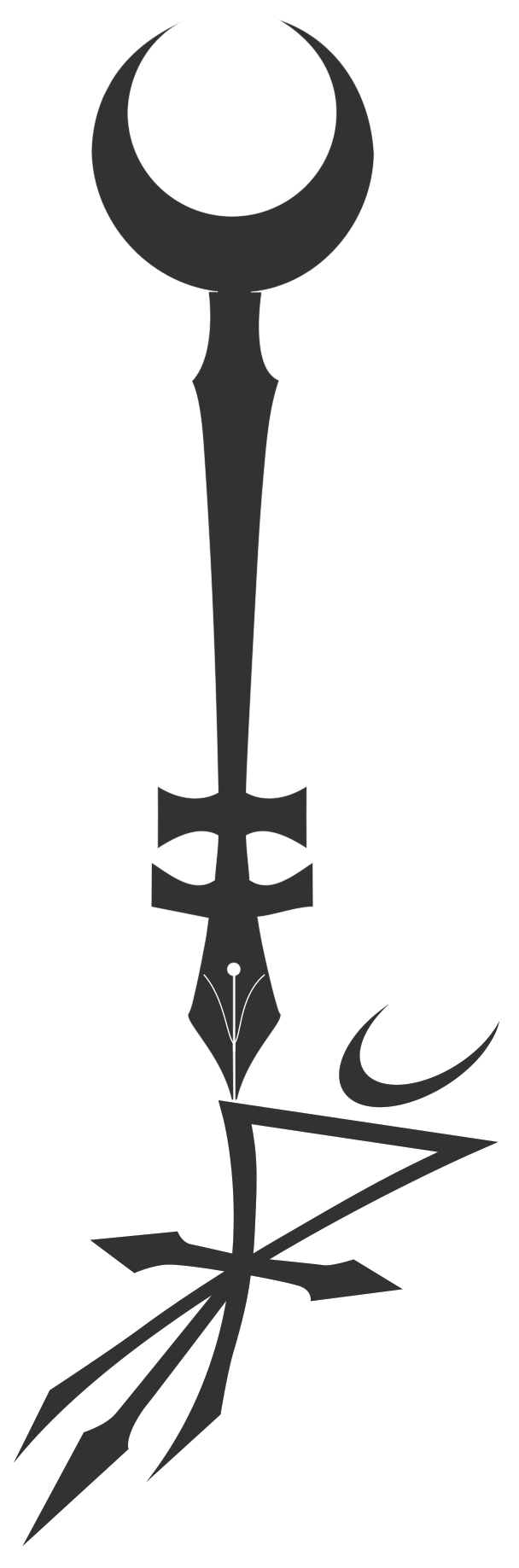
Powers, Zürn, and Anzaldúa all present discrete methods and bodies of wild writing, but they do not overtly blend their wild literacies with spellcasting. Aidan Wachter does. A self-described practitioner of “dirt sorcery” — that is, an embodied sorcery of the present moment, connected to the assemblage of earth/human/animal/spirit11—Wachter offers a craft of spellcasting-by-wordsmithing: palimpsest-like petitions to spirits and deities, invocations, sigil creation (Fig. 3).12 While many esoteric practitioners work with magical literacies, Wachter brings them to a different level. The hypersigil, which he describes as “a long-form narrative work of magic,”13 is the most apt exercise I have found that demonstrates wild writing and/as spellcasting.
In short (but the reader should go to Wachter), the hypersigil is a serial journal of diary entries describing events that have not happened, but that are strongly desired. Key to this working is that the diarist-spellcaster must write all entries in the now, as if they are taking place. Here, the spellcaster works time as a pliable device, weaving their desired present moment in full and sensuous and playful detail, and in doing so comes closer to manifesting their desires off page. Wachter also pays attention to the material culture of the practice, suggesting a spiral-bound notebook so the writer can rip pages out that they no longer feel tethered to.14
The hypersigil is a way of experimenting with different forms of living and being, where writing works more as a wormhole or portal than a system of signification: “we are working with a method of creation,” Wachter writes, “that doesn’t play by materialist rules as we understand them at this time.”15 The past, present, and future are all answerable to reshaping: Wachter defines magic itself as the process of telling true lies.16 This is the bewitching quality of the craft, where the crux of witchcraft is never to enter a “truer” or even more liberatory way of being and acting, but is rather the craft of becoming nimble, cunning, and wise while caught in the inevitable heart of the given episteme’s tricks and traps.
: :
Wild writing brings us a kind of social writing that bends the perimeters of the social and reminds us that we are plural when writing to begin with. The buzzing of bees and refrigerators, the rustling of flightlines and leaves, the bacteria in our guts scaling mood swings to our pens. The spit of spiders. All of this. Whereas the writing of large language models is reigned into servitude to corporate metastasis, wild writing unsettles the demand on writing to make meaning make, or even to serve the human.
Whether spellcasting using knots or hypersigils, an important part of the work is the work itself: the process of conocimiento, a gradual and everyday spiritual attunement that takes hold through daily and manual practices that we could call rituals, the intentional/attentional changing and charging of one’s (un-)habits and atmospheres. These rituals involve, but are not limited to, consecrating one’s materials, cleaning one’s workspace, developing connections to inhuman presences through altars and offerings, and simply sitting in stillness. This is what shapeshifting is: the small ways we engage in the labor of crafting the daily, feeding it, and feeling it bloom.
Engaging wild writing and/as spellcasting tells us something about manifestation: that when feeling into and living into these practices, they can become the very bones and infrastructures of a wi(l)der and weirder set of capacities and literacies, apt to meet this ever weirding and wilding world. Wild writing is a salve to writing, not a strict stony discipline of syntax but a ray, a tide, a bray. With this, we are ready to play.
: :
Endnotes
- I have been holding wild writing workshops since 2015. Click here for a guided induction.
- Elissa Washuta, White Magic (Tin House, 2021), 92.
- Washuta, White Magic, 97.
- The phrase “carrier bag” comes from Ursula K. Le Guin, “A Carrier Bag Theory of Fiction,” in The Ecocriticism Reader: Landmarks in Literary Ecology, ed. Cheryll Glotfelty and Harold Fromm (University of Georgia Press, 1996), 149–54.
- The portmanteau bodymindspirit comes from Petra Kuppers. It surfaced while she was doing archival work on dance therapy in order to develop a ritual homage to her crip/mad dance ancestors. Petra Kuppers, “Crip/Mad Archive Dances: Arts-Based Methods in and out of the Archive,” Theatre 52, no. 2 (2022): 67.
- “Wildness” has recently been taken up as a queer analytic in a special issue of South Atlantic Quarterly edited by Jack Halberstam and Tavia Nyong’o.
- Harryette Mullen, “African Signs and Spirit Writing,” in The Black Studies Reader, ed. Jacqueline Bobo, et al. (Routledge, 2004), 286–87.
- See Unica Zürn, The Man of Jasmine and Other Texts, trans. Malcolm Green (Atlas Press, 2020).
- M. Jacqui Alexander, Pedagogies of Crossing: Meditations on Feminism, Sexual Politics, Memory, and the Sacred(Duke University Press, 2005), 320.
- Gloria E. Anzaldúa, Light in the Dark / Luz en Lo Obscuro: Rewriting Identity, Spirituality, Reality, ed. AnaLouise Keating (Duke University Press, 2015), 124.
- Aidan Wachter, Weaving Fate: Hypersigils, Changing the Past, and Telling True Lies (Ygret Niche Publishing, 2020), 5.
- For petitions and sigils, see Aidan Wachter, Six Ways: Approaches and Entries for Practical Magic (Ygret Niche Publishing, 2018).
- Wachter, Weaving Fate, 7.
- Wachter, Weaving Fate, 58.
- Wachter, Weaving Fate, 72.
- Wachter, Weaving Fate, 57.
Sandra Huber