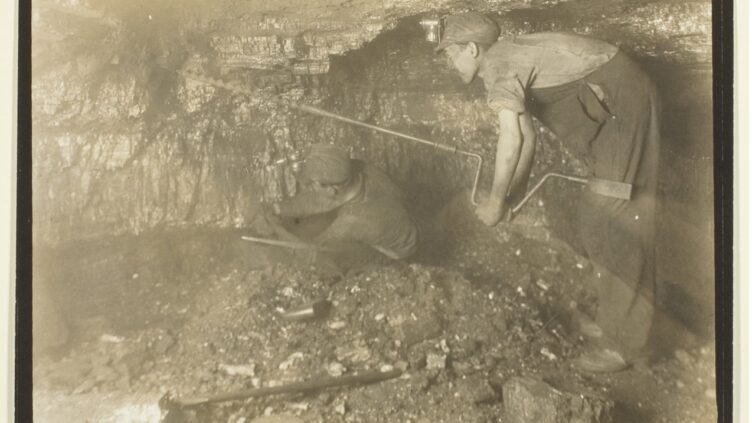
This essay begins below, underground, in order to re-encounter crawling. I say re-encounter because we all begin our lives on our knees, toddling forward and falling to the ground to try again. Over time, some of us become upright, both physically, figuratively, and lyrically, but others remain close to the ground, either because they are unwilling or because such a position is imposed on them. What knowledge comes from below? And how might attending to the ground(s) relate to more livable present and futures? Finally, how do we remember what we learn from below?
I am interested in how the knowledge that comes from below is obscured, marginalized, minimized, or refused to be characterized as knowledge. I am not concerned with this knowledge being officially recognized, but I am curious about how those who have been positioned on the bottom rungs of hierarchies remember what they know. What kinds of art, music, film, and politics come from a self-recognition of onto-epistemological orientations that sprout, grow, and mature from the ground? Knowledge that was already there but often is forgotten or ignored.
: :
Ground Onto-epistemologies: Crawling, Crouching, and Falling without Getting Back Up
“Giving up verticality” is how Pope L. described “Crawl,” an ongoing public performance, starting in 1978. In the performance, he wore a thrifted brown suit and crawled around NYC. The photos of the performance are striking because he is on the ground, sweaty and dirty, and everyone around him is upright, befuddled by the competing symbols and his location on the ground. The suit is a uniform associated with someone important, a job creator, but his place on the ground counters the assumption. In this act, he creates a world for himself closer to the ground, a place with which he likely was familiar as a Black man in the United States.
Pope L. crawled to draw the eyes of people walking through the city toward the place that they might tend to avoid: the ground, where people who do not have anywhere else to go must coexist with rodents and trash. In this act, he refuses “verticality,” to use his word. I read this refusal as a kind of “giving up,” as a praxis and an acknowledgement of the kind of ground knowledge that becomes available when verticality is de-prioritized and dis-inherited. Mierle Laderman Ukeles also refused verticality, remaining close to the ground in her 1970s “Maintenance Art Performances”where she cleaned the sidewalks. The performance made visible the labor of sanitation workers, the labor that is central to the city being a functional center of commerce but rarely acknowledged. Ukeles crouches down on the dirty ground, teaching observation through her performance of the ordinary.
I do not wish to romanticize economic, racial, gendered, or other kinds of oppression. Instead, I hope to begin to account for the ways that oppressed and disregarded people know themselves and the world, particularly when that self-knowledge counters the imposed and disciplined story.1 This is of interest to me, because the current way of doing politics and living in the world with others does not feel aligned with the kind of world I hope to live in. What are the conditions of possibility for living when rehabilitation, repair, or recovery are not only impossible, but also not desired? How might we refuse the inherited terms of our humanity and crawl, knowing that we know what cannot be known by others?
In graduate school, I worked at what I call a scam school. It was a for-profit school that preyed on people that could not navigate the community college system that was understaffed and overextended. Exploitation and extraction were central to the business model. The school paid me $900 a class to teach Composition 101 and drew from some of the poorest communities in the state. Many of the students in my class took the bus from far outside the city and lived in trailers or on farms with no electricity or running water. They came to classes after shifts at Walmart, AutoZone, and Taco Bell.
At the time I was inexperienced. I had the zeal of a beginner too enthusiastic to be cautious. I thought we should read about labor. I reasoned that this was a topic that was relevant to all of us. I imagined they would have a lot of insight and feel empowered to express themselves because they worked in jobs that created suffering. But I was surprised to find that they were unconvinced by arguments that workers deserved protections and rights. I had incorrectly assumed that lived exploitation would produce a politics of labor that I would recognize. In these conversations, I became the radical. I learned that they did not necessarily see their work situation the way that I did. They argued enthusiastically against public healthcare, minimum wage increases, and unions. I think about this time often but have only more recently come to understand their response in terms of hierarchies of knowledge, with embodied and experiential knowledge near or at the bottom. I knew from teaching composition at the scam school that the vibrant workers movement that gave us Unions had morphed into something completely different.
Hierarchies of knowledge have been meaningfully critiqued with great implications on how we understand ourselves in relation to the world. Stefano Harney and Fred Moten’s reference to the nurses in the smoking room destabilizes what counts as intellectual. “When I think of study,” Harney says in an interview with Stevphen Shukaitis, “I’m as likely to think about nurses in the smoking room as I am about the university.”2 Knowledge and study take place through labor and shared conditions. And while critiques such as this have been essential to shift how we understand knowledge and the people who are positioned as knowers, both the knowledge and power that comes from below can be forgotten or, worse, erased. In some ways, the critique can reinforce that very same hierarchy, as critique often counterintuitively does. I am reminded of the tension between producing enslaved Black people as ignorant and incapable, while relying on them in every way. The rhetoric and propaganda overdetermined and overwhelmed the material evidence because so many people had unlearned how to sense what was right in front of them. Ground onto-epistemologies refuse the imposed standard which are reliant on uncritical submission to the bad-faith standard imposed from above, muting or diminishing the power of embodied knowledge, gut data, or what Imani Perry has described as “the critical gaze provided by otherness.”3 Said differently: if those of us below are so dumb, why is so much energy needed to keep us down?
An early scene in the documentary film Harlan County (1976), directed by Barbara Kopple, shows a cluster of men, loaded down with their gear, lying on low truck beds to enter the mine. Their workday will be in the dark, crouched and crawling through the dangerous mines. They go into the mines each day knowing the risk of explosions and accidents. They enter each day accepting the near certainty that they will eventually be debilitated over time. The men will work down there; they will eat their lunch down there and then emerge filthy and exhausted. While this is one choice, it is one among few. The men are like the worms who wriggle and writhe, breaking down dirt, so that food can grow and the rest of the world can live without giving them much thought. They are invisible labor, out-of-sight, out-of-mind, out-of-sight, in the mine. Both work underfoot, down below, making holes through the earth. The film follows the miners, their children, and their wives in fighting for their rights to better pay and benefits. The fight is hard and dangerous, but being miners, they are used to danger, and they are used to continuing on, through pain and despair. Their wives and children were used to a different kind of danger.
The miners gained hard fought ground knowledge. Recently watching the film in a darkened theater, I was struck by how the time that they spent underground was pedagogical, and the time they spent living in dilapidated homes without running water was also pedagogical. They learned their place but not in the way that was intended. They did not learn their place in the way that aligned with imposed dehumanization or diminished value. They learned and taught others about their place in a violent system that sought to destroy them while exploiting their labor.
The kind of working done in holes, covered in soot, future lung disease certain, disallowed the miners from remaining ignorant about the system that put one there. But 50 years later, what strikes me is how this knowledge has been repressed, with the white working class often led by nationalist voices to fight against the unions and collective practices that these miners previously fought for. The generational shift from physical labor to service labor, stable schedules to picked up shifts, underground to ground-level, permanence to precarity, has muddied the analysis of many workers.
Performance art can create time and space to rehearse a world different from the one that has been largely imposed through violence but maintained through disciplined amnesia. Pope L., dragging his body across sidewalks and asphalt, at eye-level with the furry bodies most of us avoid, gifts a visual rupture that cannot be subsumed into vertical norms. A man on the floor, not dead, not dying, challenges what can be taken-for-granted about who and what matters. Mierle Laderman Ukeles’s art, or what I will call groundwork, also does this. The streets do not clean themselves, and the trash does not disappear without the labor of those that are easy to not see. Her performance draws attention to this labor, even as her labor doubles as valued labor when it is recognized as art. Both must crawl to perform, teaching through their body-labor-art assemblage.
Those of us on the bottom of hierarchies teach and learn things that could never be known or sensed vertically. To double-down on the hole, particularly when liberal rights discourse encourages us to stand upright to be recognized by those who will not acknowledge our personhood, is transgressive. How do the worms avoid death in order to do their important work? By privileging the kind of knowledge that comes from below—worm knowledge, ground pedagogies—they burrow down to depths that are not known to those who are upright.
: :
Endnotes
- On this point, see Natalie Loveless, How to Make Art at the End of the World: A Manifesto for Research-Creation(Duke University Press, 2020).
- Stefano Harney & Fred Moten, The Undercommons: Fugitive Planning and Black Study (Duke University Press, 2013), 112.
- Imani Perry, Prophets from the Hood: Politics and Poetics in Hip Hop (Duke University Press, 2004), 33.
Asilia Franklin-Phipps