Kristina Kay Robinson makes art that speaks and feels, that resounds and echoes, distilling centuries of meaning into singular cacophonous moments that speculate alternate histories and future revolutions. As her session of the Gulf Coast Showcase opens at ASAP/16, the room goes dark and the words “MYTH IS | METHOD | IS MYTH” flash across a screen in bold white letters. Behind them, images filter in and out: pictures of the New Orleans waterfront, photographs of Robinson costumed and in performance, video of New Orleans’ famous second lines. Finally, faintly behind it all, is an image of Buddy Bolden, a Black cornetist who is often cited as the creator of jazz.
Against the shifting backdrop, a menagerie of sounds fills the room. Music, equal parts melodic and unnerving, mingles with Amiri Baraka’s voice reading from “The Revolutionary Theater.” He booms, “And even the language must show what the facts are in this consciousness epic, what’s happening. We will talk about the world, and the preciseness with which we are able to summon the world, will be our art. Art is method. And art, ‘like any ashtray or senator’ remains in the world.” Baraka’s voice tangles with the sound of drums and echoes. Egrets fade into the chaos of crowds; oranges blur into muffled, synthed language; jazz shifts into reds and pinks. The short snippet of video bleeds one era into another; it collapses time and place. All together—the sound, the music, the color—it offers a kind of sensory overwhelm, a lesson in imbrication, in overlap, in how amalgamation makes art.
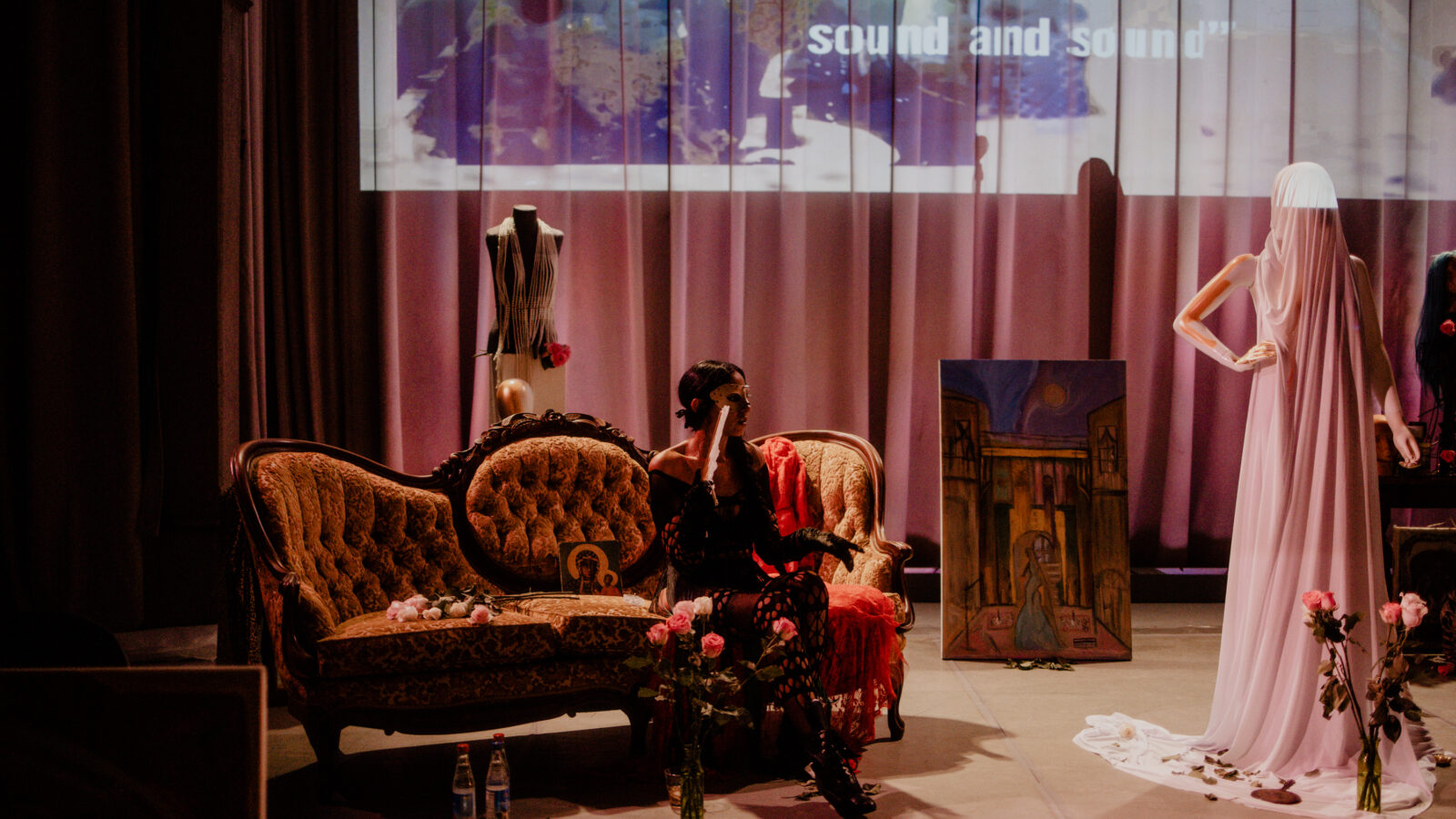
This interplay between noise and image, myth and color, is at the root of Robinson’s artistic practice. In Republica: Temple of Color and Sound, Robinson’s ever-evolving installation and performance art project, sound is both, as she told me in an interview, a “primary organizing principle” and a revolutionary strategy of liberation. Inspired, in part, by the Sufist teachings of Hazarat Inayat Khan (Robinson calls Khan’s The Mysticism of Sound and Music the Bible of Republica), the project is a synesthetic mingling of the senses, a series of curated moments where sound meets color and the past is revised through an embodied present. As installation, Republica brings together an abundance of historical research, a playful performance practice, and a traveling venue manned by Robinson’s persona character, Maryam De Kapita.
At the center of the installation is Robinson’s conjuring of Republica, a free Black Republic on the Gulf Coast of America. A speculative reimagining of the Gulf Coast, Republica exists on an alternative timeline, one where the 1811 German Coast Uprising—an insurrection in which over 200 enslaved people marched towards New Orleans to establish a free republic and a Trans-Caribbean network of freedom—succeeded rather than failed. With a capital that sits at the mouth of the Mississippi, Robinson imagines Republica as playing a central role in a continued struggle for Black autonomy throughout the Western World. Its history sprouts from the social and cultural possibilities of a Gulf Coast which was never incorporated into the United States. Republica, as a result, has its own culture and influences, even its own maps, which, Robinson notes, are oriented from the South up. Maryam, her performances, and her traveling venue are all tethered to the continuing possibility of this alternative timeline, serving as a reminder that the histories of brutality which underpin the United States were not inevitable—are not inevitable. Republica, then, is a place, a time, and a performance of history which imagines that the world might be otherwise.
The artistic forms that Republica takes are broad, varied, and continually evolving. As a traveling installation, it looks a little different each time. It’s composed of three different parts: Maryam De Kapita’s performances, her traveling venue, and the historical backdrop which serves as its foundation. In some instances, all elements of the installation are present: Maryam performs amidst her venue, explicitly interweaving bits of historical context through her curations of sound and objects. In others, the installation may only be present as a single component. Maryam might perform on her own outside of her venue, for example, shedding any explicit references to the speculative history from which she derives.
Robinson sees Maryam de Kapita not just as a persona character, but as an “energy, a thought process, a philosophy.” Her temporality is porous. In 1811, she’s a revolt participant who helps aid in the founding of Republica, and while every iteration of Maryam in some way begins from the seeds of that successful rebellion, she’s not stuck in time. She moves and transforms, demonstrating the ways that, even when it remains illegible, history is borne out through the body. On some days when Robinson performs as Maryam, she’s not serving as a participant in the 1811 German Coast Uprising. Sometimes, Robinson explains, she’s just acting as another “hot girl in a bar.”
Although 1811 is, in some capacity, the starting point for Robinson’s Temple of Color and Sound, the fabric of Republica stitches together a profusion of historical and contemporary influences. In addition to that uprising, Republica is also shaped by the social and architectural landscape of New Orleans, pre-Hurricane Katrina. Before Katrina, Robinson explains, New Orleans felt like a nation within a nation. It felt independent, separate from the country which surrounded it—“I always say I moved to the United States in 2005,” she laughs. The culture that Republica fosters retains that same feeling: layered and diverse, but incredibly distinct.
One iteration of Republica as an installation is Robinson’s practice of curating altars through assemblage. Intertwining indigenous spiritual practices with African cosmologies (especially those of the Bambara people), Islam, and Catholicism, these alters vary greatly in their sizes and compositions. As Robinson’s showcase goes on, for example, she shows images of one altar which involves a collection of mannequin feet hanging from a wall, and then another which sees the Virgin Mary surrounded by candles and notes of gratitude. Amidst these shrines, there are flowers and glasses of water, small collections of what appear to be innocuous objects become sacred through ritual.
Another manifestation of Republica is a performance conceptualized around civic remembrance called “Viva La Republica.” In Republica, it is celebrated once a year. Unlike the altars, Viva La Republica figures meaning primarily through the body. Rather than relying on the “coloniality of monument,” as Robinson explains many memorials do, Viva La Republica memorializes through a mixture of choreographed and improvised dance, chanting, storytelling, and the possibility of spirit possession. The performance reminds us that remembrance is fleshly, caught up in the way we move, the noises we make, and the connections to land and spirit that we forge as we do so.
More than anything, I understand Republica as an exploration of connection forged outside traditional language. It is about the connections between sound, color, and feeling. As Robinson’s showcase begins to come to a close, another video flashes in front of the audience. The screen goes dark except for a black lit Maryam in performance, her voice speaking in the background. The bass booms; at the start, it sounds almost like house music. Maryam’s faint figure appears multiply across the screen in shades of blue and purple. The muffled sounds of a pitched down voice ring out amidst the continuous striking of a single piano key. Periodically, what sounds like a trumpet plays a little tune.
The sound feels like it belongs in a horror movie just moments before a jump scare. But quickly, things shift. The dark becomes light. Maryam is suddenly shrouded in daytime. She wears a tomato red dress, dancing in a fountain. She points towards the viewer, and beside the video, the word “arrival” appears. The music, too, has changed. It’s more melodious. There’s saxophone; a refrain—a repetition of the same chords. It’s hauntingly beautiful, and I drift, for a second, into thinking about one of Robinson’s descriptions. Republica, she had said only moments earlier, smells like “rain, oud, bakhoor, trinity seasoning, frankincense, and fresh bread baking.” It’s always loud, she explained, it’s bustling with the goings on of its people. It is hot and wet and filled with commotion, celebration, creation.
The music lulls me into Republica’s possibility. Before I can get too comfortable though, things start to devolve. Maryam’s image becomes less and less legible; she blurs. The red of her dress melds with the blue of the water in the fountain. The image starts to blink in and out. Color shifts. The music sows discord. There it is again, the refrain, but it’s slower this time, eerie. The screen, for a moment, returns to those same words with which the showcase began—MYTH IS | METHOD | IS MYTH—before they settle, again, into the backdrop of Maryam’s performance. This journey through sensation—the melody, the disruption, the evolution of a story in sound—this is what Republica is all about: a world which offers not the promise of utopia, but instead, the possibility of movement, the possibility of a present which, although it is not unencumbered by loss, finds a way, always, to keep moving towards freedom.
: :
Sarah Buckner