During my visit to Jana Sterbak’s retrospective on opening night, I did not immediately recognize the famed “meat dress,” Vanitas: Flesh Dress for an Albino Anorectic (1987). The flank steak from which the piece was stitched shone in the gallery light and reflected such a soft sheen that it recalled a satin nightgown eagerly awaiting to be put on. Its materiality was in sharp disconnect from the red steaks worn in the original performance of Vanitas, documented in a photograph hanging on the neighboring wall. In the photo, the streaks on the floor suggest that the steaks are wet, moving with the model’s body to leave a trace. In the Black Box Gallery space of the Esker Foundation, the dress on the mannequin looks like it might be dry and itchy to wear, less squelchy than the original version in the photograph but no less successful in eliciting a sense of discomfort.
Dimensions of Intimacy is the first retrospective of the Czech-born multidisciplinary artist Jana Sterbak in 30 years. The show includes eighty-four pieces produced between 1979 and 2025, while pieces like Vanitas, which are susceptible to degradation over time, were made anew in 2025. Sterbak is known for her provocative pieces that engage familiar materials and everyday objects, such as ice, chocolate, and human hair, to warp reality as we know it. The effect is an unsettling of the familiar, a way of bringing reality slightly off-kilter. To some extent, Sterbak’s pieces may be described as conceptual sculptures that follow in the footsteps of Canadian artists like the collective N.E. Thing Co., who played with the banality of consumer packaging with pieces like Bagged Landscape (1966). At the same time, parallels to European conceptual artists, such as Rebecca Horn, also come to mind, especially in the way Sterbak keeps the human body centered in her work, even if it is not always physically present and being put to work.
The exhibition has the quality of an artist’s workshop in both layout and content. Objects are frequently paired with their documentations and share the same title, as with Sisyphus II (1991). The work is at once a physical object, a human-sized bowl-like spinning top now sitting idly in the Southeast Gallery, and a performance that is projected onto the wall as a 16mm silent film. In it, a man pushes around the spinning top visitors see before themselves. Looking between the sculptural object and the film gives a sense of the futility to the endeavor. The performer exerts a notable amount of energy to maintain his balance and not fall out of the object, which never moves but continually wobbles, forcing him to resist being thrown out each time. Similarly, the East Gallery wall contains several photographic works that create a sense of evolution between the artwork as a concept and the artwork as an embodied object, or even presence, in the world, one that must be “activated” by a performer’s body. Cones on Hand (1979) is another work that includes an everyday object. Five measuring tapes have been wrapped up to form five cone “fingers” placed on a mannequin’s hand.
In the West Gallery, Absorption: Work in Progress (1995) is a playful engagement with Joseph Beuys’s “Felt Suit” (1970), an autobiographical series that served as an extension of Beuys’s body. Whereas Beuys’s suits engage with ideas of warmth and survival on a literal and existential level, Sterbak’s Absorption is closer to a tongue-in-cheek commentary. For Absorption, Sterbak created a cocoon-like structure, covering a felt suit with newspaper and binding the two together with tape, that facilitated her artistic metamorphosis into a moth, after which she “proceeded systematically to eat, one after another, the 100 suits Beuys sold to private and public collections around the world”. This statement, printed on a vinyl-like material and pasted on the gallery wall next to a photograph documenting Absorption, is the only instance of the artist’s voice coming through directly in the exhibition.
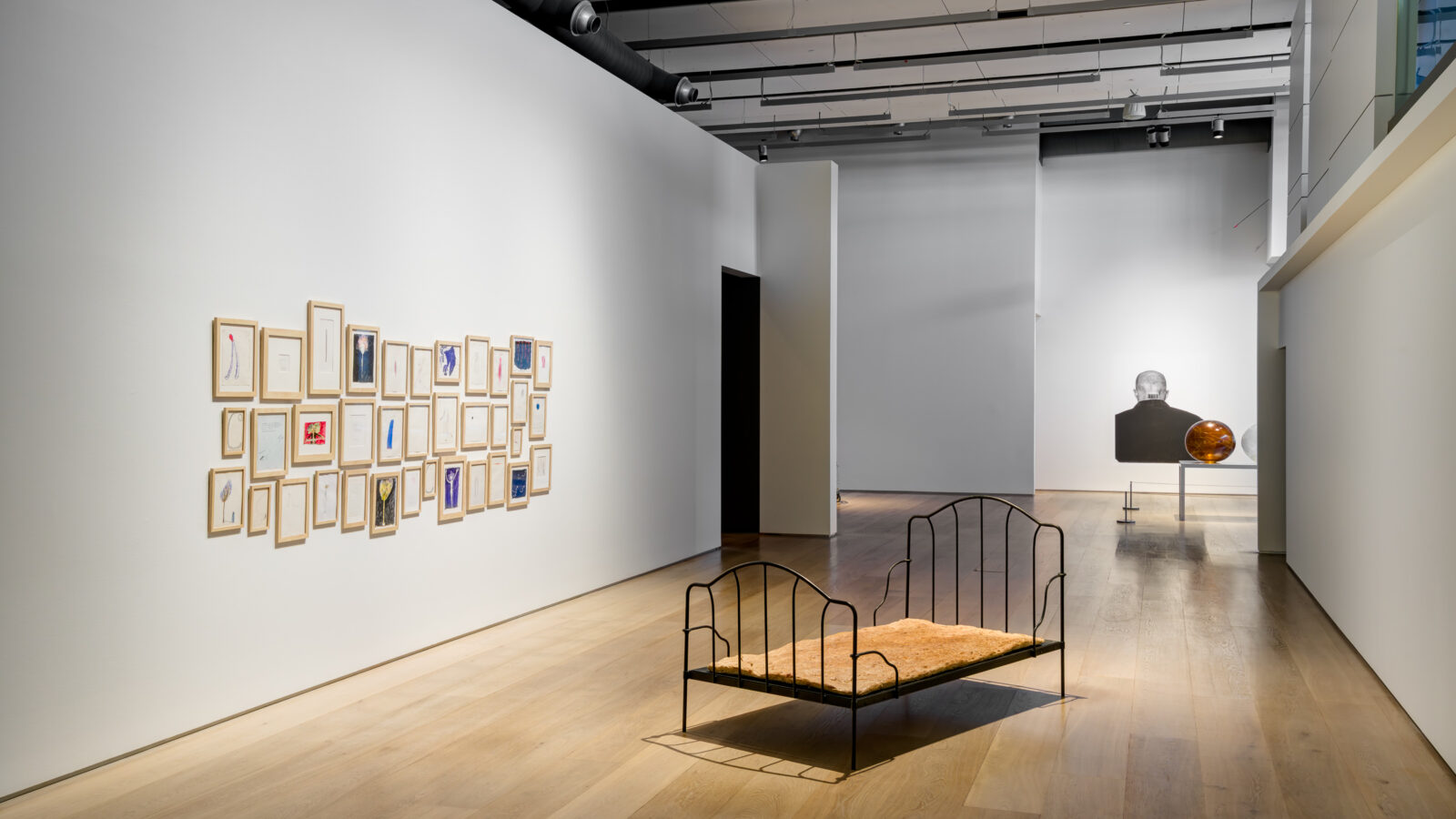
In an artist talk that took place on the exhibition’s first official day, Sterbak stated that not all ideas become fully-fledged pieces, in part because materials can make or break a project, in turn causing a rupture between idea and reality.1 The North Gallery wall, with its quasi-Salon style hang, lays out the creative process by including preparatory drawings and designs, some of which lack a large-scale counterpart in the exhibition. Other sketches by Sterbak live to become finished pieces, such as [I Want You to Feel the Way I Do… (The Dress) no. 1] (1984-85), the final version of which can be found in the Southwest Gallery. Made from uninsulated nickel-chrome wire that glows an orange-red when the sculpture turns on, The Dress alludes to an ancient Greek myth in which Medea takes revenge against Jason’s bride-to-be, Glauce, by sending her a dress covered in poison.
The allusion is made even more unsettling by the inclusion of a single line written at the top of the page on which Sterbak sketched out the wire dress: “THAT WHICH IS MY DREAM DOES NOT EXIST I AM SO SAD”. This line is carried through the entire arrangement of images on the Southwest Gallery wall, as several pieces are dominated by swaths of colour, primarily blue and red. Their materiality—as pigment on paper—leads one to imagine how they would have looked like if they had been created. Those forms that look more recognizable, as with a couple of drawings of women with fire-like hair appearing to combust, encourage the viewer to compare the design to the finished product, in this case, the video piece Artist as Combustible (1987), to wonder whether the realized work is complemented by the design rather than predicated on how accurately it may bring the vision to life.
As is befitting of an artist workshop, there are no conventional museum labels describing the objects, their materials, or their context. This curatorial decision prevents “the very semantic reducibility of things to objects,” as Bill Brown writes in distinguishing between the two terms. According to Brown, objects are defined and thus limited by their function. Things, on the other hand, capture the imagination and take on meaning through their interactions with the human body.2 As is typical of museums and galleries, the body is denied physical engagement with the artworks in Dimensions of Intimacy barring a couple of exceptions outlined below. More important to the exhibition, however, is the affective response, the visitor’s movement through the exhibition like through the artist’s workshop. Knowing what is on display becomes less important than what kind of sensation the primarily visual experience invokes and how these sensations may be reconciled with the exhibition guide one may choose to pick up.
Take, for instance, Sisyphus Sport (1998), another photo-object pairing much like Vanitas and a more on-the-nose reference to the Greek myth than Sisyphus II. An oval-shaped stone with two leather straps leans against the wall. Nearby, a black-and-white photograph of an individual carrying the stone backpack serves as a kind of documentation of what the piece looks like when activated. The exhibition guide notes that “[b]y adding simple straps to the heavy stone, Sterbak sarcastically offers some help to make the moving of the stone up the hill easier, while simultaneously doing nothing to lessen the load.”3 I found myself enthralled by this object in large part due to its unknowability.
For me, this unknowability recalls Eve Kosofsky Sedgwick’s observation that “to perceive texture is always, immediately, and de facto to be immersed in a field of active narrative hypothesizing, testing, and re-understanding of how physical properties act and are acted upon over time.”4 I wondered what it would be like to feel the straps on my shoulders and whether the seemingly pleasant surface of the stone might become unbearable once my body felt its full weight. In her role as an artist, Sterbak put forth this question of possibility by reconciling physical materiality, that which is on display in the gallery, with physical memory and the visitor’s ability, even desire, to imagine interacting with the body in a way that becomes a secondary act of creation.
In another case, the affective response was the primary form of engagement even when a physical interaction was possible, as with Seduction Couch (1986-87), a metallic sculpture of a bed made to resemble the couches now commonly associated with therapists’ offices. The work is hooked up to a Van de Graaff generator that will give a zap to anyone who touches it, as all are invited to. Placed in a separate room with only a floodlamp to cast long shadows against the walls, I could not bring myself to touch the couch during either of my visits, too haunted by the memory of seeing Janet Cardiff and George Bures Miller’s The Killing Machine (2007) at the Art Gallery of Ontario over ten years ago to trust a seemingly docile “machine”.
Time also plays a major role in the exhibition. In addition to its most literal manifestation, in the sense that a retrospective is a consolidation of an artist’s work across time, several of Sterbak’s pieces also hinge on the inevitability of time’s passing. When I returned to the gallery some three weeks later, the steaks of Vanitas had already darkened significantly, no longer mistakable for the soft satin. Likewise, the bread “mattress” of Bread Bed (original 1996, remade 2025) had several deep cracks running through it, while Masque (The Mask) (2014), a costume with a headpiece that reads as a cross between a balaclava and a Medieval helmet, sits silently on its mannequin after navigating through the crowd on opening night as if coming alive like in a fairytale. In this way, Dimensions of Intimacy—and Sterbak’s artistic practice more broadly—embodies the relationship between artwork-as-object and artwork-as-affect as defined by Simon O’Sullivan when he writes that art is not limited by its physical boundaries as an object but rather is an event that produces affects into infinity.5 The work, a document of Sterbak’s career, is always alive, eager to captivate and unnerve in equal measure.
: :
Endnotes
- “In Conversation with Jana Sterbak”, Jana Sterbak and Naomi Potter, Esker Foundation, September 20, 2025.
- Bill Brown, “Thing Theory”, Critical Inquiry 28, no. 1 (2001): 3-4.
- Jana Sterbak: Dimensions of Intimacy Exhibition Guide: List of Works & Exhibition Text (Calgary: Esker Foundation, 2025), n.p.
- Eve Kosofsky Sedgwick, Touching Feeling: Affect, Pedagogy, Performativity (Durham: Duke University Press, 2003), 13.
- Simon O’Sullivan, “The Aesthetics of Affect: Thinking Art Beyond Representation,” Angelaki: Journal for the Theoretical Humanities 6, no. 3 (2001): 127-128.
Margaryta Golovchenko