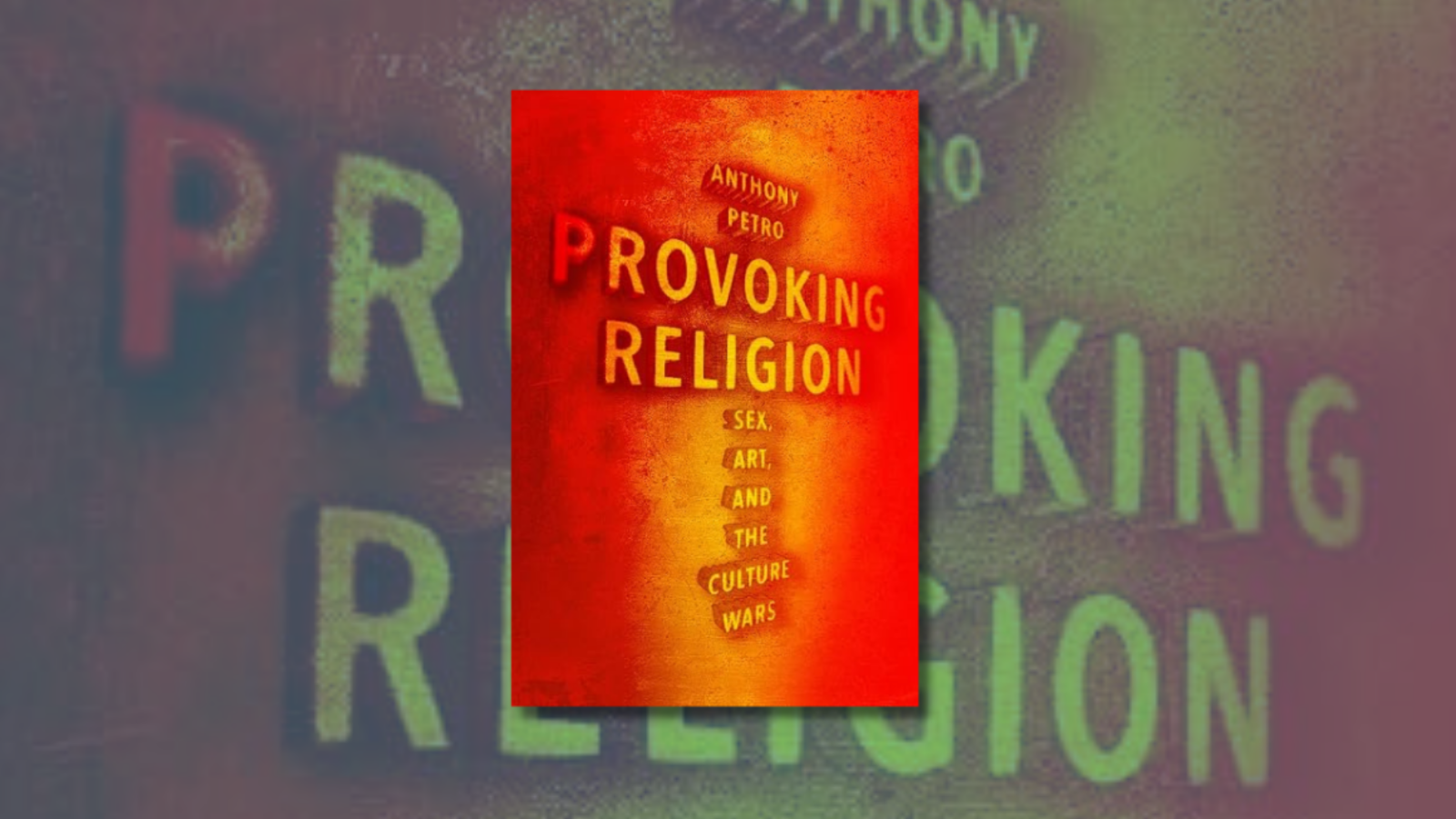
Anthony Petro’s Provoking Religion: Sex, Art, and the Culture Wars brings forward a significant counternarrative of the role of religion in American art during the 1980s and 1990s. This period is frequently narrated as the “Culture Wars”: a fierce battle between (secular) artists and the Religious Right during the height of the HIV/AIDS crisis. Conservative political agitators such as Senator Jesse Helms pushed to rescind funding for the National Endowment for The Arts by describing the work of funded artists as specifically anti-Christian and pornographic. In his book, Petro argues that the views of Helms and his colleagues were shortsighted: in many cases, both politically active artists and those who attempted to censor their work were engaged in religious commentary. In Petro’s telling, artists, more than political actors, offered novel religious insight, rather than mere iconoclasm. Petro’s book opens the varied ways that artists of that period were critically engaging religious forms in their work, writing, “I have found that, far more often than simply mocking Christianity, they strived to express legitimate criticism of conservative religious institutions and leaders and to foster new political and spiritual visions, from Bob Flanagan’s crip Catholicism to Renée Cox’s Black female Jesus” (20). Petro’s attention to the formal decisions within individual works of art shows how aesthetic choices in art of the period had serious theological and political implications. Attending to these works in light of Petro’s examination can open up queerer and richer modes of religious thinking.
In his introduction, Petro briefly discusses the well-known controversy around works by Robert Mapplethorpe and Andres Serrano, two artists who used forms from their Catholic upbringings—such as the cross—alongside erotic and bodily imagery. Petro chooses not to focus on these artists and to take a new approach to the Culture Wars.1 Instead, the first chapter focuses on the performance artist Bob Flanagan’s collaboration with Sheree Rose, which experimented with the formal qualities of the disabled body and sadomasochism. Petro views these works as exhibiting a “crip Catholicism.” In one work, called “Visiting Hours” (1994), Flanagan laid in a staged hospital bed and welcomed visitors in a room which, when
glimpsed from the outside, one could see an external wall painted to look like a blue sky with a few wispy clouds. Periodically, usually twice a day, Rose would turn a lever behind the exhibition’s main room. It tightened a strap attached to Flanagan’s ankles. As she pulled, Flanagan began to rise, higher and higher, against the backdrop of the blue sky and finally beyond it. They called this scene “The Ascension” (42).
This citation of a religious form in Flanagan’s work restages Christ’s ascension in the seemingly secular museum, in the context of a medical treatment and a kink scene. Petro’s attention to the formal choice makes clear the rich religious subtext of Flanagan’s work which could otherwise fade to the background. Intriguingly, Rose was Jewish and Flanagan converted to Judaism toward the end of his life after growing up Catholic. Petro opens the queer possibilities, both in erotics and subversion, in religious hybridity.
The second chapter focuses on the controversy over the feminist artist Judy Chicago’s “The Dinner Party” (1974–1979) in which famous women from Western history are depicted on dinner plates through the “butterfly/vulvar imagery characteristic of Chicago’s feminist aesthetics” (47). While Chicago’s depiction of women is limited by her Eurocentric focus, the work still had a vast impact in rethinking conventional narratives of history through a feminist lens. In her frank depiction of anatomy, Chicago’s work was often viewed exclusively as pornographic. Petro attends to how Chicago cites the Christian form of the Last Supper in creating “a work of mythology,” which moves the painting to the level of a sacred text, thus elevating (what about the subject matter of the painting that is controversially not-sacred?) etc. (64). Petro also takes as a focus a possible “Jewish sensibility to the piece” and argues that the focus on history and lineage over belief connects to the way that the “sacred text becomes a historical narrative of collective Jewish identity” for secular Jews like Chicago (67). Petro does not take up the commandment against “any graven image” as a background against the “literalism” often questionably ascribed to Chicago by “Culture Warriors,” members of the largely Christian right focused on the supposed excesses of artists and creators, with Chicago herself pushing back against “clinical” descriptions of “my abstract, organic, aesthetic—not anatomical—forms.” (quoted on 88). Petro’s obervations oallow us to ask further questions, such as how Chicago might draw on traditions of abstraction in dinner table Judaica, alongside the paintings of Georgia O’Keefe, in choosing the formal strategies of the “Dinner Party” and what that might open for her work’s connection to Jewish cultural history. Still, Petro’s animating point is that Chicago, as a Jewish artist, draws extensively from a well of Christian imagery for a striking American feminist statement that women should be given a seat at the table.
Ultimately, the strongest argument of the book is that the historian of American culture ignores the significance of Christianity and particularly Catholicism for an exclusive focus on queer history or politics at their peril. The next three chapters focus on artists who directly focus on Christian imagery: David Wojnarowicz, Ray Navarro and Renee Cox. In all these chapters, Petro plays impressive attention to the works themselves. The most striking and consistent point throughout the book is that “Christian forms circulate in visual and performance art that conventionally falls under the umbrella of secular, if not anti-Christian” (26). What I hope for future books to do is to supplement Petro’s pathbreaking work with fuller consideration of how artists from minority religions in the United States, such as Judaism and Islam, both contest and utilize Christian forms as well as those of their own backgrounds. In different ways across the chapters, Petro generously opens some possible frames for around how a Catholic artist like Cox engages these forms in a way different from the irony presented by the Jewish and satirical approach to Christian imagery by Chicago.
Petro recognizes the multivalent impact of works of art in the social and political world. It is all too common to see art—when discussed outside of the art historical field—reduced to what Petro describes as an “aesthetics of literalism” which “transforms images into words” (19). By attending to the various and sometimes excessive formal possibilities of the works, beyond the strict intentions of their creators, Petro can open far more resonances. This is also a far different and formally queerer understanding than the usual Culture Wars narrative provides: as Petro notes, further, “it is the nature of language (and much more so images) to exceed the fixity that literalism desires” (19). In the study of art and religion, attending to how religious forms recur in sometimes surprising, troubling and shifting ways is a particularly exciting zone of inquiry. Petro largely, though not exclusively, engages works focused on queer sexuality, with the implicit argument that queer art makes a particular theological intervention in recognizing the significance of various bodily experiences. This view is particularly generative read alongside queer theorist Ramzi Fawaz’s recent argument for the significance of a “queer formalism,” which he describes as both representing non-normative sexuality and also an attention to the various shapes which can be made to “articulate queer genders and sexualities.”2 After reading Petro, it is unquestionable that these forms could include a cross floating in piss (Serrano) or a vulvar dinner plate from a Last Supper (Chicago). Petro successfully models, and inaugurates, a Queer Religious Formalism: a mode of critical attention that considers gender and sexual difference alongside modes of belief and methods of ritual.
: :
Endnotes
- Petro is building on earlier scholarship which addresses Mapplethorpe and Serrano in more depth by S. Brent Plate and Eleanor Heartney. See: S. Brent Plate, Blasphemy: Art that Offends (Black Dog, 2006); Eleanor Heartney, Postmodern Heretics: The Catholic Imagination in Contemporary Art. (Midmarch Arts Press, 2004.)
- Ramzi Fawaz, Queer Forms. NYU Press, 2022. 37-38
Gabriel Chazan