Los Angeles is the kind of place that drives people—artists, writers, filmmakers—not just to understand it but to reckon with it, to publicly parse its ungraspable multiplicity. Such is the task handed to the rotating curators of the Hammer Museum’s Made in L.A. biennial, a survey of artists living and working in greater Los Angeles. This task is not, to my mind, an enviable one. Biennials, charged with representing (or perhaps manufacturing) a moment in contemporary art, inevitably risk incoherence—a risk multiplied exponentially when the charge is also to say something about a place, especially one as slippery as L.A.
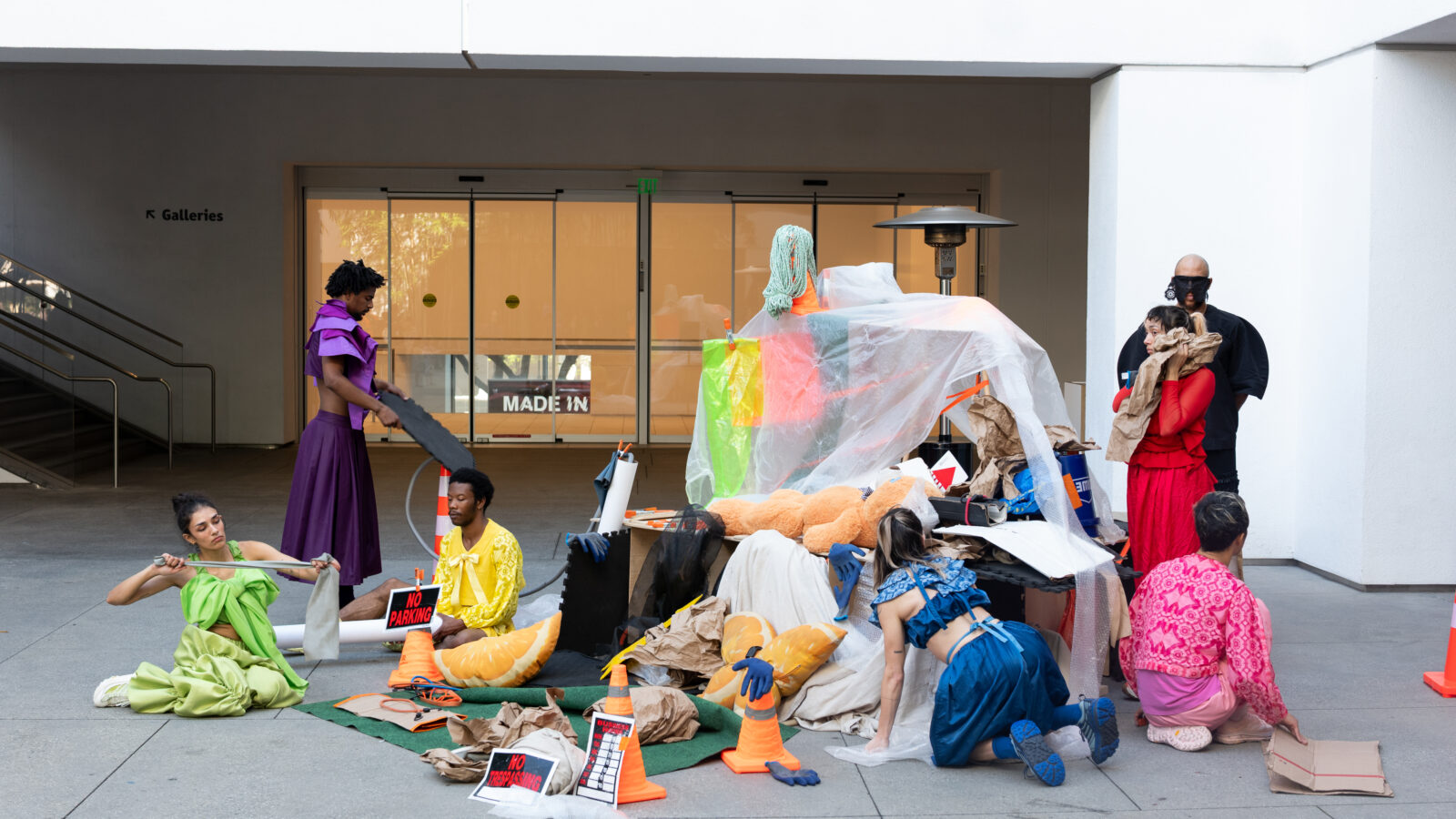
Among the 28 artists selected (by curators Essence Harden and Paulina Pobocha) for the 2025 iteration of Made in L.A. was the choreographer Will Rawls. A recent arrival to the city, Rawls’s inclusion anoints him, officially, as a Los Angeles Artist. His contribution to the biennial—a four-hour performance presented monthly during the exhibition’s run—seems to wrestle with that designation, starting with its cheeky title: Unmade. The Hammer’s website and wall text describe Unmade as “a choreography spun from conversations with the performers about the daily frictions of life across LA’s built environments.” Across the two performances I attended there were, indeed, a few references to freeways and commutes. There was even an improvisatory catalogue aria by performer Ajani Brannum, whose body carved out a sequence of shapes (some gymnastic, others pedestrian) as they called out the names of various cities and neighborhoods of greater Los Angeles: “Inglewood! Westchester! Don’t forget about Los Feliz!”
Such references, though, ultimately don’t say anything about Los Angeles in particular so much as they draw on local familiarities to surface the feeling of place, an overarching concern of the work. In Unmade, Rawls probes the phenomenological geographies of metropolitan life. Lingering with those “daily frictions” and the movements that produce them, the performance asks how a sense of emplacement emerges from the instability of the quotidian, its unassimilable contradictions. For Rawls, that instability is itself a kind of form—a perspective that rhymes with scholarship in critical geography, which has long theorized space as a kind of contingent choreographic assemblage rather than a fixed container. Marxist feminist Doreen Massey, for instance, offers the concept of “throwntogetherness” to describe the way space is constituted by overlapping, even perhaps opposing, trajectories that find themselves in simultaneous interaction.1 Similarly, the Afro-Brazilian geographer Milton Santos holds movement and relation together in his definition of space as “an indissoluble set of systems of objects and systems of actions.”2
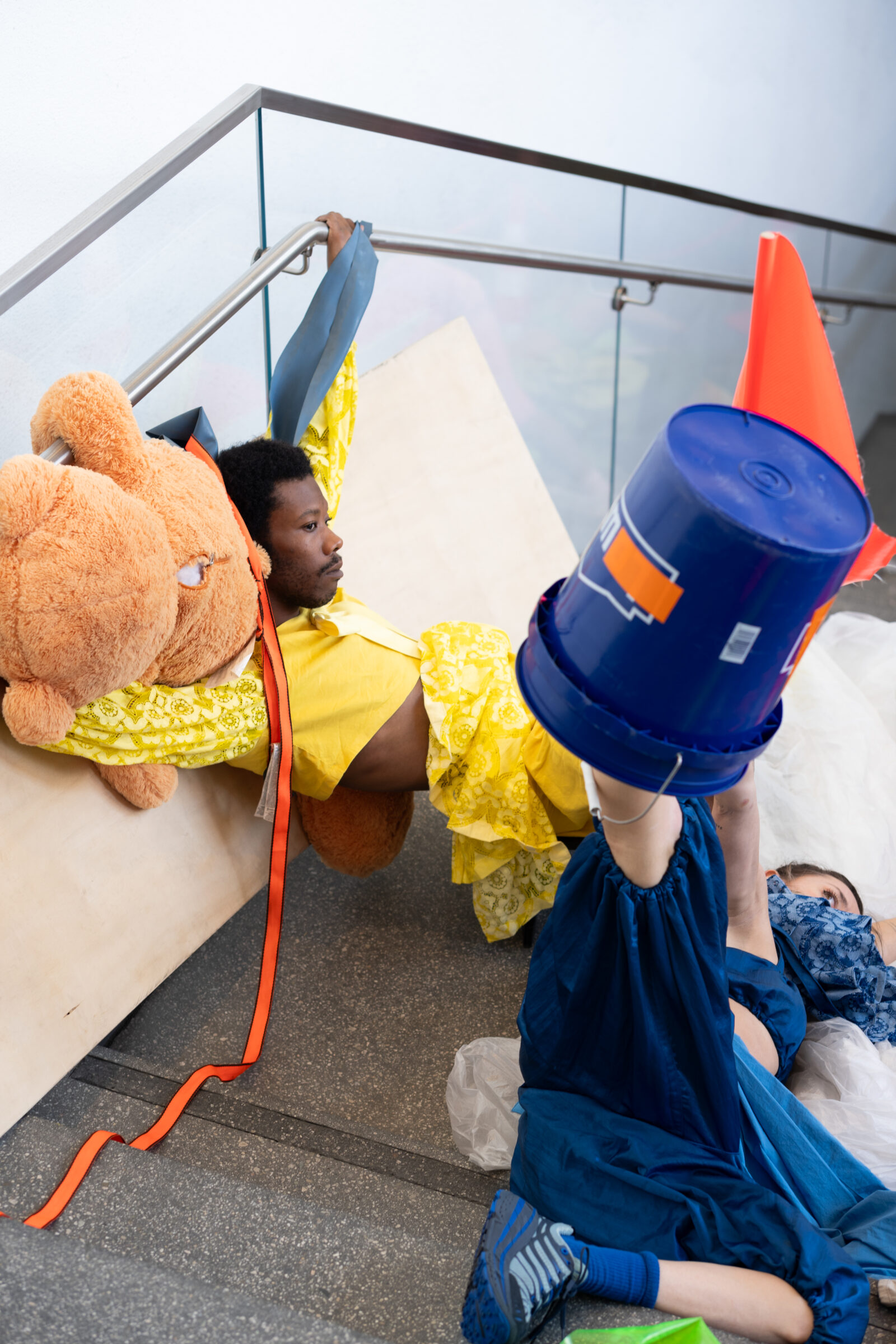
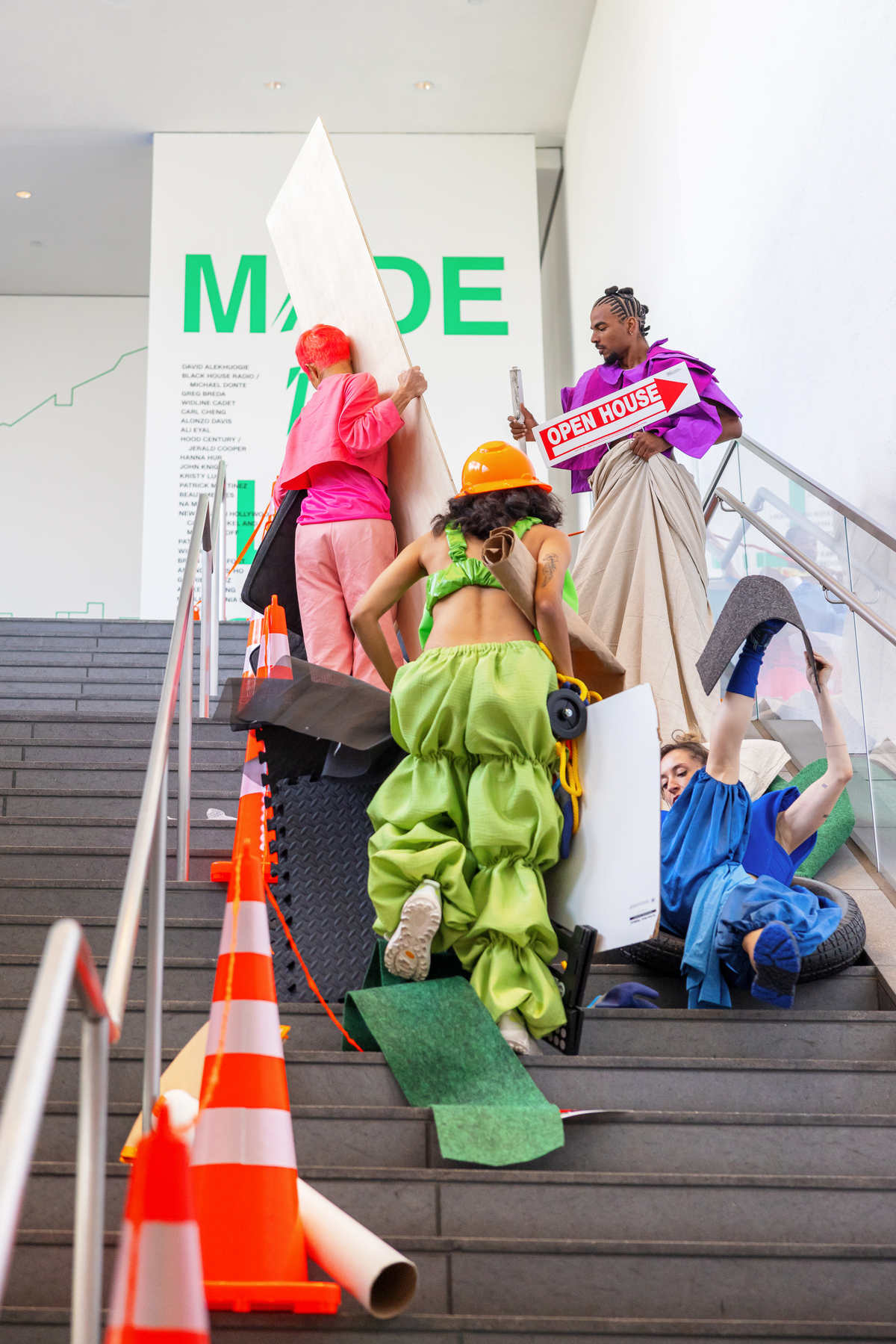
This last might as well be part of the wall text for Unmade itself. Across its four-hour duration, the work’s six performers—Brannum, Gurmukhi Bevli, Maya Billig, jeremy de’jon guyton, Tiara Jackson, and Kensaku Shinohara, plus Rawls himself in a mostly silent, supervisory role—wrangle an unruly assortment of materials through the museum. Rawls described the objects to me as “a mix of things that are useful for building and things that are useful for living”: plywood and pillows, construction cones and cardboard tubes, a giant teddy bear. Sometimes working individually and sometimes in tandem, the performers gather and scatter these materials; they scrutinize them, fantasize with them, transport them according to immanent logics that seem to pertain as much to the objects themselves as to human intention. Above all, they build with them: intimate haptic relationships, precarious communal structures, most of which come apart nearly as soon as they’ve come together. After four hours of near-constant motion, nothing remains the same as when the performance began, yet nothing definitive seems to have happened either. In its active irresolution—moment-to-moment as well as beginning-to-end—Unmade can be a frustrating spectatorial experience, offering little in the way of dramaturgical clarity or conclusion. (Perhaps this is fitting for a city lousy with unresolved major construction projects; the excruciatingly protracted rollout of the L.A. Metro’s “new” D Line is nothing if not durational performance on an infrastructural scale.) At one performance, I overheard a fellow spectator confidently informing their befuddled companion, “It’s called Unmade Town.” It’s not, quite, but that’s as good a way as any to make sense of the throwntogetherness.
Rawls’s work has long been concerned with processes of sense-making. His prior choreographies and installations have broken language down into symbols and moving images into still frames, often in order to lay bare how unassuming building blocks coalesce into anti-Black regimes of meaning. With Unmade, Rawls turns his attention to the grammar of the city—how our experiences of emplacement take shape within structures of power embedded in the built environment. Though this piece is less explicitly grounded in Black thought and performance than many of his prior projects, it nonetheless sits in a lineage of Black aesthetic engagements in and with Los Angeles. In their visual art practices, for instance, native Angelenos Betye Saar and Mark Bradford deploy the resonances of everyday materials in abstractions and assemblages that situate these materials within broader spatialized and embodied forms of power. If Unmade is indeed to some extent Rawls’s attempt to reckon with his new home, he does so through such situated, attentive techniques, producing a fragmentary take on the city that avoids the kind of sweeping iconographic impulses associated with L.A. bards (and white transplants) like Joan Didion, Reyner Banham, and Ed Ruscha.
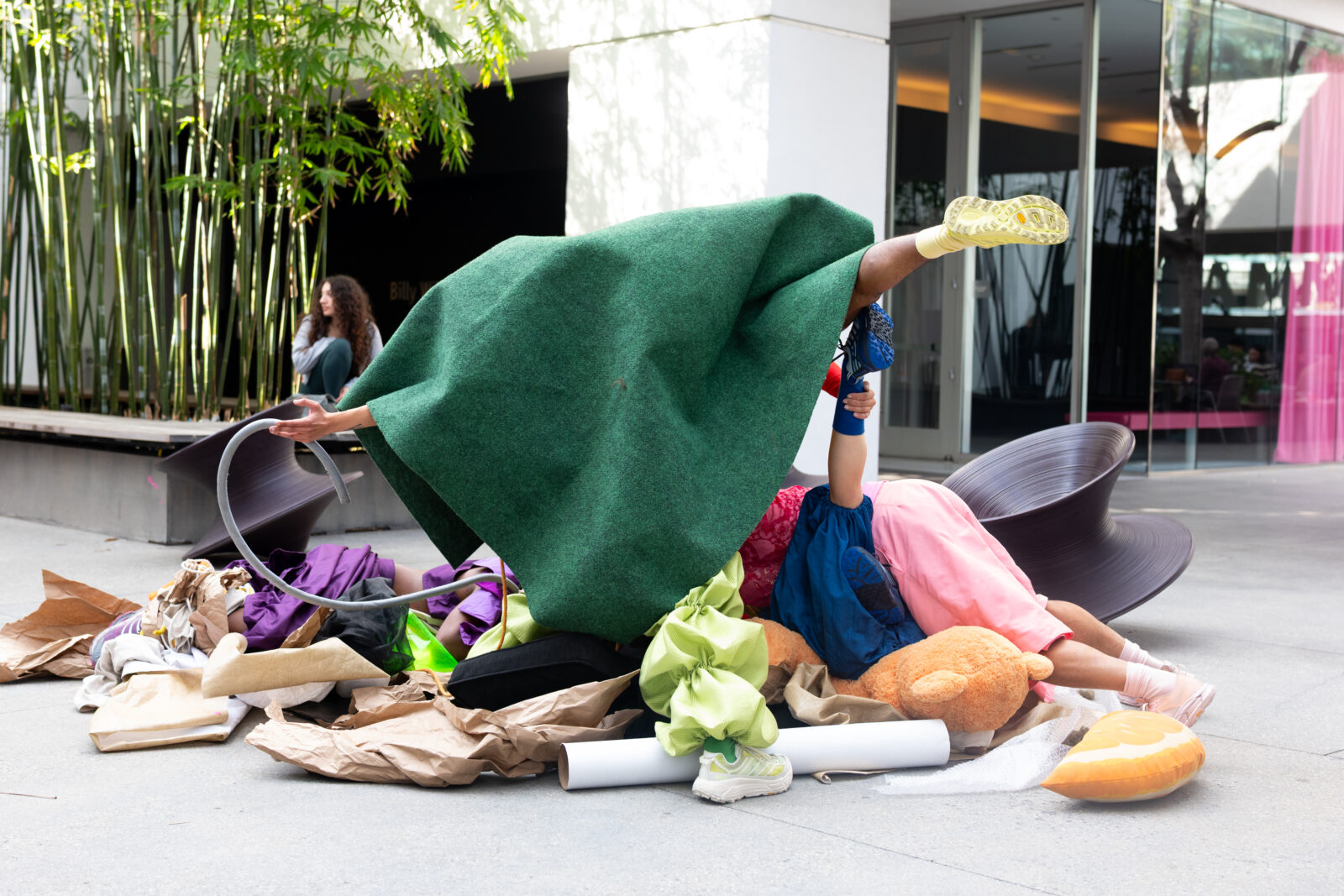
In Unmade, the choreographer’s localized attention is doubled by that of the performers, by their restless curiosity about their surroundings and the materials at hand. To shape their explorations, Rawls draws on a performance tradition characterized by ingenuous inventiveness (and, perhaps not incidentally, currently boasting a robust community of practitioners in L.A.): clown. Creating their own order out of disorder, and often vice versa, the clown is a logical figure to populate Rawls’s world of (un)making. Clown also, for all its apparent levity, demands a merciless exactitude, a very particular high-wire walk between artful and artless at which Unmade’s performers—dancers of exceptional sensitivity and charisma—do not always succeed. Nonetheless, the formal encounter Rawls has staged offers productive friction, particularly with regard to the choreographies of attention. The rigorous somatic explorations and sensory attunement of much contemporary dance—in which audiences, though invited to witness, are not always directly implicated—are difficult to fully reconcile with the clown’s equally rigorous awareness of their fundamentally presentational existence, their almost ontological need to be seen doing. My own efforts to tune in, to be co-present with the performers, correspondingly felt as if they were being simultaneously solicited and stymied in a kind of relational whiplash—of a piece with the work’s interest in the constant shifting of structures and bonds, material and relational alike.
This unstable current between performer and spectator is, fittingly for the work’s concern with place, contextualized and triangulated by the architecture of the museum itself. The first time I saw Unmade, it took place almost entirely in the Hammer’s exterior spaces, the courtyard and the open-air walkways above it. I experienced the movement scores in these settings as diffuse, even at times unfocused, a perception I ascribe at least in part to their immediate context. Fully enclosed yet ostensibly open to the public, the Hammer’s courtyard evokes the blandly pleasant POPS (privately owned public spaces) characteristic of neoliberal urbanism. Witnessing Rawls’s choreographic assemblages come together and apart in such a space, there are glimmers of, say, the communal improvisations of Zuccotti Park, site of the original Occupy Wall Street. A more recent resonance is the student occupations of university spaces to protest the genocide in Palestine; among the largely nondescript everyday objects, a watermelon pillow draws the eye. Such reverberations, however, are effectively swallowed up by the courtyard’s vacuum of meaning. It is difficult to stage friction in a place where there is so little to rub against. (This insidious intangibility abstracts all that is, in fact, here to push back on—not least the complicity of UCLA, the Hammer’s parent institution, in the brutalization of students at their campus’s own Palestine solidarity encampment.) Choreographic specificity is mediated and diluted by such deliberately forceful anonymity; here, the performers’ meticulous curiosity risks collapsing, for the spectator, into a generalized impression of whimsical activity among the courtyard’s palms and spinning plastic chairs. The bright, color-blocked costumes, gorgeously designed by Nancy Stella Soto, photograph especially well on the phones of the museum’s curated pseudo-public.
When I saw Unmade a second time a few months later, Rawls had made several changes, including moving the performers into the Made in L.A. galleries in the performance’s third hour. With something external to itself—both individual works by other artists, and the spatial frame of the gallery itself—to provide friction, the piece snapped into focus. The clowns finally had a clear order within which to run amok; the rules pertaining to the gallery could be unmade far more easily than those of the courtyard. As the performers transformed details in other Made in L.A. works (sculptures by Alake Shilling, an installation by Amanda Ross-Ho, paintings by Beaux Mendes) into the basis for verbal choreographies, movement scores, and participatory rituals whose sense only they could comprehend, they transformed my own attention to those works. Sometimes, they provoked subtle reflection on the visions of Los Angeles that the exhibited works offer. Arriving at a video by New Theater Hollywood (recent arrivals to the city like Rawls himself), the clowns framed both sides of the screen in awe and innocently parroted back the video’s dialogue, devastatingly puncturing the seriousness of its metafictional musings on the creative process and Hollywood as mythic site. “Your voice is a dolphin,” the video’s narrator intoned; the next line, whatever it was, was drowned out by a chorus of chittering. I guffawed.
By contrast, the clowns left alone a searing installation by L.A. native Freddy Villalobos, which draws out a drive along South Figueroa Street and a single song by Sam Cooke to render at monumental scale the microcosms of racial violence and gentrification embedded in the city’s everyday architecture. Even though the dancers didn’t enter this corner of the gallery, there was a moment of serendipitous relation: as the words “groaning and troubled” appeared on Villalobos’s screen, I heard a wordless cry from one of the performers in the next room, breaking through the low sonic rumble of the installation. The vocalization seemed to hold a kind of psychic weight I didn’t otherwise feel in much of Unmade, as if in unconscious solidarity with the South L.A. communities whose displacement Villalobos’s work evokes. By the time the performers exited the galleries, I was thinking about whose L.A. these various works were made in. I was thinking about how the performers’ movements, their temporary structures of attention and relation, had surfaced otherwise-submerged throughlines and questions within an exhibition frequently dinged in reviews and public commentary for lacking a point of view. And I was thinking about how Rawls’s work moves, flexible and volatile, through the space of “Los Angeles art,” rather than remaining fixed within this curatorial geography, and the ethics of this movement for an artist new to the city whose work has been tasked with representing it.
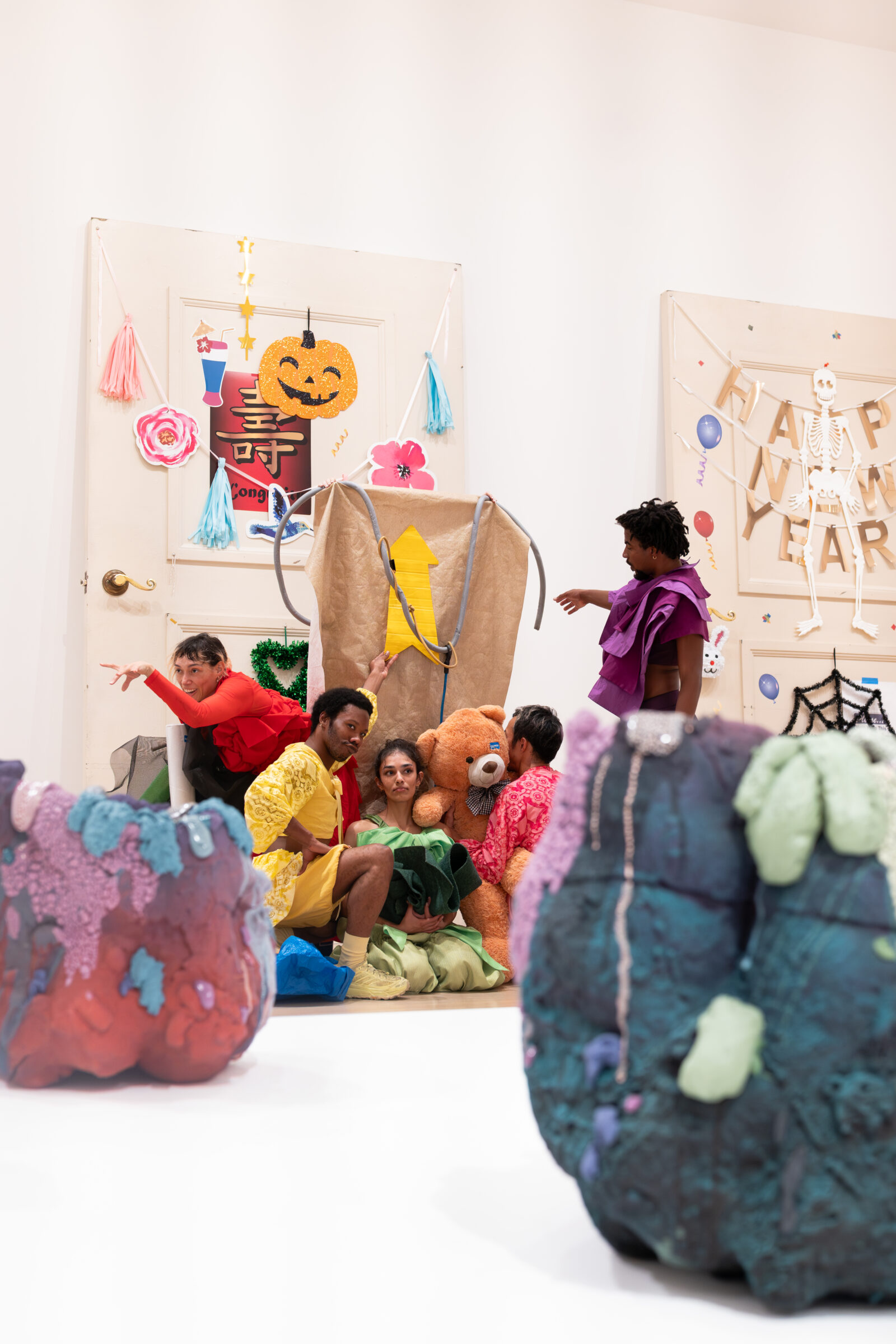
Unmade’s trajectory through the Hammer’s various spaces thus vitally reveals the much-discussed question of dance’s place in the museum as precisely a question of dance’s place in the museum. It’s still relatively rare, though less so than it used to be, for performance to be, like Unmade, actually curated into major exhibitions alongside work in other mediums. More often, dance and performance are programmed separately and cordoned off (Unmade’s proliferation of safety cones and orange tape are salient here) into designated ancillary spaces like theaters, studios, or, increasingly, flexible converted warehouses like those at L.A.’s Hauser & Wirth or MOCA Geffen. If a performance work does make it into the museum proper, where does one put it? Is it plunked into the corner of a gallery, playing the role of a living sculpture for ostensibly serious visitors? Is it placed in the lobby, the atrium, the courtyard, as an Instagrammable activation that acknowledges the public’s disordered attention? Should it go somewhere where it can work with its surroundings—and risk working against them—or somewhere where its meaning will remain self-contained? Unmade manages to do all of these, and more. In a conversation with Rawls, he spoke to me about the “institutional choreography” of the work’s planning, how the architecture of museum bureaucracy learned to bend around the performance’s inherent unpredictability. Notwithstanding my spectatorial perception of the work’s incorporability within the museum’s POPS aesthetic, the Hammer apparently took some convincing: to let literal trash go flying through its hallowed halls, certainly, but more importantly to accept that the interactions between its systems of objects and systems of actions could not be precisely mapped out in advance. This behind-the-scenes work on Rawls’s part—work that might, perhaps, make such efforts easier for future artists—extends and expands the performance’s choreographies of persistence and resourcefulness. Transiting across spaces public and private, Unmade asks where, precisely, performance in the museum might do its unmaking, placemaking work, and what the nature of that work could be.
Leaving the Hammer after the final performance, I stepped out onto Wilshire Boulevard—and into the lingering, noxious chemtrails of a nearby rally in support of the U.S.-Israel strikes on Iran. It was jarring to move out of what felt, on one level, like a staging of (or perhaps a rehearsal for) uncomfortable throwntogetherness, and into its even less comfortable reality. But then, that moment of shock itself is throwntogetherness, a choreogeography of its own. Really, I shouldn’t have been shocked at all: the Hammer’s biggest donors are the billionaires Lynda and Stewart Resnick, water hoarders and war hawks who have long supported U.S. aggression against Iran. Cultural institutions aren’t separate from the places they seek to reflect, and asking after dance’s place in the museum should prompt us to consider, further, the museum’s place in the city’s choreographies. Beyond the Hammer, I think of the time I attended a concert staging of an opera at the Walt Disney Concert Hall—which sits, along with MOCA, the Broad, and the Music Center complex, atop the ruins of a dense, working-class, largely immigrant neighborhood. Bunker Hill, like many similar neighborhoods in urban cores across the country, was bulldozed in the mid-twentieth-century to make way for these high-culture temples and their neighbors, half-empty office towers and luxury apartments that serve as investment properties. Mind-meltingly, the opera being staged in the new Bunker Hill that night was a polemic against displacement.
Rather than ignoring such overwhelming dissonances, Rawls and his careful practices of attention led me right to them. What—and who, and where—is being made, and unmade, in L.A.? How does exhibition curation, or museum architecture, or institutional procedure, reflect and shape the city’s spatial order, the movements such order allows or disallows? If Los Angeles is the particular metropolitan agglomeration within which these questions take shape, the scope of Unmade’s inquiry extends beyond Inglewood, Westchester, or (I didn’t forget) Los Feliz. Rawls and his performers hone in on a question as geographically expansive as it is choreographically intimate: what are we building as we’re living?
: :
Endnotes
- Doreen Massey, For Space (SAGE, 2005).
- Milton Santos, The Nature of Space, trans. Brenda C. Baletti (Duke University Press, 2021), 5.
Wesleigh Gates