Whitney Biennial 2026
Whitney Museum of American Art, New York
March 8 – August 23, 2026
Curated by Marcela Guerrero and Drew Sawyer
In Emilie Louise Gossiaux’s ballpoint-pen-and-crayon drawing Co-Shaping One Another with the Moon (2025), a nude human figure and a dog float upright in a pale blue field scattered with yellow stars. Their eyes are closed. They face each other across the width of the page, connected at the center by a horizontal form, something between an umbilical cord and a shared organ. Both are weightless, and both are drawn at the same scale. There is no hierarchy here, no pet and owner. There is only mutual suspension, a relational grammar drawn into being through composition itself.
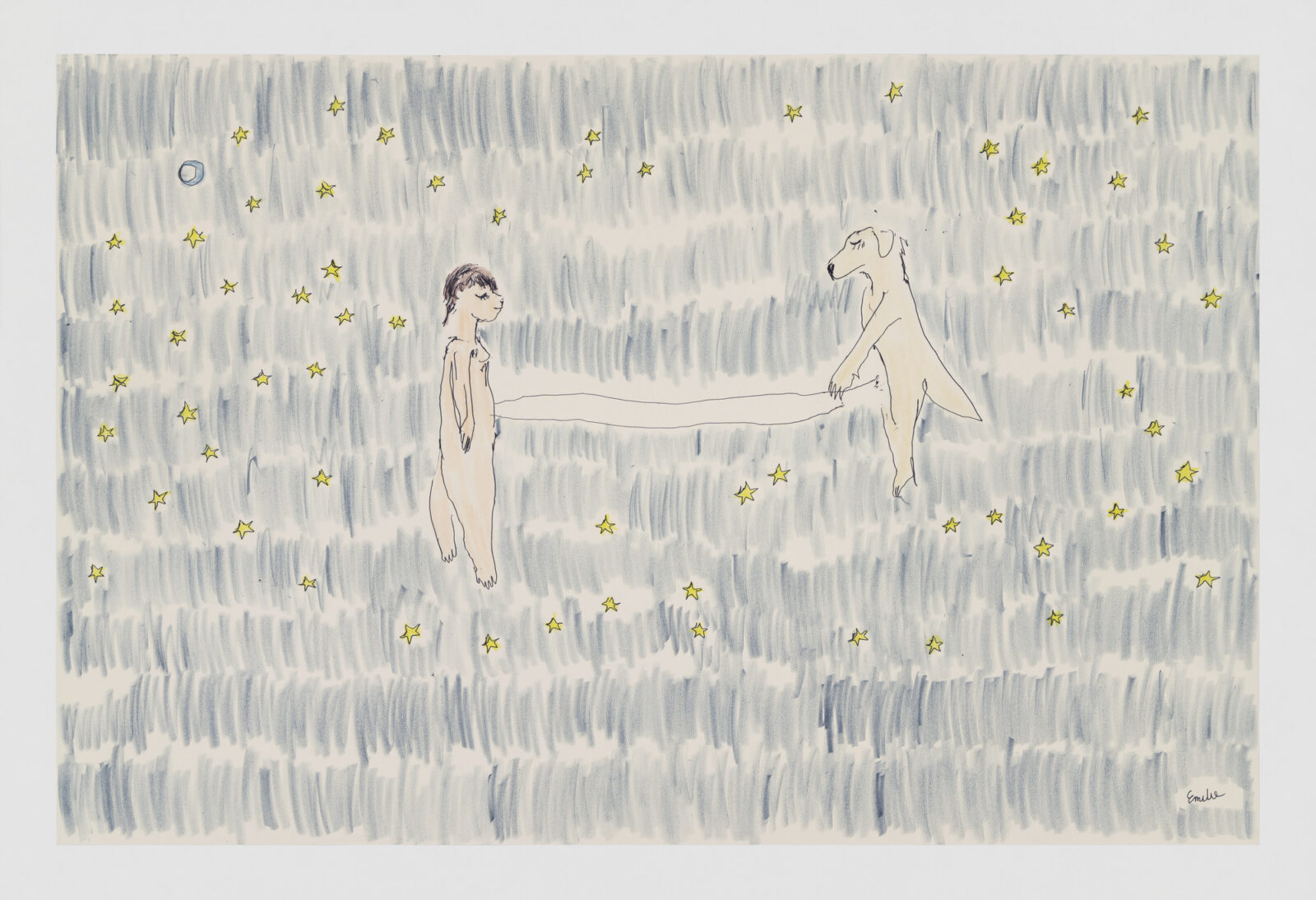
The drawing, included in the 2026 Whitney Biennial, is a memorial. Gossiaux’s guide dog London died in September 2025, and the work belongs to a series in which Gossiaux explores their interdependence. The eighty-second edition of the Biennial, co-curated by Marcela Guerrero and Drew Sawyer, gathers fifty-six artists, duos, and collectives across two main floors of the museum. The cohort spans generations and expands the definition of “American” art to include practitioners from countries shaped by U.S. imperial power, from Afghanistan and Iraq to the Philippines and Vietnam.
Most of the critical response has converged on a single question, approached from different angles: whether the show meets the present moment with sufficient force. Jenny Wu, writing in ArtReview, reads the exhibition through Sianne Ngai’s categories of “the cute, the zany, and the interesting,” and begins where visitors do, with Gossiaux’s Kong Play, a hundred or so ceramic forms modeled on chew toys and arranged on a low pedestal. The exhibition, she concludes, opens “without fanfare, without friction.”1 Wu’s verdict is that the Biennial’s political claims are intimate in scope, and that anyone looking to art for guidance on survival will find the show attenuated.
I want to begin in the same room and arrive somewhere else. Frictionlessness, as Wu describes it, is a quality of tone. It is what the room feels like. Read as composition rather than as mood, the drawing beside the chew toys is not tender. It is a diagram of dependency in which neither party is the support and neither is the supported, and it makes that claim through scale, symmetry, and the single line running between two closed-eyed bodies. Tone and form are pointing in different directions here, and the difference is the subject of this review.
The curators organize the exhibition around what the wall text calls “various forms of relationality,” a list that runs from interspecies kinship through familial, geopolitical, technological, and infrastructural entanglement. “Relation” has become one of contemporary curating’s most elastic terms, broad enough to cover nearly anything and precise enough to guarantee very little. Jacques Rancière offers a way to hold it to account. Writing about the relational art of the 1990s, he presses on its founding assumption: that assembling people in a room, staging an encounter, producing a temporary collectivity, is by itself a political act. What he proposes instead is le partage du sensible, a phrase that means both the sharing-out and the dividing-up of what can be perceived.2 A partage is an arrangement of bodies, spaces, and times that settles in advance who is visible, who is audible, and who is merely present. On these terms, relation is not something an exhibition can offer but something an arrangement either makes perceptible or forecloses.
If Gossiaux’s drawing enacts interspecies relation through scale and symmetry, several other works in the Biennial make ecological relation felt through material transformation. These are works that begin with what is already at hand—including waste, found objects, obsolete technologies—and submit it to sustained attention. They are performing ecology through the slow labor of picking up, reshaping, and re-seeing.
Jasmin Sian collects littered paper bags from delis, pharmacies, and fast-food chains, while biking to work along the Manhattan Greenway, then paints over them with minute detail and cuts them with an X-Acto knife into lace-like forms that feature the animals she encounters on those rides. The resulting objects resemble antique doilies darkened by time, though what they are made of is yesterday’s takeout. This is urban detritus transformed, through meticulous handiwork, into portraits of the nonhuman life that coexists with us. The labor of the cut is not incidental. It is the practice through which Sian registers ecological relation, not by representing nature as a theme, but by physically reshaping the waste stream into images of what persists alongside it.
Where Sian proposes care as a mode of ecological attention, Sula Bermúdez-Silverman’s wall-mounted sculptures hold beauty and violence in a single object without resolving the tension. Hand-blown glass swells through rusted iron forms that, on closer inspection, turn out to be animal traps. The glass is not placed beside the trap; it was blown through it and cooled inside the mechanism’s grip. You are drawn in by the amethyst glow and then made to recognize the apparatus of capture holding it in place.
Precarity is not the subject of these objects but the condition of their existence. The glass holds its shape because the trap held it while it cooled. The trap can no longer close because the glass has set inside it. Neither form survives the removal of the other, and capture and dependency turn out to be the same arrangement described from two positions. The trap is a device for converting animals into pelts and pelts into commodities, and the glass carries its own extractive history in silica, fuel, and heat. Fusing them makes one object out of two processes that ordinarily sit at opposite ends of a supply chain, and it does so without narrating the connection. Bermúdez-Silverman’s practice is rooted in research into colonial material histories: sugar, salt, rare earth minerals. That research gives the work a density that exceeds its modest scale.
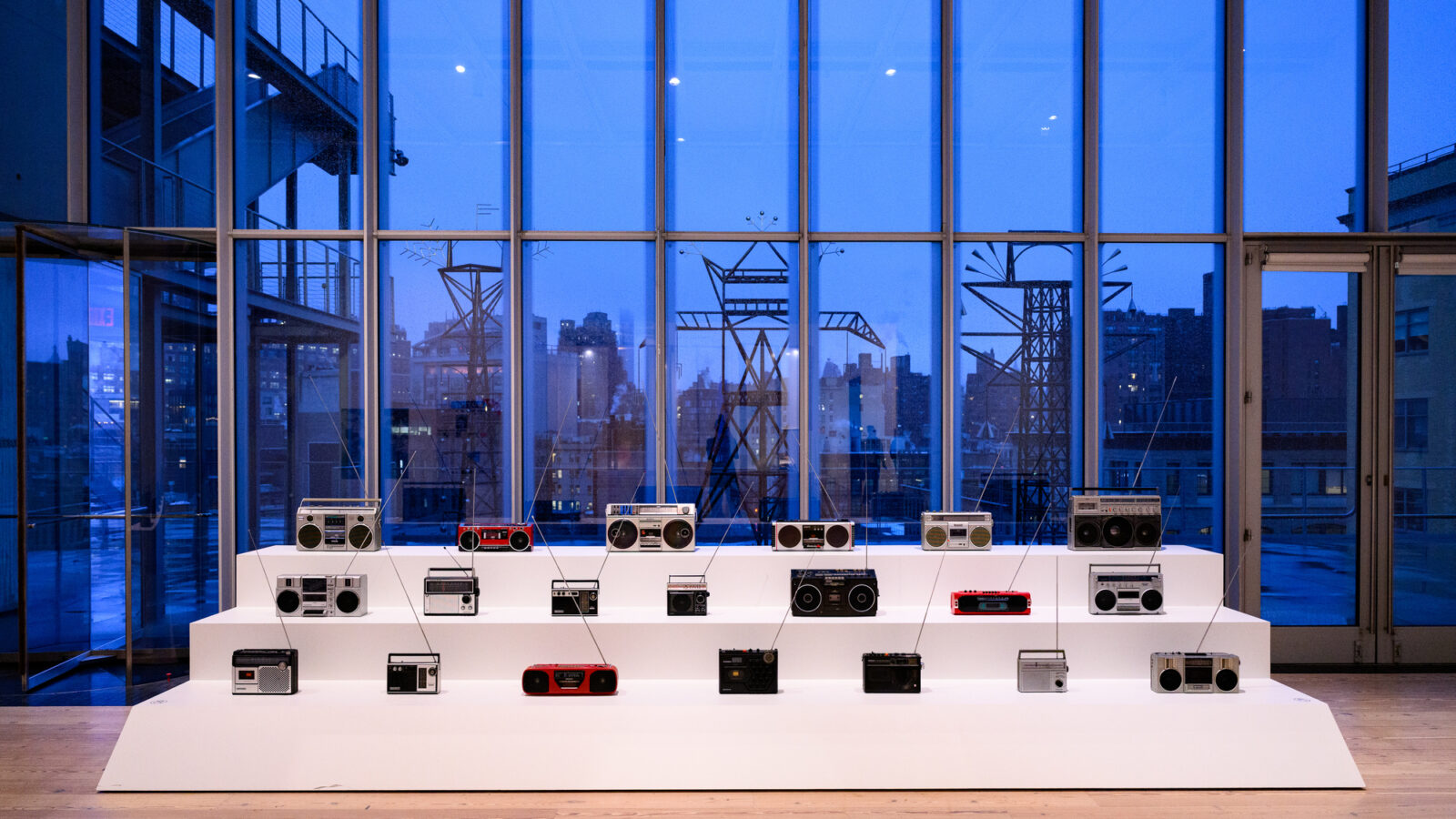
Aki Onda’s restaging of José Maceda’s Ugnayan (1974/2026) makes the same case about technology. The original was a fifty-one-minute composition for indigenous Filipino instruments broadcast simultaneously across thirty-seven radio stations in metropolitan Manila on January 1, 1974, heard outdoors through pocket-sized receivers that mixed it with the sound of the city. Onda replaces the stations with twenty vintage tape decks on a multilevel platform. You can see the cassettes turning while the drone fills the gallery. The radio network Maceda’s composition traveled through was a technological infrastructure, an ecology of airwaves and public space, and a political apparatus at once. Produced under the Marcos regime, the piece commandeered state-controlled frequencies for indigenous sound, which made it a claim about whose culture could occupy shared air. Onda’s translation into the museum strips some of that away, but the tape decks introduce a materiality of their own: the hiss, the slight desynchronization between machines, the analog texture that is itself a historical index. Sound here is not content delivered through a neutral channel. It is an environment shaped by the technologies and politics through which it moves.
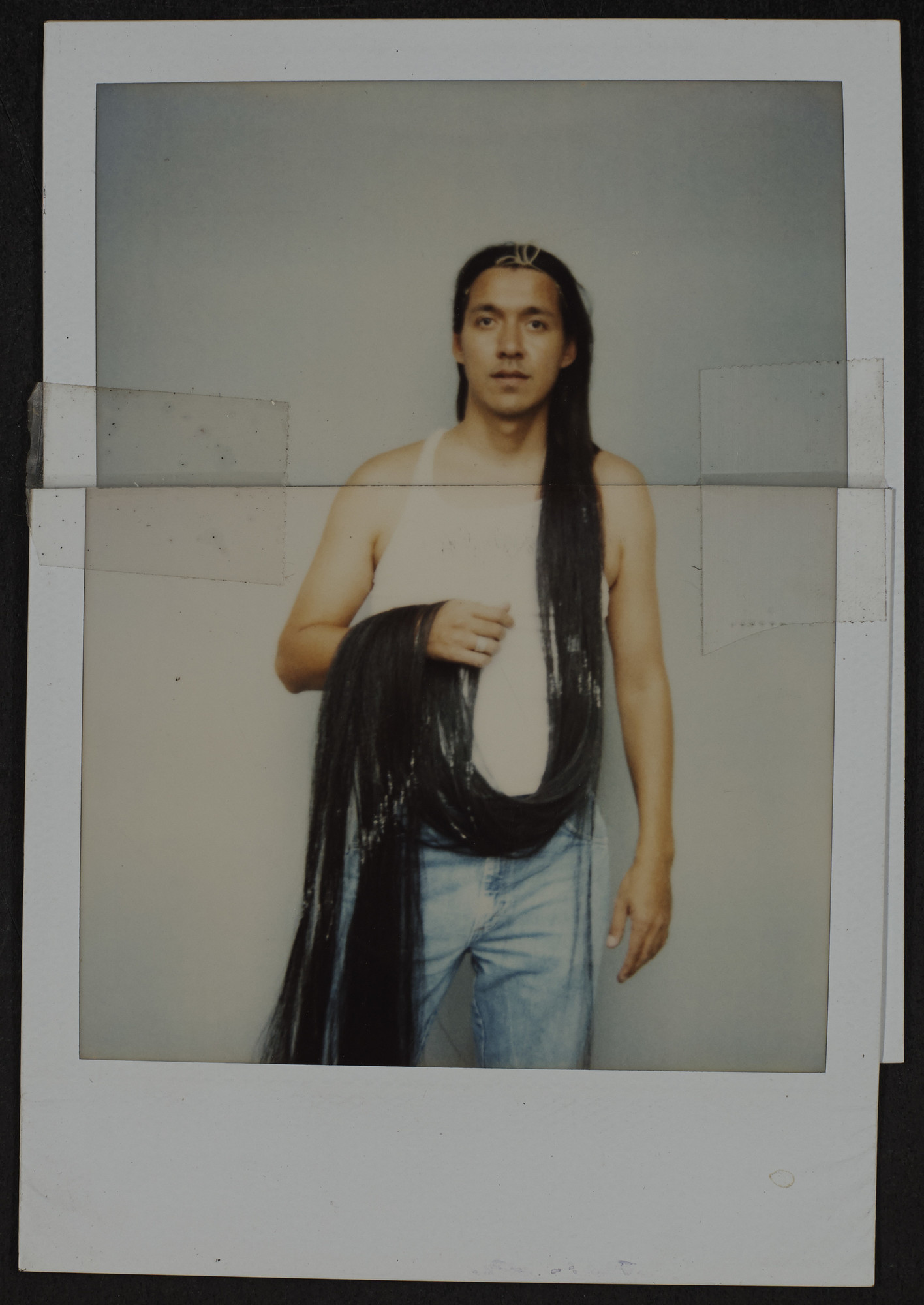
Among the Biennial’s quieter inclusions, none carries quite the weight of Kimowan Metchewais, a Cree, Cold Lake First Nations artist and photographer who died in 2011. In one self-portrait, two Polaroids are joined with adhesive tape to accommodate the full length of the figure. Metchewais stands against a bare wall, his hair falling uncut past his waist, one hand gathering it against his chest. The tape seam remains visible. No single frame could hold what had to be shown, so a second was attached to the first.
What does it mean to include a deceased artist in a show organized around relation? The exhibition has its answer: that kinship extends across temporal absence, that the networks it traces are not limited to the living. The photograph proposes something narrower and harder. Representation runs out. The instrument fails at the scale of its subject, and the response is not a better frame but a visible repair. Polaroid is a medium of instant capture, and the work uses it to make an image that could not be captured instantly, or once. Duration enters through the tape.
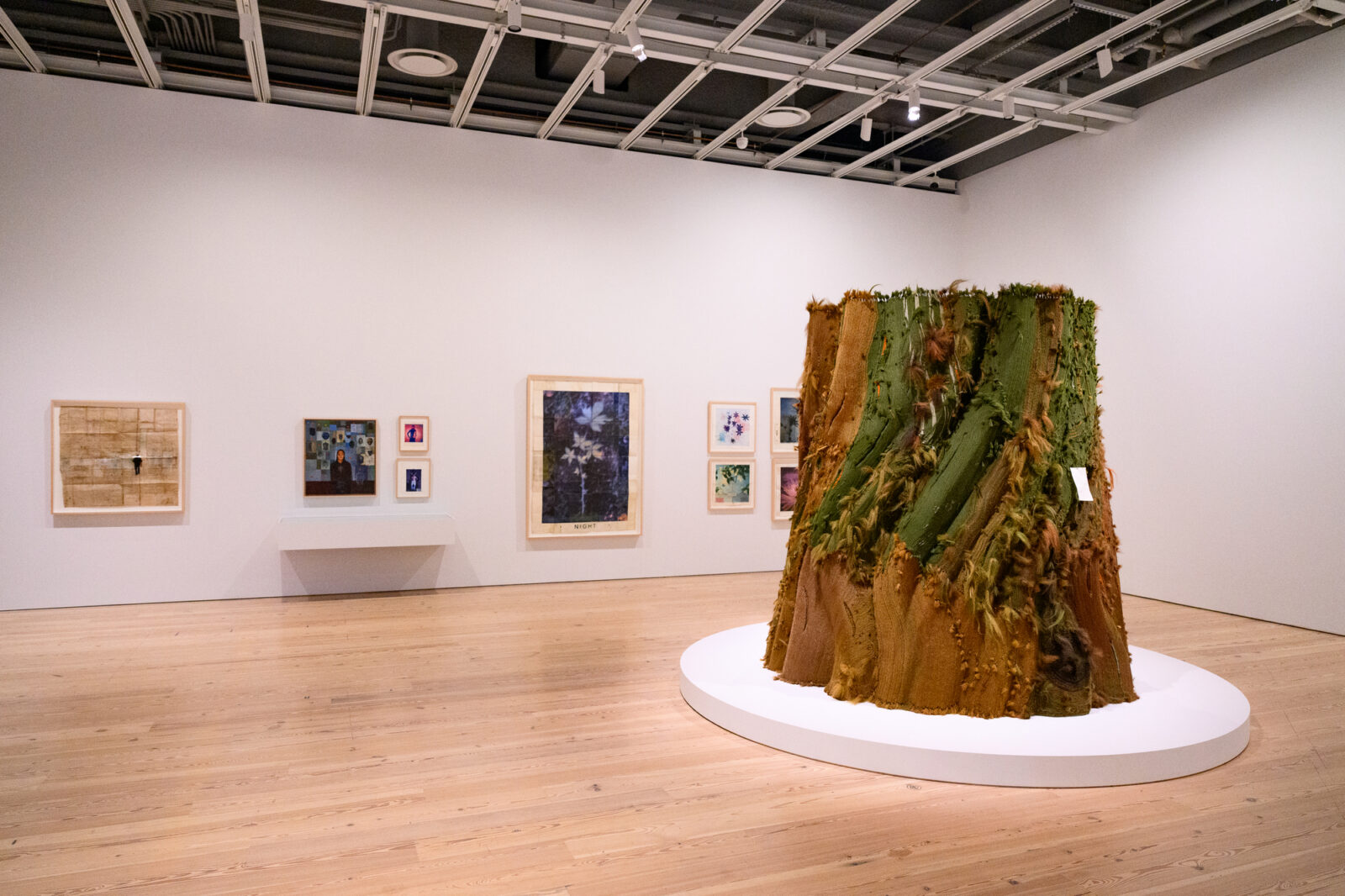
The installation makes this difficult to see. The photograph measures three and a half by five inches and hangs on the sixth floor near Malcolm Peacock’s tree-trunk sculpture, wrapped in thousands of hand-braided strands. The pairing is legible: hair and wood, bodily relation to organic material. But legibility here belongs to the arrangement rather than to either object. Peacock’s sculpture is monumental and Metchewais’s photograph fits in two hands, and the eye that has just crossed the one arrives at the other already told what to find. This is the partage at work, deciding in advance what will be visible and at what scale it will register. Metchewais is one of only two deceased artists in the show, the other being Maceda, and that fact does its work before the photograph does.
To attend to how glass is blown through an animal trap, or how a paper bag becomes a portrait of urban wildlife, or how a fifty-year-old Filipino radio broadcast rematerializes through tape decks in a Manhattan museum, is not to retreat from politics. It is to insist that the material and infrastructural conditions through which art is made are themselves political, and that relation becomes legible only when it is given formal work to do.
But the same standard has to apply to the exhibition. A Biennial is not a neutral container for the works it assembles. It is an arrangement of bodies, spaces, and times, which is to say a partage, and it can be read formally as they can. Read that way, the 2026 Biennial distributes attention through adjacency. Works are set beside one another so that a shared material—hair and wood, glass and iron—produces the impression of a connection, and the wall text names the category the pairing illustrates. Adjacency is a weak form. It generates resemblance rather than relation, and it costs the works nothing, since neither object is altered by the encounter. Set this against Bermúdez-Silverman, where the glass cannot be removed from the trap without destroying both. That is what a relation looks like when it is load bearing, and almost nothing in the exhibition’s own organization is load bearing in this way.
The show’s strongest moments occur inside single works: the cord stretched between Gossiaux’s two floating figures, the hiss of Onda’s tape decks, the trap holding Bermúdez-Silverman’s glass. In each, one maker has control over the whole arrangement. Relation is not a theme to be curated but a practice that has to be built, and the Biennial demonstrates this most clearly where it has delegated the building to someone else.
: :
Endnotes
- See Sianne Ngai, Our Aesthetic Categories: Zany, Cute, Interesting (Harvard University Press, 2012).
- Jacques Rancière, Aesthetics and Its Discontents, trans. Steven Corcoran (Polity, 2009), esp. “Problems and Transformations in Critical Art,” on the political claims made for relational art. On partage as both sharing-out and division, see The Politics of Aesthetics: The Distribution of the Sensible, trans. Gabriel Rockhill (Continuum, 2004); the double sense is clearer in the French, Le Partage du sensible: Esthétique et politique (La Fabrique, 2000). The curatorial vocabulary at issue descends from Nicolas Bourriaud, Relational Aesthetics, trans. Simon Pleasance and Fronza Woods (Les Presses du réel, 2002).
Evelyn Hanyue Qin