
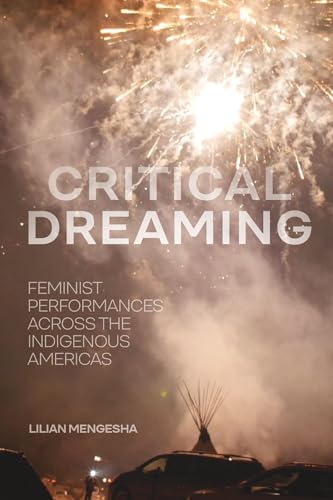
In December 2015, at the close of Acting Out: A Symposium of Indigenous Performance Art in Santa Fe, Anishinaabe artist Rebecca Belmore appeared as a projected face wearing a paper “Indian Brave” mask bought at a UK dollar store. Asking spectators to put on matching masks, she ventriloquized the first-person words of nineteenth-century Native leaders, detailing the theft of their land, calling “brother” to a steel guitarist whose twang answered each address as the somber auditorium filled with warnings of imminent settler destruction. It is with this scene from Belmore’s Theatre of the Brave (2015) that Lilian Mengesha opens Critical Dreaming: Feminist Performances across the Indigenous Americas (NYU Press, 2025). It anchors the book’s central wager of how performance stages historical accountability as an embodied, collective reckoning with colonial inheritance, summoning its audience into kinship across difference rather than recognition of likeness.
Critical Dreaming is a hemispheric project responding to a particular political conjuncture—among others, the 1990s convergence of NAFTA, the Violence Against Women Act, the unfinished afterlives of US and Canadian residential schools, the 1990 Oka Crisis, the Guatemalan civil war’s feminicidio, and the resulting surge of missing and murdered Indigenous women that stretches from the US-Mexico border through Guatemala City to Vancouver. What binds this geographically dispersed violence into a single frame is Mengesha’s central methodological intervention: the preposition across. To read performance across rather than in the Americas is to center “horizontality and coalition” (18), letting works speak not from settler-Indigenous relation but through Indigenous-to-Indigenous context. Reading across thus foregrounds a shared colonial past and an Indigenous intimacy that spans the hemisphere while refusing to dissolve the specificities of place, nation, and racialized difference.
For Mengesha, critical dreaming names “a social and collective exercise in decolonial practice” (3)—a theorization of alternative forms of accountability that draws on global Indigenous practices of ritual that recognize various understandings of temporality and animacy, rather than relying on Eurocentric humanism and land-return legalism through which decolonial studies has too often proceeded. Drawing centrally on Tanana Athabascan scholar Dian Million’s theorization of “intense dreaming” as a “communicative sacred activity,” Mengesha positions dreaming neither as metaphor nor as escapist phantasm but as a minoritarian aesthetic strategy.1 To dream critically, in her account, is to apprehend “the residues of historical violence wrought by colonialism in the Americas” (4) and to insist, against linear progress and against the demand that one’s pain be only one’s own to bear, on a collective capacity for accountability that binds the living to the disappeared across both time and territory.
If dreaming is the book’s method, the body is its medium. Across Mengesha’s case studies, the body emerges as an intangible and recursive site, central at once to feminist performance and to Indigenous epistemology. It is a porous architecture of grief that refuses to be attached to any fixed appearance or motion, the surface across which Mengesha apprehends irreconcilable ecologies of affect and transmissions of sensation. Indigenous flesh registers, otherwise, where gendered and racialized comportment have been targeted by settler and colonial violence. Dreaming for Mengesha, as a decelerated practice of embodied historiography that sits in between storied bodies and storied lands, aesthetically and politically subverts the rigidity of colonial modernity.
Chapter One, “Evading Capture, Slowing Down,” develops an approach to decolonial deceleration through paired readings of Oji-Cree choreographer Lara Kramer’s NGS: Native Girl Syndrome (2013) and Guatemalan performance artist Regina José Galindo’s No Perdemos Nada con Nacer (2000). The female body in plastic—Kramer’s dancers collapsing among urban refuse, a photograph of Galindo sedated in a body bag at the municipal dump—emerges across both works as a porous architecture of grief: not the wounded interiority of trauma-as-redemptive-arc, but a fleshly endurance that absorbs and slows the durational violence of the residential school and the feminicidio. Drawing on “the genealogy of decelerating body to reckon with the swift devastation of colonization” (51), Mengesha attends to slowness and the durational decomposition of grief as an embodied endurance that breaks “progress, communicability, and uniformity” in the nonlinearity and messiness of the performances. Critical dreaming here names the disordered status in which Indigenous bodies hold the circulative, accumulative, and accelerative loops of colonial and capitalist ravaging open. What Kramer and Galindo stage in their decelerated and arrested aesthetics is not catharsis but a saturated endurance that holds intergenerational pain open against the closures of either state reconciliation or the demand for trauma’s redemptive arc.
Chapter Two, “Fugitive Formations in Megaphones and Mounds,” turns to land as a sentient body and medium of more-than-human kinship. Mengesha opens the chapter with an analysis of Rebecca Belmore’s Ayum-ee-aawach Oomama-mowan: Speaking to Their Mother (1991), a seven-foot birchbark megaphone created in the wake of the Oka Crisis and the Canadian state’s armed siege of Kanien’kehá:ka land protectors. Connecting with Cree scholar Greg Young-Ing’s idea of “remember when,” this chapter reiterates earth as elder, survivor, and creation’s warrior.2 She pairs it with Side Show Freaks and Circus Injuns, Choctaw poet LeAnne Howe and Guna/Rappahannock playwright Monique Mojica’s collaboration developed through embodied research at seven-thousand-year-old earthwork mounds, whose layered density and accretive history become a method for performing the land as text. Through these works, Mengesha uplifts fugitivity to swing on the contrast—“forms of sensorial engagement that circumvent settler structures of recognition through the summoning of a loop—a loop of reciprocity dependent on sensation” (78). Drawing on Stó:lō scholar Dylan Robinson’s “sensate sovereignty” and Édouard Glissant’s poetics of relation, Mengesha turns to a sonic fugitivity that enacts indiscernibly sensuous transmissions across Indigenous kinship to land—“how reciprocity with the land embodies a particular form of flight, a suspension of beginnings and endings, a form of never-ending transit” (81)—holding homeland not as fixed origin but as the ongoing labor of being “consistently in the midst of building” (112).3
Chapters Three and Four turn to the body itself as an inscriptive surface and an archive of ancestral memory. Chapter Three, “Inscribing Visions, Ancestral Skins,” pairs Belmore’s Vigil (2002)—her elegy for the murdered women of Vancouver’s Downtown Eastside and the Highway of Tears—with Galindo’s PERRA (2005), opening with the Inuit skin-stitching practices of Holly Mititquq Nordlum and Melissa Shaginoff at Knowledge of Wounds(2020). Mengesha unbinds the constitutive flesh systems from the body’s meaning-making, responding to feminist methodology through the invocation of transitional sensuousness on skin as “a container of history, and genealogies of writing on the body” (121) that “operates with and alongside violent histories as well as kin-making ones” (117).
It is here that Mengesha stages her sharpest polemical break with the field: against Kathy O’Dell’s Contract with the Skin and the broader Amelia Jones / Rebecca Schneider tradition that has read women’s self-injury through a psychoanalytic grammar of repression and desire. Mengesha, following Frantz Fanon, insists on the prior fact of the “racial epidermal schema” that conditions how Indigenous and Brown flesh enters the frame in the first place; masochism, here, is not the secret of these performances but the misrecognition that performance studies has too readily imposed upon them.4 Reading the cut, the ink, and the scar through Hortense Spillers, Amber Jamilla Musser, Alexander G. Weheliye, Saidiya Hartman, and Tiffany Lethabo King on the flesh, and through a transpacific genealogy of tattooing in Albert Wendt and Juniper Ellis, Mengesha figures skin as a politicized permanence through which kinship with women no longer in this realm is reinvigorated.5
Chapter Four, “Alchemies of Accountability,” extends the logic of inscription outward from the body to the wooden post and the nail. It is anchored by Belmore’s six-hour durational One Thousand One Hundred & Eighty One (2014), in which she hammered 1,181 nails—the state-reported count of missing and murdered Indigenous women—into a wooden surface outside Toronto’s Justina M. Barnicke Gallery. The chapter places the hammer in transnational dialogue with the hypothetical Construction imagined by Chanel Miller in Know My Name (2019) and with Kongolese Nkisi Nkondi figures. Mengesha rewrites the “sensuous accumulation of bodily violation” (145) through collective memory and invocation. Mobilizing Katherine McKittrick’s “mathematics of Black life,” she names this an alchemy: a transmutation that turns grievance into public promise, where the puncturing hand, the exhausted body, and the surface that holds the nail become a task of evidence, exposure, and public witness.6 Mengesha’s leap from performance to everydayness—“a space to revel in participatory forms of ceremony that seek collective accountability and transformation” (174)—redirects accountability toward the collectivity and temporal continuity born of shared skin and kinship with land.
The book’s conclusion turns to Ho-Chunk filmmaker Sky Hopinka’s Dislocation Blues (2017) and the 2016 pan-Indigenous gathering at the Oceti Sakowin camp at Standing Rock. It is where the resource-extraction violence that has been the beating pulse of every case study—the Dakota Access Pipeline, the residential schools, the maquiladora belt, the Highway of Tears—gives way to a tableau of two-spirit camp life, drumming, water protection, and the commitment to “something bigger than oneself” voiced by Cleo Keahna over Hopinka’s slow shots of grass, sunrise, and the swaying tepees of Sacred Stone Camp. Critical dreaming here shows itself as collective dreaming: not the inward turn of the inscribed body alone but the embodied practice of land back, in which dreaming binds Indigenous, queer, and trans kinship into a present-tense world-building that the settler camera, trained on clashing forces and tear gas, has consistently failed to see.
Critical Dreaming makes its sharpest intervention not by inaugurating anticolonial critique within feminist performance studies—a project with its own thick and ongoing lineage running through Diana Taylor, Rebecca Schneider, Jill Carter, Julie Burelle, and Stephanie Nohelani Teves—but by reorganizing that conversation along two axes the field has only begun to inhabit.7 The first is methodological: where comparative and transnational frames have tended to route Indigenous performance through the settler-Indigenous relation, Mengesha’s “across” stages Indigenous-to-Indigenous copresence as the primary commitment, letting Anishinaabe, Cree, Choctaw, Oji-Cree, Ho-Chunk, and Guna/Rappahannock practices in Canada and the United States speak alongside Maya and ladina practices in Guatemala without subordinating any to a single national or colonial referent. The second is polemical: Mengesha’s sustained departure from the psychoanalytic vocabularies of repression, desire, and masochism through which performance studies has long read women’s self-injury reframes as misrecognition what an earlier generation of scholarship took for theoretical insight. It is critical dreaming that positions dreaming not as escapist phantasm or utopian futurity but as a fleshly, decelerated practice of being attached in the in-betweenness of storied bodies and storied lands.
The questions Critical Dreaming opens for future scholarship are therefore less about extending Mengesha’s framework outward than about testing where its conceptual seams meet other terrains: how the “across” might travel beyond the hemispheric Americas to the transpacific, transatlantic, and circumpolar Indigenous worlds Mengesha gestures toward; how critical dreaming’s quarrel with the psychoanalytic body might extend into adjacent registers of embodied minoritarian practice, where the racial epidermal schema and the wounded interior have likewise been mistaken for each other; and how Mengesha’s alchemical reframing of accountability, located here at the seam of Black and Indigenous studies, might intervene in the broader impasse between punitive and transformative justice that performance studies has tended to approach from a distance. These are the lines along which a hemispheric, fugitive, dreaming feminist performance studies might yet be built in the company Mengesha has so generatively gathered.
: :
Endnotes
- Dian Million, “Intense Dreaming: Theories, Narratives, and Our Search for Home,” American Indian Quarterly 35, no. 3 (Summer 2011): 315, quoted in Mengesha, Critical Dreaming, 13. Minoritarian aesthetic strategy is drawn from José Esteban Muñoz, Disidentifications: Queers of Color and the Performance of Politics (Minneapolis: University of Minnesota Press, 1999).
- It is worth to highlight that the Indigenous materiality that the birchbark carries punctuates its own valence in the work itself. In Mengesha’s words, “the significance of birchbark as the medium through which an intensive network of beings, such as terrestrial elements, plants, animals, and humans, could meet on waterways, in a meal, or in ceremony, evokes the historical vitality and malleability of the material.” (91)
- On “sensate sovereignty,” see Dylan Robinson, Hungry Listening: Resonant Theory for Indigenous Sound Studies (Minneapolis: University of Minnesota Press, 2020), 24-25. On the poetics of relation, see Édouard Glissant, Poetics of Relation, trans. Betsy Wing (Ann Arbor: University of Michigan Press, 1997).
- Kathy O’Dell, Contract with the Skin: Masochism, Performance Art, and the 1970s (Minneapolis: University of Minnesota Press, 1998); Amelia Jones, Body Art/Performing the Subject (Minneapolis: University of Minnesota Press, 1998); Rebecca Schneider, The Explicit Body in Performance (London: Routledge, 1997); Frantz Fanon, Black Skin, White Masks, trans. Charles Lam Markmann (London: Pluto Press, 1986), 112.
- On the Africana genealogy of flesh, see Hortense Spillers, “Mama’s Baby, Papa’s Maybe: An American Grammar Book,” Diacritics 17, no. 2 (1987): 65–81; Alexander G. Weheliye, Habeas Viscus: Racializing Assemblages, Biopolitics, and Black Feminist Theories of the Human (Durham, NC: Duke University Press, 2014); and Amber Jamilla Musser, Sensational Flesh: Race, Power, and Masochism(New York: New York University Press, 2014). On the related Black/Native and subjection traditions Mengesha engages alongside this genealogy, see also Saidiya V. Hartman, Scenes of Subjection: Terror, Slavery, and Self-Making in Nineteenth-Century America (Oxford: Oxford University Press, 1997); and Tiffany Lethabo King, The Black Shoals: Offshore Formations of Black and Native Studies (Durham, NC: Duke University Press, 2019).
- Katherine McKittrick, “Mathematics Black Life,” The Black Scholar 44, no. 2 (Summer 2014): 16.
- On this lineage, see Diana Taylor, The Archive and the Repertoire: Performing Cultural Memory in the Americas (Durham, NC: Duke University Press, 2003); Rebecca Schneider, The Explicit Body in Performance (London: Routledge, 1997); Jill Carter, “Discarding Sympathy, Disrupting Catharsis: The Mortification of Indigenous Flesh as Survivance-Intervention,” Theatre Journal 67, no. 3 (2015): 413–32; Julie Burelle, Encounters on Contested Lands: Indigenous Performances of Sovereignty and Nationhood in Quebec (Evanston, IL: Northwestern University Press, 2018); and Stephanie Nohelani Teves, Defiant Indigeneity: The Politics of Hawaiian Performance(Chapel Hill: University of North Carolina Press, 2018).

Chengbao Seong-Bo Jin