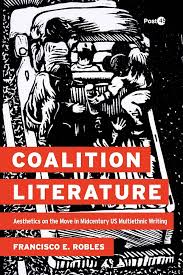
Coalition Literature offers a future for art that expresses and inspires effective protest, drawing on twentieth-century leftist power. Francisco Robles’s book is an illuminating literary history of multiethnic America, confronting questions in the contemporary US landscape around identity politics, representation, and the scope of political organizing. As far as the eclectic works encompassed in the book cohere, their canon, which Robles names an “alternative midcentury American modernism,” is defined by lyrical experimentation and multivocality. Such experimentation is “distinctly political in its coalition character” and “reimagine[s] proletarian engagements with literary and institutional history” (10).
The author especially makes a case for the Popular Front’s enduring form of radical democracy. The chapters mostly move chronologically, starting in 1935, the heyday of the Popular Front, and ending in 1981. For instance, Chapter Two engages with the historical zenith of the Front, unpacking its racist roots and prohibitively nationalistic purview through the lens of US farming. It is a testament to the intuitive structure of the book that, two chapters later, we return to agrarian labor, this time in midcentury migrant literature. As a result of its timespan, Coalition Literature inevitably positions itself as a successor to Michael Denning’s 1996 The Cultural Front : The Laboring of American Culture in the Twentieth-Century (Verso, 1996). It takes and runs with Denning’s contention that the Popular Front was a structure of feeling that outlived its epochal truncation at the outbreak of the Second World War. Denning’s centering of what he terms “plebeian artists” casts a widespread influence on histories of the postwar multiethnic US, which Robles recognizes (8). Other descendants of Denning have also made it their mission to project the ethos of the Popular Front onto political activity of the midcentury, such as historical analyses of Black radicalism by James Smethurst and Mary Helen Washington.1
Although many of these descendants acknowledge the aesthetics of political movements and the political heft of artistic movements, Robles is distinct in his rigorous interrogation of literary forms. He even goes as far as to carve out and name a new genre of midcentury Chicanx fiction, the migrant pizcaresque, as enshrined by Carlos Bulosan and Tomás Rivera (162). In this way, he has more in common with Sarah Ehlers’s 2019 book, Left of Poetry (University of North Carolina Press, 2020), about the Depression-era US. But Robles also perceives a key discrepancy between his and Ehlers’s conceptualizations, as they both engage with Muriel Rukeyser, but through different metaphors. He contrasts his theory of representational strategy (speaking with) to Ehlers’s of alloy, favoring “relation” over the “combination or synthesis” of registers and voices (71). This distinction articulates one of the book’s deepest contours, which opposes the liberal, melting-pot vision of multiculturalism (not to suggest that Ehlers endorses it) and insists on coalition as an alternative. Coalitional thinking, in turn, expresses itself through polyvocal literary forms.
The central aesthetic that Robles diagnoses in the texts at hand is one of speaking with. He defines this “shifting set of styles, tones, and positions” (6) as an ethic opposed to multiculturalism—which, he pronounces, speaks to instead of with (12), or nominates representatives to speak for a particular group (74). For Robles, the tenets of speaking with are: maintaining and recognizing difference across minoritized subjects; pushing the boundaries of author, text, and reader, through polyphony or collectivized subjectivity; and imagining and reimagining futures of coalition. Speaking with rethinks political and artistic authority as a structural concept (32). It is found in polyphony, or multivocality, which allows for flexible and generative approaches to cultural encounter, as Robles argues of Zora Neale Hurston and Muriel Rukeyser in Chapter One; and eschews essentializing or totalizing accounts of minoritization, as picked up in Chapter Five. By breaking down text, author, and reader, speaking with imagines new forms of communal engagement (116). Robles evokes the lyric “we” as another example of this framework, identified this time in race- and class-based political poetry of the 1960s (122).
In his explorations of solidarity among minorities, Robles is closely indebted to Édouard Glissant’s ideas about relation as well as José Esteban Muñoz’s notion of the brown commons.2 Speaking with also outlines Robles’s critical method. Comparison, for him, is not unidirectional, nor is it constrained to chronology, and it transcends genre, reaching across novels, poetry, and songs (Chapter Two discusses Woody Guthrie alongside author Sanora Babb). Just as genres can neither be mapped onto one another nor allegorized, neither can ethnic and other minority groups; they can only speak with each other (4). This concept offers scholars a vocabulary for thinking beyond representational politics without abandoning attention to difference, which is bound to serve as a productive resource in ethnic studies going forward.
Robles’s timeline traces a “scalar shift” from the Popular Front’s “transnational inflected labor politics” to multiculturalism’s “goals of institutional inclusion prioritized by [ . . . the] politics of representation” (3), treating This Bridge Called My Back (1981) as a connecting thread between coalitional and multicultural aesthetic modes, and as a pivotal work in the US academy after 1968. By taking the position against institutional multiculturalism, Robles engages in long-standing debates around representation as an organizational logic in ethnic literature. In terms of Latinx literary criticism, he follows Ricardo Ortiz, who puts identity and literary form in a mutually constitutive, continuous process of becoming;3 and Ralph Rodriguez, who militates against expectations that Latinx texts should represent a particular political reality.4 In its embrace of anachronism and transhistorical connection, this book is reminiscent of Ortiz, as well as of Raúl Coronado’s A World Not To Come (Harvard University Press, 2016) and Renee Hudson’s more recent Latinx Revolutionary Horizons (Fordham University Press, 2024), both of which view latinidad through complex, non-linear temporalities. As for Robles’s reaching back to the Popular Front for these inflections, Marcial González and Carlos Gallego identify a tradition of 1930s proletarian literature to which contemporary US Latinx literature is indebted in terms of its commitment to issues of class.5
In his critique of identity politics, the author bridges midcentury artistic output and contemporary Marxist theoretical concerns around the literary propensity to resist neoliberalism, the emergence of which dovetails with his period. From this angle, his book is in conversation with Mitchum Huehls and Rachel Greenwald Smith’s Neoliberalism and Contemporary Literary Culture (Johns Hopkins University Press, 2017), González and Gallego’s Dialectical Imaginaries (University of Michigan Press, 2019), as well as with theorists of contemporary poetry like Chris Nealon’s The Matter of Capital : Poetry and Crisis in the American Century (Harvard University Press, 2011). In the coda, Robles’s censure of multiculturalism, as well as of similarly disingenuous concepts like intersectionality and postcoloniality, lends itself to a feeling of nostalgia for the Popular Front, to a fear that coalitional days are behind us for good. A last-minute maneuver sees him point to the futuristic capacity in his midcentury findings. He celebrates the successes of ACT UP and the Movement for Black Lives, attributing them to their affinity groups’ coordinated responses (229) and transnationalism (230) respectively. It requires courage and originality to revisit foundational paradigms like Robles does, especially at a time when radical leftist solutions may seem out of reach. This can only attest to the book’s intellectual confidence and commitment to imagining new political futures.
: :
Endnotes
- See James Smethurst, Behold the Land the Black Arts Movement in the South (University of North Carolina Press, 2021); Mary Helen Washington, The Other Blacklist : The African American Literary and Cultural Left of the 1950s (Columbia University Press, 2014).
- See Édouard Glissant, Poetics of Relation (University of Michigan Press, 1997); José Esteban Muñoz, The Sense of Brown (Duke University Press, 2020).
- Ricardo Ortiz, Latinx Literature Now: Between Evanescence and Event (Springer, 2019).
- Ralph Rodriguez, Latinx Literature Unbound: Undoing Ethnic Expectation (Fordham University Press, 2018).
- Marcial González and Carlos Gallego, Dialectical Imaginaries : Materialist Approaches to US Latino/a Literature in the Age of Neoliberalism (University of Michigan Press, 2019), 8-9.
Grace Tierney