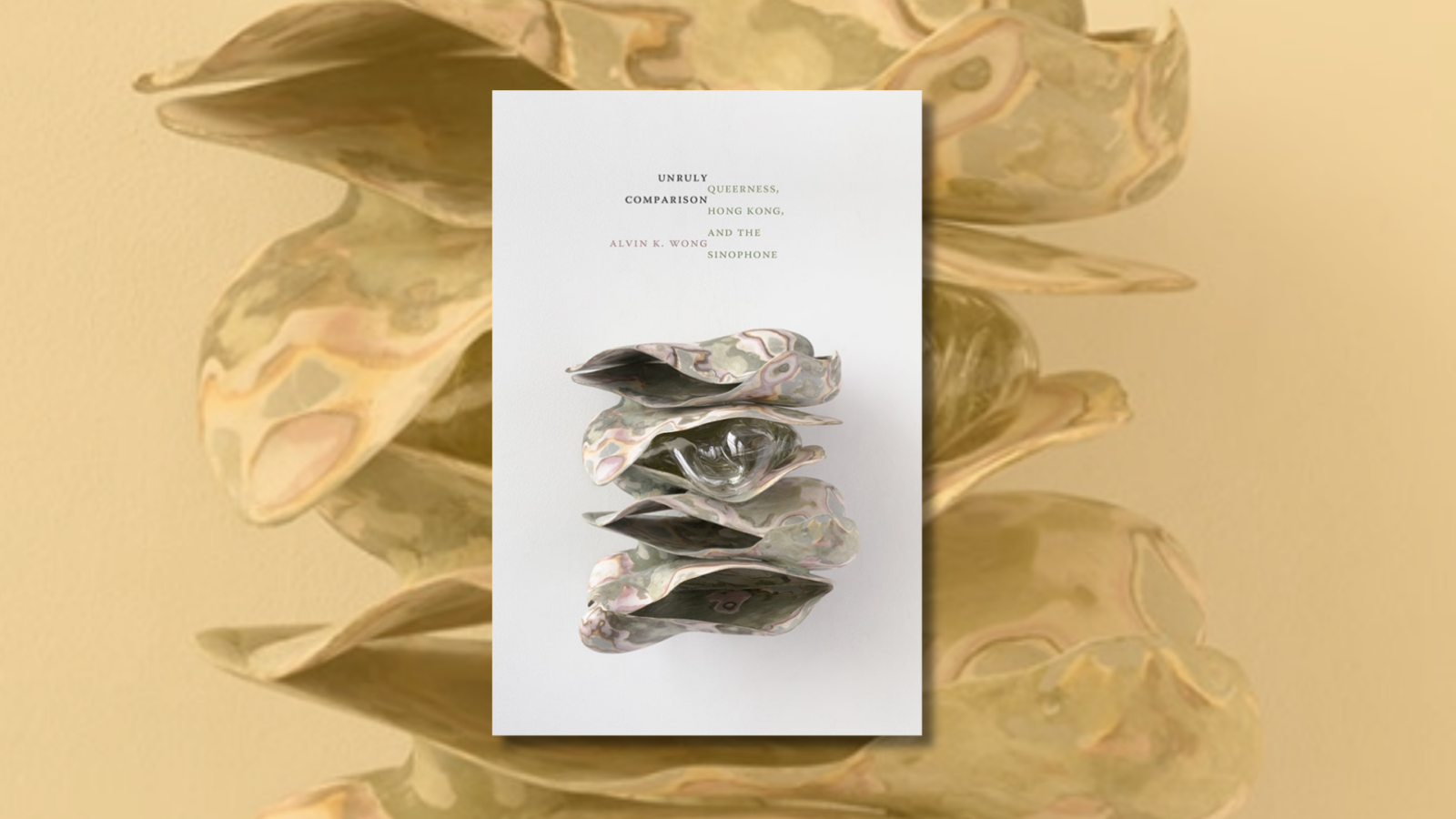
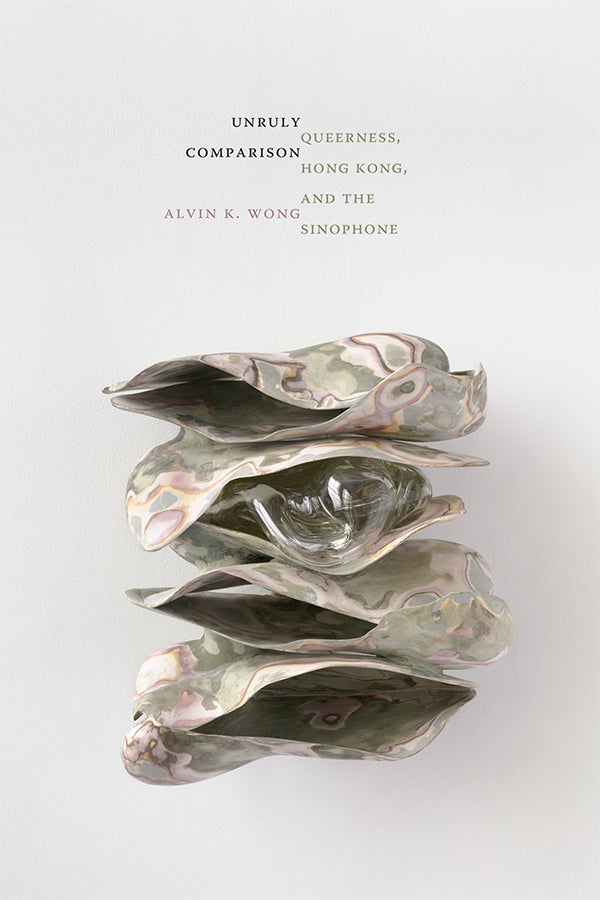
The tension between the global and the local has long been a productive site of debates within queer studies. Transnational queer scholarship in recent years has largely moved away from “including” Asia for globalization of queer theory, and instead seriously interrogated how queer knowledge is co-produced through Asian politics, histories, aesthetics, and community organizing. Alvin K. Wong’s new book Unruly Comparison: Queerness, Hong Kong, and the Sinophone asks us to grapple with why and how queer theory needs Hong Kong (and vice versa). By examining Hong Kong literature, cinema, visual art, and social movement between the 1990s and 2020s, Wong reckons with how queer theory, archives, desires, and representations are entangled with empire and globalization in, and in relation to, Hong Kong. His capacious network of objects of study as well as his nuanced focus on regionalism offer an exciting unruly transnationality to the field of queer Asian studies.
While Hong Kong is often reduced to a middleman of the United Kingdom, China, and global finance, Wong asks his readers to dwell in its “asymmetrical relationality” that refuses the totalizing epistemologies of colonialism, nationalism, and late capitalism. In a tender and compelling voice, Wong begins the book by situating Hong Kong in the context of the 2019 anti-extradition bill protest that created conditions for new political alliances across racialized, gendered, and classed subjects, in particular, the formation of solidarity between South Asian minorities and LGBT celebrities at Chungking Mansions in Tsim Sha Tsui. He tends to the art exhibition Unruly Visions curated by Tse Ka-Man in 2021 (echoing Gayatri Gopinath’s monograph of the same name), visualizing legacies of social unrest in post-2020 Hong Kong that do not smoothly assimilate into restoration of capitalism and order.1 This exhibition’s visual disorientation introduces and grounds Wong’s theoretical contribution of “unruly comparison,” a method that “intersects queerness, Hong Kong, and the Sinophone through friction, asymmetry, and perverse juxtaposition” (8).
This book is in conversation with works such as Gayatri Gopinath’s Unruly Visions, Anjali Arondekar’s For the Record, and Lily Wong’s Transpacific Attachments that intervene in the trafficking of non-Western regional specificity as raw materials for the making of Eurocentric feminist and queer studies.2 Alvin K. Wong builds upon inter-Asian cultural theorist Kuan-Hsing Chen’s Asia as Method to compare racialized and gendered subjects, archives, desires, and aesthetics on both transregional and transnational scales without fetishizing the West or Han Chinese-ness as the default.3 Rather than reproducing a non-Western alterity, the book conjures a perverse relationality between Hong Kong and the rest of the world, including Southeast Asia, Mainland China, Taiwan, the UK, and Israel/Palestine, gesturing towards a much more fluid and dynamic understanding of South-South relation beyond relying on nation-states as the basis for comparison. Wong’s text addresses the urgent need to tether disparate geographic locations and disciplinary practices in order to address the multiply positioned queer, feminist, and anticolonial struggles of the world. The model of “unruly comparison” builds on the works of Shu-mei Shih, Lily Wong, Brian Bernards, E.K. Tan, and many others who have shaped the collective of Sinophone studies, as well as scholarship in women of color feminism and queer of color critique from Rodrick Ferguson, Lisa Lowe, and Grace Kyungwon Hong.4 Wong skillfully reframes the debate between queer Chinese studies and queer Sinophone studies by building on the former’s “[deconstruction] of Chineseness both spatially and temporally” and the latter’s “critique of the presumed hierarchies between an ‘original’ China and its lesser ‘Sinophone’ copies” (14). He forestalls the desire to turn to Chineseness or any other non-Western area for the sake of countering queer theory’s Euro-American liberalism and gestures towards Hong Kong as an immense site of incommensurable local differences and global intimacies.
These unruly historical and aesthetic analyses, Wong argues, on the one hand, refuse to subsume seemingly insignificant sites like Hong Kong into totalizing narratives of global empires, and on the other, refuse to flatten out the differences of race, class, and citizenship within Hong Kong. The subsequent chapters are not only oriented by cultural analysis of a wide range of case studies including novels, films, documentaries, art exhibitions, and poetry, but also a set of theoretical concerns from Sinophone studies and queer theory that undo confines of time and space. Whereas conventional discipline configurations such as area studies and comparative literature can sediment normative understandings of history (as linear and male-centered) and place (as bounded by national borders), Wong examines much understudied sites of knowledge, including lesbian erotic archives, post-1997 Hong Kong cinema, transgender legal rights and visuality, migrant workers’ labor activism, and sex workers’ border crossing. Chapter 1 assembles a queer archive that comprises lesbian factory workers in 1960s in Wong Bik-wan’s novel Portraits of Martyred Women, self-combed women from Shunde in Jacob Cheung’s film Intimates, and examples of homoerotic interracial desire during WWII in Ma Ka Fai’s novel Once Upon a Time in Hong Kong. Building upon Muñozian utopian strand of queer of color critique, Wong challenges dominant historiography of Hong Kong by illuminating minor gestures, affects, and desires that exceed the binds of masculinist narratives of historicism. Wong also highlights the unevenness of queer modernity by illuminating how Hong Kong as a site of contradictions nuances queer theory’s critique of US-centered liberalism.
Chapter 2 takes us to post-1990 Hong Kong cinema that expresses “dystopian, rhizomatic and multidirectional mode of queerness” beyond revolving around China and Chineseness (42). In the chapter, Wong Kar-wai’s Happy Together, filmed in the shadow of the handover, follows queer Hong Kong exile in Argentina; Scud’s bromance movies Permanent Residence and Amphetamine expose that the queer capitalist subject’s erotic mobility is complicit in financial development, sexual exploitation, and settler colonialism in Israel/Palestine; Mak Yan Yan’s film Butterfly, based on Taiwanese writer Chen Xue’s novella, inserts and remembers a Hong Kong lesbian political history. Wong theorizes queer nonrelationality as a visuality framework to unsettle the obsession with China-centrism in Hong Kong cinema and to embed the Sinophone in an expansive, minor-to-minor transnational network of desires. Chapter 3 unfolds a legal analysis of LGBT and transgender rights as well as cinematic representations of transness in Hong Kong. By reading Jun Li’s film Tracey along with Maisy Suen’s film A Woman Is a Woman, Wong examines the conditions of “queer globalities”—the globalizing tendencies of queer rights, representations, and industries articulated anew through Asian regionalism. Wong refuses translatability as a presupposition in the transnationality of transness by considering how a subject like Tracey, closeted in a heteronormative household, does not follow the globalizing current of Euro-American trans rights movement but takes cues from cultural and aesthetic lineage of Cantonese opera to constitute emergent feminization and trans subjectivity.
Chapter 4 and 5 weave in differently racialized and classed border-crossing subjects from migrant domestic workers to sex workers. Chapter 4 expands queer Sinophone cinema towards documentary activist films as an emergent genre. Wong first analyzes how Southeast Asian migrant domestic helpers have been problematically represented always as a heterosexual, maternal, and caretaking subject for the Han Taiwanese or Hong Kong family. Then, he tends to documentary films wherein queer sexual intimacies and labor activism are co-constitutive, from Susan Chen’s Lesbian Factory and its sequel Rainbow Popcorn to Baby Ruth Villarama’s Sunday Beauty Queen. Wong entangles post-Cold War Taiwan and Hong Kong not only in their enactment of citizenship hierarchy, domestic labor, and racial abjection, but also in the modes of resistance, solidarity, and queer kinship among migrant workers. Chapter 5 engages with the representation of the figure of the sex worker in Fruit Chan’s “prostitute trilogy”, revealing the porousness of the Sinophone border between Hong Kong and the Mainland. Durian Durian’s juxtaposition of sex scenes with unglamorous depictions of waiting and boredom grants viewers access to the more unpleasant conditions of labor without reproducing a sensationalizing gaze. Hollywood Hong Kong’s attention on the cosmopolitan sex worker’s flexible citizenship queers the borders of Mainland China, Hong Kong, and Los Angeles that attempted to contain her. In Three Husbands, the female protagonist, depicted through uncanny interspecies embodiment, negotiates power dynamics between her three husbands, symbolizing mediation of Hong Kong from British colonialism, Chinese nationalism, and global capitalism. Wong attends to how Chan’s films provoke a multidirectional critique of mobility, power, and assumption of the border of Chineseness.
What feels simultaneously heartbreaking and liberating in Alvin K. Wong’s expansive theoretical analysis is the evidence of his deep love and grief for Hong Kong in the afterlife of the 2019-2020 protests. His conclusion tends towards a post-2020 atmosphere of nihilism, disorientation, and unbelonging in Hong Kong by comparing Jun Li’s film Drifting and UK-based Eric Yip’s poetry “Fricatives.” As artists in Hong Kong and those in diaspora continue to adapt and grapple with its unresolving legacies of colonial and inter-imperial modernities, Wong articulates a necessity to “unknow” Hong Kong, even as its local identity, for many, becomes ever important to preserve and perhaps even to strategically essentialize in the face of strengthened nationalist control. Unknowing Hong Kong—as Wong’s book does—enacts a refusal to fall into totalizing narratives of capitalism, nationalism, and colonialism as the unquestioned grammars of knowledge. Instead, unknowing allows readers to engage with unruly archives and aesthetics without losing sight of what could have been. To unknow also suggests a space for alternative knowledge formations, particularly queer, anti-colonial, and anti-imperial struggles with and of the world—and their radical possibilities that already dwell within Hong Kong. Wong’s insistence on the unknowability of Hong Kong, echoing with recent discussions of opacity, inscrutability, and refusal in visual, cultural, and performance studies, enables us the capacity to dream strategies and ways of life without being caught up in cycles of cruel optimism. I wonder, what happens after a reader “unknows” Hong Kong? How might speculative aesthetics motivate and mobilize us towards realizing queer Sinophone world(s) after empires?
: :
Endnotes
- Gayatri Gopinath, Unruly Visions: Aesthetic Practices of Queer Diaspora (Durham, NC: Duke University Press, 2018).
- Anjali Arondekar, For the Record: On Sexuality and the Colonial Archive in India (Durham, NC: Duke University Press, 2009); Lily Wong, Transpacific Attachments: Sex Work, Media Networks, and Affective Histories of Chineseness (Columbia University Press, 2018).
- Kuan-Hsing Chen, Asia as Method: Towards Deimperialization (Durham, NC: Duke University Press, 2010).
- Sinophone studies, as Shu-mei Shih defines, is “the study of Sinitic-language cultures on the margins of geopolitical nation-states and their hegemonic productions.” See: Shu-mei Shih, “The Concept of the Sinophone,” PMLA 126, no. 3 (2011): 709-718.
Wenxuan Xue