“Yves Saint Laurent and Photography”
June 11, 2026 – Sep 28, 2026
International Center of Photography (ICP)
How best to present the dialogue between fashion and photography? Each medium depends on the other—for material, for inspiration, for documentation. An exhibition that opened this summer at the International Center of Photography (ICP) in collaboration with Musée Yves Saint Laurent explores that mutual imbrication through the case study of Yves Saint Laurent, one of the most photographed couturiers of all time.1 Photography preserves, interprets, and ultimately gives afterlives to the fashion designer’s evolving career.
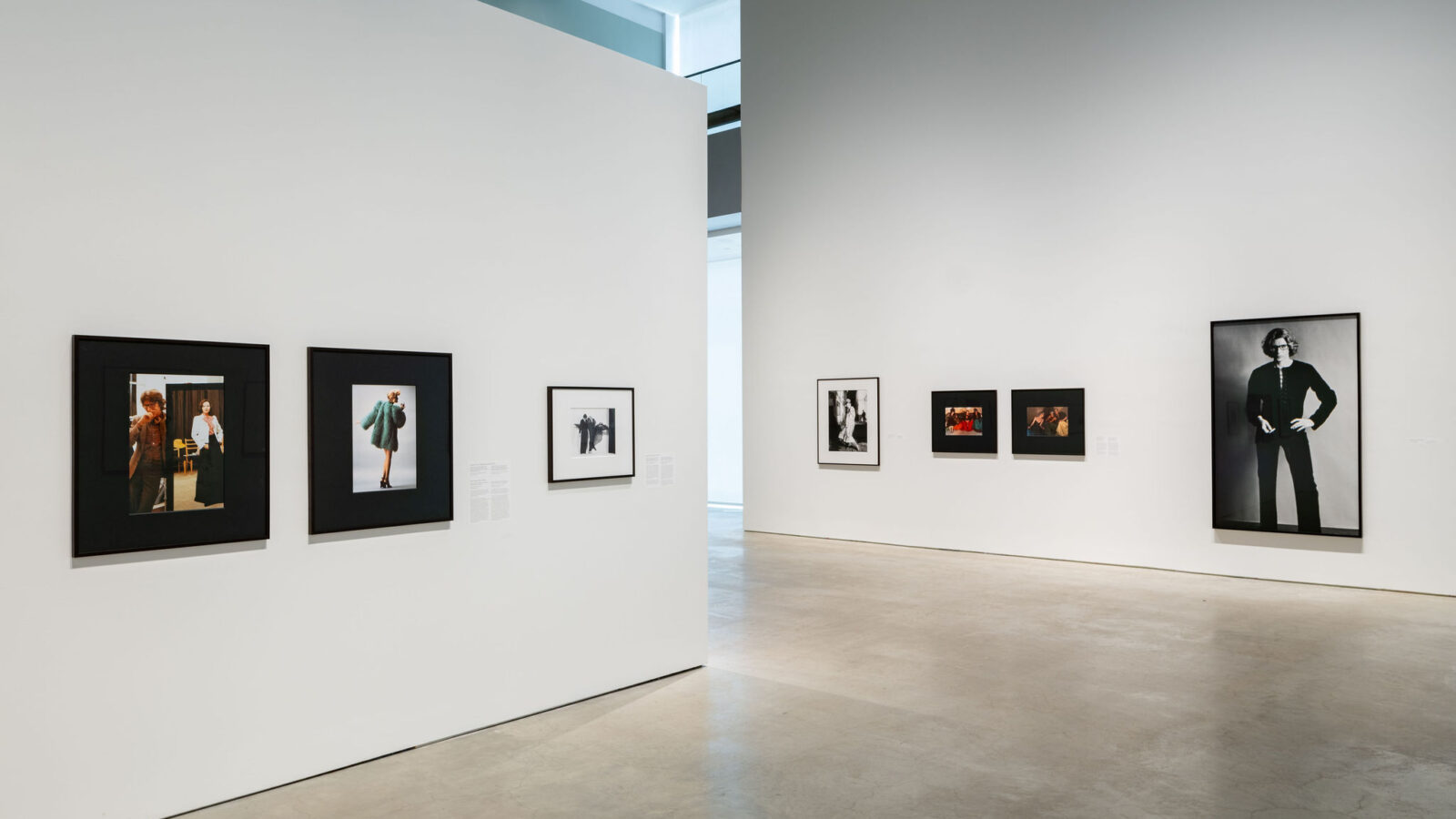
The exhibition unfolds in two parts: it starts with the presentation of matted and framed images of Yves Saint Laurent and his creations and then leads us to a space where around 200 magazine pages, contact sheets, campaign catalogs, press clippings, and archival objects come together to recount the history of his fashion label. Adopting the familiar language of the white cube, the first room invites the audience to encounter photographs as autonomous works of art. By contrast, the second room, with ephemera in vitrines and images spread across the wall space, asks us to consider the documentary quality of photographs. This dialectic between autonomous artwork and supporting document runs throughout the shows and, indeed, throughout the history of these relatively young mediums.
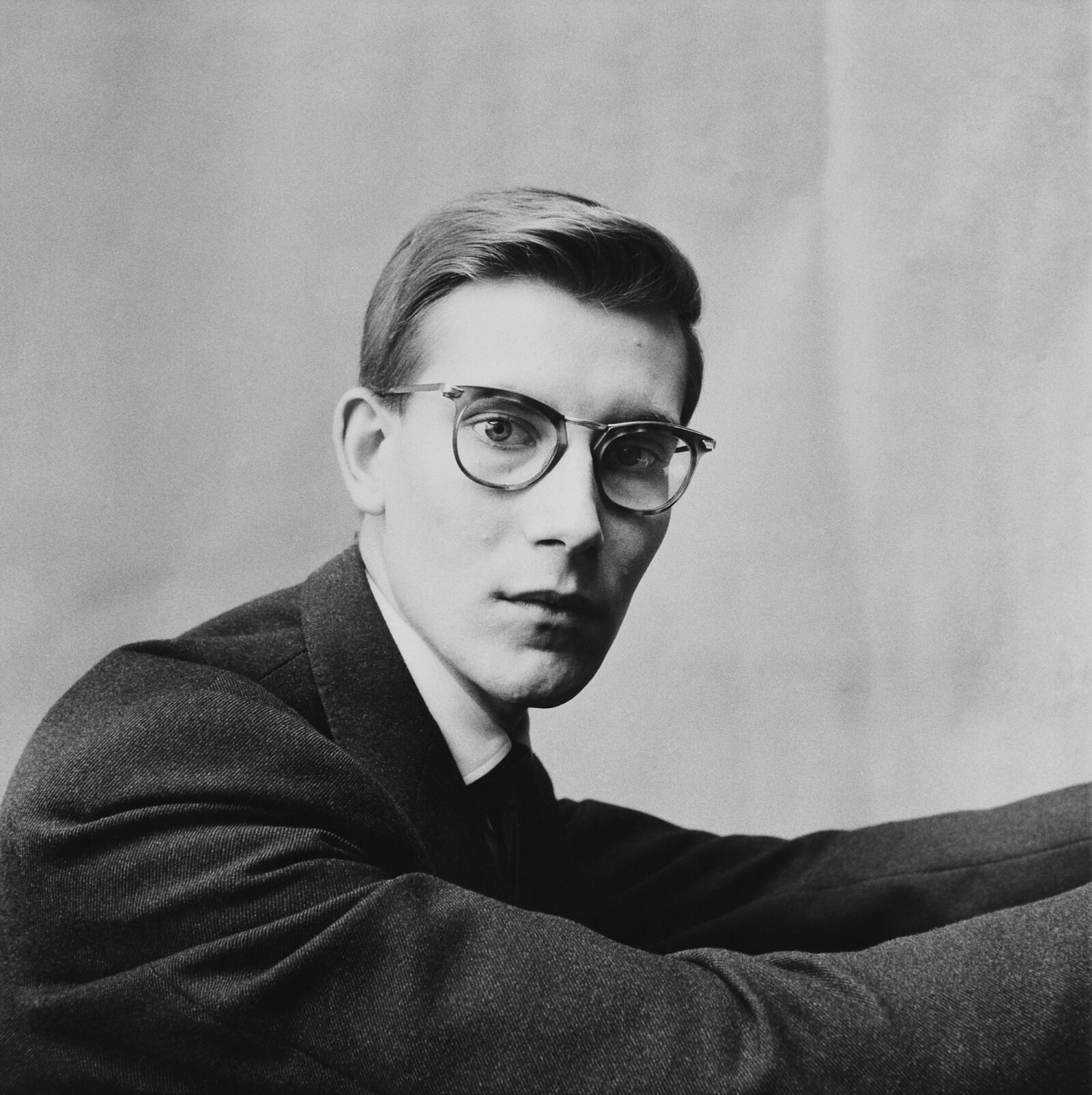
In the first room, portraits of Yves Saint Laurent exceed the traditional conception of portraiture: many of them seem less concerned with Saint Laurent as a sitter, and more with him as an object susceptible to the creative manipulation of photography. In Irving Penn’s 1957 portrait shot for Vogue Paris, Saint Laurent poses against a simple backdrop at the photographer’s studio. Using a wide-angle lens and playing meticulously with proportions and light, Saint Laurent’s left eye recedes into the shadow in the seemingly simple image, and his right eye becomes the irreducible focal point. Placing Saint Laurent’s head at the center of the image, with his shoulders abstracted, his hands extended beyond the frame, and a soft eye that refuses to look away, Penn constructs an austere and haunting neutrality.
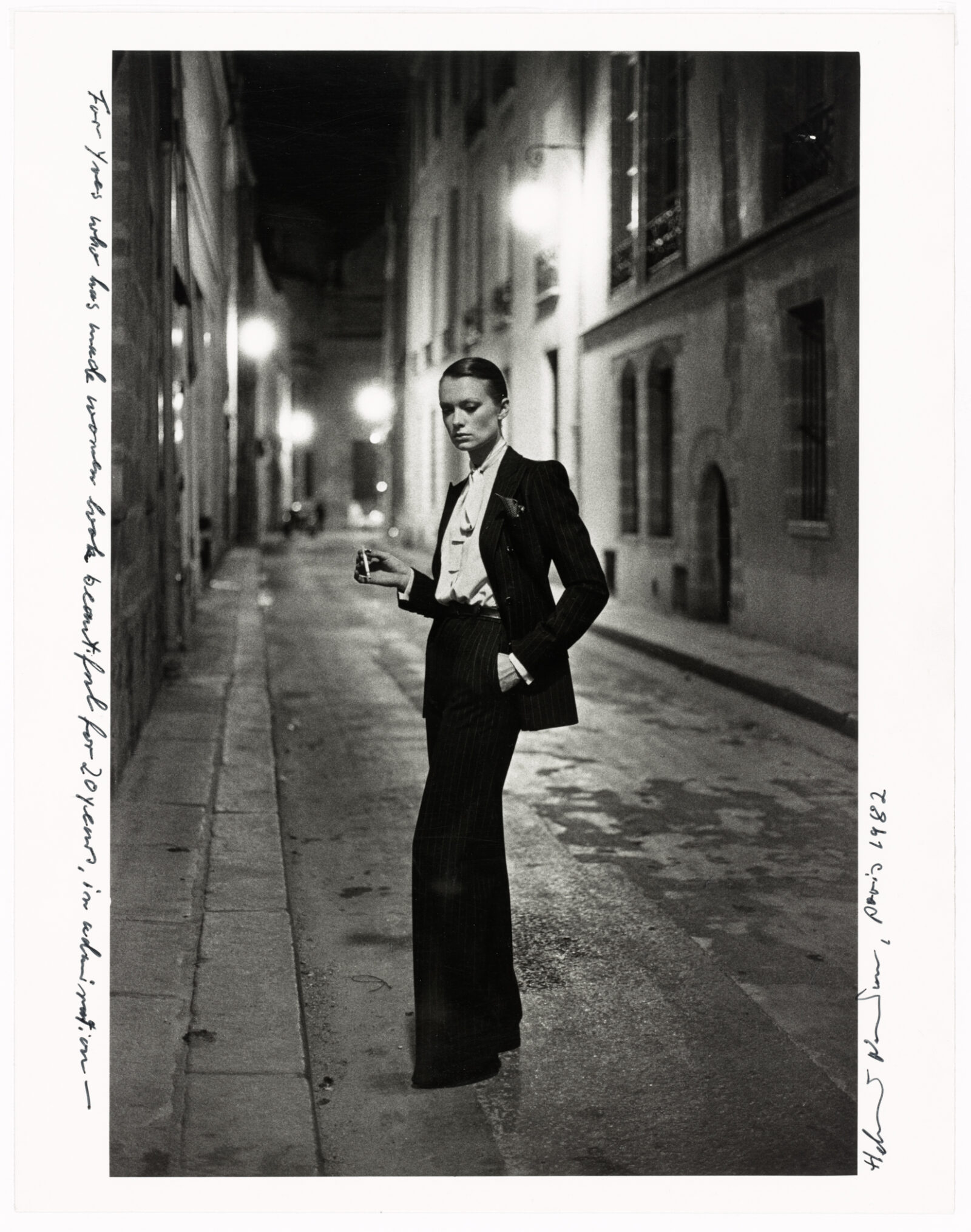
If Irving Penn interpreted the man, Helmut Newton translated the clothes. In his iconic 1975 portrayal of Vibeke Knudsen in Saint Laurent’s tuxedo, Newton sets a cinematic stage, skillfully heightening the gender tension of Saint Laurent’s revolutionary creation. In the image, Knudsen’s figure appears slender and elongated, yet the visual language refuses to claim her as fully feminine. Composed and relaxed, cigarette in hand, with a soft gaze directed onto the street, Knudsen’s posture projects a quiet sense of confidence. Her left hand draws our attention to the pocket: a garment detail that is traditionally privileged in menswear. In one of the defining images of both Helmut Newton’s and Yves Saint Laurent’s careers, fashion and photography become inseparable in their collaborative play with gender.
In an accompanying image, Newton places another female figure behind Knudsen. With her head tilted slightly downward, her body turned towards Knudsen, and her hand gently resting on Knudsen’s right arm, a sense of trust and intimacy emerges between the two figures. In nude, the new figure appears fully vulnerable—yet her vulnerability seems shielded by Knudsen in the tuxedo. Neat gender stereotypes do not apply in this scene of trust, support, safety, strength, and partnership. And this is the legacy of photography for Yves Saint Laurent: when we remember his subversive gender plays today, we are less likely to think of the tuxedo in isolation and more likely to remember the entire scene in which the tuxedo is immortalized. In this way, photography becomes our memory of fashion.
: :
As we approach the second part of the exhibition, the atmosphere shifts. Photographs now escape mats and frames, instead making it onto magazine pages, press clippings, campaign catalogs, Polaroids, contact sheets, and everything else. Against the dark green wall, arranged in the style of a visual montage, the photographs in this room engage in an intimate conversation with each other, assuming a diverse range of roles in relation to fashion. Although contact sheets, for instance, appear small, serial, and provisional, often depicting the same subject in similar poses, they also, to Saint Laurent’s eye, document subtle but significant differences. From the persistent marking on these contact sheets, we witness Yves Saint Laurent’s creative process: the careful selection through which his creations assume their photographic identity. Here, photography becomes a tool that aids Saint Laurent’s fashion practice. He is able to find the precise moments where his fashion speaks, only through a conversation with photography.
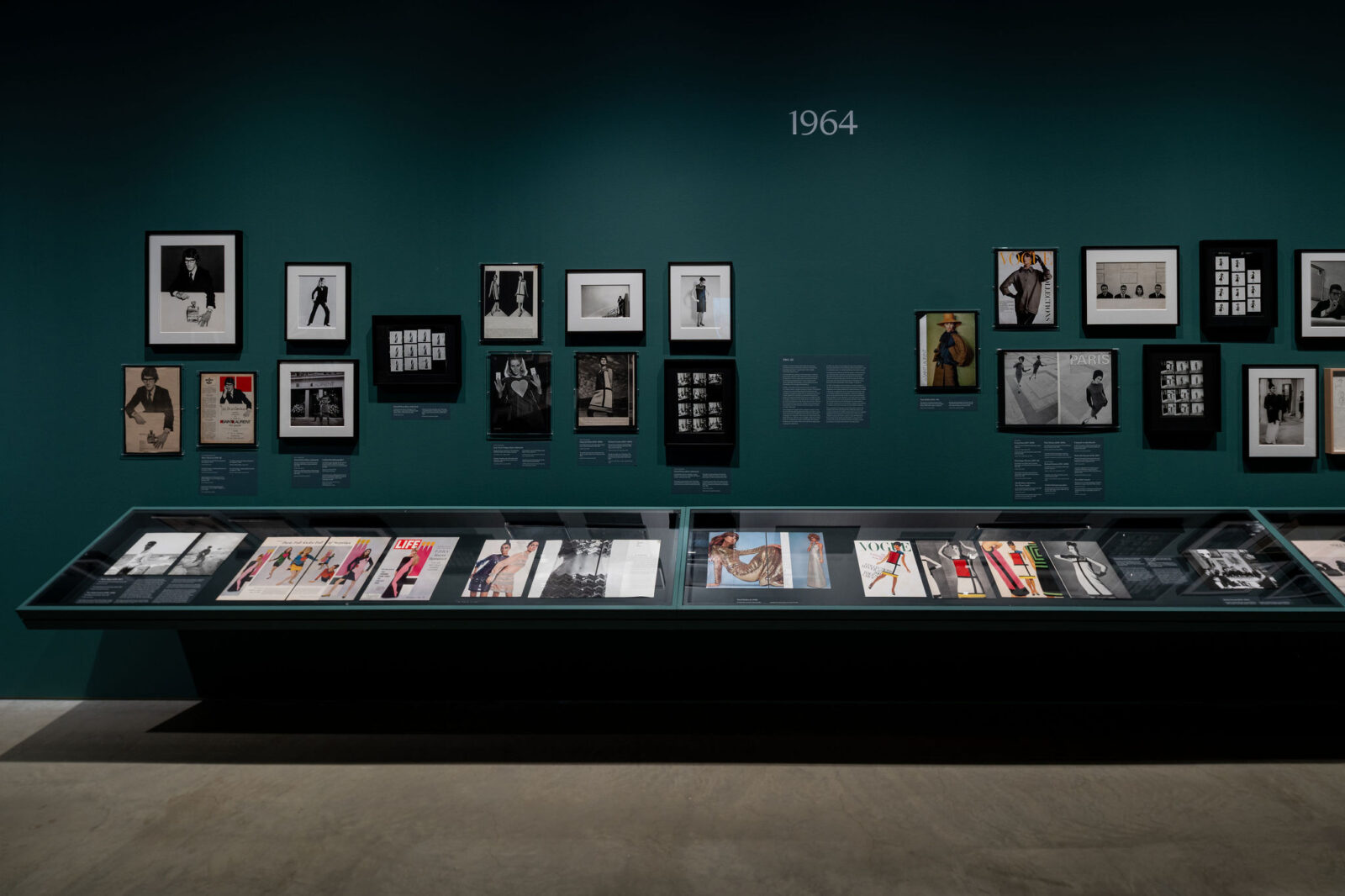
Nowhere is this conversation between fashion and photography more apparent than on the pages of magazines. In the September 1965 issue of Harper’s Bazaar UK, Saint Laurent’s iconic Mondrian dress, photographed by Richard Avedon, appears with the text “Dress of tomorrow.” In the photo, Jean Shrimpton stands against a cloud-filled, otherworldly sky. Shot from a low vantage point, with Shrimpton’s gaze up and away from the camera, her figure appears to be statuesque. The monumentality of the composition—together with the bold stripes of the Mondrian dress, the minimalist head dress, and the otherworldly nature of the setting—projects the vision of modernity and utopia, of “tomorrow.” Still, at the end of the caption, the text doesn’t forget to include a site where the dress can be found—and bought, today. “At Bergdorf Goodman”: as utopian, perhaps intangible, as this photograph makes it feel, fashion is, in fact, within reach.
Perhaps this tension between utopia and consumerism is a double of the dialectic between photography as artistic collaborator of fashion and photography as silent record of fashion. But the exhibition “Yves Saint Laurent and Photography” ultimately suggests photography can become the medium through which fashion takes on its meaning, memory, and cultural life. The history of fashion is not only written in fabrics, but also in images. Fashion and photography indeed need each other—much like how tomorrow might need today, as static as it might seem.
: :
Endnotes
- Introductory wall text, “Yves Saint Laurent and Photography,” International Center of Photography, New York, NY, Jun 11, 2026 – Sep 28, 2026.

Rong Wang