
At one point in Gangsterism, Isiah Medina’s 2025 experimental feature film, the protagonist, filmmaker Clem, confronts the comrade he suspects of unauthorized online leaks of his film. The respondent, seemingly the only white character in the film, rebuts “but aren’t you a communist?”
By this point we’ve seen the filmmaker and his allies talk frankly and at length about their troubles raising money for Clem’s new film. Across numerous sequences of philosophical musings, the characters speculate on cinema, language, and art as a life’s project. Their reflections are often peppered by acerbic jabs against the establishment rhetoric of card-carrying film bros, self-exoticizing ethnic minorities, and mass market apologists alike. Yet their conversation remains deeply, unusually rarefied. References to film history and political theory are dropped quickly and casually—gravity of thought with an unprecious delivery. As the film progresses, its sequence of events is less palpable than its dialogic scenery—unabashedly heady and proclamatory.
Underneath a work in which seriousness and commitment permeate the overall tonal register and the characters’ spoken dialogue, irony keeps coming back in Gangsterism. Or rather, it surges in, like the waves of quick cuts that visually unsettle the narrative suture of any of its segments. The academic, theoretical tenor of much of the manifesto-like dialogue is heavy, then suddenly it is light: quick flashes of other landscapes or other characters infiltrate the scene. Sometimes these cuts extend to the work’s sonic architecture, with intermittent mutes superposed over an intense exchange, or sudden cessations of a quirky, ebullient score.
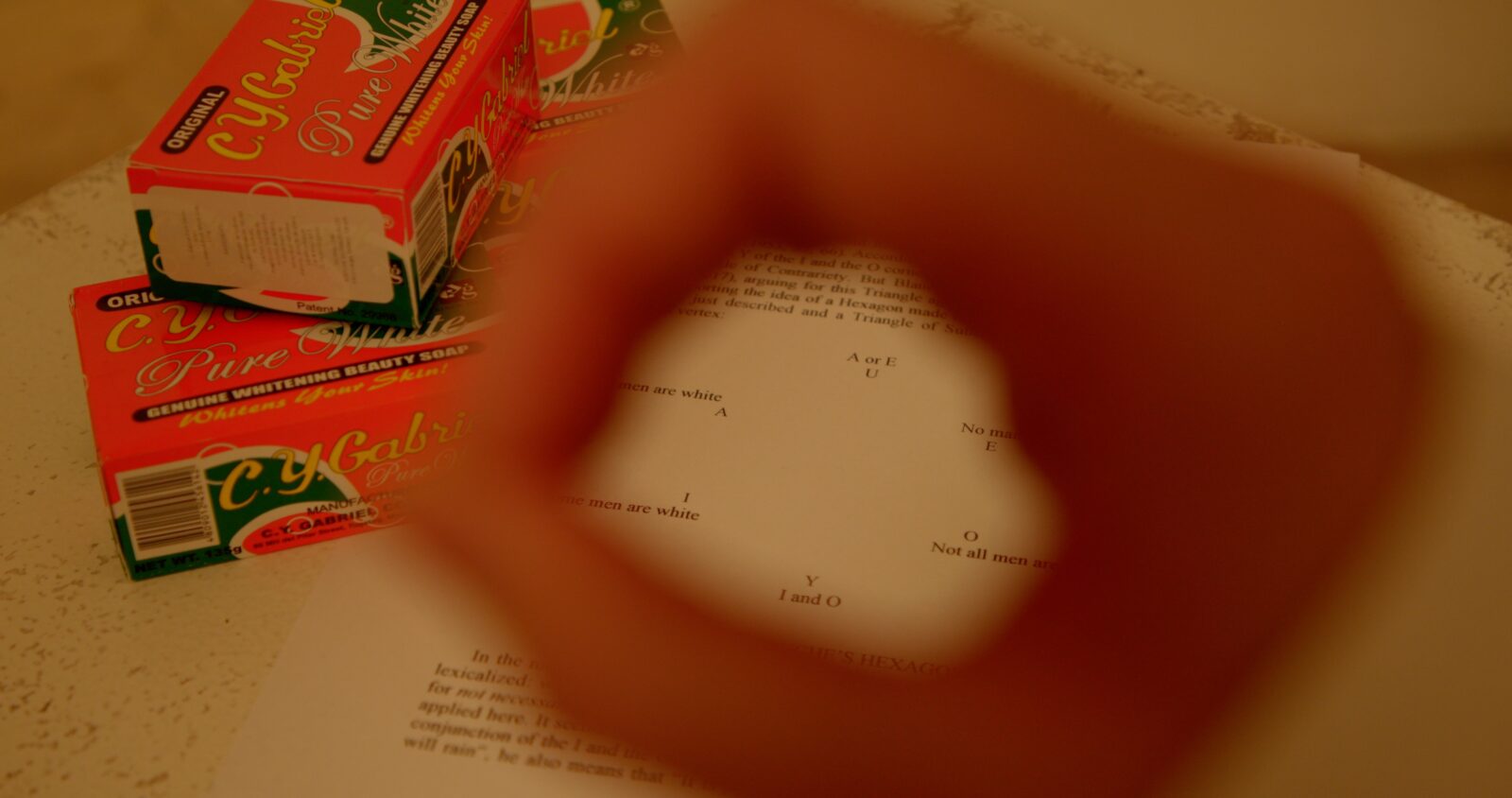
Fig. 2: Film still from Gangsterism (dir. Isiah Medina, 2025).
Gangsterism constantly averts any pat resolution into totality—occasionally, scenes echo themselves in secondary, dual shots; characters repeat their lines or the audio doubles them. At one point Clem remarks: “We are the thing that philosophers desire to know. We have to defend ourselves against their dialectics . . . ” and shortly after: “sublation’s a colonial trap . . . I can’t let the outside sublate me.” Amid the regal tenor of the film’s oration, and the characters’ collective denial of plot’s processual form in favor of the punctum’s declarative mode, Medina remains uncannily open to forfeiting the sovereign position.
Irony, it would seem, is the subtle underdrawing of the work—underdrawing being a sub-painterly gesture that remains through its erasure, constitutive through its continual displacement. Gangsterism seems held together through a willingness to let everything go, to self-assert and self-efface in the same breath. Various loose threads of performance (those crystalline lines delivered like throwaways) that will not be metabolized by the narrative of the film are taken up formally in the work’s radical montages. These scripted moments refuse to be transmitted through surrogacy into a new substrate—the king is dead, long live the king!—and refuse the cause and effect of evental plot.1
Tracking what still hovers at the level of narrative, the protagonist filmmaker’s struggle with money is explained and explored through ironic scenarios. A room full of Asian jurists assessing the Filipino Clem’s grant application plainly tell him he hasn’t properly fulfilled the terms of anti-colonial critique, or otherwise accuse him of false consciousness. This all comes after opening sequences in which Clem has, also, bemoaned the overwhelming whiteness of much of the industry he is received by. One figure in the jury-crowd tells him to consider his audience. Pervasive misalignments with groups whom Clem would, on the surface, seem aligned with—film connoisseurs, theory initiates, postcolonial thinkers—keep reinforcing the core, romantic irony of the film. Clem is a character to whom nothing is sacred—but who all the same remains obsessively, undyingly devoted to specific tenets of cinema and of thought.
As the film’s art-movement-like title hints, Gangsterism offers a screen test for a lived spirit of collective study that refuses monarchies of legitimacy. It’s an exercise in how to create an artistic work that’s willing to unravel itself while retaining a posture of ideological intensity. What would it mean to assert the authority of a novel school of thought, to insist on the possibility of conviction, without becoming a new institution of one’s own?—while, on the contrary, holding the cut, the friction, the practical failure, right at the center of the work?
At another point in the film, Clem says to another character: “I won’t repress what you repress—I think that’s the real function of friendship.” Insofar as the sudden cutting and disassembly of its scenes architects the film’s form from its frames’ edges, in Gangsterism, resolution is repression—and it is constantly refused. Tracking shots (or any kind of movement in the camera frame) are exceedingly rare—more often we’re given quick flickers and afterimages that careen between scenes, betraying moments that feel like the film’s subconscious. If Clem’s nemesis is the Hegelian with his dialectical sublation, his ally is the philosophical ironist, more towards the literary figure of Friedrich Schlegel. Schlegel’s writings speak of the fragment’s capacity to illuminate the whole—not a closed whole of completeness, but a “chaotic universality” of infinitely opposing states.2
In the film, Clem’s new project cannot be funded because its critical audiences do not find the movie reflecting themselves back to themselves in any organizing categories of social value. The form of the “leak” (introduced through the plot’s inciting incident, a leak of digital film material online) is fundamental to Clem’s tragic relationship to the value form and to community. (And Gangsterism is resolutely a work about community, even where it plays at an echo-chamber chamber play). The ironic futility of Clem’s fundraising efforts charts how easily his critical dislocations of race, class, and nation politically neutralize each other, dissolving in a morass rather than resolving in synthesis. Implicitly, the ideological answer to Clem’s dilemma is not, say, intersectionality, but rather the cut’s foreclosure of a closed present. The cut creates an unstable relationship to time and continuity that allows Gangsterism to be ambitious in its characters’ relationship to their own possible futures. It allows for excess, for a revolutionary expansion of the common time of events, and the forceful discomposure of idealism’s peaceful dreaming.
: :
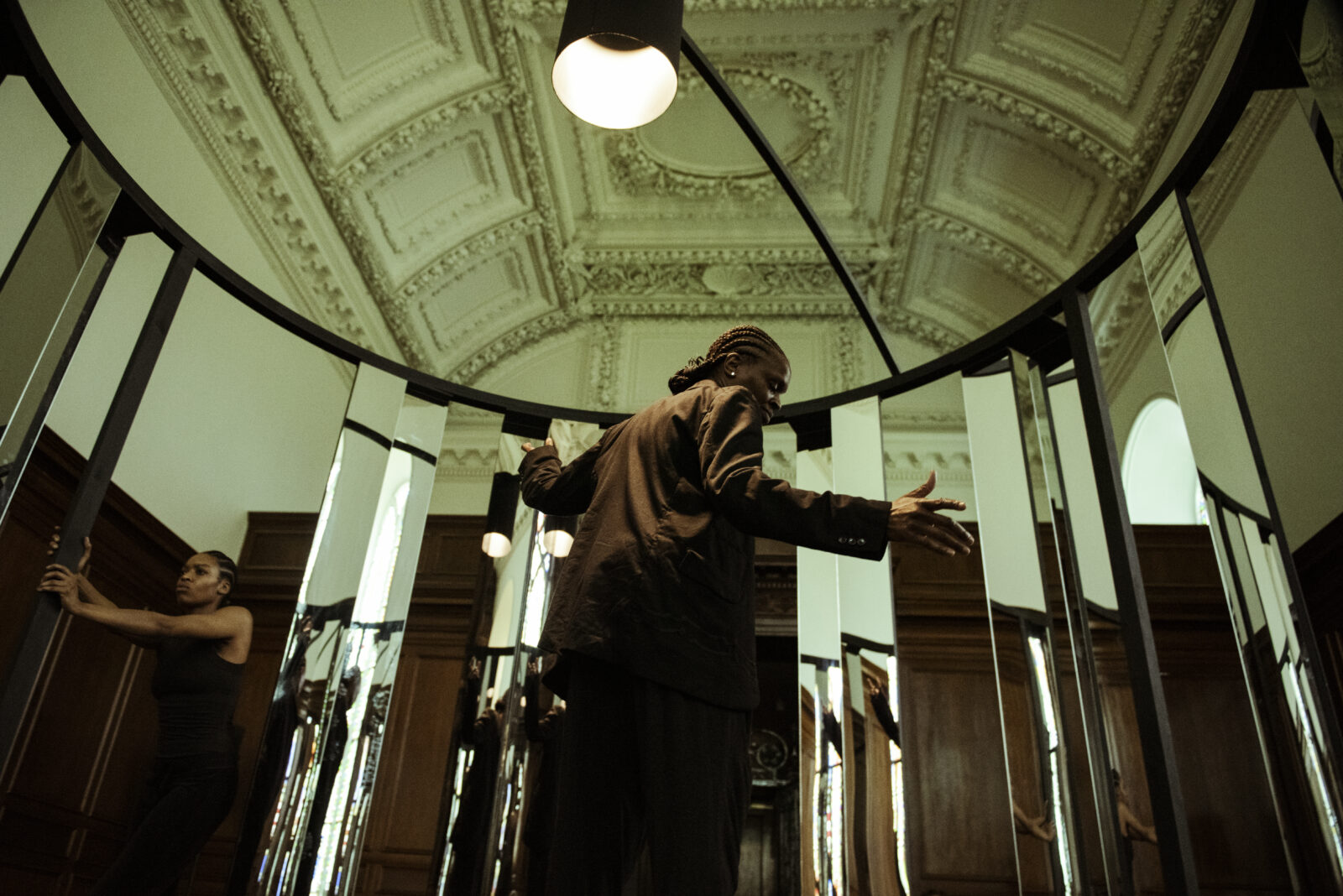
Fig. 5: sweat variant, my tongue is a blade, with Bria Bacon (left) Okwui Okpokwasili (center). Photo by Luca Truffarelli.
It was only some weeks after seeing my tongue is a blade by sweat variant (Okwui Okpokwasili and Peter Born) outdoors on Governor’s Island in New York City that I thought of the confines of the set as being like a caged enclosure. The thought came to me in a deeply subjective manner—not as a spectator, but in my memory as if from the first person of a performer, consciously at a delay to my experience in the audience. By comparison I thought of The Couple in the Cage, the darkly ironic work by Coco Fusco and Guillermo Gómez-Peña in which the pair had play-acted the dehumanized, “savage” subject of the othering ethnographic gaze. As this untimely symbolism came to mind, I felt almost embarrassed, perplexed to conjure this debasing imagery alongside the sweat variant performance, in which the dancers had seemed to freely control the terms of their exhibition. Indeed, throughout the durational three-hour work, the performers slowly turn the rotating exterior of my tongue is a blade’s cylindrical stage. The exterior surface of this structure is all mirrors on both sides and is punctured by numerous cuts, apparently two or three feet wide on average. The dancers, all black female-identified performers, carry out this rotational task with steady purpose—unhurried but also unvaried, without slack.
Why convene an audience to witness a willful self-enclosure? my tongue is a blade was a work that remained deeply intimate and embodied, but kept us/them (in my reflection, me/the ones watching me) at a distance. Reflecting more on my subjective affinity with the dancers, I was conscious of that uncanny somatic memory of violation when the optics of hypervisibility collide with the ideological shroud rendering black personhood perpetually unwitnessed. Yet I quickly abandoned this line of reflection. Yes, this work sketches a scene of subjection, but loosely—and it’s too easy to read it through accumulated codes of black abjection.
my tongue is a blade is choreography conjugated with a performance of looking—between the audience and the dancers, between the dancers and each other. Where irony took Medina’s Gangsterism to the North Pole of icy seriousness, my tongue is a blade effaces territories of enslavement in favor of self-fashioned histories of warm, controlled transmission: what Diana Taylor might call a repertoire of acts of transfer, a repository of survival tactics.3 Passions remembered in the body, unrequited unions longed for through a lingering sensitivity on the skin.
Contact in my tongue is a blade is profuse during duets that alternate with successive solos: a performer who’s been dancing alone is joined by another in a co-conjuring of the other’s feelings; movements don’t sync but they do respond subtly to each other, gradually aligning sensibility, tempo, and texture. Sometimes a dancer is fully holding another’s weight; at other times they seem consciously to balance the other’s spatial placement in the small stage area—one rises vertically while the other drops low. What language comes from my tongue is a blade? It says: When we speak, sing, or show you ourselves we cut into the body of the world. We don’t just endure the cut, we become it; we make the blade and we cut through the forest of signs and symbols that constantly re-erect the terms of our suffering. Even in all our vulnerability and loss, we find a clearing.
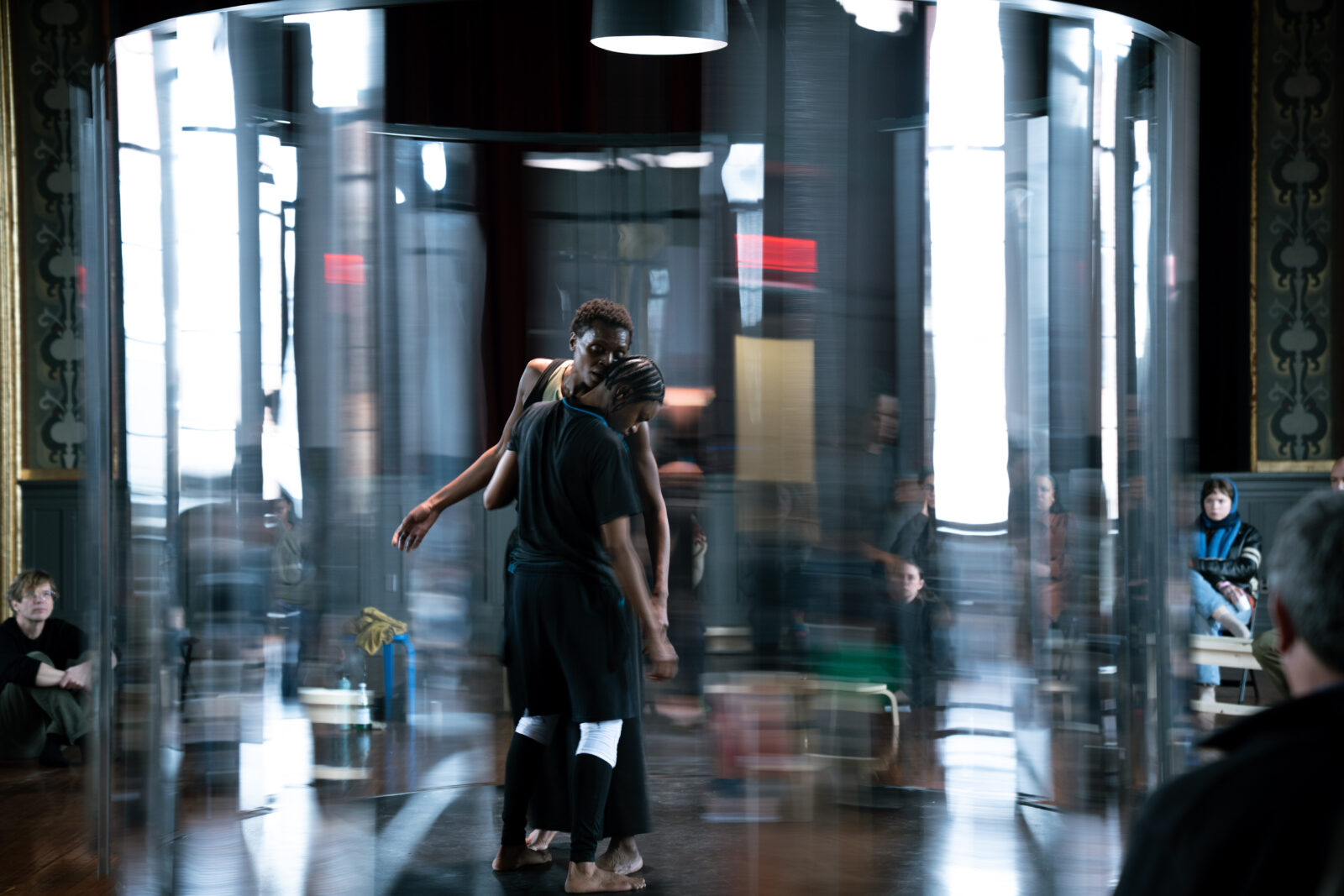
Trusting my intuition, I come away with a different conclusion than before: The cage is an alibi. my tongue is a blade is a performance of distancing as much as of forced closeness. Consider the dancers’ muted circulation of the outer armature, their steps free from affected character or style. Consider the interiority of the movement grammar and its physical language. Gestural sequences appear to sense the stage’s close quarters not as the sequestering of motion but as a concentration of energy. This concentration of mnemic energy—which facilitates the passage of embodied thought across and between the dancers—becomes the guarantor of choreographic integrity in the center of the stage. The work’s panoptic yet visually fragmented exterior leaves viewers awash in that “chaotic universality” of Schlegel, lacking any fixed image for the choreographic connective tissue that unites each moment of the performers’ unbroken movements.4
my tongue is a blade winnows away the darkness of the black box from which nothing leaks (the black box being the standard, semi-theatrical site for a performance in its register). The performance didn’t need an airtight prism to create privacy and shadow; it just needed a newly cut architecture for the spectatorial image. The cut-ridden threshold of its dancing ruptures continuous looking. The sense of continuity and mutuality that unfolds between the dancers, in their non-stop, intimate and high-contact performances, can’t be copied in our mind’s eye. The price of access to my tongue is a blade is a leap of understanding.
: :
What is commitment in a world without belief, what is rigor when irony seems to be intellect’s only honest posture? Gangsterism plays with the hyper-masculine and its cult of genius; my tongue is a blade cogitates in a feminine key. Both leave the infinity mirror of self-reflexivity behind—neither needs nor wants the ontological settledness of essence. They deal with a null space that remains unabsorbed into the fullness of the present; yet abjectness, which would hold them there motionless, is held at bay through unceasing movement and insurgent cuts. Through the form of the cut—its aggressions, its frayed ends, its mystery and fragmentation—they displace received constructions of the people in favor of new practices of becoming un-subject.
: :
Endnotes
- Diana Taylor, The Archive and the Repertoire: Performing Cultural Memory in the Americas (Duke University Press, 2003), 46. Speaking about performances that enable the continuity of banned indigenous cultural traditions, Taylor contrasts transculturation’s proliferation of performed repertoires with this monarchic example of what Joseph Roach termed “surrogation.”
- Allen Speight, “Friedrich Schlegel,” in The Stanford Encyclopedia of Philosophy, Spring 2025 Edition, ed. Edward N. Zalta and Uri Nodelman, https://plato.stanford.edu/archives/spr2025/entries/schlegel/.
- Taylor, The Archive and the Repertoire: Performing Cultural Memory in the Americas.
- Speight, “Friedrich Schlegel.”

Katherine C. M. Adams