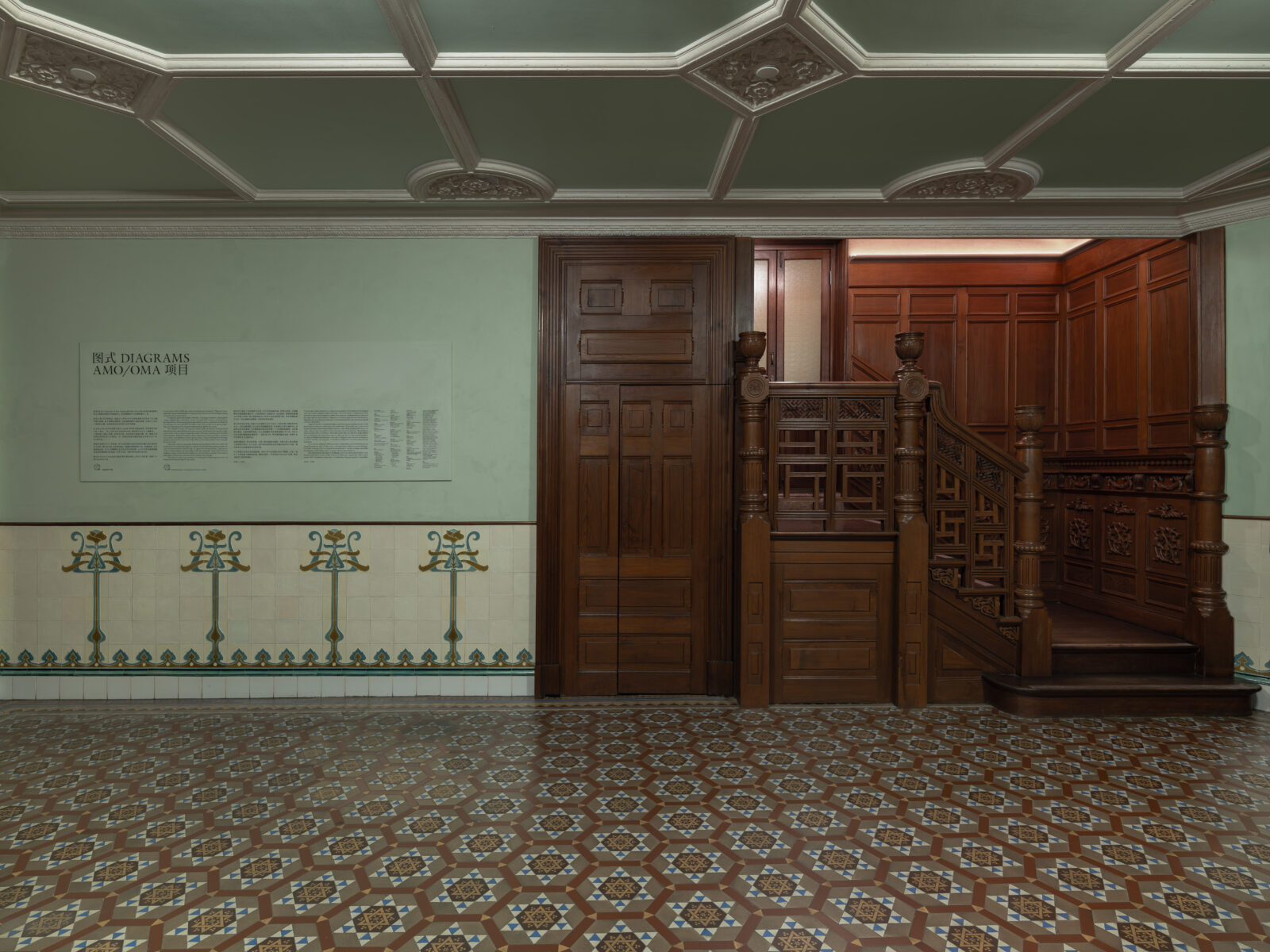
The Prada Rong Zhai sits on North Shaanxi Road in Shanghai, behind a stretch of wall and a detail of guards. Built in the early twentieth century as a private mansion, with Corinthian columns, leaded-glass windows, and painted ceilings hung with brass and alabaster, it is now operated as an exhibition venue by the Fondazione Prada. Earlier this year, the Fondazione hosted Diagrams: A Project by AMO/OMA, the touring exhibition by Rem Koolhaas’s research arm AMO/OMA. Although the exhibition originated at Ca’ Corner della Regina in Venice, Rong Zhai is a fitting home: like the venue’s eclectic style standing in for a swath of Western civilization, Diagrams aims for universalism.
Koolhaas and his curators describe the diagram as a “universal language,” a form of communication that “can be understood without necessarily speaking the same tongue,” with a “very long prehistory” extending from medieval manuscripts and Roman city plans to digital climate models. The diagram’s formal apparatus carries an “aura of objectivity,” and one of the show’s central claims is that this aura is at once the diagram’s persuasive strength and its political risk: diagrams clarify, but they also rationalize, mislead, and propagate.1
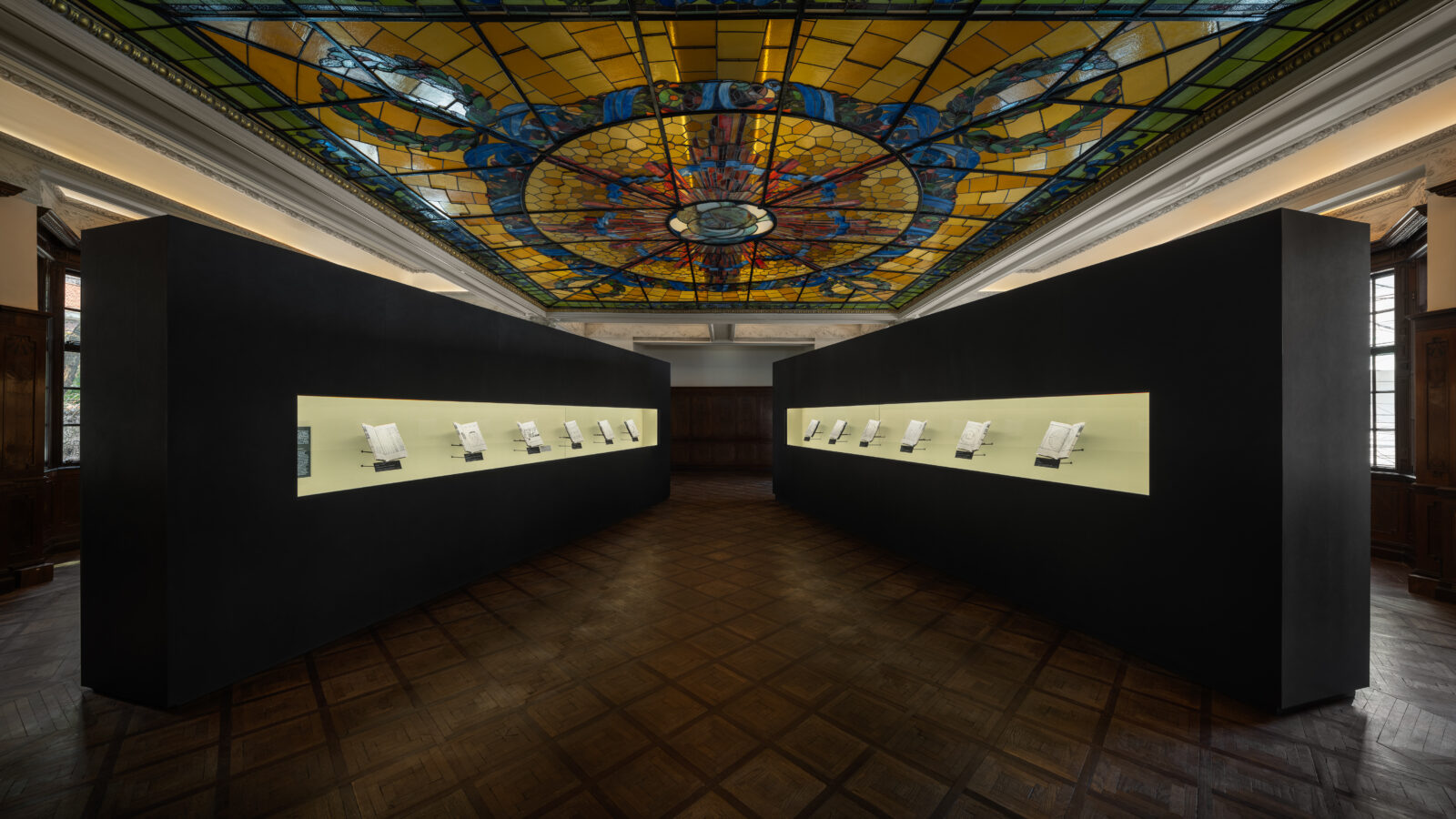
The exhibition juxtaposes two case studies, arranged symmetrically across the mansion’s second floor ballroom. On one side, we find the Sancai Tuhui (三才圖會), the early seventeenth-century illustrated encyclopedia compiled by Wang Qi and Wang Siyi, opened to pages drawn from its sections on astronomy, geography, and the human body. Prominent among them is a celestial chart whose concentric rings of constellation names trace the heavens. On the other side, we find a row of charts by W. E. B. Du Bois originally produced for “The Exhibit of American Negroes” at the 1900 Paris Exposition Universelle. Coiled spirals, blocked bar diagrams, and the rest of his now-canonical visual idiom document the social and economic conditions of Black Americans thirty-five years after emancipation. Both displays are exhibition copies; the originals are at the National Library of China and the Library of Congress.
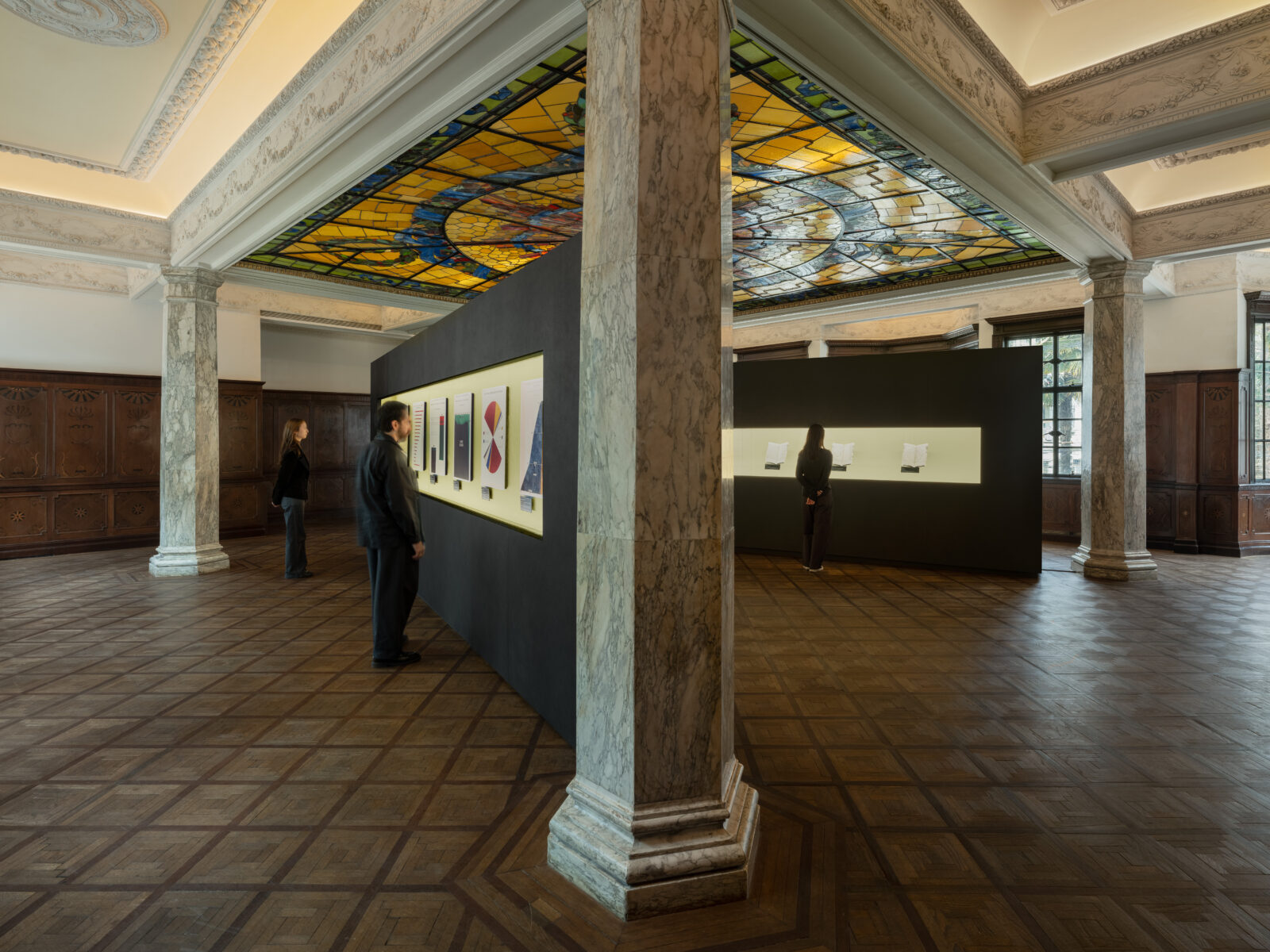
The two are presented as parallel: a Ming-period Chinese encyclopedic project beside a turn-of-the-twentieth-century African American sociology, both treated by the curators as foundational diagrams. This wide historical reach is one of the exhibit’s real strengths: the formal resemblances it identifies across cultures and centuries are not invented, and the visual rhetoric of objectivity has indeed shaped how knowledge is transmitted. The question is what becomes of these observations when they are gathered under a single category and asked to perform as a coherent argument.
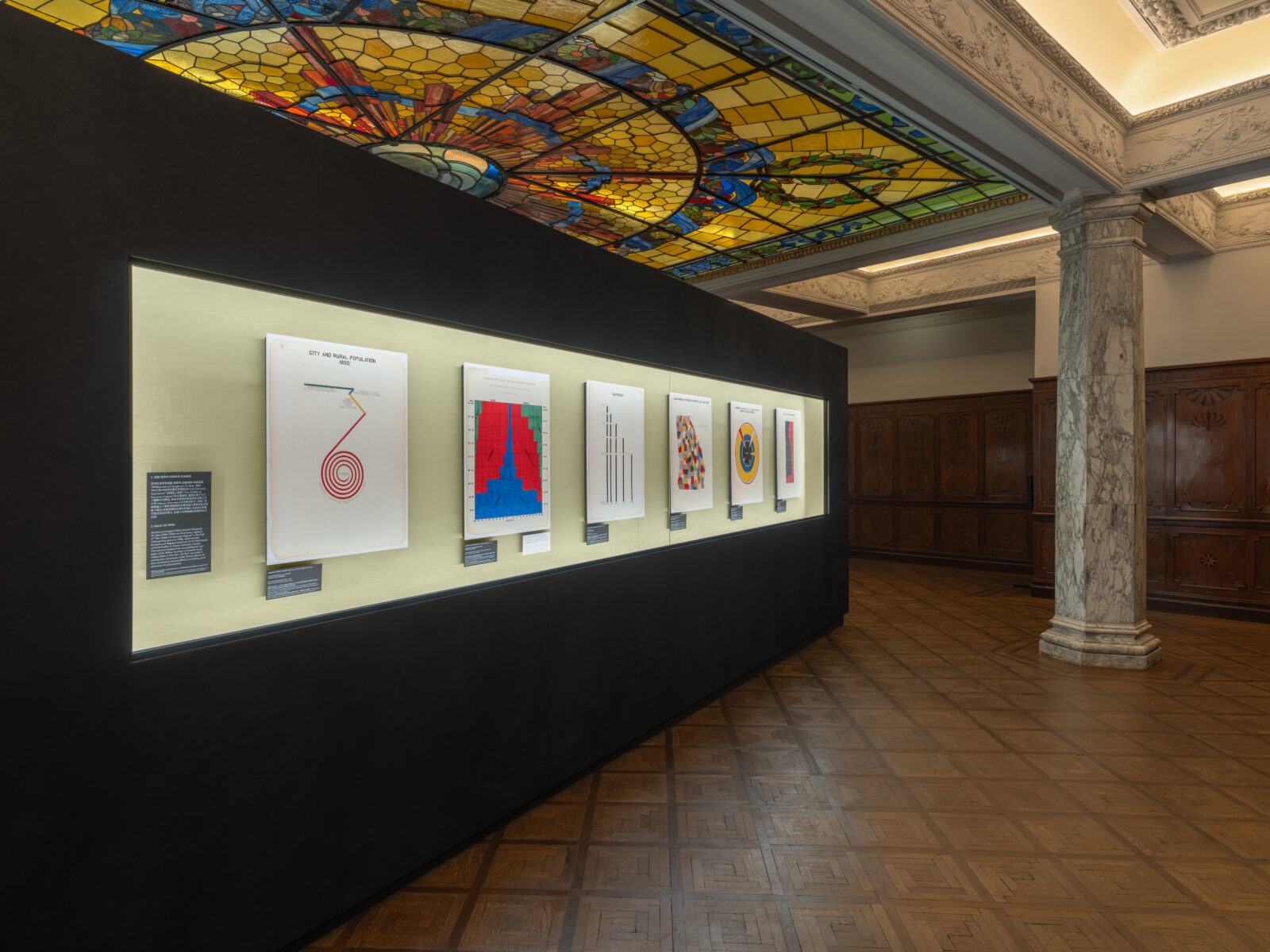
The exhibition design both demystifies the diagram’s authority and operates by it: its symmetrical layouts, its taxonomic confidence, and its calm institutional address all belong to the same rhetorical mode it is examining. More parallels follow: Du Bois’s original audience in France might feel they have walked into a Parisian salon at the Prada, where the diagrams hang below a stained-glass dome built into the ballroom’s ceiling: a piece of early twentieth-century domestic ornament, leaded glass in greens, blues, and amber yellow. Du Bois intended to persuade by deploying the visual rhetoric of objectivity that lent science its authority against the scientific racism of the day. But now, the decorative has, quietly, absorbed the political. The diagram that was made to argue is now part of the room’s ornament.
Whereas the diagram was, for Du Bois, political, it is pedagogical for Wang Qi (1530–1615) and his son Wang Siyi, who compiled the Sancai Tuhui for late-Ming literate readership. The 106-volume encyclopedia belongs to the long Chinese tradition of leishu (类書), categorical reference works that ordered the world for an educated elite. Its diagrams connect with Du Bois centuries later, but only by privileging form over purpose—a formalism that rejects context. This is the show’s structural argument: context does not matter if the diagram is universal and transhistorical.
And yet context seems to matter for the design of the exhibition itself. Ca’ Corner della Regina was organized by nine “urgencies”: Built Environment, Health, Inequality, Migration, Environment, Resources, War, Truth, and Value. Rong Zhai uses only five: Truth, Resources, Value, Built Environment, and a new addition, Body. The curators describe the restaging as a response to “a more intimate, domestic space,” aligned with a “private house” register that “resonates with local methods of preserving and transmitting knowledge.”2 Fair enough: fewer rooms, fewer categories. But why drop Inequality, Migration, and War, the three most politically pointed terms on the Venice list? The form persists; the urgencies travel less freely.
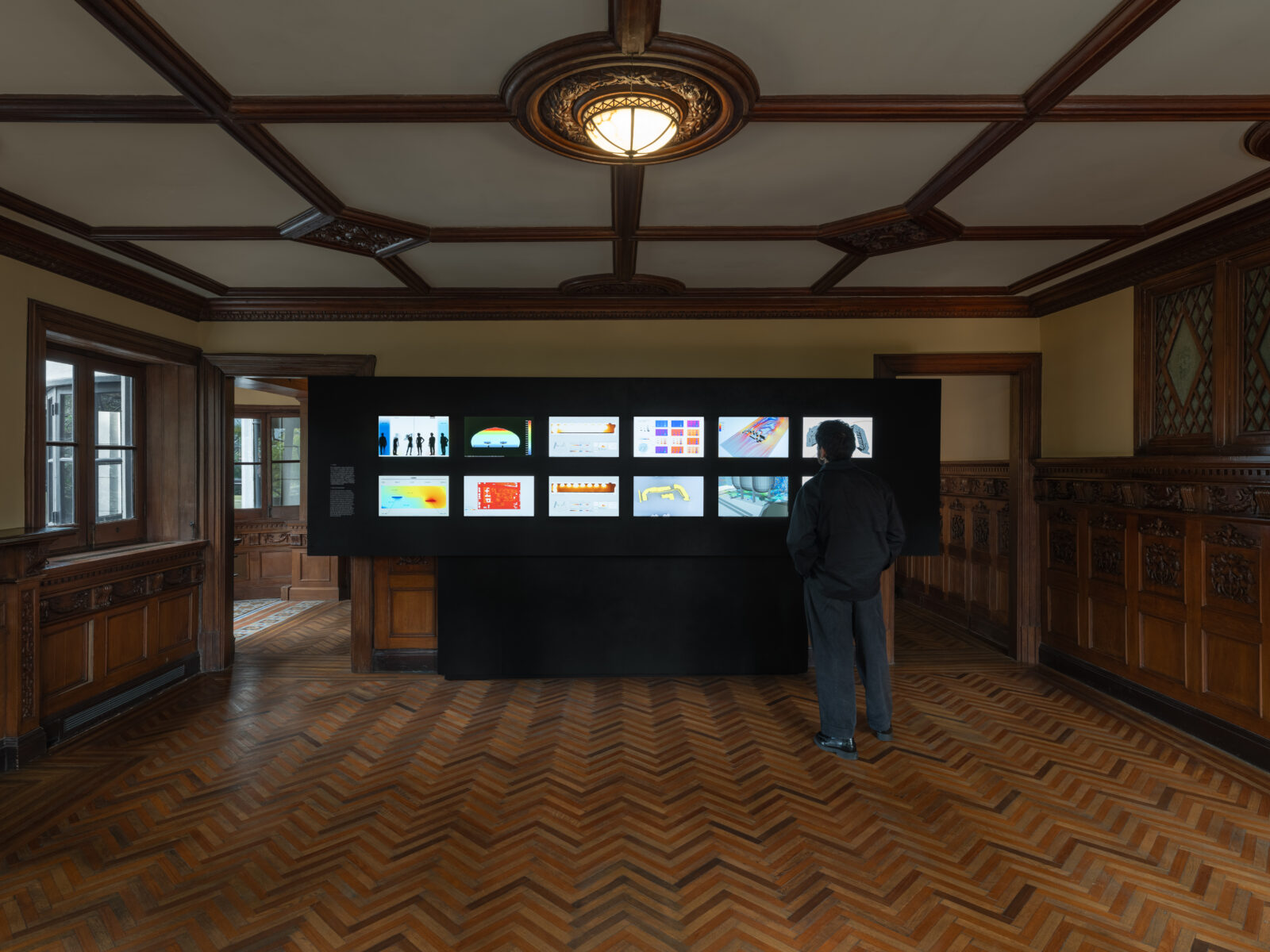
The show’s strongest room is the one most narrowly its own. On the third floor, in a side gallery away from the case studies, a wall of twelve digital screens runs floor to ceiling. Each plays a short loop of architectural and environmental modeling: wind currents around a building envelope, thermal gradients across an urban block, crowd-flow simulations, light studies, the silent atmospheric calculations that now precede a contemporary building’s design. The work shown is largely OMA’s, together with that of collaborators such as Transsolar and Atmos Lab. It is the section in which the show stops arguing universal history and simply demonstrates a practice. These diagrams are not historical artifacts under glass but operational tools, the daily working language of an architectural office that has shaped the discipline for half a century. They are precise, technically literate, and absorbing.
The exhibition’s wall text gestures, in passing, at the political stakes of architectural diagramming: built environments, it notes, have “sometimes” served “to rationalize exclusion and reinforce political divisions.” The gesture remains brief. The rest of the text returns to ventilation, daylight, energy efficiency. Again we find form over purpose: the strongest room of the exhibition is also its quietest about what diagrams have been for.
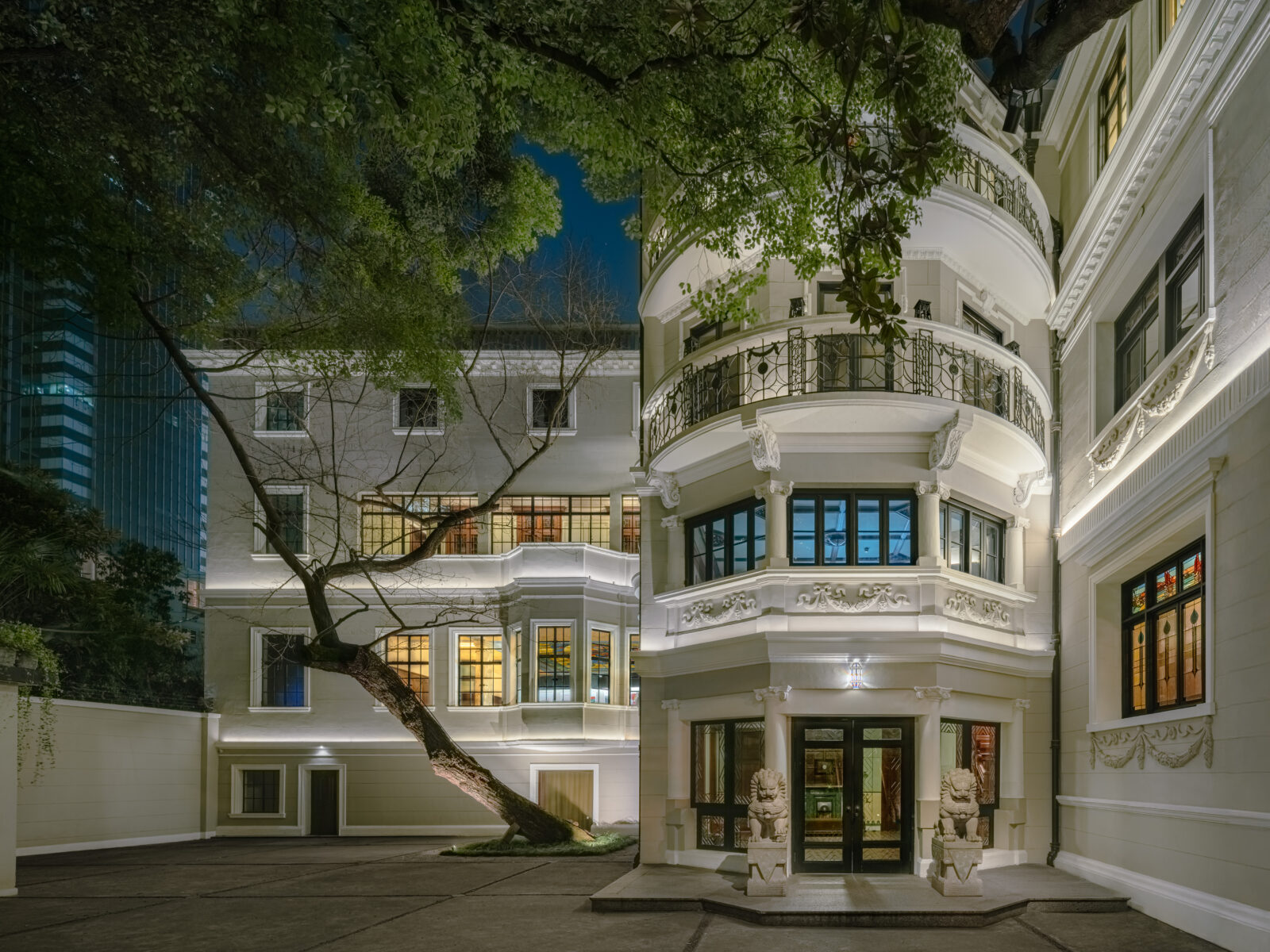
Walking back down the stairs, one finds the building completes itself around the exhibition. The hall mosaics, the iron gate, the Corinthian columns, the gardens with their Japanese maples and palm: all of it remains what the visitors at the entrance had come for. Outside, two visitors are taking a photograph of one another against the white façade. A third is filming a short video. The guards watch from the gate with practiced disinterest. The case studies and the urgencies, the encyclopedic syntheses and the anti-racist statistics, the whole assembled argument about what diagrams have done and what they have been for: all of it stays inside. The building, on the way out, still asks to be looked at first.
: :
Endnotes
- Rem Koolhaas, “On Diagrams: Rem Koolhaas in conversation with Katya Inozemtseva,” in Diagrams: A Project by AMO/OMA, exhibition guide (Fondazione Prada, 2026): 16–18.
- Cornelia Mattiacci and Giulio Margheri, “From Research to Exhibition,” in Diagrams: A Project by AMO/OMA, exhibition guide (Fondazione Prada, 2026): 11.
Vivian Jin