The Art of Alison Knowles In/Out of Fluxus. University of Chicago Press, 2026.
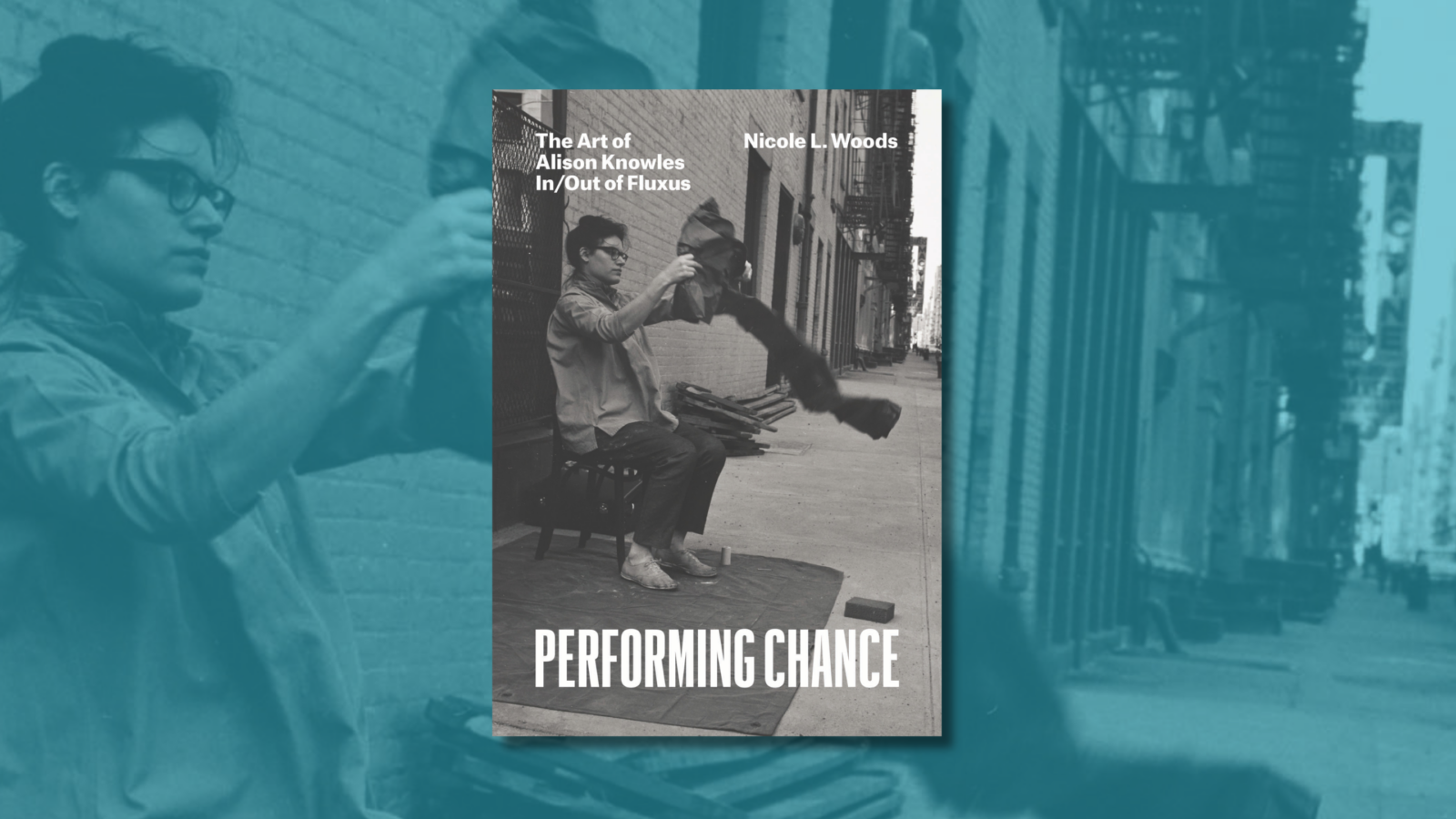
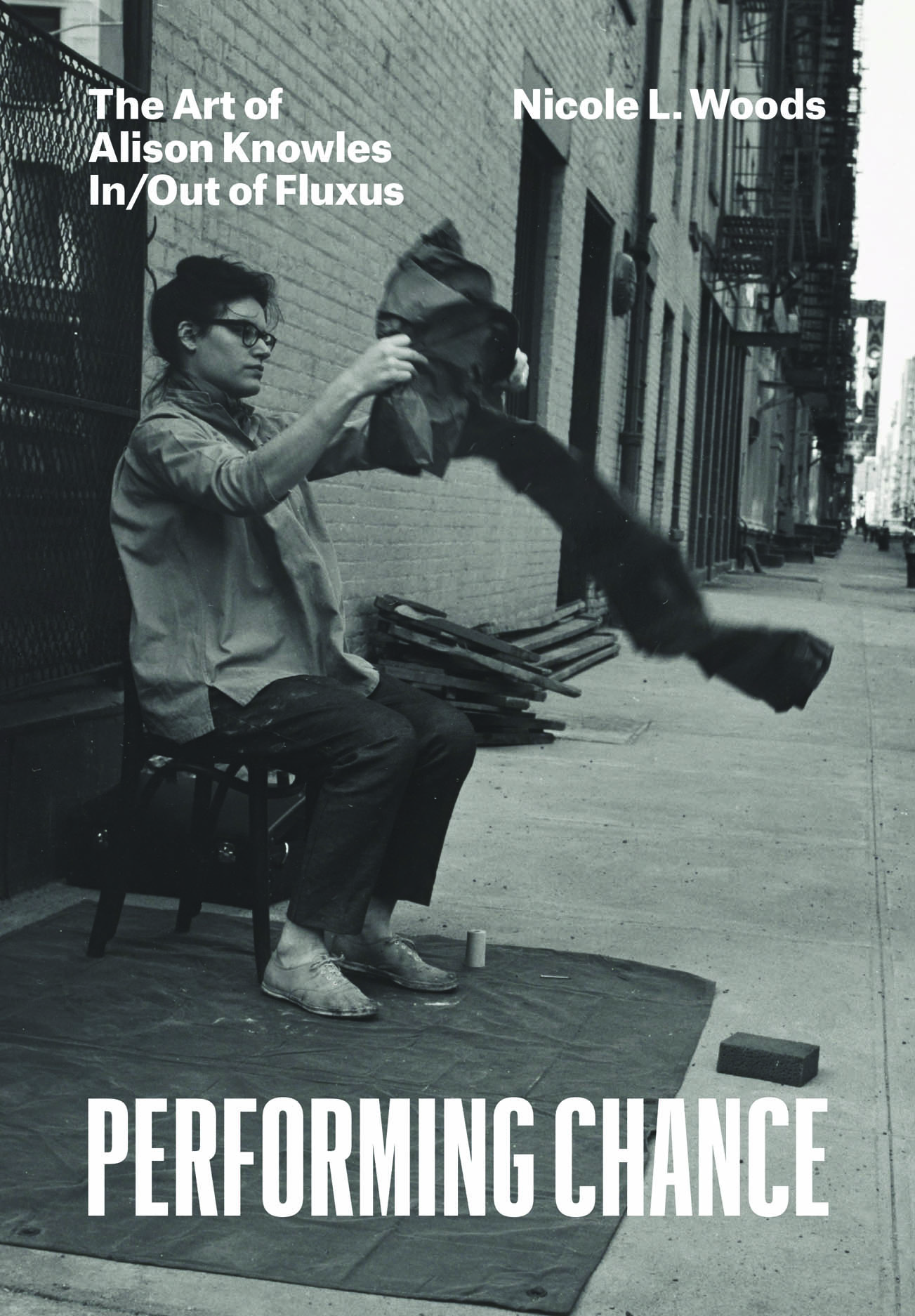
American artist Alison Knowles (1933–2025), one of the founding members of Fluxus—an international network of artists, composers, and poets most active in the 1960s and 1970s—long remained without the kind of dedicated scholarly monograph afforded to many of her male peers, despite numerous exhibition catalogs, journal articles, and edited volumes which have illuminated aspects of Knowles’s career and underscored the need for a dedicated study. That gap has finally been filled by art historian Nicole L. Woods’s Performing Chance: The Art of Alison Knowles In/Out of Fluxus (fig. 1). The manuscript traces Knowles’s prolific career, from her early years painting in New York where she aspired to become “the next [Helen] Frankenthaler” to her later involvement with Fluxus, performance art, and poetry, capturing the richness of the life Knowles lived (21).
Performing Chance does not read as a conventional biography, nor was it intended to. While Woods acknowledges aspects of Knowles’s complex intimate relationships, she does not focus on exploring the personal dimensions in depth. This approach reflects the study’s monographic focus, which seeks—and succeeds—in situating Knowles’s artistic career within the broader contexts of postwar art and politics. The publication’s most remarkable achievement is its deliberate exclusion of details from the artist’s private life, a choice supported by the author’s meticulous research and extensive knowledge on Knowles’s oeuvre, which remains the central focus of the study. By prioritizing Knowles’s artistic practice over her personal life, the author makes a deliberate strategic choice that keeps the focus on her creative contributions. This approach resists the tendency to reinforce parasocial dynamics, which are often intensified when artists, particularly women, are expected to disclose intimate details of their personal relationships, allowing her work to remain the primary subject of analysis.
In the introduction, Woods establishes the need for this publication not only because it is the first of its kind, but also because of the rich and multifaceted life Knowles lived and the work that she made within and beyond Fluxus. Even though she worked alongside key Fluxus artists such as her husband Dick Higgins, Nam June Paik, George Maciunas, Benjamin Patterson, George Brecht, and Emmett Williams, figures whose careers have generated substantial scholarship and numerous publications, Knowles was far more than simply another member of the collective. Drawing on archives, photographs, ephemera, and oral histories, Woods repositions her remarkable oeuvre as a paradigm of the rigorous experimentalism that emerged with the neo-avant-garde; an experimentalism whose ephemeral nature—together with Knowles’s marginalization within the male-dominated Fluxus movement—contributed to its historical neglect.
The introduction highlights the various influences on Knowles and establishes a timeline that traces her career from the 1950s to the mid-1970s alongside the aesthetic, institutional, and political developments that shaped the postwar American avant-garde. While this timeline provides a strong conceptual framework for the study, it also leaves readers wondering about Knowles’s work after the 1970s, subtly suggesting that her career peaked during the most active years of Fluxus. The author addresses this concern in the epilogue by providing context on how this period influenced Knowles’s legacy and shaped perceptions of the Fluxus movement, offering valuable insights that complete her story and deepen our understanding of twentieth century art movements.
Chapter 1 begins with one of the artist’s most significant realizations: identifying what defines their practice and distinguishes it from others. This chapter unfolds through that process of discovery, tracing the shift from painting to performance as the foundation of the artist’s unique voice. Informed by the vibrant avant-garde scenes of New York, Knowles began as a painter before turning to silkscreen art and action-based live performances. Her development was shaped by informal mentors and intellectual collaborators such as John Cage, the American composer and artist whose ideas profoundly influenced the Fluxus collective. This chapter examines their relationship, as well as Knowles’s partnership with Higgins, whose support and influence helped direct her work toward sonic experimentation and public performance. At points, the chapter suggests that Knowles relied heavily on the support of fellow male artists; however, as the book unfolds, it becomes clear that her true talent lay in her ability to listen and learn, transforming that knowledge into power and channeling it into her practice to create extraordinary works.
Chapter 2, more than any other, contains the core of the book’s argument, tracing the development of Knowles’s artistic voice as she situates herself within a male-dominated field and a feminist space of creative expression. Surrounded by artists such as Charlotte Moorman and Yoko Ono, who used their bodies as central elements of their performances, Knowles instead developed a practice that worked against the male gaze and its emphasis on the female body. Like Knowles, Moorman has only recently received her first monographic study: Topless Cellist: The Improbable Life of Charlotte Moorman (2014) by art historian Joan Rothfuss, with a foreword by Ono. As the title suggests, the manuscript focuses on Moorman’s bodily exposure within her artistic practice, particularly through her collaborations with Nam June Paik, whose celebrated artistic innovations often positioned her body as a medium for his work. Rothfuss’s study recenters Moorman by foregrounding her creative agency and highlighting her significant contributions as an artist in her own right.
In chapter two, Woods undertakes a similar recuperative project alongside Knowles, demonstrating how Knowles aligned herself with contemporary feminist movements through alternative, non-bodily strategies. Rather than using her body to challenge the male gaze, Knowles instead reclaims the kitchen, a space traditionally associated with women, as a site of gathering and resistance. Knowles transforms domestic imagery and actions into sites of artistic agency, subverting conventional associations with femininity in ways that became central to her practice through performance works such as Make a Salad (1962) and Bean Rolls (1963). Through the performative act of sharing food with the community and incorporating everyday objects into her practice, she transforms the kitchen from a symbol of domestic labor into a site of activism, foregrounding women’s agency, authority, and collective power. Whereas her peers were focused on fighting the patriarchy and breaking the glass ceiling with their bodies, an effective and groundbreaking artistic expression, Knowles sought alternative ways to empower women and be part of the movement.
Chapter 3 sets the stage for her experimentation in New York, as the Fluxus collective moved most of its activities from Western Europe to the United States. By tracing the steps that led Knowles to her performance works, including some discussed here for the first time, this chapter illuminates her social and institutional networks and demonstrates the central role of collaboration in her career. Unlike her peers, who often worked in isolation, Knowles shaped her practice through community involvement and collaboration, a principle that forms the core of her artistic practice and the author’s central argument. From her collaborations and performances with fellow artists Shigeko Kubota and Benjamin Patterson to relationships with her twin daughters, Hannah B. and Jessica, the book reveals the range of personal and creative connections that shaped Knowles’s practice.
By tracing these relationships, readers gain a deeper understanding of how collaboration and community informed her artistic process and the development of some of her most well-known works. Knowles, however, worked on the periphery of the mainstream art movements, navigating the “receptiveness to provisional, unknowable outcomes” that generated “politics, a system, a stake in the reception and distribution of meaning” (107). The book demonstrates that Knowles’s independent position in relation to mainstream art movements allowed her to develop an innovative practice, particularly through her exploration of the relationship between word and image.
In chapter 4, the author focuses on her large installation, The Big Book (1966–1969), starting from its conception in Knowles’s home in New York to its later larger installations within institutional settings. By enlarging the physical experience of holding a book and moving through one, The Big Book became an installation that expanded one’s body to experience and reexperience spaces and narratives as the author writes “(literal) concrete phrase” (112). By expanding the body through the physical contours of the installation, this chapter presents The Big Book as an exceptional work of art that pushed her practice into the relationship between the written word, performance, and artmaking—steering into her audience-activated environments.
The final chapter continues the discussion on The Big Book and complements it with The House of Dust (1967–1975), one of the first computer-generated poems. The House of Dust builds on the human interaction explored in her earlier works by integrating a technological component, which demonstrates how artists evolved alongside emerging technologies and adapted their creative practices in response. On top of conversations surrounding these two works, Woods introduces her involvement with the academic community at the California Institute of the Arts. More than any other chapter, this one highlights the collaborative nature of Knowles’s artistic practice, which brought together fellow artists, students, and community members to different iterations of The House of Dust in California. These structures functioned as communal gathering spaces where members of the intellectual community screened films, engaged in conversations, and participated in discussions surrounding the antiwar movement in the United States. In doing so, both works remained grounded within the parameters of Fluxus and the “epistemology of domestic space as ever-evolving form and process” that helped establish Knowles’s practice (167).
Published one year after the artist’s passing, Performing Chance creates a significant shift in the scholarship surrounding Knowles and her contemporaries, repositioning her career not as one that trailed behind her male peers, but as that of a trailblazing artist who forged her own path while navigating the pressures of her environments.
: :

Vuk Vuković