Oil circulates crisis. Paying forty bucks at the gas pump bankrolls war crimes; occupations abroad top off gas tanks at home. Speculation made in crude oil stocks monetizes occupation, and plunder finances endless consumption. Infrastructure’s deadly life, to riff on Deborah Cowen, is not only fueled by oil but also drives oil’s extraction.1
Devin Wilson’s short-lived exhibition at the Cerritos College Art Gallery in California, Whale Oil (2026), takes on oil’s infrastructural lives and afterlives. Wilson, an emerging interdisciplinary artist and digital fabricator, bridges the social and technical in their wide-ranging critiques of capitalism. Whale Oil makes the often-ignored historical and contemporary infrastructures central to crude oil’s extraction and circulation readable through a figure that continues to loom in our cultural imaginary: the whale. From Herman Melville’s cetological investigations in Moby-Dick to orcas attacking yachts in the Strait of Gibraltar, the whale takes on varied forms throughout the stages of capitalist expansion. In one case, it represents the raw violence of accumulation, and in the other, it signifies resistance to wealth’s excesses.
As the exhibition’s title makes clear, the whale and its relation to industrialization cannot be disentangled. Wilson’s project echoes Jamie L. Jones’ Rendered Obsolete (2023), which traces the ways America’s reliance on whale oil laid the groundwork for oil’s logistics today. It maintained not only a technical system of extraction, but a cultural imaginary of whaling necessary for our current energy economy. Without whalers who labored throughout the Atlantic and Pacific oceans to harvest oil from the blubber and head cavities or the titillating stories of their toils, what Jones calls “fossil modernity” might never have emerged. But this shift to a period of history marked by intensive fossil fuel consumption was by no means a quick or easy transition. Energy from the bodies of whales or underground oil wells has become something that people perceive as “infinitely interchangeable”—whether that’s steam, coal, petroleum, natural gas, oil shales, bitumens, wood, or whale oil.2 The whaling and oil industry rely on distinct infrastructures for harvesting and transportation. Yet, as Jones demonstrates through the idea of “energy archeology,” we can find “traces of old energy resources, technologies, and cultures in contemporary and emerging energy cultures.”3 Waves made by ships sailing in search of whale pods transformed into huge swells by tankers hauling crude.
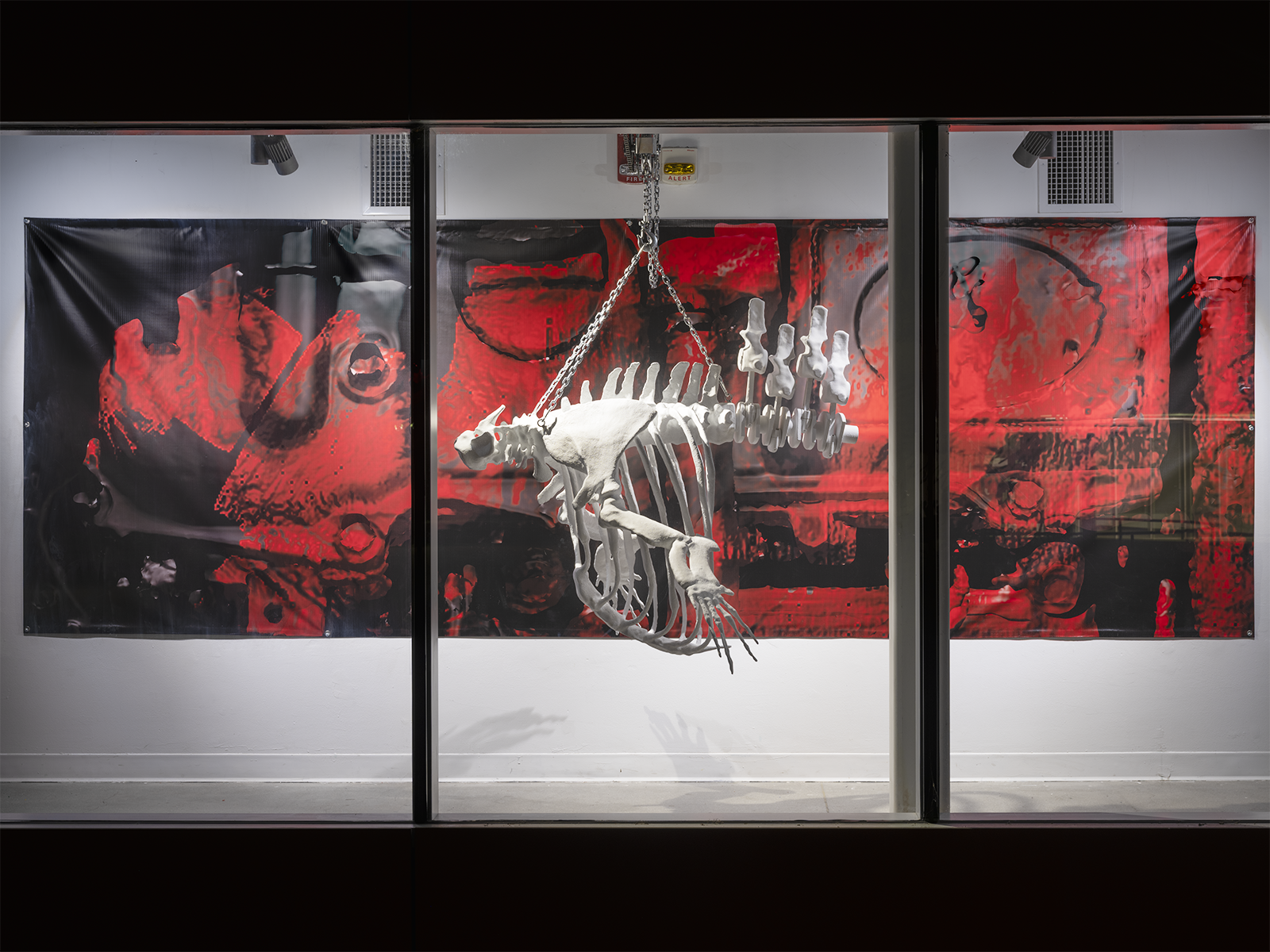
Both the whaling industry and the whale’s body are metonymic in Wilson’s Whale Oil, which asserts an infrastructural imagination that extends beyond the sea. The four pieces in Wilson’s exhibition grapple with the emergent and dominant contingencies of late-stage capitalism and corporate culture. Hanging from the gallery’s ceiling is a replica of prehistoric remains chained up. Across the room, a 55-gallon oil drum with seismic data printed on it serves as a pedestal for an oil can shaped like an ammonite fossil. Mesozoic zooplankton are reencoded on rubber in the shape of the 2010 Deepwater Horizon oil spill. And serving as an arresting backdrop for the show, a red-and-black print covers an entire gallery wall. Like Nancy Holt’s Pipeline (1986), in which the art itself wraps and wends around the institution and leaks oil, Wilson makes the infrastructural visible. Whale Oil illustrates how infrastructures “emerge out of and store within them forms of desire and fantasy and can take on fetish-like aspects that sometimes can be wholly autonomous from their technical function.”4 All over the exhibition space, the rubbers, plastics, polyester, and fiberglass—themselves petroleum made anew—reveal how oil is sticky and thick.
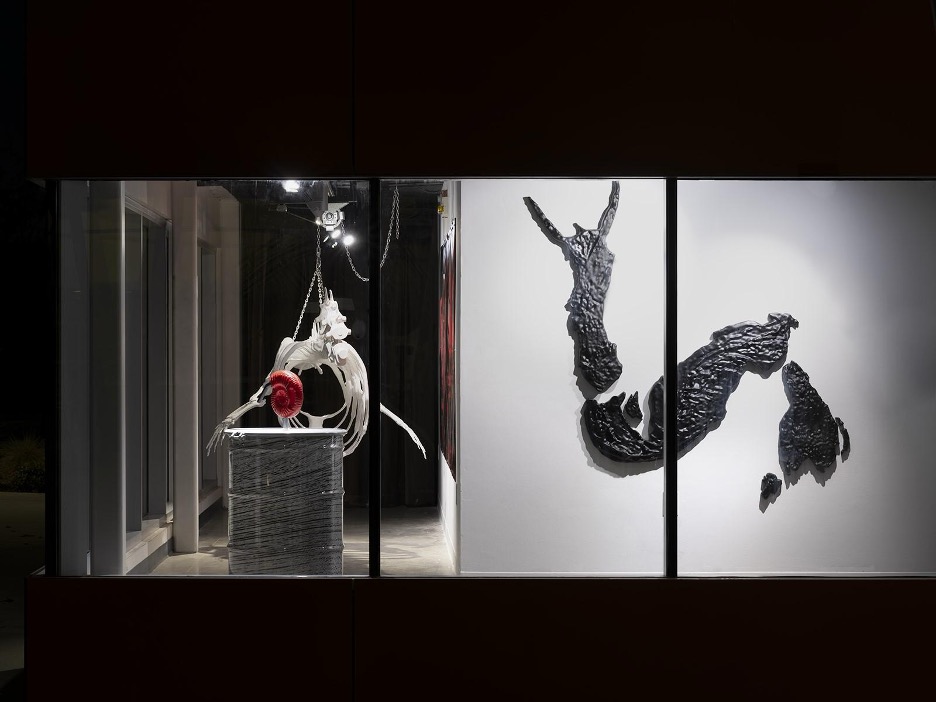
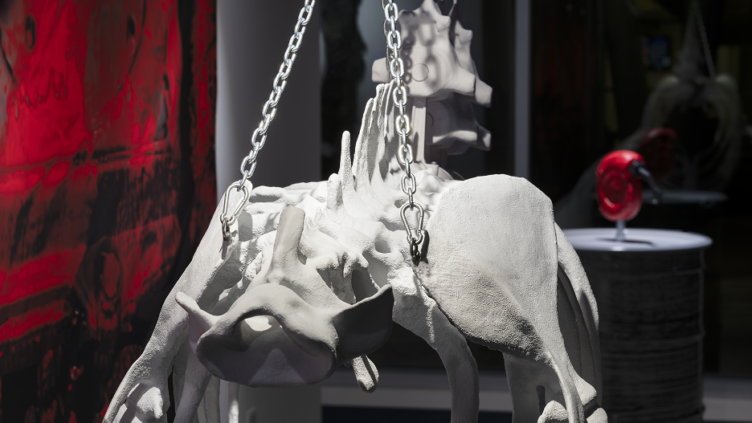
At the center of Whale Oil is “Check Engine,” a suspended motorized whale skeleton that looks like a specimen in a natural history museum—a whale without organs, muscle, or flesh with a large, open chest cavity. The fins, an adaptation from sea to land and from land back to sea, illustrate a mammalian phylogeny of shared ancestry and, in some ways, a shared fate. Wilson’s anatomical detail is almost didactic in its accuracy. But the sculpture lacks the head, the back part of the spine, and the vestigial legs, all of which are key features for identifying this species in fossilized remains. Instead, the final discs of the vertebrae look like a small skull. The whale swims nowhere–suspended indefinitely, both alive and not. A kind of automaton that makes visible our present dependence on oil as it hangs there precariously.
Wilson’s sculpture is a modified reproduction of Dorudon atrox, a prehistoric creature about the size of a narwhal that swam the oceans nearly 40 million years ago. The whale, hoisted up like an engine under repair, is moved slowly and hauntingly up and down. And, on closer inspection, the Dorudon’s vertebrae are fashioned from replicas of an engine’s crankshaft, the chamber and piston layout of a 4-cylinder engine. Compression and combustion processes become embedded in replicas of fossilized remains, obscuring the distinction between the organic and the inorganic. The sculpture’s title, “Check Engine,” refuses the dry nomenclature of scientific classification. Rather, it is a pithy commentary suggestive of the light on a vehicle’s dashboard that shows something is wrong. Wilson alerts us to the failures of engineered life. We have gone past the point of emergency, and the indicator is broken, too.

The whale’s suspension, in time and place, makes it a kind of boundary object. “Boundary objects,” as Susan Leigh Star and James Griesemer write, are “objects which are both plastic enough to adapt to local needs and the constraints of the several parties employing them, yet robust enough to maintain a common identity across sites.”5 The whale, as a member of the infraorder Cetacea that Wilson presents here, stands in for industry. Whales have become, and are, a part of competing and yet overlapping social, political, and technical worlds and infrastructure that shape how we access energy and fuel war, poverty, and the climate crisis. In Wilson’s refashioning, the mobility and immobility draw out the infrastructure of transit and of automobility—liberty at the expense of unfreedom for others.
Wilson further connects personal automobility and the limits of freedom in a 3D LiDAR (Light Detection and Ranging) scan of the engine block under the hood of their own Toyota Prius, overlaid on a deep-sea oil extraction map from the National Centers for Environmental Information, also titled “Whale Oil.” The extraction map shows data collected from a Shell Offshore Inc. survey of Alaminos Canyon in the Gulf of Mexico. Alaminos Canyon is one of the deep-water reserve discoveries in water depths greater than 7,000 ft. Shell is currently preparing this site, unironically named “Whale,” for drilling.6 Rendered in red and black, the land is superimposed on their engine’s scan to implicate Wilson as artist and consumer in the relational properties of harvesting, refining, circulating, and using petroleum products. In this sense, it illustrates Wilson’s view of how the dead are vivified through corporate and artistic frames and processes. It becomes an inversion of Michel Foucault’s biopolitical dictum. No longer is it to “make live and let die,” but to make dead and keep alive.7 Death material fuels capital.
Wilson also provokes us to think about how futures are for sale. Shell’s press release on “Whale” in Alaminos Canyon explains how it believes this site will provide 480 million barrels of oil equivalent.8 In rhetoric that merges the politics of the market and law, Shell speculates on efficiency and possibility, but it tempers these claims. The release closes with a critical reflection on the use of “forward-looking statements,” which are, as they describe, “statements of future expectations that are based on management’s current expectations and assumptions and involve known and unknown risks and uncertainties that could cause actual results, performance or events to differ materially from those expressed or implied in these statements.” It reads like a disclaimer or a warning; the corporation is averting accountability based on factors that would make things “differ materially.” Shell’s legalese connects speculation and extraction. Yet, Wilson’s rendering of Whale Oil is not abstract futures but rather a way to see death’s past and present, signaling how integral this has become to our economies. Death today, tomorrow, and yesterday lubricates the crisis.

Oil, indeed, greases the wheels of the economy, as Adam Hanieh remarks in Crude Capitalism
(2024). Not because of what it offers in its crude form but for its capacity to transform.9 Like the whale’s figural malleability, oil materializes the dead into adaptable and abuseable forms. Now that it can be turned into petrochemicals and plastics, oil serves as a material substrate that underlies the manufacturing, computational, and logistical processes central to late-stage capitalism. If infrastructure is what makes other matter move, oil does more than ease that process. Whale Oil makes this process palpable.
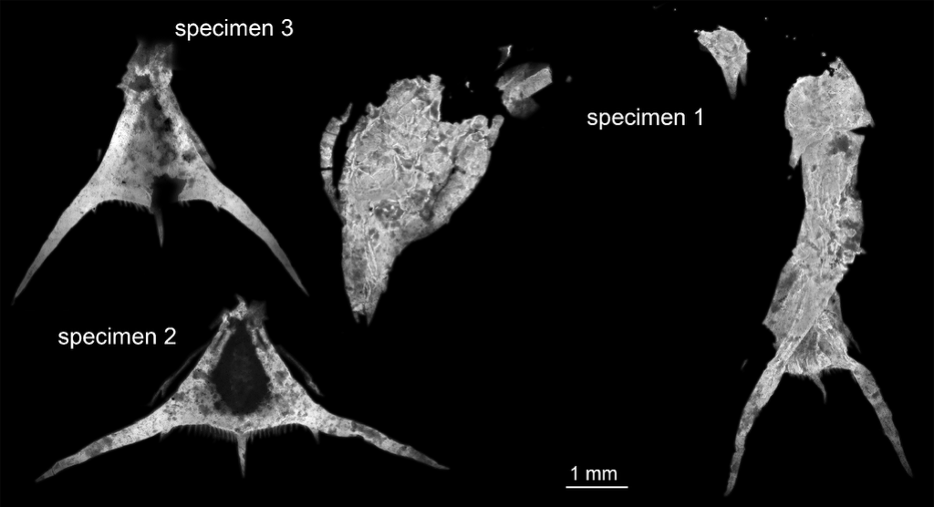
From afar, Wilson’s “Deepwater” looks like a slug moving along the gallery’s wall with a trail of mucus in its wake. The wall-mounted, rubberized sculpture depicts an aerial view of the 2010 Deepwater Horizon disaster, which is set against a composite fluorescence micrograph of a Mesozoic zooplankton fossil (see Figure 5).10 “Deepwater” best reflects Wilson’s archeological project, both in a Foucauldian and materialist sense. A lifeform that is only a few millimeters in size and a part of the ancient slew of microorganisms that make up crude oil is displayed at the same scale as the nearly 4.9 million barrels that polluted 45,000 square miles of the Gulf of Mexico. Its textured spray coating gives a sheen to its roughness. With grooves and ridges that look like scars or pockmarks, it seems to suggest that life, in any form and at any scale, can’t escape the urges of capital, where even fossilized remains are made explosive. As deepwater drilling becomes more common, oil will continue to discharge from turgid pipes. Oil is viscous; it moves slowly. But it quickens the pace and violence of modern life.
We wait at the edge of a dead future. In anticipation, there is tension and in tension, there is potential. Jones reminds us: “It is not within the imaginative scope of extractive capitalism to understand its own limits, its own ends, or to deal with the hulking material structures it leaves behind in the abstract market turbulence of creative destruction.” While Wilson’s Whale Oil stylizes the stages of multiple, overlapping crises, it provides a moment to reflect on blockages and breakages of those crises that might seem impossible to imagine. Some things need to be shattered, and Wilson shows us that to understand our present, we need to reckon with the dreams of the past.
: :
Endnotes
- Deborah Cowen, The Deadly Life of Logistics: Mapping Violence in Global Trade (University of Minnesota Press, 2014).
- Jamie L. Jones, Rendered Obsolete : Energy Culture and the Afterlife of US Whaling (University of North Carolina Press, 2023), 2.
- Jones, Rendered Obsolete, 13.
- Brian Larkin, “The Politics and Poetics of Infrastructure,” Annual Review of Anthropology (Palo Alto) 42, no. 1 (January 2013): 329.
- Susan Leigh Star and James R Griesemer, “Institutional Ecology, ‘Translations’ and Boundary Objects: Amateurs and Professionals in Berkeley’s Museum of Vertebrate Zoology, 1907-39,” Social Studies of Science (London) 19, no. 3 (August 1989): 393.
- “Whale: Setting New Standards for Deep Water | Shell Global.” Accessed April 19, 2026. https://www.shell.com/news-and-insights/our-stories/whale-setting-new-standards-for-deep-water.html.
- Michel Foucault, “Society Must Be Defended”: Lectures at the Collège de France, 1975–1976.” Eds. Mauro Bertani and Alessandro Fontana. Trans. David Macey (Picador, 2003).
- “Shell Starts Production at Whale in the US Gulf of Mexico | Shell Global.” January 9, 2025. https://www.shell.com/news-and-insights/newsroom/news-and-media-releases/2025/shell-starts-production-at-whale-in-the-us-gulf-of-mexico.html.
- Joachim T. Haug and Carolin Haug, “A New Glimpse on Mesozoic Zooplankton—150 Million-Year-Old Lobster Larvae,” PeerJ (United States) 5 (February 2017): e2966. https://doi.org/10.7717/peerj.2966.
- Deborah Hanieh, Crude Capitalism: Oil, Corporate Power, and the Making of the World Market (Verso, 2024), 193.

Benjamin Williams