Set against the Hong Kong Island skyline, WY Kwan’s photograph “P.S. It’s an Emergency—Dancer” (2019–2020) shows three subjects glancing sideways, faces turned away from the camera, arms outstretched, and bodies mid-hop. Hiding the face mocks state surveillance embodied by the Anti-Mask Law, which discouraged protesters from joining the 2019 Anti-Extradition Law Amendment Bill Movement.1 Their oblique postures simultaneously gesture at a detour from the linear march of capitalist progress and authoritarian control in the political present. A cropped version of this photograph also adorns the cover of Kai Hang Cheang’s Sideways Developments: Queer and Trans Aesthetics of Global Hong Kong and encapsulates its central intervention: to imagine modes of development that move sideways from “the temporality of linearity that is synecdochic of heteronormative developmental regimes” by scavenging an impressive archive of post-2014 queer and trans texts by Hong Kong-based and diasporic creators (13).
The concept of “sideways developments” is positioned against what Cheang terms “chrononormativity with Chinese characteristics” (21), taking cues from Elizabeth Freeman’s critique of the temporal gearing of human bodies toward maximum productivity. Cheang contextualizes the developmental timeline that synchronizes individuals’ life schedules, first promulgated by British colonialism and later extended by China in pursuit of the Chinese Dream, a timeline that “runs in tandem with hegemonic temporalities (like settler colonialism in North America)” (25). Against these chrononormative narratives, Cheang builds on theorists including Sara Ahmed and Kathryn Bond Stockton to conceptualize “nonlinear movement, growth, and evolution” in queer and trans literature and visual culture that swerve away from cis-heteronormative, developmentalist forms of (re)production while vitalizing lateral, non-hierarchical relationalities (26). The potentiality of these nonlinear paths lies not in their guaranteed success but in the uncertain possibilities they open. Per Karen Barad, these sideways orientations reach for an “intra-active engagement” whereby agency emerges through the entangled configurations of queer and trans lives within their milieu (7). Focusing on post-2014 Umbrella Movement productions, these narratives bear the lingering traces that pro-democracy protests have left on LGBTQ+ Hongkongers and their “commitment to survival and transformation” (8).2
Tracing alternative trajectories for queer and trans resilience and regeneration, Cheang departs from earlier postcolonial approaches that theorize Hong Kong queer culture through idioms of opacity and invisibility,3 which parallel the city’s political anxiety over its imminent erasure after the 1997 transfer of sovereignty.4 Aiming to derail the logic of representation, Cheang joins a recent turn to decolonial methods that deexceptionalize the city and untether queerness from the totalizing frameworks of colonialism and nationalism. His work thus sits alongside adjacent works such as Alvin Wong’s Unruly Comparison, which exposes Hong Kong as an incommensurate region whose queerness “exceeds its normative geopolitical referentiality” and connects it to other sites through minor-to-minor affiliations.5
To analyze how “sideways developments” materialize into aesthetic expressions, Cheang advances “intersectional formalism” as a method that dissects the “narrative and aesthetic” strategies signaling lateral movements from “cisgender hetero(homo)normative spaces and times” (13). His approach corroborates recent scholarly attention to the relations between queerness and form, demonstrating how “[a]esthetic innovation and formal manipulation” enable “artists’ engagement with legacies of social violence.”6 While the book does not explicate which aspects of form it attends to, one through-line is how genre is deployed or twisted to imagine minoritarian survival. If genres, as Lauren Berlant has it, “provide an affective expectation of the experience of watching something unfold,” Cheang’s readings reveal how queer and trans texts exploit and disappoint those expectations, bending generic conventions to animate alternative affective possibilities.7
Each chapter unpacks one form of sideways development while reading the cultural texts alongside LGBTQ+ legal developments in Hong Kong to give them a materialist grounding. Chapter 1 examines how failed romance narratives about working-class and poor gay and lesbian subjects expose “the longue durée of capitalist accumulation and dispossession” (73). Pairing Wong Bik-Wan’s and Cheung Yuen Man’s narratives, Cheang reads the gay protagonists’ unconsummated queer love as the affective spark igniting political desires exceeding the chrononormative scripts of adulthood, activism, and national belonging across the 1966 Star Ferry riots and the 2014 Umbrella Movement. Conversely, the lesbian characters’ intimacy in Yu Yuen Lan’s and Wong Yi’s short stories evinces the exclusion of poor queers from housing and privacy. Here, though, Cheang’s reference to Jack Halberstam’s The Queer Art of Failure, which frames failure as “the refusal of legibility, and an art of unbecoming,” seems incomplete.8 Lo Kei’s suspicious death and historical erasure in Wong’s nonfiction novel seem less an active refusal of normativity than an imposition of state violence, while the lesbian couples in Yu’s and Wong’s stories appear less to refuse capitalism than to negotiate with it and make do with limited material conditions.
Chapter 2 expands this intersectional theorization of queerness and capitalism to elucidate how the Anglophone coming-of-age genre is twisted to accommodate relational developments of the self that sidestep “the nation’s patriarchal imaginations and the diaspora’s patrilineal holds” (74). Jason Ng’s story stages an “arrested development” wherein the ghost Suze returns to forge a spectral bond with Choi, critiquing the violence imposed by capitalist projects like gentrification (82). Kit Fan’s novel uses “stunted and delayed” development plots to meditate on the ramifications of pre-1997 urban development and global capitalist modernity for lower-class Hongkongers (88). Larissa Lai’s fiction employs “queer mutations” to forward a posthuman bildungsroman in which collective survival and adaptation replace liberal individualist development amid environmental catastrophe and techno-capitalist extraction (99).
Chapter 3 extends this diasporic focus to (mis)translation as a loose genre for developing queer and trans horizontal alliances and creating what Cheang beautifully terms, à la Eve Sedgwick, an “aesthetic of beside-ness” (111). Wu Tsang’s Duilian employs mistranslation to forge minor-to-minor affiliations between present-day trans-of-color artists and the historical figure of Qiu Jin, acknowledging the “errors and misrecognition” involved to build indebted relations across disparate spatiotemporalities (120). Mary Jean Chan’s and Grace Lau’s poetry treats queer translation, respectively, as a non-teleological praxis of reconciling the multiplicity of self and as a “gastronomic” poetics that metabolizes diasporic history into “trans/nonbinary affective sustenance” (145). Cheang elegantly teases out “how forms figure and sustain queer relations of belonging in and across time,” to borrow Teagan Bradway’s words.9 I nonetheless find Cheang’s use of Nicholas Wong’s poetry as a contrastive case debatable, as he wagers that Wong’s Besiege Me “appeal[s] to Western audiences” by mobilizing “the fraught legacy of the protests” (115). This may flatten Wong’s reflection on British colonialism and the poet’s playful politics of English to contest both China-centrism and Western empires as he imagines queer protesters’ sideways orientations.10
Chapters 4 and 5 home in on trans aesthetics. Chapter 4 analyzes DIY transition videos to challenge the “trans(chrono)normative narrative of growth” that folds trans subjects into a unilateral trajectory of transition anchored to disciplinary institutions (159). While Beatrice Wong’s video follows the “medicalized, pre-to-post-op account,” its use of “bad body humor” pokes fun at the binary gender ideals that limit trans subjects’ appearance (180). Siufung Law’s and Kaspar Wan’s works de-emphasize medical intervention to visualize, respectively, a non-binary, non-teleological experience of bodily transformation and a “trans-crip temporality” foregrounding the necessity for more accommodating laws and infrastructure for trans flourishing (179). Cheang’s nuanced analysis of the artists’ milieu persuasively illustrates why some visual narratives remain tethered to medicalized scripts for institutional legibility and funding, while others have more leeway to experiment with alternative aesthetics.
Chapter 5 advances molecular critiques through the trans speculative genre, recalling other queer theorists’ recent works that harness the molecular to deconstruct normative assumptions of race, gender, and sexuality, but deployed by Cheang in the specific Hong Kong context11. The TV series Alpha Maria focuses on the “para-ontological figure” of Maria, a reincarnated trans domestic worker whose subjectlessness enables a critique of the biopolitical taxonomization that renders some lives livable and others disposable (184). Sin Wai Kin’s sci-fi drag dissolves the bounded liberal subject into particles that can be (dis)assembled, summoning a “postapocalyptic” dimension that legitimizes “gender-expansive lifeways” (184). Drawing on the life cycle of agarwood, Jes Fan’s Viscera renders transition as a symbiotic process of “wounding and regeneration” that binds the trans diasporic artist to Hong Kong’s extractive histories (184). The chapter thus attends to the entanglements of trans bodies with economy and ecology.
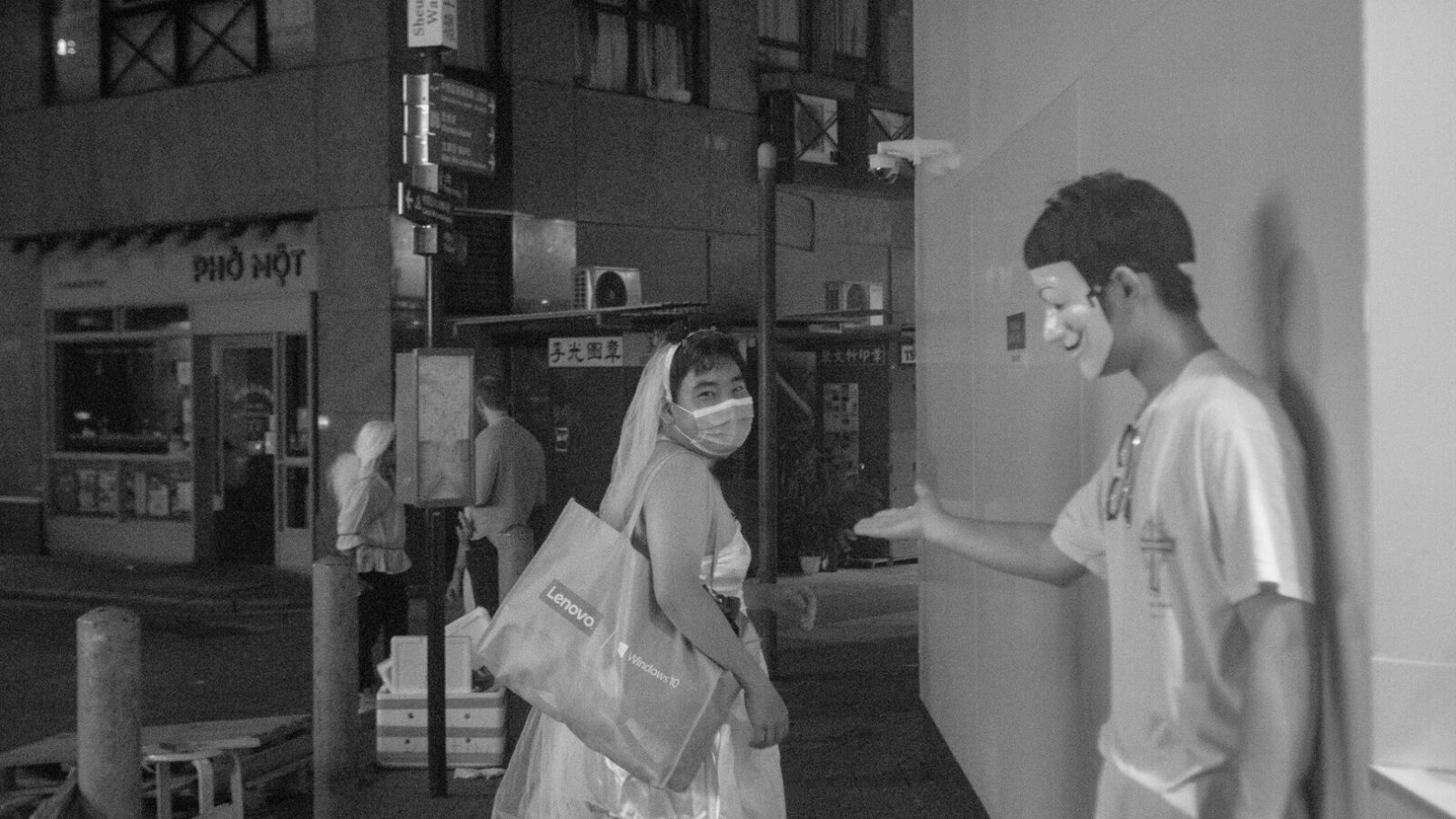
With its compelling close-readings and theoretical interventions, Cheang’s monograph is a significant contribution to queer and trans theory, Sinophone studies, and literary studies. Given Hong Kong’s heightened political control, shrinking queer visibility, and pushback against alternative frameworks for same-sex partnerships,12 Cheang teaches us to forge lateral networks and glean possibilities for survival despite—or perhaps because of—the fog of political pessimism. As with the protester extending a hand to the person in drag in Nelson Tang’s photograph at the top of this review, Cheang shows that a sideways gesture of alliance can be a practice of survival, as we reach toward one another without guaranteed futures.
: :
Endnotes
- Officially known as the Prohibition on Face Covering Regulation (PFCR), the Anti-Mask Law took effect on October 5, 2019, after being enacted by the Chief Executive in Council using the colonial-era Emergency Regulations Ordinance (ERO). The law banned facial coverings that prevented identification at unlawful and unauthorized assemblies, public meetings, and processions regulated under the Public Order Ordinance. The 2019 Anti-Extradition Law Amendment Bill (Anti-ELAB) Movement was a political movement held to oppose the government’s introduction of a bill to amend the Fugitive Offenders Ordinance that would have allowed case-by-base transfers of criminal suspects to jurisdictions with which Hong Kong had no prior extradition treaties, including mainland China.
- The 2014 Umbrella Movement was a political movement demanding universal suffrage. It was sparked by the Standing Committee of the National People’s Congress (NPCSC)’s decision regarding the public elections for Hong Kong’s Chief Executive.
- Helen Hok-Sze Leung, Undercurrents: Queer Culture and Postcolonial Hong Kong (UBC Press, 2008), 6. Leung argues, “The story that cannot quite get told is also a queer story—a tale of ‘difference’ that is palpable only as an undercurrent. It resists the logic of the norm and risks oblivion under its representational pressure.”
- Ackbar Abbas, Hong Kong: Culture and the Politics of Disappearance (University of Minnesota Press, 1997). Writing in the context of the 1997 Handover, Abbas contends that Hong Kong’s cultural identity flickers into view only at the moment of its imminent vanishing, a condition shaped by the convergence of colonial governance, the impending transfer of sovereignty, and late capitalist globalization.
- Alvin K. Wong, Unruly Comparison: Queerness, Hong Kong, and the Sinophone (Duke University Press, 2025), 1.
- Kadji Amin, Amber Jamilla Musser, and Roy Pérez, “Queer Form: Aesthetics, Race, and the Violences of the Social,” ASAP/Journal 2, no. 2 (May 2017): 227. For recent works on queer formalism, see, for example, Teagan Bradway, “Queer Formalism,” in The Palgrave Handbook of Feminist, Queer and Trans* Narrative Studies, ed. Vera Nünning and Corinna Assmann (Palgrave Macmillan, 2025), 95–109; Kate McCullough, Never on Time, Always in Time: Narrative Form and the Queer Sensorium (The Ohio State University Press, 2024); and Ramzi Fawaz, Queer Forms (NYU Press, 2022).
- Lauren Berlant, Cruel Optimism (Duke University Press, 2011), 6.
- Judith Halberstam, The Queer Art of Failure (Duke University Press, 2011), 88.
- Teagan Bradway, “Queer Narrative Theory and the Relationality of Form,” PMLA 136, no. 5 (2021): 723.
- Nicholas Wong, “City Mess, Mother Mess, Fluids Mess,” in Besiege Me (Noemi Press, 2021), 40–53.
- For recent works on molecular critiques, see, for example, Michelle N. Huang, Racial Beings: Experiments in Asian American New Materialisms (Duke University Press, 2026); Mel Y. Chen, Intoxicated: Race, Disability, and Chemical Intimacy across Empires (Duke University Press, 2023); and Rachel Lee, “A Lattice of Chemicalized Kinship: Toxicant Reckoning in a Depressive-Reparative Mode,” Catalyst: Feminism, Theory, Technoscience 6, no. 1 (2020): 1–27.
- In September 2025, Hong Kong’s Legislative Council voted down the Second Reading of the Registration of Same-sex Partnerships Bill, an alternative legal framework for same-sex relationships following the Court of Final Appeal’s ruling in Sham Tsz Kit v Secretary for Justice. 71 members voted against the bill, 14 in favor, with one abstention. For an analysis, see Kai Hang Cheang, “Thinking Sideways after Sham; Or, What Is Left of Queer in Hong Kong Now?,” University of Michigan Press Blog, July 8, 2026, https://press.umich.edu/Blog/2026/07/Thinking-Sideways-after-Sham-Or-What-Is-Left-of-Queer-in-Hong-Kong-Now.
Ronny Chan