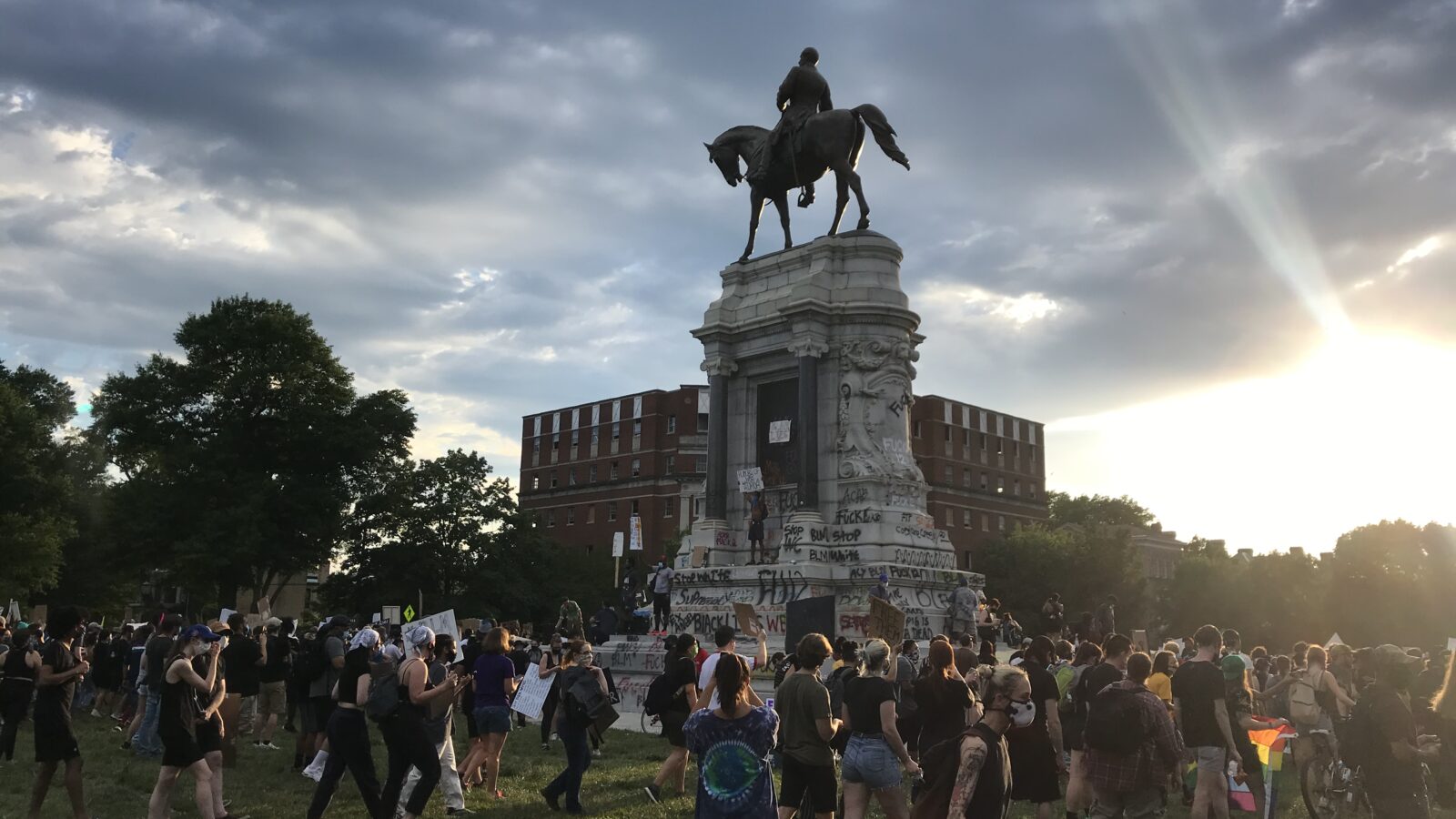
This June, I visited the Monuments exhibit at the Museum of Contemporary Art in Los Angeles with trepidation. The collection presented monuments that had been deposed in the so-called racial reckoning of 2020 following the police murders of George Floyd and Breonna Taylor in Minneapolis and Louisville. I lived in Richmond, Virginia, during this “reckoning,” and participated in actions where the city’s monuments were, to put it lightly, recontextualized: defaced, toppled, and dragged, in the case of its statue of Christopher Columbus, into the nearest lake. The explosive moment was one of the most powerful mass protests in my life, especially when witnessed from the former capital of the Confederacy. When we gathered that summer—dusted in tear gas, tense with the threat of riot police, but ecstatic at our mass refusal—reckoning actually felt possible. Now, its memory circulates as a cudgel the right uses to stoke further animus, or an embarrassment many liberals appear eager to forget.
In our time of mass-scale national amnesia, Monuments entered the conversation as a rebuttal—and a warning. Much like the Redemption era when the South’s Slaveholder’s Rebellion—now politely called the Civil War—was sanitized in national memory, we watch as a decade’s worth of activism for Black Lives has curdled into a program of spectacular revenge, factual contortion, and the broad-scale resurgence of white supremacy.1We witness what Kimberlé Crenshaw, the lawyer and Critical Race Scholar, calls the American pattern of reform and retrenchment.2 The targets are not just activism, but the national memory archived in public parks, museums, libraries, and universities with what the regime declares “improper ideology,” Marxist radicalism, insufficient fealty to America’s greatness, or antinationalism for speaking against American complicity with Israel’s genocide in Palestine. It would be tedious to list these details but, as Beth English and Christopher Sellers write, the regime’s revisionist program has “enormous stakes for American democracy.” Forgetting breeds forgetting, and the casualties of our memory remain the same: the racialized, colonized, and displaced underclass, whose history we dare not encounter publicly.
Alongside these contexts, my visit to MOCA felt personal because of that earlier summer in Richmond. Thick in this exhibit were many of the very monuments around which Richmonders had gathered in the summer’s heat, their gray edifices made resplendent with graffiti decrying their white supremacist origins, surrounded by the life-force of resistance. Revisiting those disassembled edifices in LA, far from the bloody soil their statues lorded over, I wondered what purchase such monuments—and the moment that lead to their toppling—might retain in an environment that seems hellbent on forgetting 2020’s insurrection. Just as quickly as media termed 2020 a reckoning, that reckoning’s content and meaning have been eviscerated, diminished into a farcical facsimile of itself. In our fascist resurgence, and the broader liberal abandonment of 2020’s insurgency, what role does revisiting these monuments have?
: :
Entering MOCA, I was confronted with the remnants of a stone pedestal that could have been from anywhere. It turned out to be the Robert E. Lee Monument from Richmond, the most intense site of resistance and organizing in the city that summer of 2020. When I’d moved to Richmond from LA, the scale of its monuments had left me stunned. Lee’s was especially imposing. As the largest of Confederate monuments, an equestrian statue of Lee posed on a huge pedestal that towered over Monument Avenue, it was part of the 1880s era Redemption era project in Richmond to codify the romance of the Lost Cause into the urban landscape. In 2019, the monument was imposing, gray, and inhospitable. By the next summer, it had been transformed, splashed with an ever-changing palimpsest of colorful graffiti with slogans against the police, for trans people, and celebrating Black life. The traffic circle surrounding it was rechristened Marcus-David Peters, after a Black Richmonder killed by police, and became a center of community gathering, protest, mutual aid, even joy, as Black residents played basketball and celebrated high school graduations—all with the specter of COVID and the police, who often disbanded our gatherings, sometimes violently.3
Disassembled in Los Angeles, this hunk of stone lost its site-specificity; I had no idea of its origins until reading the interpretative signage. But then I saw familiar traces—spray-paint celebrating Black trans life, decrying police—markers that brought me back to the stress and fury and feeling of possibility that saturated that summer. Lost in the detritus at my feet was the energy of Richmond’s streets—the rage at white supremacy that coalesced around the Lee monument—and of the acts of everyday resistance that overwhelmed it. In this displacement, the problem of memorializing monuments emerged clearly. In removing a white supremacist edifice without memorializing the protest that gathered around it, we threaten to erase the memory of this explosion of resistance and the many that preceded it.
On the other hand, bringing these monumental to the Confederacy back into the fore in Los Angeles – thousands of miles from its origins—felt both unsettling and necessary after the Trump administration’s attempt to re-install them, and more broadly, to entrench white supremacist goals into every element of public life. In LA, they lost their original context in a city founded on Spanish empire, Gold Rush settler colonization, and Hollywood glitz. In displacing monuments, the exhibit explored the limits and ends of what they monumentalized. Broken down and relocated, the monuments built broader connections across space and became a site to encounter white supremacy’s durability in our social fabric, while diminishing the threat of celebrating what they’d been deigned to embody.
Transplanted in LA, these familiar edifices transformed, sharp with markers of refusal: paint, slogans, and evidence of their dismemberment. They brought to the fore specters that might feel unfamiliar to many Angelenos, but they also indirectly excavated cultural memories lingering through the Great Migration and resonant with California’s own monuments to settler violence: the Mission system, indigenous massacres, the Japanese incarceration. Visiting MOCA was to encounter Robert Taney, the author of the majority opinion in Dred Scott v. Stanford (1857), alongside other infamous figures such as monuments to Robert E. Lee, the Confederate Navy, and an assortment of other Confederate equestrian figures. The scene was almost mundane—just another Confederate memorial, just another stone edifice sprayed with paint.
What was interesting was how they spoke in ways their architects never could have intended, but that protesters made possible. The monuments commissioned over 100 years ago are static, immobile representations, attempts to fix culture in one place. It’s a misprision to imagine them as anything but an attempt at ossification—which culture never accommodates, no matter what revanchist and fascistic attempts are made to lurch us back to a mythic past that attempts to “deny, or belittle the historical experience of those who have not had the civic power or privilege to build them.”4
Monuments invited us to think beyond that history, to the way their static claim demands a response. As Monument Lab, the collective that conducted a census of monuments across the US, optimistically argues, they incite a “call to action: engage in a holistic reckoning with monumental erasures and lies and move toward a monument landscape that acknowledges a fuller history of this country.”5 That landscape is everywhere, as the streets of LA demonstrated in 2020 and again in 2025’s uprising against ICE.
: :
As Anna Venarchik at The New Republic writes, MOCA’s exhibit reached “beyond the binary of take them down or leave them up.” Beyond that binary, Monuments created narrative contrasts by placing, for example, a Jefferson Davis monument in the same room as Andres Serrano’s The Klan series from 1990, which forced viewers to see the Klan in direct relation to the Confederate president. Simple pairings like this evacuate Lost Cause venerations that the presence of monuments uphold, undercutting mythologies that praise any aspect of the Confederacy as a neutral aspect of US history. In another space, a Robert E Lee and Stonewall Jackson monument (1948) from Baltimore, a Union city, sat next to Hank Willis Thomas’s A Suspension of Hostilities (2019), which reappropriates a Confederate flag-painted car from The Dukes of Hazard, demonstrating the embedding of Confederate apology within US culture that has not only extended its white supremacist violence, but made it an occluded subtext of the political right more generally.
The pairings demand that we connect the contested iconography of the monument to this larger function of embedding and erasure. Decontextualizing these artifacts both in space and in shape, but recontextualizing them in conversation, the exhibit reminds us of the failure monuments ultimately represent. More importantly, it refashions them to reflect on the possibilities and limits of resistance—and to consider how they can have a meaningful life informing our ongoing political upheaval.
The most effective pieces, to my mind, were Jon Henry’s Strange Fruit photo series and filmmaker Julie Dash and opera singer Davóne Tines’s film HOMEGOING, commemorating the 10-year anniversary of the Mother Emanuel African Methodist Episcopal Church shooting in Charleston in 2015. Henry’s Strange Fruit series, composed between 2014 and the present, focuses our eye on the police violence that endangers Black men with special viciousness. Orchestrated as pietas, Henry’s photographs show mothers holding sons in positions of repose, forcing us to think of the life and grief following police murder of Black men. In some, mothers gaze directly at the camera; in others, away. In many, Henry invited mothers to respond in their own words to the photos. The reference to the tenuousness of life in these photos rejects stone and recovers the aliveness of grief and ongoing loss, a rebuke to the ossified statues to which these photos sit in spatial opposition.
At the sensory level, Dash and Tines’s HOMEGOING immerses us in a sonic and visual experience, with the formal repertoire of opera repurposed to remember the Mother Emanuel shooting. As I entered the space of their film, a museum docent warned me that many viewers left in tears. the combination of classical European orchestral and operatic forms contrasted with the Spanish moss of the church, rebuking monumentality in both. The performance requires a different affective response—a movement into the captured embodiment of the singer on camera, and his voice above the sonic overload of the orchestra. Stone only overwhelms with its threat; here, Dash and Tines demand of our bodies a reaction of relation that traditional monuments cannot conjure.
Most striking to me was Kara Walker’s “Unmanned Drone,” held in a separate space in Koreatown, another displacement in space and further decontextualization from the material held in the Geffen Contemporary. Rather than presenting monuments merely recontextualized, she literally dismantled one. Repurposing the Charlottesville, Virginia, Stonewall Jackson monument, Walker carved it to pieces to create an unsettling amalgam of man and horse where a monument to a racist icon had been. Walker wrote that she “was thinking about cutting it up and butchery, that, in some regards, this act of reclaiming the sculpture required an act of butchery.”6 How else to approach what Walker describes were “the ruins of an idea of completeness that those sculptures were holding down” than a radical dismemberment? Ultimately, this prompts Hamza Walker, a collaborator on the MOCA project, to posit that “to melt it down is an erasure that would have been a benevolent death, as opposed to the horror, right? There are far worse fates than melting it down.”7
: :
Reflecting on MOCA’s assemblage of past and present, reimagination and static artifact, I found myself moved by what I saw. In part by the memory of such an insurgent moment, in part by the reality of that moment’s passing. It also reminded me, as Walker reflected, that we cannot, as many clearly wish to, forget that time. Her dismemberment of Lee approaches a larger idea: that we need to rethink “the ruins of an idea of completeness that those sculptures were holding down.”8We face these ruins again and again. More than facing the monument per se, Walker materializes the ideology underpinning them, forcing us into harsh conversation with their violence, but also endeavoring to imagine beyond them.
That imagination—forcing the monument to speak to both the violence persisting and the possibilities that monuments have gathered—is what struck me most after visiting MOCA. Monuments themselves are perhaps less interesting at the end of the day than the kinds of political action they convene. For that reason, they’re hard to reject outright. We can take down the monument, and neuter some of its force—we can display it, as in Monuments, to give it context. But what’s harder to assemble is a record of their role in assembling people against the monument itself.
Ultimately, the monuments at MOCA remind us of the larger cultural conversation occurring across multiple time scales that our insistence on 2020 as the moment intentionally obscures. It is a moment amongst many, going back to the many moments of 19th and 20th century resistance that congealed from quotidian events to become a movement. Indeed, as Kayinsola Anifowoshe reflects: “How can gathering and ritual happen in that space? . . . I feel like there’s so much work in just honouring that bringing down a monument affects each and every one of us.”9 Such confrontations realize how we “must become undisciplined,” as Cristina Sharpe beseeches, to look beyond Eurocentric constraints to develop “new modes and methods” that move us beyond our “ongoing rupture.”10 Monuments are, in the end, memorials of their rejection, reminders that they contain the seeds of their failure. From this, they implore us to remember the lineage of rejections from which we might build the departures that lead to our future.
: :
Endnotes
- For more on the scholarly sanitization of the Civil War, see Eric Foner, “Reconstruction Revisited: The Supreme Court and the History of Reconstruction—And Vice Versa,” Columbia Law Review 112, no. 7 (2012): 1585–606, esp. 1589-1590.
- Kimberlé Williams Crenshaw, “Race, Reform, and Retrenchment: Transformation and Legitimation in Antidiscrimination Law,” Harvard Law Review 101, no. 7 (1998): 1331–87.
- For more on how the activist spaces of the circle connects to the classroom, see Will Clark, “The Classroom as Monument,” The Rambling, September 17, 2021. https://the-rambling.com/2021/09/17/issue12-clark/
- The Andrew W. Mellon Foundation, National Monument Audit (2021) 25.
- National Monument Audit, 28.
- Kara Walker, interviewed by Hamza Walker, “Only Noble Feelings” (The Brick, Los Angeles, CA, 2025), 6.
- Walker, “Only Noble Feelings,” 16.
- Walker, “Only Noble Feelings,” 6.
- Paul Farber and Kanyinsola Anifowoshe, “On Moumental Failure,” in The Failures of Public Art and Participation, edited by Cameron Cartiere and Anthony Schrag (Routledge, 2022), 53.
- Christina Elizabeth Sharpe, In the Wake: On Blackness and Being (Duke University Press, 2016), 13.
Will Clark