
“It would be good to think that the soul lives separately from the body, that the soul lives forever and the body only for a time,” says Johanna Hofer’s character in Andrzej Żuławski’s Possession (1981). “But it isn’t so.” Hofer plays a quasi-incestuous and quasi-pedophilic guardian of the family: the character, (over)identified as “Heinrich’s mother,” indeed as her son’s possession, is a voyeuristic accessory to his affair with a fidgety housewife named Anna. Possession unfolds as an infernal joke about what happens when Anna and her absentee husband Mark, a spy, agree to get a divorce. They find each other again through their doppelgängers (paging fascist mirror-world gazer Naomi Klein) even if, in Anna’s case, sexual satisfaction must continue to be crowdsourced, now to squidlike creatures born of the decomposing torsos of Heinrich and other murdered men.
Amidst this apparent body-switching and -matching, Heinrich’s mother doesn’t say that the soul lives forever and the body only for a time. Nor does she say that it would be good if they did. She says that “it would be good to think” that way—as if negating an alternate reality did not require having rendered it, and therefore thought it, in the first place.
Possession is a Cold War artifact, set in West Berlin a decade before Germany starred in its own dark comedy of remarriage. But it is now being remade by Paramount, the Hollywood studio that, under the leadership of the MAGA-curious and Israel-romantic David Ellison, has sought to take possession of its rival, Warner Brothers. Margaret Qualley—bolstered by the success of the bicameral horror farce The Substance (2024), in which her all-American bimbo steals the life (in both senses of the term) of the mother/twin/self who gave Demi Moore a late-career renaissance—is set to take over the role of Anna hitherto synonymous with Isabelle Adjani.
Possession, a horror/comedy trope that inheres within national and nationalist genres of sexual and racial morality, is in vogue. In the box-office-smashing rape fantasia Obsession (2025), the confinement of a manic pixie dream girl to a foreign (if also manic-pixie-dream-girl) consciousness might just be the solution to the male loneliness epidemic: the in-cell to my incel. After a buzzy premiere at the 2026 Cannes Film Festival, a restoration of Ken Russell’s nunsploitation classic The Devils (1971) was announced as the inaugural release of Warner’s new arthouse subsidiary Clockwork (named thusly, of course, so that its titles would be presumed Kubrickian by association). The list goes on: it sure looks like Joe Biden lost “the battle for the soul of the nation,” etc.
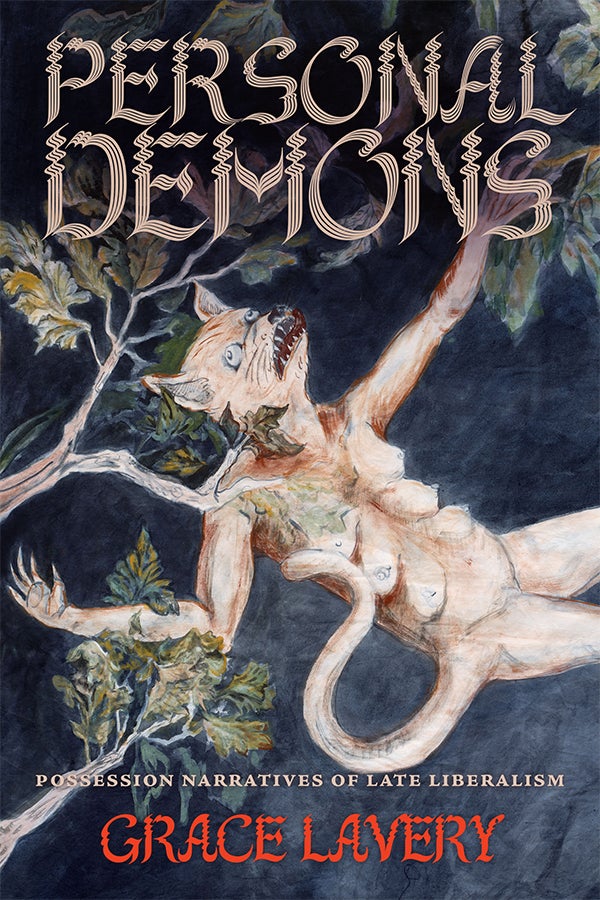
The remake of Possession, the release of Obsession, and the re-release of The Devils all postdate the completion of Grace Lavery’s genius, devastating new book, Personal Demons: Possession Narratives of Late Liberalism. They nevertheless blend into her corpus of anachronistic pop-culture curios, which, frozen as they are in the second half of the twentieth century, evidence “the position of dominance without hegemony” then held by “American cultural power and, crucially, cultural powerlessness” (13). Figures like Mary Harron, L. Ron Hubbard, Jordan Peele, Ye (f.k.a. Kanye West), Jerry Zucker, and, belching out a correlated memory of a memory of empire, J. K. Rowling are called upon to demonstrate “how we have come to believe that we have souls, when we know (or should know) that we do not have souls”—why, that is, it would be good, although sometimes not-so-good, to think that the soul lives separately from the body (8).
Lavery’s monograph, her fourth, issues from the premise that neoliberalism’s reigning form of secularity was monist, allowing no difference between mind and body, and dissolving personhood into a plurality whose scholarly correlates were network and affect theories. It is a premise that Lavery shares with Jennifer Fleissner’s Maladies of the Will: The American Novel and the Modernity Problem (University of Chicago Press, 2022). But whereas Fleissner searches the archive of dualism for notes toward a revival of the will, Lavery—who anyway does “not believe that ‘individual autonomy’ possesses or is entitled to possess anything like ‘dignity’” (16)—contends that neoliberal monism proliferated dualist exceptions.
The supernatural figure par excellence of such exceptions has been the demon. And, in cases pertaining to “the possession of an incorrigible and universal sexuality” (219), this demon has manifested as the transsexual. Amid a “(probably) terminal collapse” of democratic institutions “since roughly 2015” (18), demonic figures hover, generating mass Christian and Christianish fascination along with “syncretic theologies and nonce cosmologies” (10). For instance: “Both the paedophile and the transsexual are ghosts haunted by ghosts—they frighten us not because they permeate our body but because they demonstrate the permeability of our souls” (100). God is back. Or, God is dead, but all the same . . .
Personal Demons is an anxious book, and a sorrowful one. Lavery, for whom the transsexual is the “Cartesian subject” (57), remarks that sex transition necessitates one’s ability to express, “No, this is not my body—my body exists in my mind” (63). Hence, in Żuławski/Hofer’s conjecture, it would be good. And yet, loath to recover “the demon as an agent of some dubious sense of queer and/or revolutionary potentiation,” Lavery sells no program for uniting the subjects of monstrous epistemologies (20). A mid-book interlude models “a coalition of psychotics” in vignette form, nothing else (112). Anything more may not be desirable: Should transsexuality and, another one of Lavery’s objects, transraciality really be united? Anything more would also breach the logic of a book whose readings are conducted with scrupulous attention and admirable stamina, but also refreshing candor about their argumentative jurisdiction.
Take Lavery’s twisty chapter on David Lynch and Mark Frost’s Twin Peaks (1990–91, 2017), whose belated third season, subtitled “The Return,” is itself proof of the long shadow cast by late-twentieth-century mass culture. The series’ original tagline—“‘Who killed Laura Palmer’”—became obsolescent once its question was answered: a demon named BOB did, though not without the compromised if extant consent of his host, Laura’s father Leland (166). That tagline was eventually replaced by “‘it is happening again,’” a sentence that had come to refer to a formal cohesion between the murders of women who were, for their part, neither the same nor exactly distinct; two of them were played by Sheryl Lee (168). Twin Peaks’s new motto indexed a scalar shift from the empirically contained whodunnit to a transcendental “infinitude of violence,” summarizes Lavery, before noting a reintroduction of the forensics of identification in “The Return” (168). Having definitively answered the question of the origin of contemporary evil—BOB, it turns out, is short for atom bomb—the series could only, like the neo-avant-gardists in the mid-twentieth century, repeat a set of formal gestures loosened from their political context. Lynch and Frost would go on to clone characters, such as their affable protagonist, FBI Special Agent Dale Cooper, with renewed intensity, begging a new question: “‘Who is the character that Kyle MacLachlan is playing?’” (175)
According to Lavery, Lynch is not an artist of capitalist totality but, both more locally and more precisely, “a critic of genre storytelling” (175) who proves the inadequacy of narrative frameworks “to the intolerable fact of trauma” (176). As a whodunnit mutates into a tragedy, and a tragedy into what we might call a whoisit, Twin Peaks swings from dualism (one body, two minds/souls) to monism (an atom-splitting, radiating evil), to, once again, dualism (one body, multiple characters). The generic buildup is wholly unproductive: split figures accumulate none of the prestige virtues, such as autonomy or agency, by which they might be regarded as exceptional to late liberalism, let alone as belonging to some counter-normative public.
Personal Demons would benefit from a defense of the late liberalism concept, certain genealogies of which seem tangential to the late neoliberalism that interests Lavery—sure. But any gripes on my part are trivial. Lavery is one of the greats. Few literary critics have conveyed such intellectual energy and integrity. I see Personal Demons everywhere. Has it taken hold of me?
: :

Jean-Thomas Tremblay