Introduction — Sarah Dowling
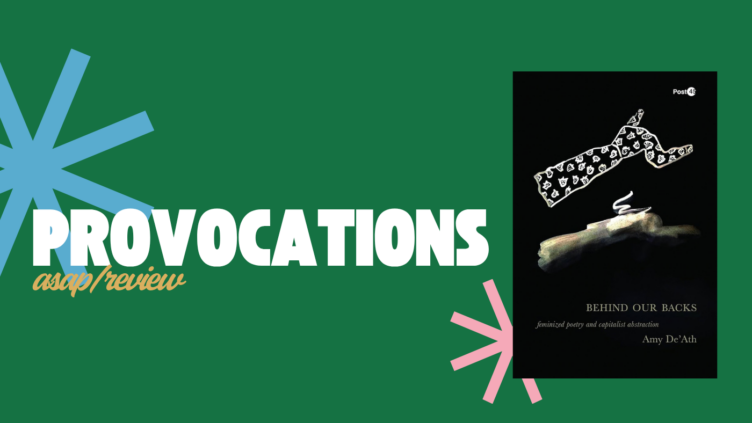
Amy De’Ath’s Behind Our Backs: Feminized Poetry and Capitalist Abstraction attends to the whirring of social forms in motion, asking its readers to connect sense perception and the total system. This connection, De’Ath shows, is what many feminized poets are thinking about in their work: the American poet Bernadette Mayer’s poems and the Canadian poet Kay Gabriel’s poems link the “concretization of gender and the production of whiteness” to “systemic shifts in labor markets” (9). Similarly, the British Indian poet Bhanu Kapil and the Anishinaabe poet Marie Annharte Baker track the reproduction and circulation of “racial representations of feminized subjects” (9). At first, this might sound familiar: these poets expose or unmask the well-known social structures of race and gender. But De’Ath is actually pointing to something different: this poetry “unfemininely dares to theorize a social totality” (9). It holds together social contradictions without enforcing their resolution—that is, the poems themselves engage the dialectical nature of aesthetic experience. Instead of blunt structural critique, this poetry helps us to grasp the “processual reproductions of gender, race, and class in their dynamism as social relations” (10).
Perhaps this sounds rather abstract. But De’Ath’s first sentence reminds us that Karl Marx famously argued “that human beings are ruled by abstractions” (1). These abstractions—which include things like the freedom to own property, to work, or to have a family—are not concrete entities we can touch or grab. Although these abstractions are intangible, De’Ath insists that “they are,” of course, “real” (1). They arise “behind our backs,” through the collective but uncoordinated actions of individuals, taking place “beyond conscious thought and outside of language” (1).
What De’Ath shows throughout her book is how contemporary feminized poetry’s own abstractions—its formal experimentation, its not-always-direct referentiality, its qualities of verbal artistry—bring these capitalist abstractions into language, and into view. Feminized poetry, De’Ath argues, takes capitalist abstraction out from behind our backs, and puts it in front of our faces. The repositioning is crucial because it “enables reader and poet to meet as dialecticians” (9). Together, readers and poets undertake “the speculative leap of faith inherent to all theory” (9).
In four chapters on six contemporary poets from Canada, the United States, and the United Kingdom, De’Ath explains how the kind of poetry that interests her—and that interests so many readers of contemporary writing—can teach us how to “read the world in its constitutive relations and in the nonidentity of its appearances” (179). This is as much a claim for what we read as for how we read it. It is an argument for the importance of feminized poetry as a source of theoretical knowledge, and it is a new method for Marxist interpretation. In these Provocations, we explore what Behind Our Backs makes possible for readers invested in theorizing Marx’s critique of value, in transfeminism, and in practices of analysis that begin from the position of the surplus population and attend to the specificities of wageless life. Just as De’Ath proposes, we meet here as a group of scholars interested in what she puts in front of our faces—in what her writing enables us to consider and examine.
: :
Provocation #1: A Poetics of Averages — Fintan Calpin
Capital is a world where human beings are ruled by averages. When Amy De’Ath writes about value as an abstract social relation, she is talking about an average: the socially average amount of labor necessary to produce commodity x as a fraction of the total social labor, i.e. a measure of one private labor in relation to all others. That’s the abstraction that, in all our collective making and doing, we remake every day. And it’s also the force that governs the reproduction of capital and all of us alike: value, the index of an aggregate. The continuous movement of that average is what we call history.
Behind Our Backs contributes to the tremendous advances in the last decade alone in how we read Marx’s critique of value, cresting a wave of work that re-centers analytical categories like totality, accumulation, surplus population, and abstraction. De’Ath shows us how much we can do with value theory, which also means showing us the limit points of that theory. For those of us interested in understanding the reproduction of race and gender under capital, this book’s gift is a nimble and pragmatic understanding of abstraction as “processual activity and relationality” (1). Where Beverley Best has described this function of abstraction as capital’s perceptual physics, Behind Our Backs opens the door for grasping it as a poetics.1
Capitalist abstractions are social averages: categories and concepts that emerge in the aggregate, illusory-but-real appearances cast off by the zoetrope motion of ratios as they tip over and reset. What’s analytically useful—and politically salutary—about this view of abstraction is that it keeps our eyes fixed on the contradictory movement of accumulation. As capital flows into profitable spheres, ratchets productivity, and squeezes out labor, it “gathers, institutes, and deploys difference wherever it goes” (78). Profit, ground rent, and wages are all averages. In a different way, gender and race are averages too: that is, they are mediated by ratios, such as the “gendered average” (87) of the price of labor-power and the shifting boundary between waged and unwaged activities. These ratios therefore shape abstract identity categories and social experiences of racialization and feminization.
Another way to put this is that De’Ath shows us how, under capital, abstraction is only another name for socialization: the perverse and historically peculiar mode of socialization qua domination that Marx names as the “fetishistic objectification of social relations” (50). What should be clear about value is that the portion of human activity that enters into its determinant social average is extraordinarily narrow (as Best, among others, has shown, only productive waged labor counts).2 This blindly operating average casts off as its remainder the persons and activities it doesn’t measure: the “underside” of value, figured in the abject and in reproduction as a “negative dialectic internal to abstract labor” (100). Marx’s value theory, read with De’Ath, can help us to see how capital’s function of abstraction doesn’t crush all particulars beneath the universal; rather, it spits out new kinds of difference, negating and preserving all that persists in the shadow of socially necessary labor time (which, I should add, makes up the lion’s share of human activity!).
And here we arrive at the limit point of Marx’s critique of value. Value determination is a one-way street, the movement of a relation through different social forms: gender does not determine the social average, but rather the social average determines gender. What De’Ath shows us is that—and this is the twisty bit—it is because of the unilinearity of value determination that future scholarship must think beyond Marx’s critique of value to understand the amalgam of concrete activities and modes of abstraction that shape gender and race as the social forms through which the value-relation is lived in the actual world. Behind Our Backs points the way forward when it looks to feminized poetry to intuit something more about the historical contingencies and political realities of “what looks like a capitalist social form” and “who counts as a viable gendered ‘reproductive’ subject,” as well as the “affective, embodied, and intellectual activities” that take place on both sides of this ever-shifting boundary.3
: :
Provocation #2: Transfeminism’s Dialectical Readers — Frances Jean Wohlscheid
In Behind Our Backs, Amy De’Ath’s engagements with queer Marxism, trans studies, and transfeminism do not only appear in her brilliant reading of Kay Gabriel’s poetic thinking on the “forms of identification and disidentification with gendered and sexed identity categories” and “feminization’s unnatural-ness” in Gabriel’s collection A Queen in Bucks County (57). They also form a significant methodological thread in De’Ath’s new Marxist-feminist literary critical mode, concerned as it is with how categories like sex and gender are produced by capital’s mediations, accrete to particular bodies, and mediate desires and felt senses of things. In the introduction, De’Ath draws on work by Rosemary Hennessy, Cameron Awkward-Rich, and Emma Heaney to articulate different elements of feminization. Crucially, and building on vibrant conversations about the wide range of possibilities for trans political life writ large, it is specifically in “recent developments in transfeminism” that De’Ath finds a connection between the Marxist critique of value and the processes of feminization: namely, “a renewed focus on gendered categories of identity as social abstractions that in part emerges from queer theory’s longstanding critique of identity” (30).
De’Ath’s dialectical reading of capital’s “hidden abodes” and “inner bonds” is itself an invaluable contribution to transfeminism. While this method proceeds from an identification and critique of gendered and sexed categories as social abstractions, Behind Our Backs demonstrates what an agile transfeminist reading practice can accomplish. For instance, De’Ath draws out how the motion, tones, rhythms, and relations in Gabriel’s poem “You Say Wife” enact a transfeminine critique of the sexed and gendered body in the capitalist totality. For De’Ath, Gabriel’s own poetic dialectical movement “between constraint and excessive overflow” and “fixity and unknowable freedom” reveal abstraction to be tethered to the historical processes of feminization and the dominative social relations of value (77).
As Jules Joanne Gleeson and Elle O’Rourke note in their introduction to Transgender Marxism (2021), perhaps it is our “revealing fate” that “our genders exist at once in normative and abstracted terms (women do this, men do that …) and intimately concrete ones (‘I have been on HRT for nine months now . . . ‘).”4 By refiguring sexual difference as a dialectical social form, De’Ath’s method grounds the terms and categories descriptive of trans life in the dynamic movements of value that shape them. In particular, De’Ath’s reading practice opens new pathways for reading the histories and futures of transfemininity. How might we read transfeminine artists and poets beyond the confines of the genres of confession? Consider, for instance, the work of Juliana Huxtable, which across mediums mounts a critique of capital’s racial forms while using her own body (like Gabriel does) as a site of grounded experience. Yet, she refuses to allow the gendered and sexed body to obfuscate the social relations that structure it, and in so doing, reveals the artifice of both. Such a critique is certain to find itself indebted to the dialectical movements between the socially expansive close readings and inwardly revealing theoretical explication that constitute Behind Our Backs.
: :
Theorizing the Present — Anna Zalokostas
If the group of writers Amy De’Ath brings together in Behind Our Backs is a surprising one, that is, perhaps, because “feminization” surfaces connections across literatures that might otherwise be separated by tradition or geography. Bernadette Mayer, Kay Gabriel, Ali Warren, Bhanu Kapil, Marie Annharte Baker, Hannah Black: De’Ath’s archive becomes less and less intuitive as the book progresses, and in that sense, charts new ways of apprehending interlinked processes of feminization under contemporary conditions of capital accumulation. Silvia Federici’s landmark “Wages Against Housework” offers De’Ath a jumping off point for understanding gender as a category of difference that is ultimately shaped and reshaped by economic imperatives; feminization is a function of the division of labor, and the division of labor is a function of capitalism. But what is most revelatory in De’Ath’s reading of Federici is her understanding of the housewife as one side of a dialectic whose other half is the factory worker. She is linked to “someone else’s consciousness”—and to “someone else’s wage” (De’Ath 18).
In that sense, De’Ath’s largely post-2008 archive of feminized poetry seems to me to be part of a recent tradition of Marxist criticism that follows what Michael Denning, writing in 2010, named “wageless life.”5 Reorienting leftist critiques of capitalism around surplus populations, Denning too begins with “women’s work” to think about those who have been forcibly expelled from the wage economy. We might see De’Ath’s theorization of feminization as a continuation of Denning’s thesis, a way of materializing what it could mean to reconstitute Marxist literary analysis around the dialectical other to the waged worker, particularly amidst the insecurity that characterizes many kinds of contemporary work. In De’Ath’s case, this does not mean particular types of labor that are not captured by the industrial paradigm of the wage, but an attention to “formless” histories and negative relations within capitalist totality. By directing us to the “hidden abodes,” “aching gaps,” “elsewheres,” and “polytemporal pacts” of the present, feminized poetry interrogates not only the unformed and illegible, but also the very logic by which form is wrested from formlessness (34).
In doing so, Behind Our Backs encourages us to think about what exactly literature has to offer a theory or history of the present. For De’Ath, poets are theorists of contemporary capitalism, and feminized poetry expresses the reality of capitalism’s forms of appearance; it helps us see how capitalist abstractions—like gender—become real by coercing participation in a whole web of social relations. In this account, feminized poetry shares much in common with consciousness-raising (a comparison De’Ath develops in her work on Mayer), though this is a form of consciousness-raising that neither asks readers for identification nor marshals support for the very social categories on which capital accumulation depends. Instead, by toggling between identification and dis-identification, feminized poetry enables writers and readers to “meet as dialecticians” (9). If poets are theorists, readers are too, and it is the meeting between poet and reader that is perhaps the most moving insight that emerges out of De’Ath’s method: ordinary people are involved in the work of analyzing capital all the time, and literature, in connecting writer to reader, abstract to concrete, system to experience, helps us both interpret and intervene in the world around us, as it is made and remade every day.
: :
Endnotes
- See Beverley Best, The Automatic Fetish: The Law of Value in Marx’s Capital (Verso, 2024).
- See Best, 39–45, where she makes this point with regard to debates around so-called free labor on online platforms.
- I owe a lot to the collective thinking of participants in an ACLA seminar on “Anti-socially Necessary Labor Time,” not least its organizers Anisha Sankar and Robert Jackson.
- Jules Joanne Gleeson and Elle O’Rourke, “Introduction,” Transgender Marxism, ed. Jules Joanne Gleeson and Elle O’Rourke (Pluto Press, 2021), ii-iii.
- Michael Denning, “Wageless Life,” New Left Review 66 (November–December 2010): 79–97.

Sarah Dowling

Fintan Calpin

Frances Jean Wohlscheid

Anna Zalokostas