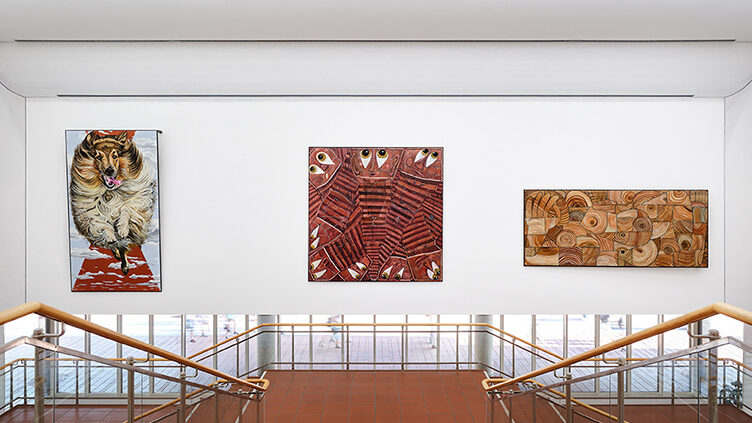
The title of Jana Euler’s new work, on view now through summer 2028 as Schultze Project #5 at Museum Ludwig in Cologne, recalls the discourse around 1960s minimalism and Michael Fried’s famous concern with the coming “theatricality” of art. Triptych – Image Viewer Connections similarly understands its meaning to reside in the manipulation of an audience response. Robert Morris’s 1966 “Notes on Sculpture” opened the question of how an artwork produces the conditions of its encounter through attention to scale, distance, duration, and the spectator’s physical movement around a three-dimensional object. For Euler’s paintings, the canvas becomes a spatial instrument whose image depends upon the coordinates of the body before it. She makes bodily movement part of the image’s legibility.
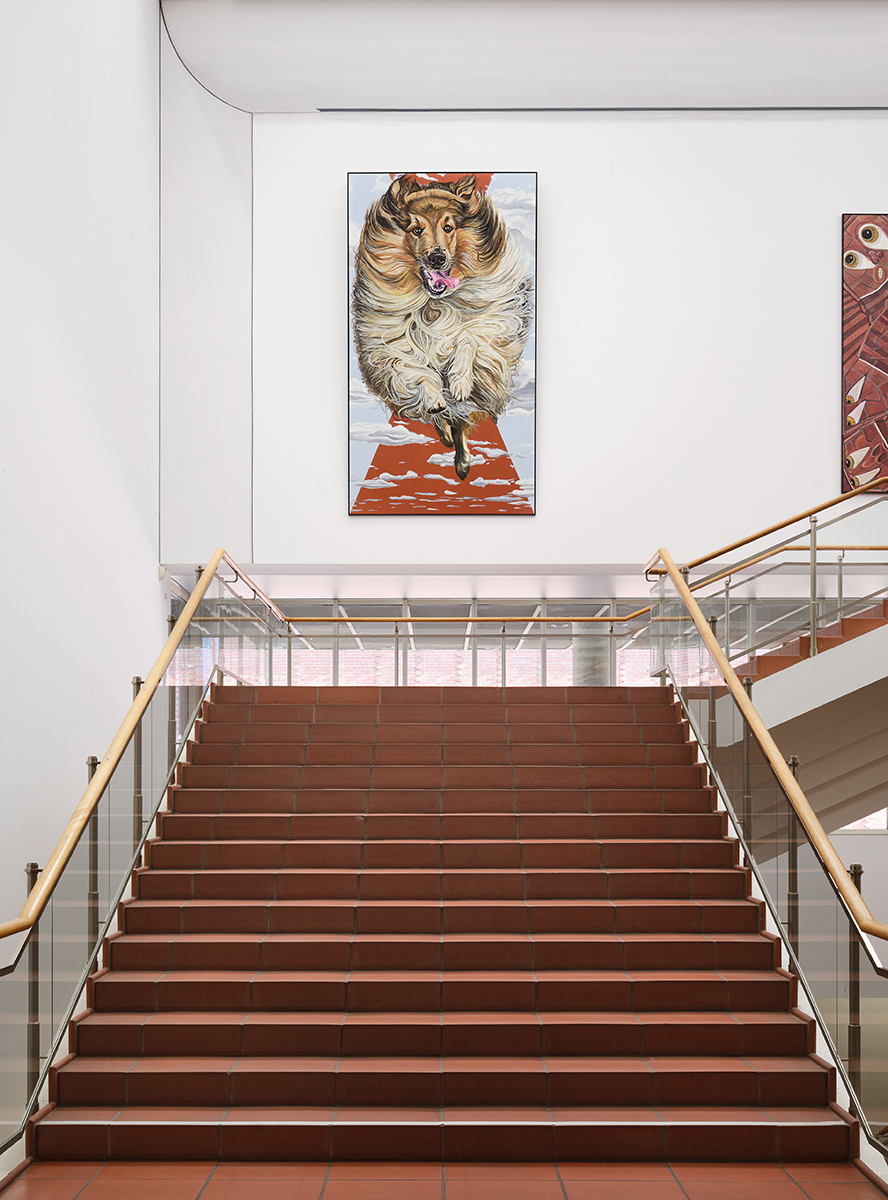
Triptych – Image Viewer Connections begins before the paintings become images. Installed on the Museum Ludwig’s largest wall, facing the main staircase, the three works share their surface with a trompe-l’œil reproducing elements of the foyer’s architecture: the sawtooth roof, the climate-control system, and the side walls. The illusion becomes legible from a particular position on the staircase, where the painted architecture alters the apparent scale of the wall and canvases. The installation establishes a viewing situation in which architecture, image, and bodily position are inseparable, and it transforms the staircase from circulation space into a pictorial coordinate system.
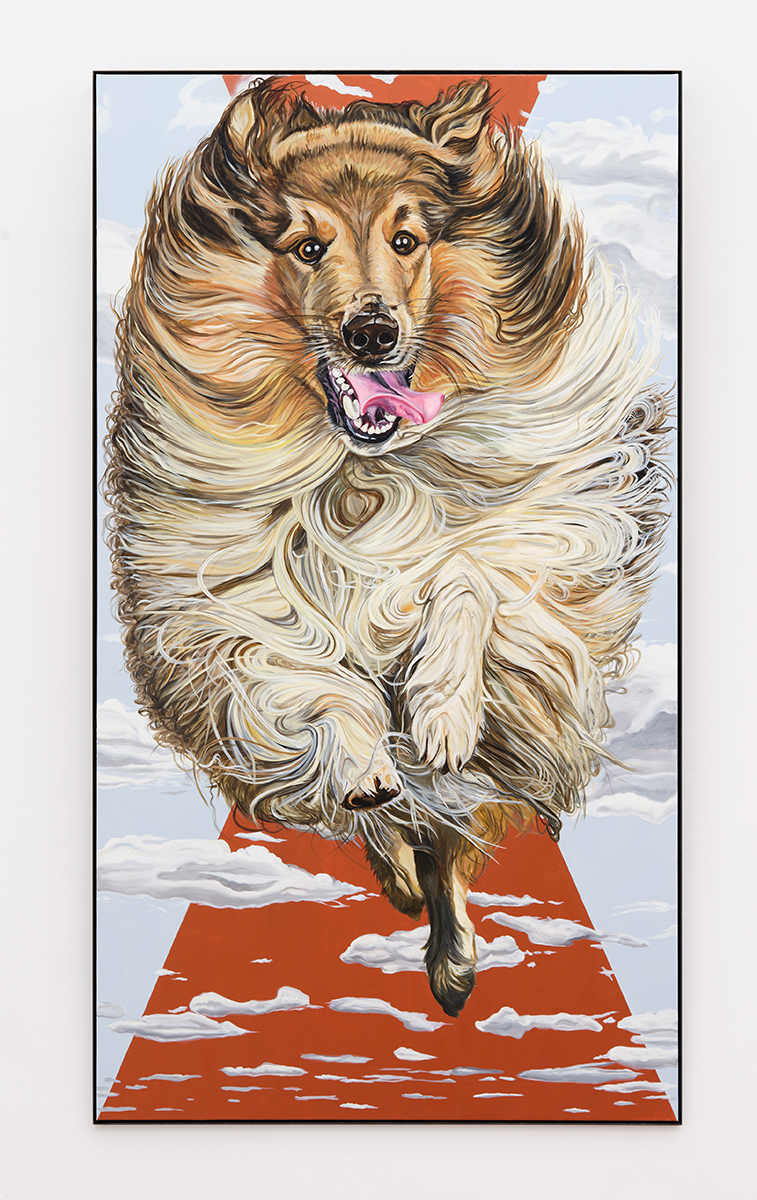
The first painting, One on One, depicts a long-haired collie in naturalistic oil paint, based on photographs. The canvas leans outward from the wall. From the bottom of the staircase, the dog appears relatively stable. As the visitor ascends, the changing angle of vision alters its apparent relation to the wall. The animal seems to advance. But movement exists entirely within the encounter between the fixed painting and the moving spectator.
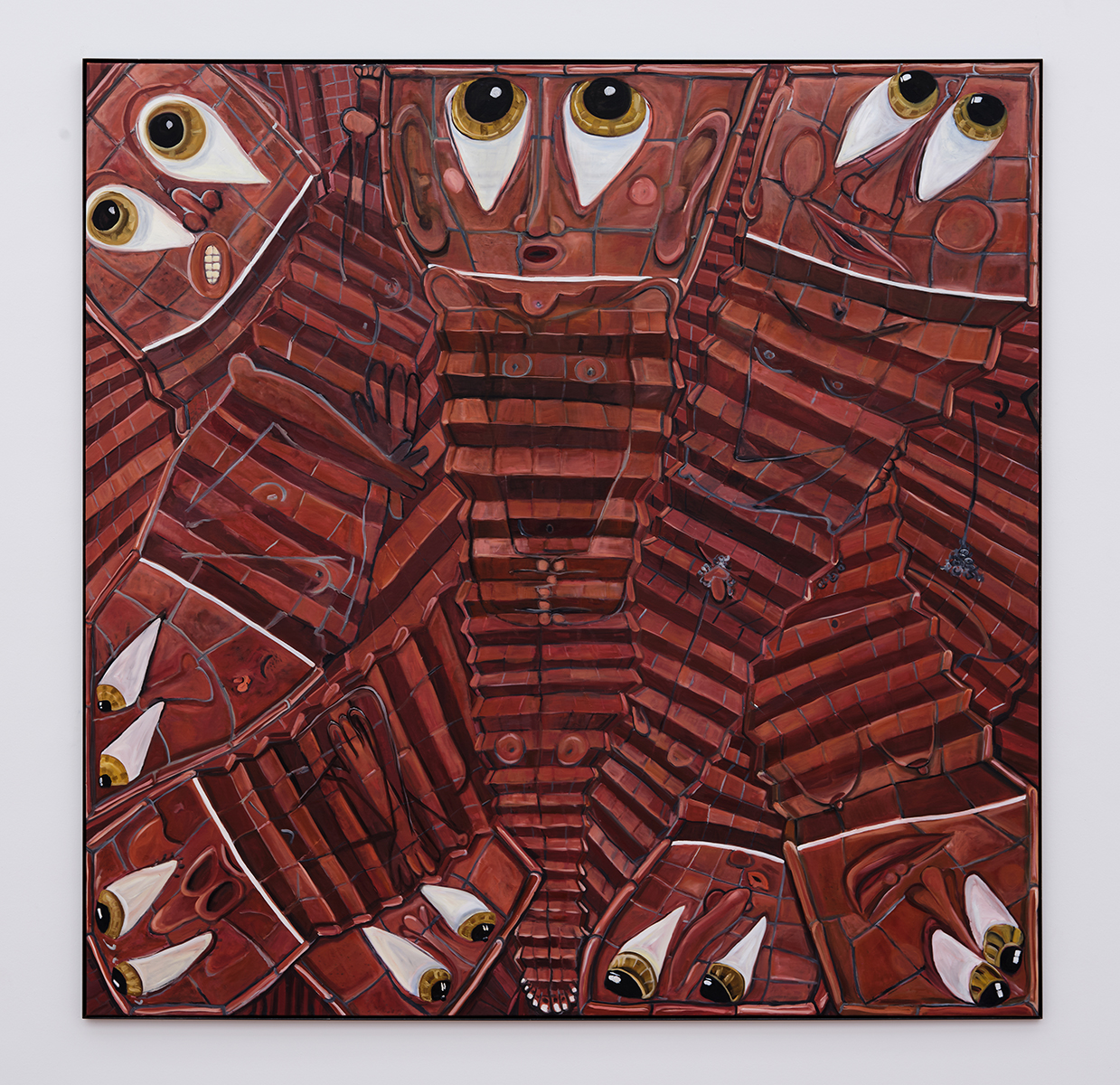
The central work of Euler’s triptych, Nude Stairs Staring Back, shifts from movement to recognition. Its reddish-brown surface echoes the Museum Ludwig’s floor tiles and initially reads as an abstract, almost Cubist composition. During the ascent, eyes appear at the margins, followed by mouths, breasts, genitals, and other anatomical fragments. The figure becomes legible through changes in height and angle. In museum press materials, Euler describes the anthropomorphized stairs as seeking eye contact from every position from which the wall can be seen. The painted gaze emerges together with the awareness of being looked at.
Euler’s painting thus recalls Dan Graham’s earlier Present Continuous Past(s) and Performer/Audience/Mirror, in which mirrors, video, architecture, and temporal delay expose the mechanisms through which spectators occupy the positions of observer and observed. For Euler, a comparable reflexivity is produced through figuration. The eyes in Nude Stairs Staring Back offer no reflection. Their function is perceptual: they turn looking into an encounter with another gaze.
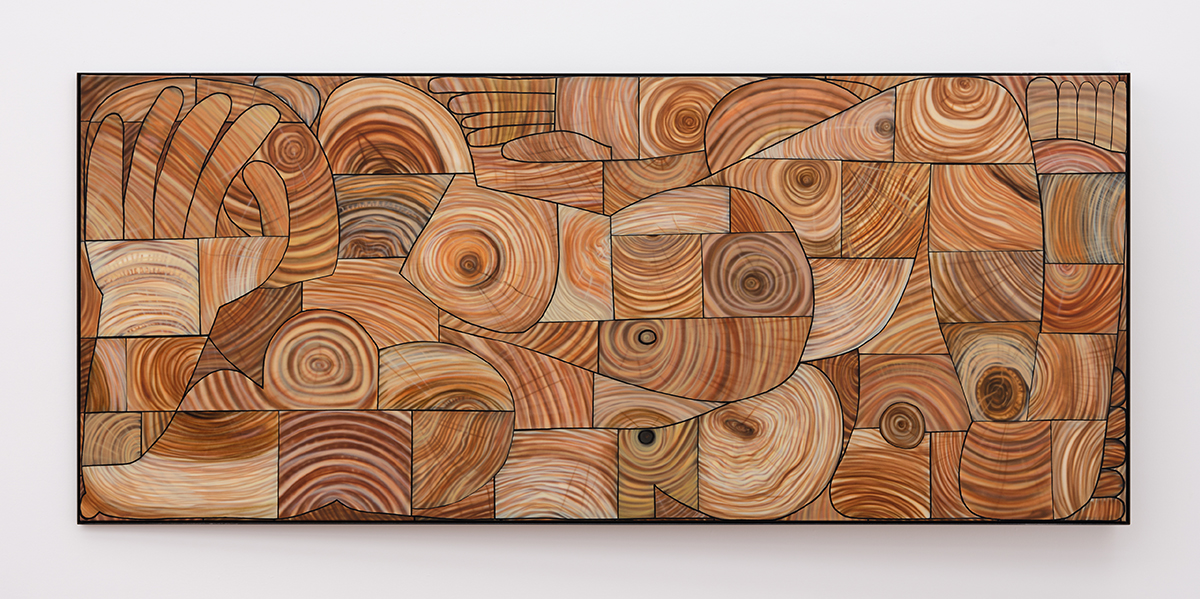
Reclining Nude establishes the opposite trajectory. Sprayed acrylic, in colors derived from the museum’s wooden floors, produces a surface that approaches abstraction from a distance. During the ascent, five fingers and a head resting on a hand become discernible, followed by the possibility of a reclining body with bent knees, turned away from the staircase. The figure remains fragmentary, requiring the spectator to assemble it from partial signs.
The three works establish three directions for pictorial encounter: advance, confrontation, withdrawal. Their differences depend on the same architectural sequence. The staircase supplies three viewing levels, each producing a distinct configuration of the wall and its images. Just as Michael Asher’s site-specific interventions brought walls, thresholds, circulation, and institutional structures into the viewer’s field of attention, Euler directs attention toward the staircase and floor. Architectural elements acquire a role in determining pictorial meaning.
Euler’s triptych extends painting into the architecture of its reception. The three figures establish different modes of encounter, while the staircase supplies the temporal coordinates through which they become perceptible. The work makes bodily passage a condition of pictorial experience and turns the act of looking into its central event.
To extend painting into architecture takes on particular importance in our moment of images extended into increasingly digital and automated contexts. Contemporary screens permit images to change while the viewer remains physically stationary. Euler assigns the movement to the opposite side of the encounter. The paintings remain fixed; the spectator generates the sequence of views.
This redistribution of movement gives the triptych its temporal form. The visitor accumulates successive configurations while ascending, turning at the landing, and descending. Each view enters the memory of the next. The work unfolds through duration. Position becomes part of pictorial knowledge.
The political force of this arrangement lies in its insistence on situated vision. The staircase demonstrates that every view has conditions: height, distance, direction, duration. A change of position changes the field of what can appear. The museum passage becomes an apparatus for experiencing the organization of perception.
For Euler, architecture brings us back to our bodies at a time when the digital sphere seems to abstract images away from embodiment. It has become popular on social media to call for people to touch grass as an antidote to digital malaise, the doomscrolling of algorithmic feeds. Euler provides an alternative: walk staircases.
: :

Margherita Artoni