Gene Swenson: What happened to you in the 1960s?
Paul Thek: I was beaten to death.1
Paul Thek’s legacy is undergoing a major revival, with recent exhibitions at Pace Gallery and Galerie Buchholz, a dual biography of Thek and Peter Hujar, and ongoing publication projects of Thek’s personal notebooks. At a discussion on Thek at Pace, I was surprised when the artist Alex Da Corte claimed to have “reinvented” Thek’s seminal 1967 installation The Tomb, calling this period of Thek’s “the most flat-footed work he’d ever make”—a put-down of an artist whose work Da Corte himself has fastidiously reconstructed. Regarding The Tomb, Da Corte said, “It just is what it is. And, frankly, there’s like, not so much to say about it. It’s a tomb of a body, and all that is contained within that is there, on the surface.”2
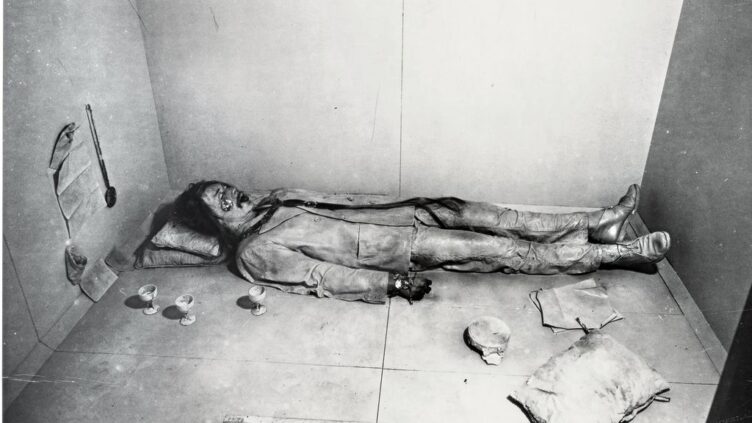
For a faithful description of The Tomb as it first appeared, consult Robert Pincus-Witten in a 1967 issue of Artforum: “One enters a spacious, rosily-lit, and incensed haze out of which rises a large, three-tiered ziggurat. Punched into the face of the ziggurat is an entrance-way, recalling, perhaps intentionally, the pharaonic tomb display built into the Egyptian Wing of The Metropolitan Museum of Art . . . Affixed to the entrance wall, like a museum label, is a coldly neutral explanation . . . Welcome: You are in a replica of the tomb. It has been prefabricated at a cost of $950.00.” Pincus-Witten lingers over the burial site, the dead artist stretched out in garments, shoes, and interior all saturated in “petal and American vermillion pink,” his blond locks brushed from his forehead revealing “a dead mask, eye-lids closed, and a dark, plagued tongue flopping upon a half parted mouth . . . moustache . . . lashes and lids have been painstakingly fitted, hair by hair, into the wax mask.” Adding to the impression of a dead hippie, discs of butterfly wing patterns adorn the cheeks of the figure, and a funerary necklace alternates locks of hair and medallions. Objects are “ardently” placed around the body: chalices, covered food bowls, poetry, blank journal pages, and “in a little pouch, the missing fingers of the effigy’s mutilated hand.”3
Thek’s career was not always glamorized: the years leading up to and following his death from AIDS in 1988 were fallow, but the rise of Abject Art in the 1990s marked a resurgence of interest in the artist, boosted by Mike Kelley’s essay “Death and Transfiguration: A Letter from America,” which played a direct role in Thek’s critical rehabilitation. Somewhat predictably, Da Corte has also recruited works by Kelley for his exhibitions—Kelley is a “huge hero”: “This is somehow as close as I can get to his work—to have some sort of physical relationship to it. It’s the same desire I’ve always had like when I wanted to put my dick against an Abercrombie and Fitch catalog—but these meetings are partly failures; we can take something that’s sentimental to us and press it up against our heart but it won’t get you any closer to the thing you want.”4
Kelley considered Thek’s Tomb a “masterpiece,” noting it generates its transfixing powers from its refusal to be accommodated, insisting on grotesque material that “official art culture” is unable to domesticate. The cast figure speaks to the art world in “a low and dirty language,” which signals “America’s disgust with and hatred of cultural otherness. It is the image of the fear of death, the erotic, gender confusion, and visual opulence—its fear of anti-institutional art.”5 Bearing evidence of the murder of counterculture and the neutralization of the deviant other, “the fingers, the artist’s generative organs” are sawed off and hung from the figure’s throat, “souvenirs of slaughter” redolent of “the kill tokens taken by soldiers in Vietnam.”
Many of Thek’s notebook entries and letters echo Kelley’s political reading of the work and share his bleak view of American culture. He wrote to a curator in 1973: “Here in NY the Viet Peace has come . . . This empire is crumbling fast even while the skyscrapers keep going up and the american [sic] experience makes me a bit sick, like blood in my mouth.”6 His close collaborator Ann Wilson considered Thek a “radical revolutionary” whose awareness of “the allocation of resources in society” and the capitalist powers that “disregarded individual and communal destiny informed The Tomb as a metaphor.” Thek’s taste for the macabre rivals Kelley’s own—yet his radical politics were inseparable from spiritual aims: the source of art, according to Wilson, “was to explicate the numinous. It was an idea of healing or spiritual emanation that people should receive.”7
Thek, like Kelley and Wilson, was raised Catholic and held deep spiritual convictions. He thought it was essential that art radiate energy from its center, “to give a lift.” Enduring impressions from Catholicism provided a deep well of theological imagery: the chalice, the veiling of statues and crucifixes in purple cloth during Lent, the themes of the Resurrection. He filled notebooks with extended passages drawn from writers who anchored his spiritual imagination: Augustine, Ananda K. Coomaraswamy, Meister Eckhart, George Gurdjieff, William James, Brother Lawrence, and Thomas Merton. He even attempted to join a Carthusian monastery (only months before his death he was apparently accepted for a trial run). In a 1975 notebook Thek wrote, “The secularization of art and the rationalization of religion are inseparably connected, however unaware of it we may be.”8 These convictions reverberate through conversations and journal entries over the course of his life. His environments of the 1970s dealt “with basic cultural-theological patterns, ecumenical symbols, myth . . . towards an ecology of earth AND spirit resources.”9
Thek’s Tomb is decadent. Though it can be read as a paean to social decay, it is also a romantic declaration, a kind of perverse fey reverie. Thek credited Larry Bell as a key influence on his Technological Reliquaries (1964–67), whose soft pastel colors cut against the machismo of minimalist aesthetics. Made alongside and culminating in The Tomb, the series satirizes minimalism’s antiseptic pretense while drawing on ancient Egyptian and Mesopotamian forms and symbols—sources that had preoccupied Thek since adolescence, crystallized by his trip to the Capuchin Catacombs in Palermo with Hujar in 1963. Christian ex-votos modeled on body parts, Johns’s Target with Plaster Casts (1955), Duchamp’s Torture-morte (1959), and Marisol’s wood-block assemblages using casts of her own face (1961–66) anticipate Thek’s work of this period—and may have shaped it directly. Thek called his work “Insulting to our sense of the humane, insulting to art history in terms of subject matter,” due to its complete lack of reassurance of cultural norms. “Only people who want to be ruffled can truly appreciate what’s happening in modern art,” he said. “In a way that’s sadomasochistic.”10
Da Corte describes the making of his The Tomb as a research-intensive process based on the few photographs and archival materials that exist, an undertaking he had wanted to realize in some form for over twenty years. The result is a technically meticulous reconstruction in which Da Corte’s body appears as Thek’s recumbent figure. From November 7 to December 20, 2025, The Tomb premiered in his exhibition Parade at Matthew Marks Gallery. Curiously, his first New York solo in over five years generated little critical response beyond promotional coverage and the gallery’s own publication: a 52-page catalog (collector’s item, out of print), devoted to “Da Corte’s recreation of Paul Thek’s lost artwork of the same title from 1967.”
According to curator Elisabeth Sussman, who is in conversation with Da Corte in the catalog The Tomb and participated on the Pace panel, “The great thing about what Alex did in recreating The Tomb was the combination of the scientific literalism—of recreating a loss—there’s something extremely Paul Thekian about that.”11 Indeed, the wax figure was abandoned, and it is through that rubric Da Corte is positioned to rescue it. But it’s a complicated story. When the figure was shipped back to Thek following European exhibitions, it arrived badly damaged. He refused, or neglected, to retrieve it at customs. The figure is presumed to have been destroyed at this time, around 1981/82. By this point, “The Dead Hippie,” as it came to be known, was Thek’s albatross. He insisted to a curator: “It’s my tomb, not a dead hippie, call it Thek’s tomb.” When a museum asked to exhibit it in 1981, he wrote to a friend: “I really don’t want to have to do THAT piece again! Oh God no! Not THAT one. Imagine having to bury yourself over and over.”12
Despite no longer existing as an object, The Tomb has remained deeply influential. Its inaccessibility increases its mystique, just as Duchamp’s Fountain (1917) resonates in infamy through Stieglitz’s photographs and in its later true copies (pour copie conforme) (1961–66). Kelley doesn’t mention if he saw The Tomb in person—like most fans of the work, he may have only seen it reproduced in photographs. Its disappearance hasn’t prevented generations from drawing inspiration from the iconic work. Thek wove striking yet ambiguous relationships, crisscrossing time and space, into a charged, associative field: a wax proxy is at once the artist, a hippie, Christ, the viewer, a friend. Death, after all, unceasingly captures our fascination, fear, and awe.
: :
“Appropriation art” can mean at least two different things: a narrow historical category tied to the 1970s–80s Pictures Generation, or a broader, descriptive term for artists who rework found, borrowed, or pre-existing imagery. Da Corte fits the broader sense well in his “embodiment” of various figures, but he never reframes that material into a critical gesture. He and his gallery seem to avoid the term “appropriation” with its connotations of unoriginality. Parade’s press release describes him as known for work “that explores the nuances of contemporary life through a masterful layering of images drawn from popular culture, art history, and modern design.” Perhaps it’s predictable to witness charmed curators eschew terms such as “cultural appropriation” or “appropriation art” in the presence of an art world darling, as was the case at the Pace panel. Yet what is at stake in evaluating Da Corte’s practice, and especially his Tomb, is not only a question of whether it constitutes appropriation, but the fact that his reconstruction seeks to collapse the distinct categories of historical inquiry and authorial possession. The former foregrounds distance, mediation, and context. The latter attempts to eliminate that distance. The “appropriation” label holds, minus its charge: Da Corte’s reconstruction sanitizes the original’s conditions, draining the historical stakes, spiritual force, and cultural consequence that give Thek’s Tomb its resonance.
At Pace, I asked Da Corte about his motivation for casting himself as the figure, and why he wanted to share it with the public. He had discovered Thek’s Tomb in a school library catalog twenty-seven years prior: “I was quite ill at the time. And I remember thinking, like, I relate to that guy—I remember, like, seeing myself in him—and thought, I’m a young person and I’m dead already, and like, how unfortunate. But I felt really connected to him.” He went on: “I want to make things that evoke a kind of poetry and a humanity and a vulnerability that was The Tomb.” Da Corte’s longing is fully evident. He described failing repeatedly to make a work in response—“it was kind of cut up bodies or whatever, but it was gory, and not quite the thing”—before falling ill again more recently and deciding, “it was kind of time for me to embody that figure, which had remained elusive and was unknown, but also to maybe address my own relationship to this kind of constantly failing body that I have.” He framed this as inseparable from a broader practice of inhabiting figures, “be it Duchamp, or Jim Henson, or Eminem, or Michael Myers, or The Wicked Witch, or whoever it is, that I’ll learn something that I don’t already know, maybe, that’s just contained right there in front of us.” To any person or character he might inhabit, Da Corte seems to insist that the occupying of bodies is simply part of the practice. Is this “embodying” a form of unwitting vampirism?
Perhaps we can best address this question by recalling Chris Burden’s refusal to grant Marina Abramović permission to re-perform Trans-fixed (1974) for her 2005 series Seven Easy Pieces at the Guggenheim Museum. Bob Nickas offers his take on Burden’s stance: “A persona is the role one assumes in order to display conscious intentions to others. But in performance, is the performer always assuming a role, or is it possible that this is the person we are seeing? When Burden refused Abramović permission to re-perform one of his works, perhaps he was insisting on the fact that he was not, at the time, assuming a role, that this was not a part that he was playing, that he wasn’t working from a script, and not on a stage within the confines of art. To any artist making such a request, Burden might likely have insisted, You can’t occupy my body, and my mind.”13
Thek is not around to claim ownership over his own story, to set the record straight. A principal discovery in Da Corte’s research for The Tomb was realizing there was a piece of glass preventing people from entering its inner chamber. “It always lived behind glass. And I thought, how strange and how urgent. Our whole lives live behind glass.” This is presented as a kind of epiphany. “As close as I was able to be inside of it, and to cast my body and be within it,” he said, “when you put up that piece of glass you’re still just as far away from it.” He lamented, “And it became a picture again, and I thought Oh fuck . . . There it’s gone again. And it became a unicorn again. And that’s just part of living, I think.”14 This is precisely where Da Corte and Thek diverge. For Thek, the distancing of the vitrine, the reliquary, the corpse, is not a condition to be removed but one to be weaponized. Da Corte, by contrast, grieves that distance, recasting it as an inevitability—a disappointing banality, the perpetual gap between longing and its object, the unicorn that remains just out of reach.
At Matthew Marks, The Tomb preserves its bare image while evacuating its antagonism. If Thek’s figure speaks in that “low and dirty language,” what register does Da Corte’s figure speak in? Who is it addressing? What it signifies is not abjection, but the language of capital, spoken with the accent of the blue-chip gallery: smooth, vacant, mute. Thek, in a 1976 notebook: “Perhaps so much of our art now says nothing, means nothing, because if art really did begin to speak . . . it would seriously threaten our lives, our ‘lifestyles’. But an art that says ‘nothing,’ that art is of no particular danger to anyone or anything.”15 Da Corte’s result is not a reinvention or a remixing, but a transposition into a different key, one aligned with institutional legibility and market circulation: another kind of house of worship. Despite his heroes, Da Corte’s aesthetic and principles are closer to the polished, brand-level spectacle of an artist like KAWS: powered-down effigies whose seductive surfaces paper over the raw, undomesticated grotesquerie that is Thek’s Tomb.
Fabricated with the ingenuity of a studio team, Da Corte’s Tomb transforms its maker into a king.16 Indeed, kings are a theme in Parade: another work, The Death of King Friday XIII, offers a woebegone facsimile of the puppet from Mister Rogers’ Neighborhood. Once you notice the echoes across Parade—kings, and likewise color—you see visual decor quietly flatten loaded signifiers. Pink, which Kelley read as a direct affront to masculinist authority—”the hippie color . . . fairydust color, gender-bender color, anti-I-beam-sculpture color, the color of the New Man, the hermaphrodite color”—now links The Tomb to the Pink Panther in an adjacent gallery through simple visual rhyme, Da Corte himself the mascot, pink-faced, roller in hand.
In an explicit fashion, Da Corte’s project suggests a desire to have the most intimate experience with Thek’s original work. The Tomb becomes in Da Corte’s hands a personal vehicle for intimacy, loss, and longing. But to recreate something lost is not the same as “recreating a loss,” as Sussman said—Da Corte’s loss carries no such emotional register, confined instead to a benign form of camp. Confusing intimacy with equivalence: to reconstruct a great work is not to have made one. It is precisely the spiritual ambition and political stakes of Thek’s legacy—and Kelley’s after him—that Da Corte sanitizes. Inserting his likeness into his replica of The Tomb, Da Corte positions himself among Thek’s torchbearers—yet one is reminded of Apostle Paul’s account of the “false brothers,” those “who slipped in to spy out our freedom that we have in Christ Jesus, so that they might bring us into slavery.” To such a claim of kinship, Paul Thek might have declared: “to them we did not yield in submission even for a moment.” 17
: :
Endnotes
- Paul Thek, interview by Gene R. Swenson, in The Other Tradition (Institute of Contemporary Art, University of Pennsylvania, 1966), 40.
- In Conversation: Andrew Durbin, Elisabeth Sussman, Alex Da Corte, and Lynn Zelevansky on Paul Thek, moderated by Oliver Shultz, Pace Live in collaboration with the Watermill Center, New York, May 14, 2026, https://www.youtube.com/watch?v=K-Fu9zQO8AE. Da Corte contrasted the supposed literalness of Thek’s Tomb and his Technological Reliquaries with the artist’s move to Europe in 1967, when he “explodes—he goes into another life, a second life, where it’s freer, and the work is unbound. . . . Post–The Tomb he’s like a freak, and you know, lets that fly in a way that’s quite cool. So there’s a kind of conservatism around those early works, being that they are both free and meaty, but also within a box.”
- Robert Pincus-Witten, “Thek’s Tomb . . . Absolute Fetishism,” Artforum 6, no. 3 (November 1967): 24–25.
- Alex Da Corte, interview by Jarrett Earnest, “Alex Da Corte with Jarrett Earnest,” Brooklyn Rail, April 2, 2015, https://brooklynrail.org/2015/04/art/alex-da-corte-with-jarrett-earnest.
- Mike Kelley, “Death and Transfiguration: A Letter from America,” in Paul Thek (Turin: Castello di Rivara, 1992); reprinted in Foul Perfection: Essays and Criticism, ed. John C. Welchman (MIT Press, 2003), 138–49.
- Quoted in Andrew Durbin, The Wonderful World That Almost Was: A Life of Peter Hujar and Paul Thek (Farrar, Straus and Giroux, 2026), 353.
- Ann Wilson and Roland Groenenboom, “International Seminar: Paul Thek,” panel discussion, Museo Nacional Centro de Arte Reina Sofía, Madrid, February 6, 2009.
- Insert in the catalog box set, Paul Thek: Alexandre Iolas (Alexandre Iolas, 1976). An excerpt was also reprinted in Michael Compton, Continuous Creation (London: Arts Council of Great Britain, 1981).
- Durbin, The Wonderful World That Almost Was, 351.
- G. R. Swenson, “Beneath the Skin: Interview with Paul Thek,” Art News 65, no. 2 (April 1966): 66–67.
- Sussman, In Conversation (see note 2).
- Paul Thek to Franz Deckwitz, letter, October 1981, quoted in “Paul Thek: Biography IV (1978–83),” Selected Confessions: A Narrative Biography, ZKM Center for Art and Media Karlsruhe, http://www06.zkm.de/zkmarchive/www02_thek/thek/index_com_content_view_37_65_en.html.
- Bob Nickas, remarks at panel discussion for Defining Contemporary Art: 25 Years in 200 Pivotal Artworks, Phaidon, the Museum of Modern Art, New York, May 4, 2012.
- Da Corte, In Conversation (see note 2).
- Paul Thek, “Composition Notebook,” 1976, Estate of Paul Thek, quoted in Durbin, The Wonderful World That Almost Was, 39–40.
- Thek created The Tomb with the help of his assistant Neil Jenney, and he went on to make European environments with the Artist’s Co-op, a rotating group of collaborators that (according to Ann Wilson) Thek often funded from his own artist fee. He insisted his collaborators be named in press materials, but the press rarely obliged, treating Thek as sole creator. The group included Wilson, Franz Deckwitz, Edwin Klein, Charles Shuts, Cindy Lubar, and others (Wahundra, Lily, Michèle, Ildiko). While Thek actively resisted the individualist myth through an anti-capitalist collectivism, today it is comfortably tolerated. Da Corte’s studio staff assist with costume, makeup, casting, fabrication, and prosthetics, yet the gallery press materials that circulate his work provide Da Corte with sole authorship. Likewise, in the Art21 episodes on the artist where his collaborators’ labor is plainly visible, they go uncredited.
- Galatians 2:4–5 (English Standard Version).
Gryphon Rue