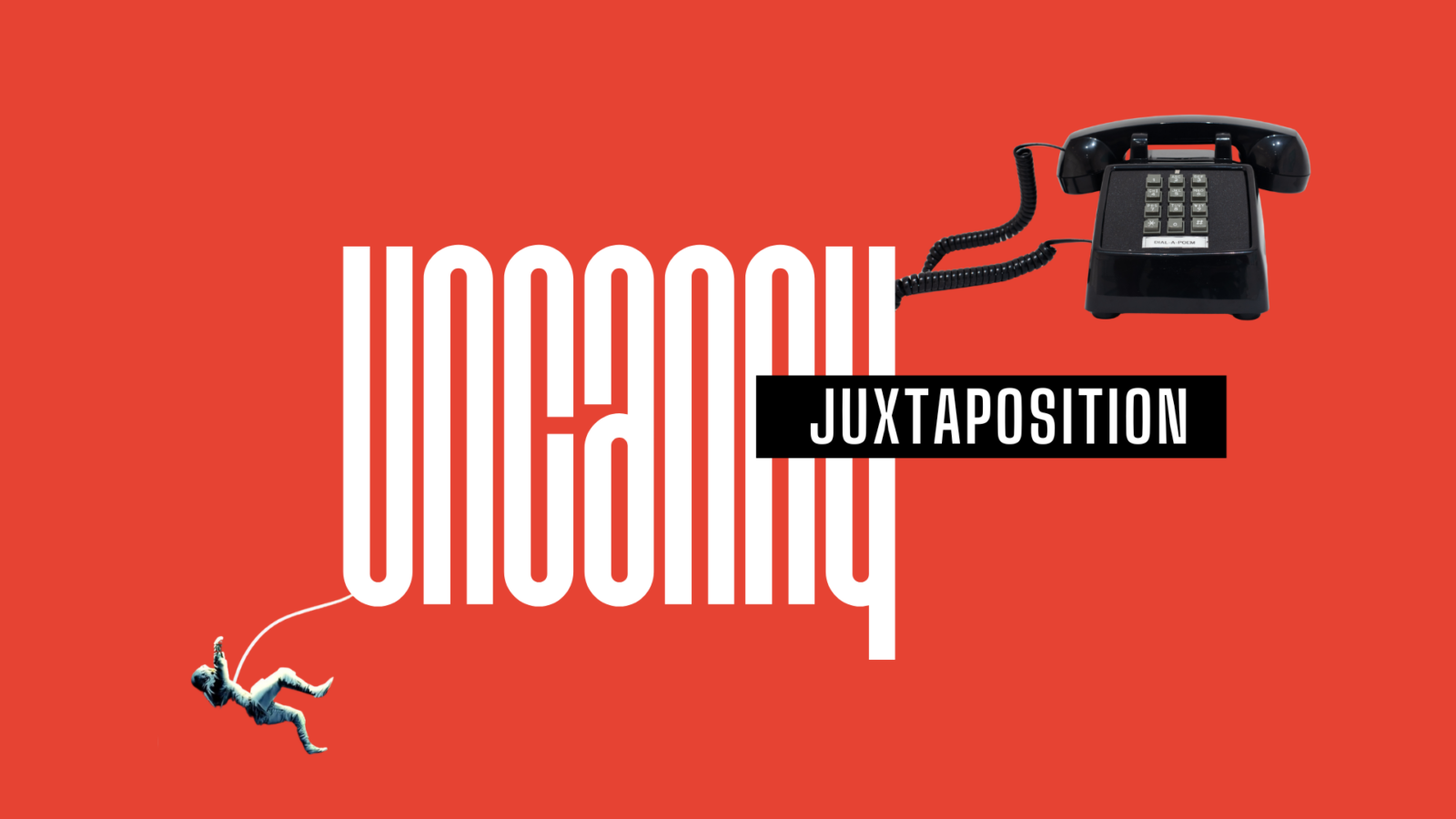

The first time I call the Dial-A-Poem Hong Kong hotline, I hear Leung Ping-Kwan’s “The Thunderbolt and the Cicada Song.” This initial experience of Dial-A-Poem is mediated by the limits of my Cantonese proficiency. I understand some individual lines, and can pick out phrases, but the written Chinese used in the poems has vocabulary not used in spoken Cantonese, and I am thrown by these unfamiliar sounds. But the exhibition text from M+, Hong Kong’s museum of visual culture, reassures me: “You are invited to enjoy the sounds and rhythms of the words, even if you do not understand the language of a poem.”
I dial again, and this time I get a poem in English, Jennifer Wong’s “Meanwhile, the sea.” Yet the phone line is staticky, the reading echoed, and when my focus slips momentarily, I realize I have missed part of the poem. Dial-A-Poem requires commitment: the poems are not listed or printed, and every dial delivers a different, random poem, so that enjoying the sounds and rhythms of the words is sometimes all one can do, swept along on an automated recording that cannot be paused and rewound. Miss any part of the poem, and it may take dozens of redials before you get a chance to re-listen.

Dial-A-Poem was launched by John Giorno in 1969 as one of his experiments in distributing poetry. The aim was both to reach a wider audience and for that audience to develop intimate connections with a poet through the immediacy of the phone. The iteration at M+ replicates this intimacy through the installation of three phone sculptures. These are not functioning rotary phones—instead, computers inside of each sculpture are programmed to play a recording every time the receiver is raised, providing a sonic experience markedly different from the experience of dialing the hotline. The audio is crisp; focus cannot slip. It is significantly easier to enjoy the sounds and rhythms of the words, and thus significantly easier to sit in the world of the poetry machine, whether or not there is comprehension.
Dial-A-Poem Hong Kong’s embrace of language as sound defies the demand that language must be instrumentalized. Yet such a demand underlies much of contemporary life, now that a new dream of universal translation through AI requires such a view of language as a semantic set rather than a musical repertoire. This may explain the appeal of questions of language and translation for the genre of science fiction, most recently in the blockbuster Project Hail Mary (dir. Phil Lord and Christopher Miller), in which the astronaut Grace (Ryan Gosling) encounters an alien, who he dubs Rocky. Rocky speaks a musical, bodily language, and over a series of short sequences, Grace develops a computer system that first comprehends and then begins to speak for Rocky. Their rapidly deepening friendship, marked by developments in their computer language, culminates in their discovery of a new planet, which Grace wants to name after Rocky’s mate. Yet when he asks the name of Rocky’s mate—an excessively long series of sounds—he interrupts Rocky to say, “It’s ok, it’s ok, I remember,” before entering Rocky’s name into his magical speech-to-text machine. He chooses Adrian, alluding to the fictional character in the Sylvester Stallone Rocky Balboa movies.
What might these distinct approaches to sound and speech, whether human or alien, tell us about the value of speaking as a kind of communication? Whereas M+’s call to listen to poetry, even without understanding, claims the possibility of “[enjoying] the sounds and rhythms of the words,” the slow replacement of Rocky’s voice by Grace’s English-speaking language machine erases the possibility that the sound of Rocky’s speech might offer anything more than the semantic content of his language. Writing in 1960 about the relation between linguistics and poetics, Roman Jakobson described a poetic function of language contained within broader linguistics, arguing it matters as much what words one uses as it does the way these words are arranged.1 Poetics, for Jakobson, is a matter of structure. In contrast, the other functions of speech Jakobson names are about the negotiation of communication itself, whether to start a conversation, clarify meaning, or provide information. This last function—the referential function—is dominant in the deployment of the language machine in Project Hail Mary, which exists only for Grace and Rocky to become friends and scientific collaborators, moving the plot along.
Dial-A-Poem Hong Kong and Project Hail Mary appear to reduce speech either to its most referential or most poetic, necessary only to communicate meaning or sound. For Project Hail Mary, the utility of the translation machine establishes communication on the basis of information rather than emotion. Even before Grace humanizes Adrian’s name, the very fact of Rocky’s mate is an afterthought. While Grace is afforded an interiority through video recordings, the audience learns about Rocky only through Grace, as and when it occurs to Grace to ask about Rocky. He is otherwise a rock, his interiority unmined. Rocky and Grace only start communicating because they are working on the same scientific problem. They only start becoming friends because all their original travel companions have died. Such friendship across different cultures and species is only possible, the film seems to suggest, in times of pure necessity, by stripping language down to a referential core, cutting out any poetic excess.
But the film also invites us to consider how, in Dial-A-Poem Hong Kong, attending to sound might show what the referential has to offer above the poetic. Dial-A-Poem, since Giorno’s initial edition, has always taken the category of “poem” lightly—the original version featured music and speeches—and the Hong Kong edition is no different. Peace Wong’s “I walk around” is a musical track in which the speaker wanders around an empty dormitory compound, and the recited lines of the poem are interspersed with echoed instrumentation. “I walk around” plays with both sound and meaning: the last two lines, 從私處走到c區 / 從四區走到死去 (Walk from private parts to zone C/Walk from zone 4 until death), have internal rhymes in “private parts” (私處, si1 cyu3), “zone C” (c區, c keoi1), “zone 4” (四區, sei3 keoi1) and die (死去, sei2 heoi3). Enjoyment of just the sound and rhythm might convey this repetition, and the uneasiness of the speaker’s pacing, but not the playful references to sex and death, turning a walk around an empty dormitory into an existential mediation. Without this referential framing, sound alone offers an incomplete experience of the poem.
Read by different writers, the poems also carry variations in their pace of reading, audio quality, or betray their written forms. For instance, Jennifer Wong’s “Meanwhile, the sea” has a spacing pattern on the page that is lost when read. The fundamental premise of Dial-A-Poem might thus lie in this looseness of form, and the Hong Kong edition, with its emphasis on the embodied experience of listening to a language one does not understand, uniquely embraces this looseness to its fullest extent. Dial-A-Poem Brasil takes the inclusion of indigenous languages as a way to explore “an expression and capacity of representation very different from our metropolitan one.” The curators of the Swiss version have described Romansh as an official language which “tends to disappear.” In contrast, Dial-A-Poem Hong Kong does not make claims to the status or value of any language over the other. Instead, its turn to sound is perhaps an argument that there is an aesthetic quality to the work, even prior to the referential, comprehensible version of these poems. By leaving open the question of where exactly meaning lies in the comprehension of the poems, and focusing on the sonic quality of the poetry, perhaps sound itself can be referential.
These questions of poetics and linguistics—and of sound as something that possess pre-linguistic meaning—have become more urgent in our age of machine learning and Large Language Models (LLMs). In a recent book Leif Weatherby reads LLM output as proof that Jakobson was misled by incorporating poetics into linguistics; instead, we might start to think about linguistics and the study of language within a more general study of poetics. For Weatherby, the poetic function “carries the other functions.”2 Moreover, because poetics relies in part on sonic similarity (consider rhyming), it is not that dissimilar from LLMs, which also produce language through algorithms that sequence similar patterns of language. From this perspective, sequential generation is itself poetic.
Weatherby’s arguments emerge from the crisis engendered by the advent of machine-generated language—in particular, the foreclosure of embodied cognition in communication. But both Project Hail Mary and Dial-A-Poem Hong Kong are instances of communication in which the communicative partner is not a machine. Instead, machines—the telephone-sculpture, the robot translator—are offered merely as easy panaceas for fundamental difficulties in communication between sentient beings. Whereas machine learning relies on a fantasy that translation is ultimately possible, and that we just need the right tools to understand one another, Project Hail Mary and Dial-A-Poem Hong Kong center a permanent remainder to translation, the necessity that some affective or experiential dimension is, ultimately, untranslatable.
Dial-A-Poem Hong Kong’s claim to sound itself as art, through phones made to look like nostalgic objects, placed in the context of an art museum, asks audiences to embrace that they might not fully understand a poem, whether or not they understand the words. Conversely, Project Hail Mary’s easy presentation of alien communication through a magic machine—not through an intense process of linguistic puzzling, such as in Arrival (2016), nor through equations that cause a national security panic, such as in Disclosure Day (2026)—allows the fallacies and frictions abundant in the machine itself to emerge. Mass media and our mass transformation into LLM-prompting machines mean the listener sometimes falls into the blank space of reception. These incomplete listening projects tell us there is much more variation in the act of listening, understanding, and responding than the machines assume.
: :
Endnotes
- Roman Jakobson, “Closing Statement: Linguistics and Poetics,” in Style in Language, ed. Thomas A. Sebeok (MIT Press, 1960).
- Leif Weatherby, Language Machines: Cultural AI and the End of Remainder Humanism (University of Minnesota Press 2025), 160.

Cheng Mun Chang