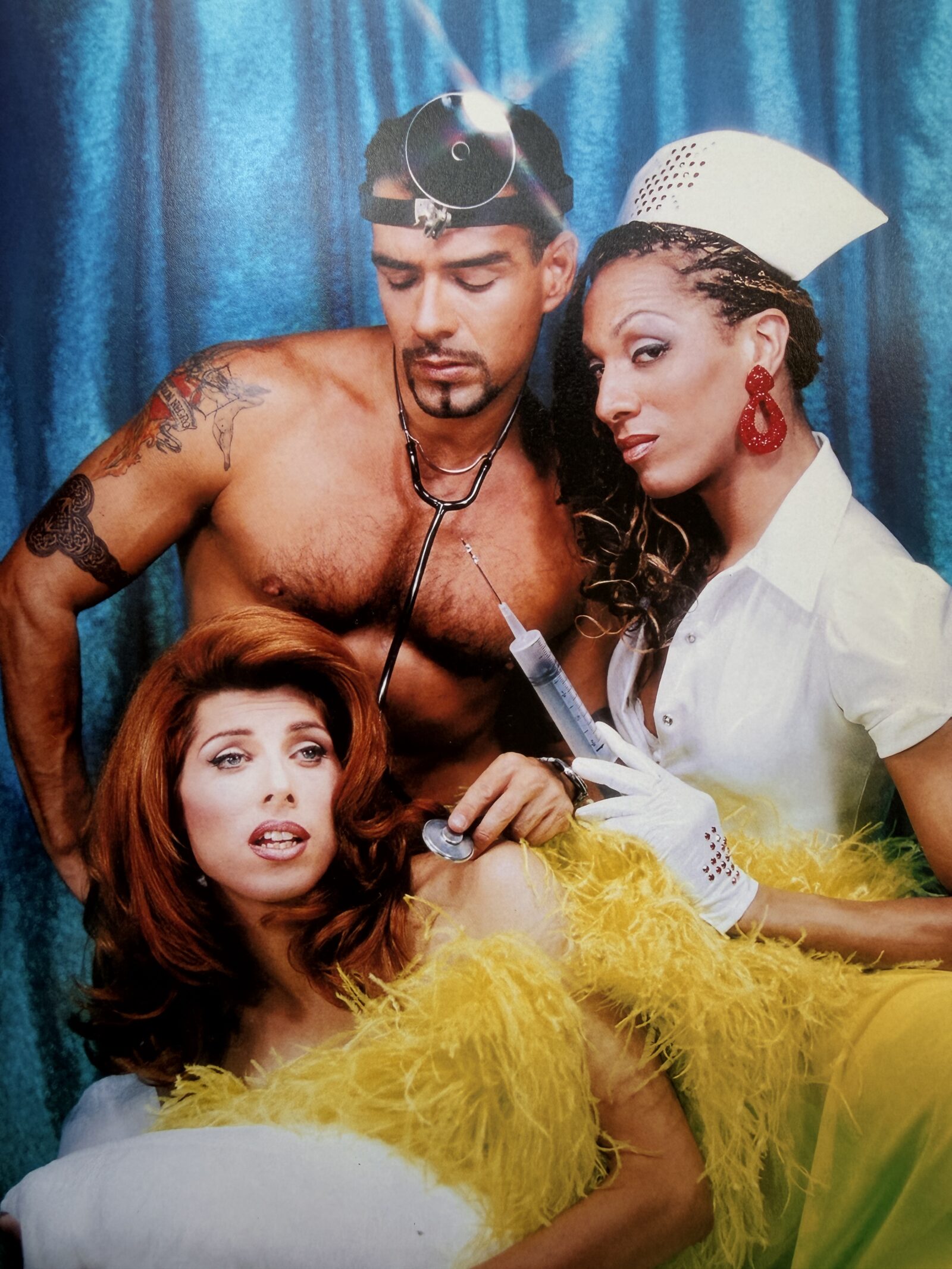
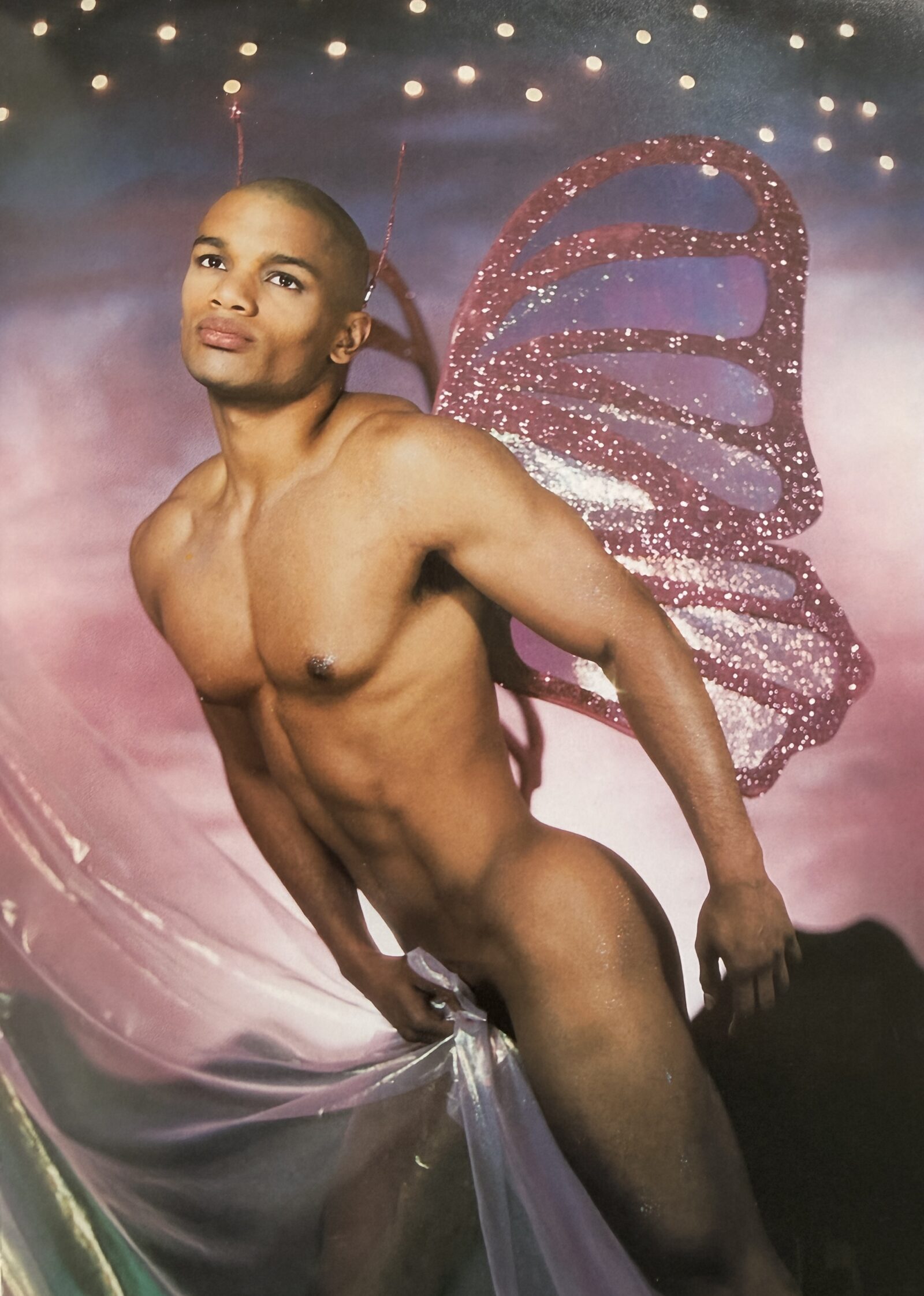
In the 1990s and early 2000s, Aaron Cobbett’s analog camera immortalized queer nightlife in Manhattan’s East Village through fabulous photo shoots that both rivaled contemporary fashion editorials and rejected the fashion world’s unattainable beauty ideals. Most of Cobbett’s models were ordinary people and East Village celebrities who had made the downtown scene their stomping ground for decades—drag queens, transwomen, male sex workers, and some of his closest friends. As activist Nick Debs noted in the introduction of Cobbett’s first monograph, Super Eros (1999), “The beauties that inhabit Mr. Cobbett’s work . . . have their idiosyncrasies, or quirks, and these quirks (or let’s face it, flaws), . . . is what makes them supererotic.”1
Cobbett’s photographs give us a glimpse of his playful, yet always ironic, relationship to fashion that began with his job in the 1980s making window displays for department stores including Bergdorf Goodman and Bloomingdale’s. His portraiture style nods to French artist and photographer Guy Bourdin’s highly stylized, provocative editorials, while also radiating a dreamy, ethereal, yet erotic atmosphere reminiscent of James Bidgood’s Pink Narcissus (1971). His photographic humor and criticism feel more akin to Cindy Sherman than Nan Goldin, Cobbett’s fellow Washington, D.C., native. While Goldin documented the grittiness and vulnerabilities from the AIDS crisis in 1980s New York City, Sherman used the city as a backdrop to stage a wide range of female possibilities in the late 1970s. As a photographer, Cobbett didn’t aspire to document anything. Instead, he staged glamorous fantasies. In turn, costume design always played an essential part in Cobbett’s photographs, enabling his subjects to role-play utopic fantasies.
“Nudity is for amateurs,” Cobbett once said in conversation with writer and gallerist Doug McClemont for the introduction of his second monograph, Cobbett (2007). As McClemont wrote, “Fabrics and their individual body-hugging qualities have been an obsession of Cobbett’s for as long as he can remember.”2 Over the past decade, Cobbett has returned once again to that obsession. Quilts have become his privileged medium, and portraits have given space to seemingly ordinary scenes of our world. He usually quilts with alternate blocks cut from deadstock fabric that friends gift him, along with other assortments of used fabrics, such as repurposed denim, salvaged leather, and men’s shirts. In his quilts, everything shimmers. They sparkle with the glistening of glass beads, paillettes, sequins, and rhinestones, often complemented with the glossy shine of buttons, enamel, and chrome, sometimes interwoven with gleaming compositions of velvet, brocade, foiled spandex, and snakeskin. The centrality of these adornments in his quilts, which simulate the sparkle of gemstones, inspired the title of Cobbett’s latest show, Semi-Precious, which ran at KAPOW gallery in New York City in the Spring of 2026. These sparkly adornments might also be one reason why the word “camp” is often evoked to describe his quilts.
And yet Cobbett doesn’t use the word “camp” to describe his quilts. He prefers vulgar. Theatrical, eccentric, camp, vulgar—these words define the aesthetics at the heart of Cobbett’s textile works, partaking of a queer and feminist lineage of cultural production, with an interest in everyday objects such as clothing, furniture, and other elements of visual décor. In Fray: Art and Textile Politics, art historian Julia Bryan-Wilson juxtaposes textile projects that have often been pigeonholed into high and low art categories to demonstrate how they are deeply intertwined and mutually influential.3 By comparing the textile projects used in the Cockettes’ drag performances with those of Harmony Hammond’s Floorpieces, Bryan-Wilson reveals how queer and feminist artists can come together to “craftily comment on consumerist excess, overflow, waste, and the queer vitality of reuse.”4 Here, excess means not wealth but thrift.
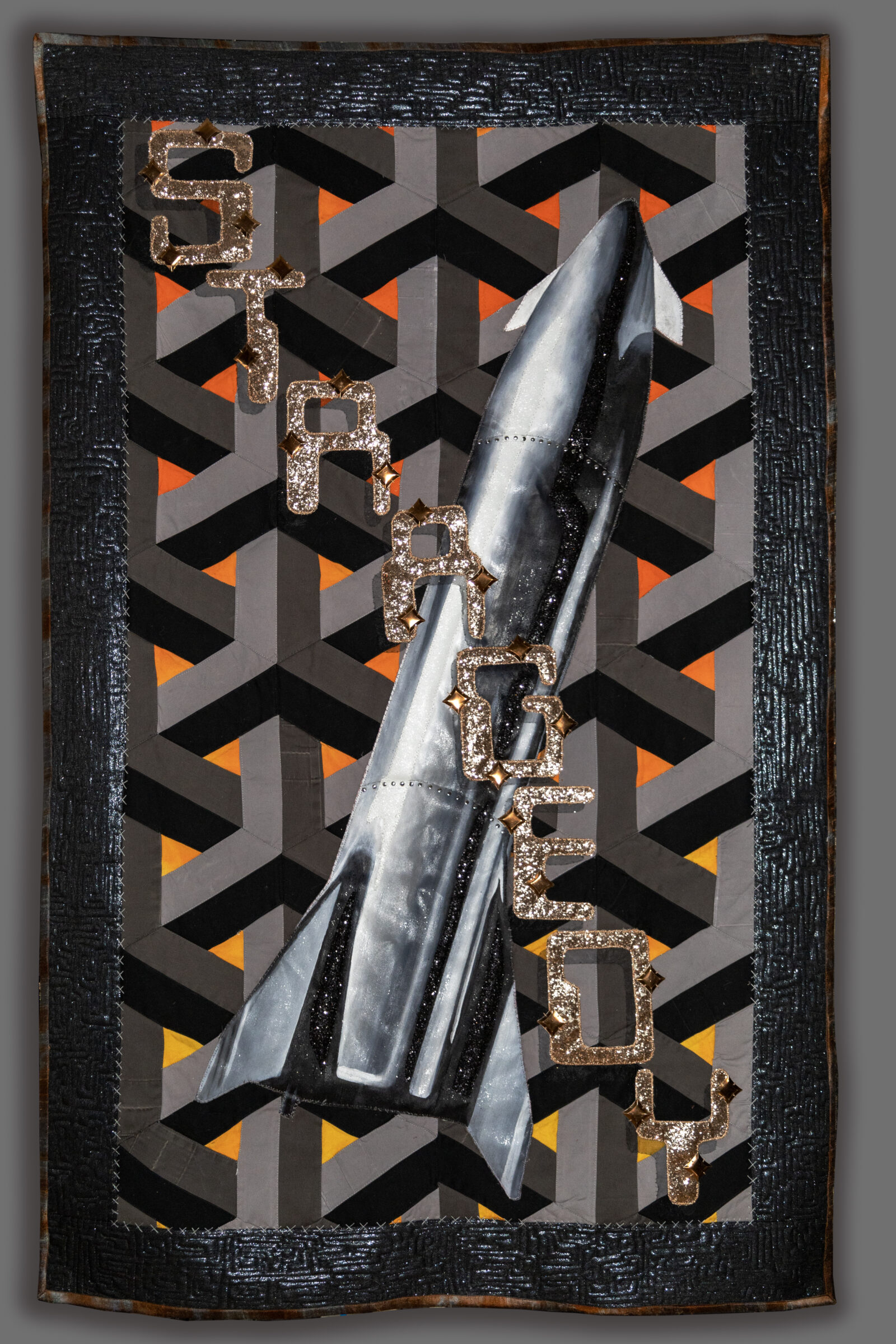
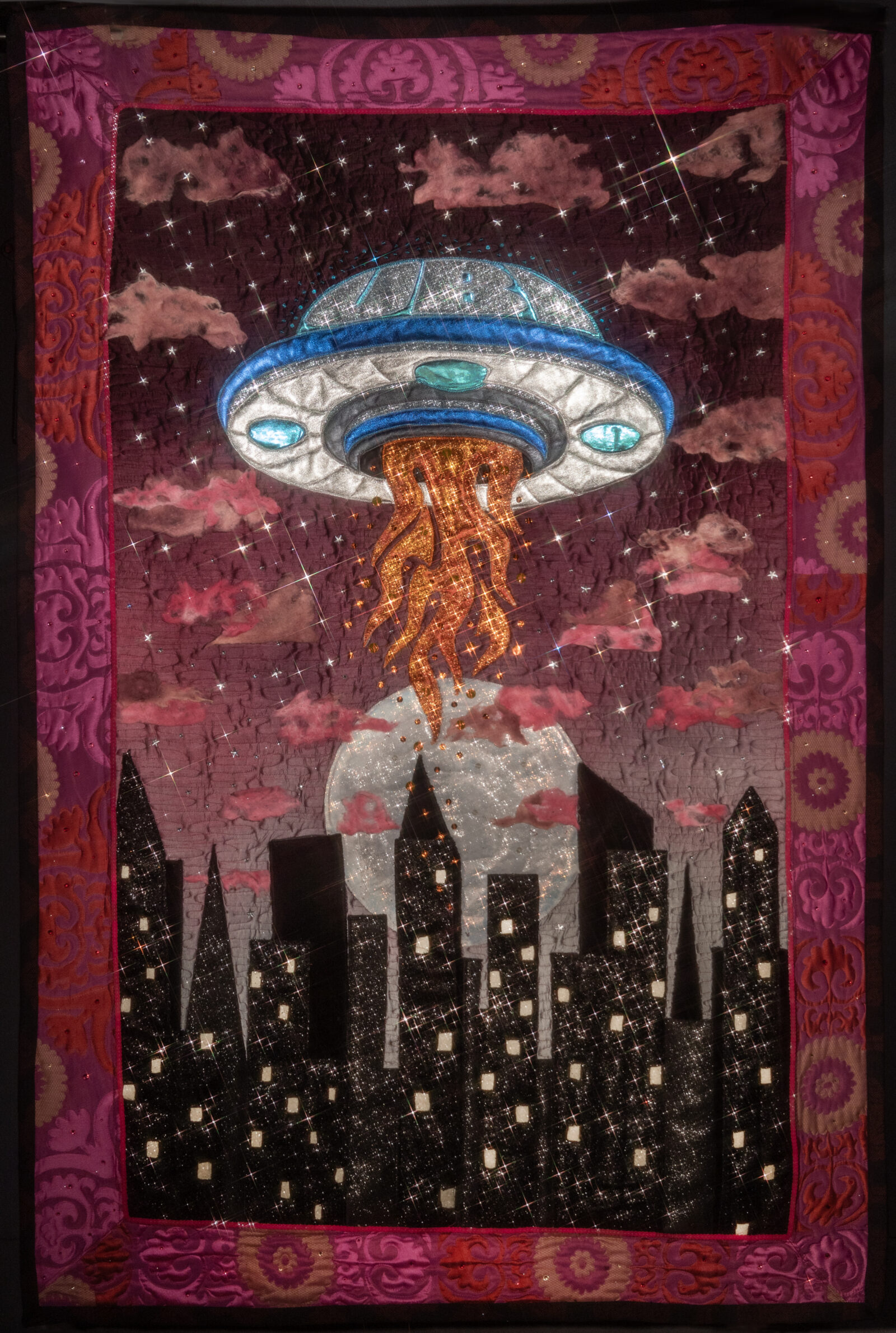
Cobbett’s quilts share with the dazzled aesthetics of the Cockettes not only a critique of gender and sexual norms but also a broader dialogue around textiles and politics. For example, two quilts exhibited in Semi-Precious tap into the current global economic disparity caused by the scandalous accumulation of wealth by tech oligarchs and the financial scarcity to which the rest of the planet’s population is involuntarily subjected. Stragedy (2024) shows a SpaceX-like rocket ship, diagonally positioned at the center of the quilt, taking off against the backdrop of a Brutalist, grid-like steel structure. Through this quilt, Cobbett unveils the ambiguities of tech oligarchs’ plans by denouncing how they exhaust our planet’s resources while planning the colonization of other bodies in our solar system. The glittery word STRAGEDY is juxtaposed against the rocket ship, a reminder that Silicon Valley strategies happen at the cost of human and natural tragedies on a planetary scale. In UBI UFO (2024), an alien spaceship follows SpaceX’s path in reverse: aliens are trying to establish contact with earthlings. The spaceship hovers over the outline of a metropolis’s skyscrapers. Its fiery nozzle expels glistening droplets all over the city, leaving in its wake a message of warm relief for many: the promise of Universal Basic Income.
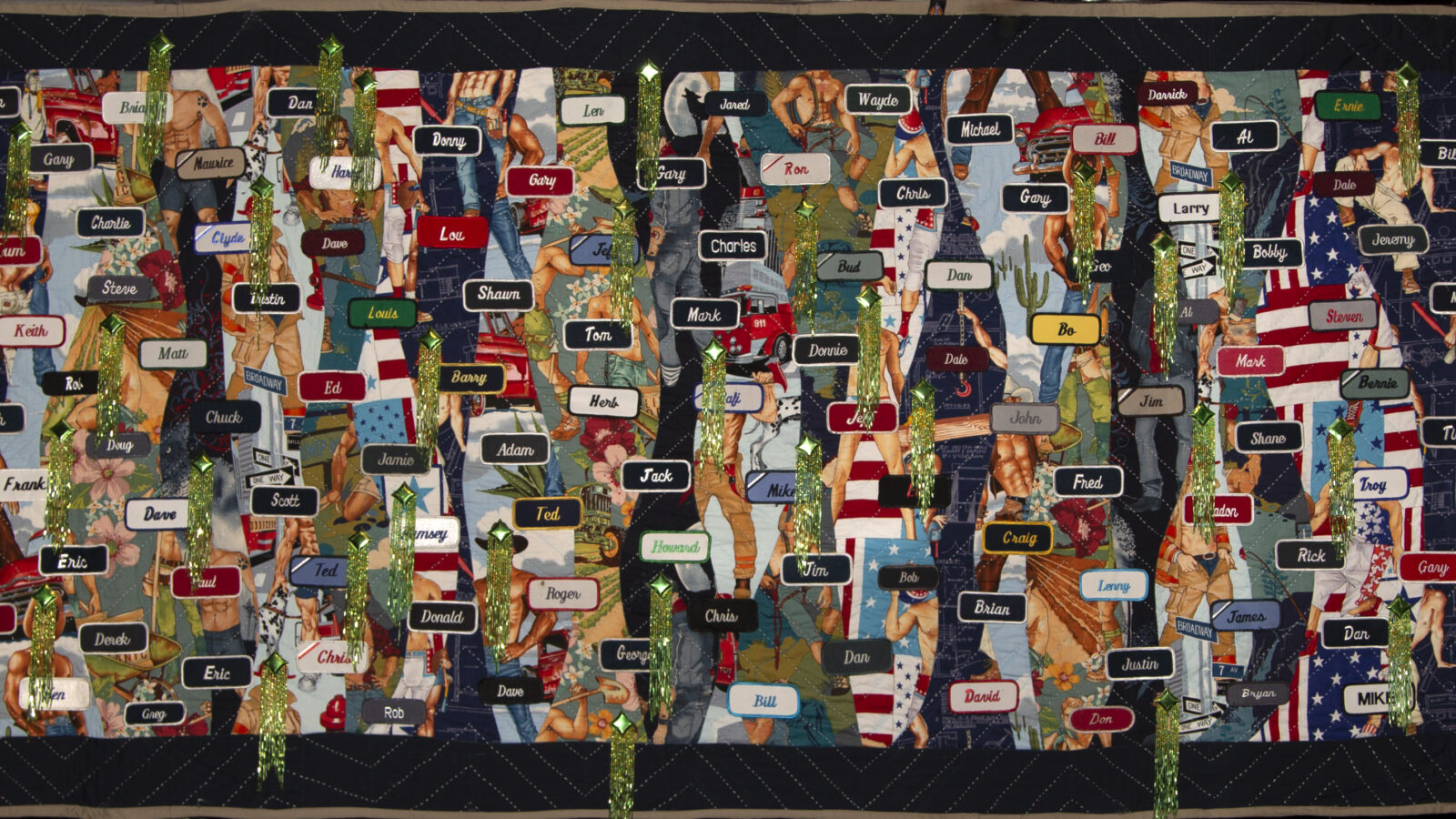
Cobbett’s textile politics also address the contemporary discourse around the revolutionary promises of AI and automation by raising the question of labor. While the daily tasks performed by tech workers rely on a constant state of updatism, the labor involved in the making of a quilt slows time, reminiscent of feminized domestic work that prioritizes maintenance and care over development and productivity. Cobbett’s Numbers (2019)—a quilt made from vintage fabric featuring cartoonish male pinups performing a series of trades and maintenance work: carpenters, firemen, farm workers, and more—also inherits the legacy of Mierle Laderman Ukeles’s 1969 “Manifesto for Maintenance Art.” As Ukeles wrote, “Maintenance is a drag, it takes all the fucking time (literally). The mind boggles and chafes at the boredom. The culture confers lousy status on maintenance jobs=minimum wages, housewives=no pay.”5
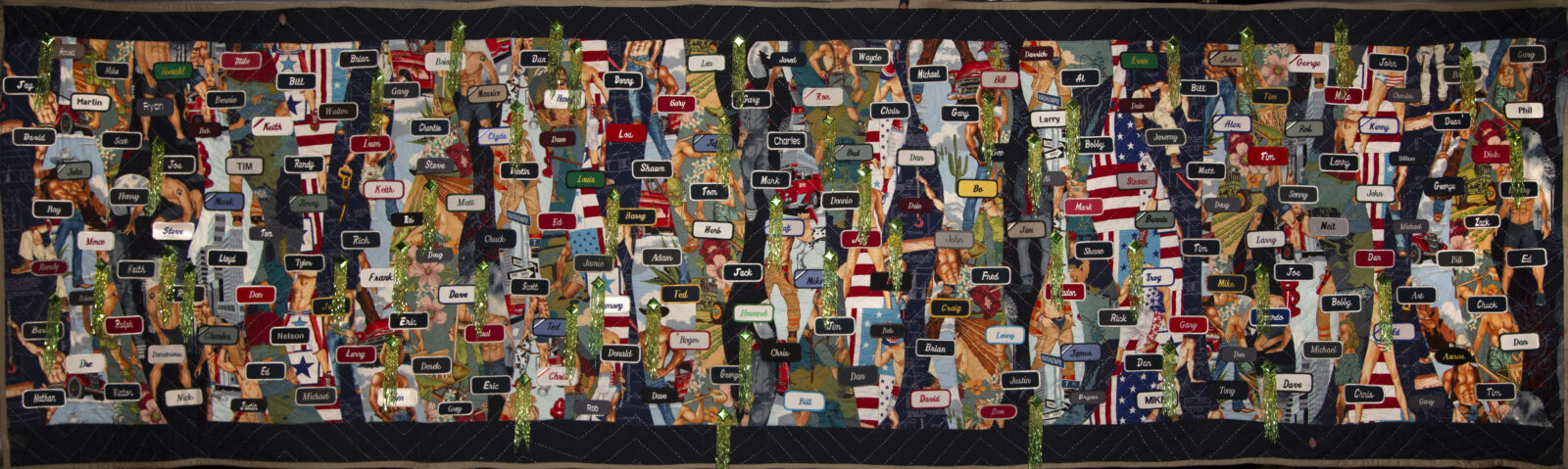
The fabric for Numbers is not cut out in standardized blocks but torn apart deliberately, making the bodies of its maintenance team seem dismembered. Their faces are often cropped, sometimes just hidden behind a paillette, as their presence would distract the viewer from what Cobbett really wanted to emphasize in this quilt: their anonymity comes at the cost of highlighting their labor. Reminiscent of Jasper Johns’s painting the American flag over collages of newsprints, cropped parts of the American flag are stitched alongside the sculpted but fragmented bodies of the anonymous male pinups, enhancing the feeling that something is seriously fractured. But Numbers uniquely turns the “Star Spangled Banner,” a textile that serves as a founding nationalist symbol, into a horny gay American Dream.
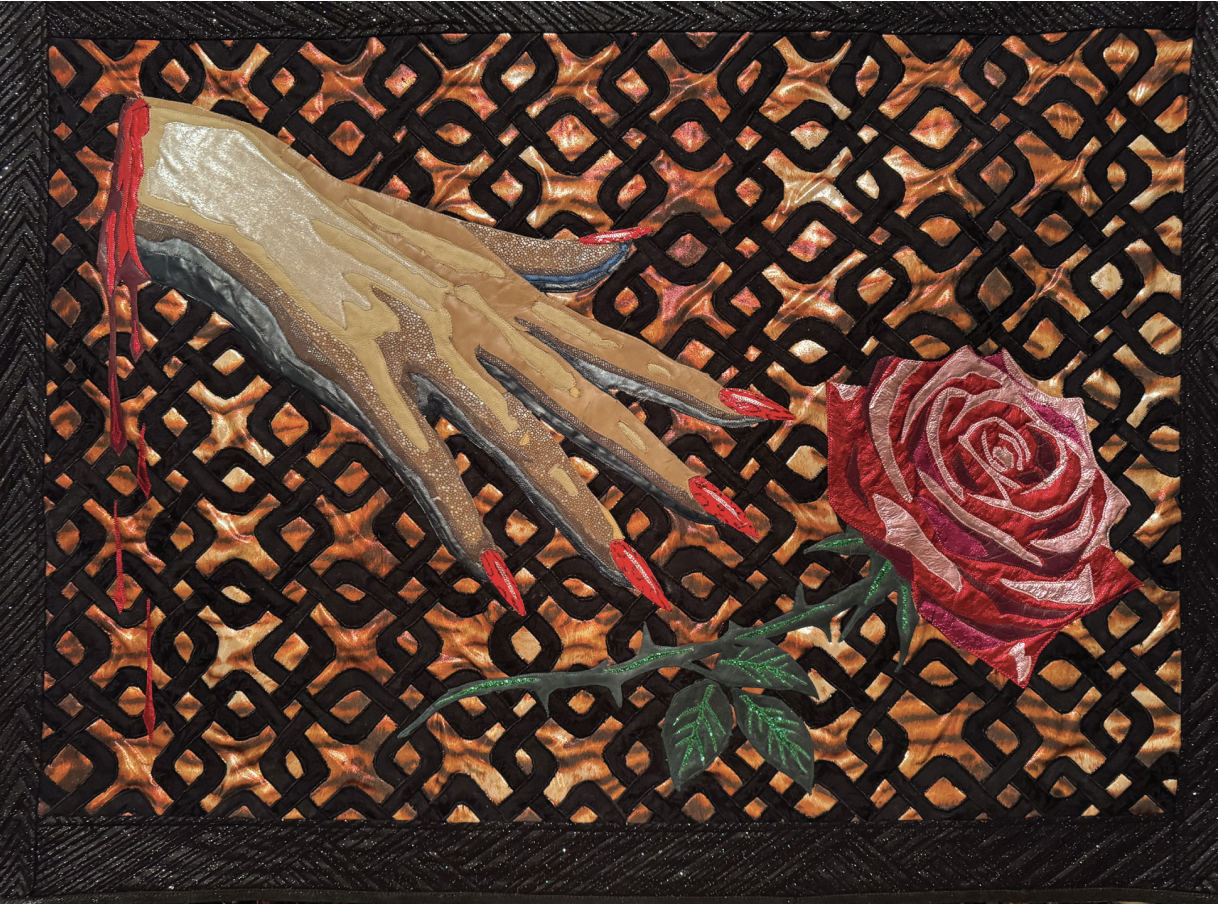
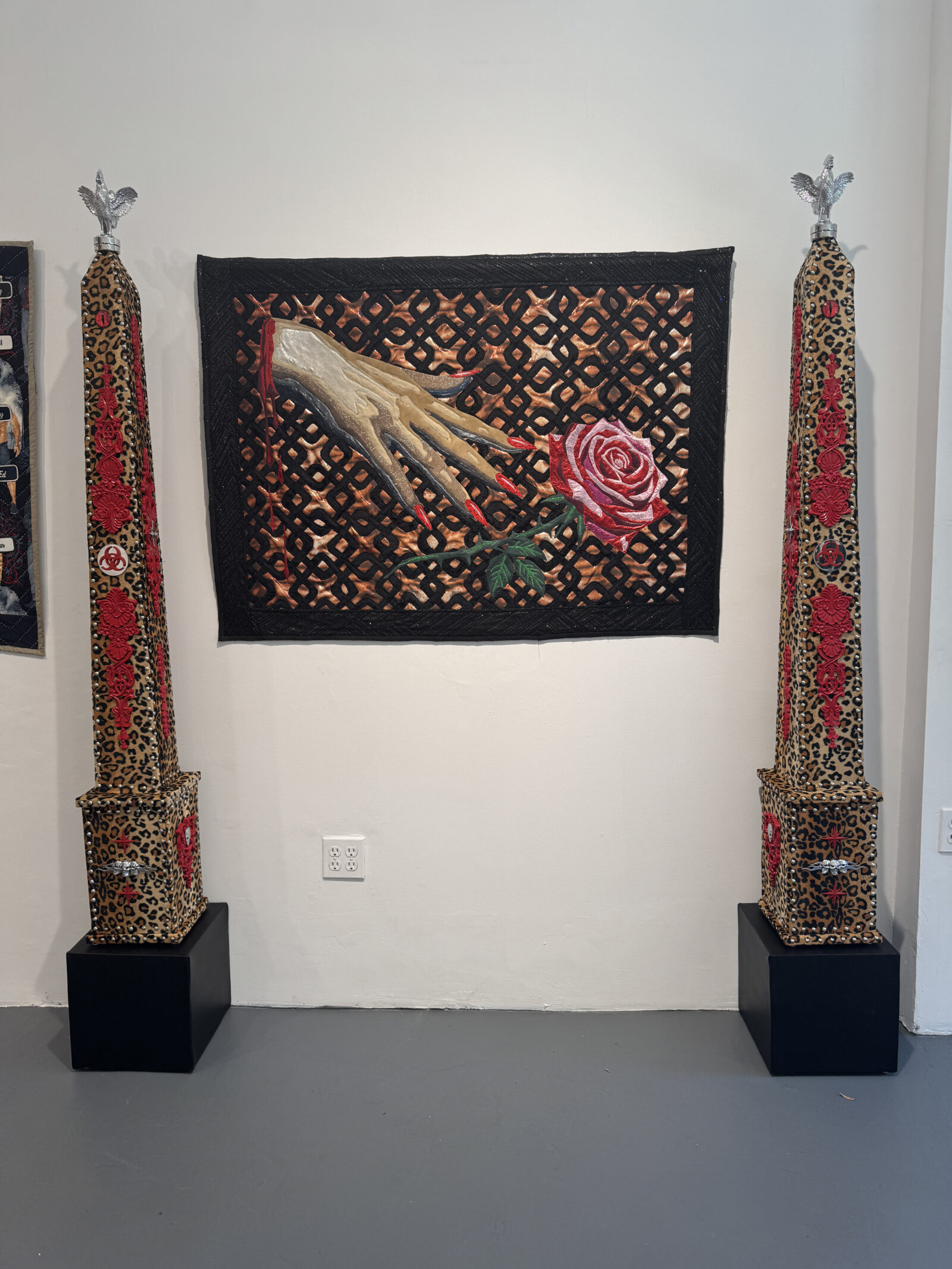
Despite its title and emphasis on anonymity, Numbers is a quilt saturated with names: name tags from workers’ uniforms populate the length of the quilt, uncannily recalling the massive NAMES Project Memorial AIDS Quilt, which has come to embody a major visual platform for national conversations about AIDS in the United States. Similarly, Cobbett’s Untitled (2026) pays homage to New York-based artist Frank Moore, who died of AIDS-HIV-related illness in 2002. Severed hands were a recurrent theme in Moore’s dreamscapes and surrealist paintings, and Untitled similarly features a red rose floating opposite a severed hand, beautifully manicured with ruby-red acrylic nails and with blood dripping from its wrist.
Shawn (2018)—which Cobbett has deemed the catalyst for his transition to textiles—is made from the old clothes of Cobbett’s best friend, the artist Shawn Peterson, who tragically died of cancer in 2016. After meeting in 1987, the duo long collaborated and influenced each other, sharing an aesthetic that is often described in the same terms: eccentric, labor-intensive, dry humor, and haunted glamour.6 Peterson also served as Moore’s assistant in the early 2000s. The quilt commemorating him shows the name SHAWN stitched just below the embroidered face of a handsome man, surrounded by stars made from cut-out denim pieces.
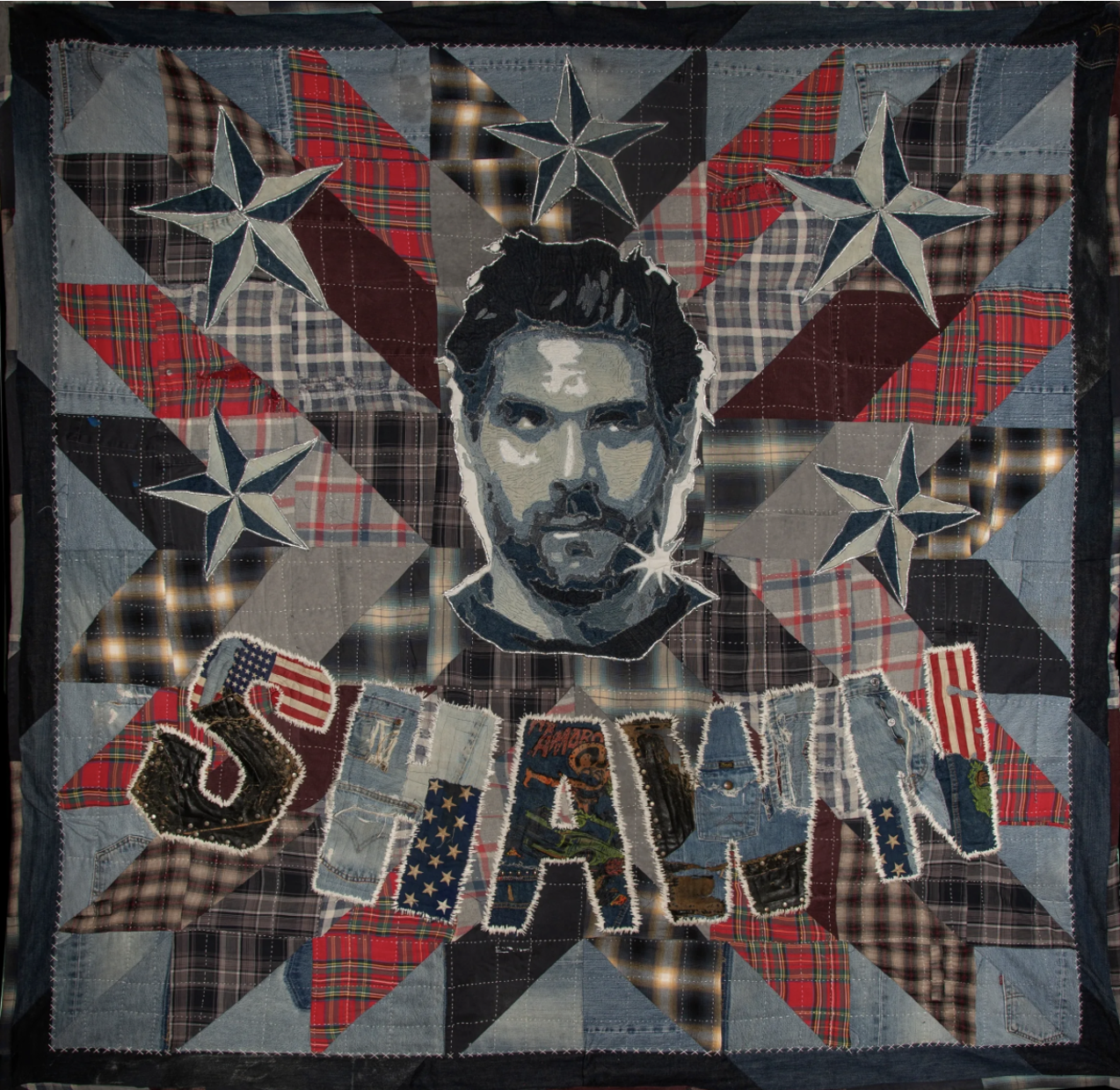
Art critic Douglas Crimp once asked, “Does the [AIDS] quilt sanitize or sentimentalize gay life?”7 Though in conversation with NAMES, Cobbett’s quilts do not sentimentalize or sanitize anything. Instead, they unabashedly convey a clear message of radical queer politics centered, like the work of women and maintenance workers they reference, on care. In our current time when the healthcare, especially for queer people, continues to be dismantled by the American government, Cobbett’s work provides a history of our predicament and a promotion of the caregiving labor that must see us through it.
: :
Endnotes
- Aaron Cobbett, Super Eros (Bruno Gmünder Verlag 1999).
- Aaron Cobbet, Cobbett (H&O Éditions, 2007), 3.
- Julia Bryan-Wilson, Fray: Arts and Textile Politics (University of Chicago Press, 2017), 41.
- Julia Bryan-Wilson, Fray, 41.
- Mierle Laderman Ukeles, “1969 Manifesto For Maintenance Art! Proposal For An Exhibition “Care,” in Mierle Laderman Ukeles: Maintenance Art (Prestel, 2016).
- In his profile on the Visual AIDS website, Peterson is described as “a visionary who created obsessive and eccentric works with peculiar materials and antiquated labor-intensive techniques, . . . each infused with a dry, deadpan wit and haunted glamour that was heightened as his health declined.”
- Douglas Crimp, Melancholia and Moralism: Essays on AIDS and Queer Politics (MIT Press, 2002), 200.

Bruno Franco